Introduction
Stepping into an executive role carries a particular kind of pressure that no job description fully captures. You're expected to lead before you've fully settled in — building relationships, reading the culture, understanding what's actually broken, and demonstrating strategic value, often simultaneously.
The data reflects how often this goes wrong. According to McKinsey, 27% to 46% of executive transitions are viewed as failures or disappointments within two years. Korn Ferry puts the failure rate even higher: 40% of executives hired or promoted from outside fail within the first 18 months.
A well-built 30-60-90 day plan won't eliminate that risk entirely. But it creates the structure and accountability that separates executives who stall from those who build lasting credibility.
This guide walks through how to build that plan — phase by phase — and what most executives get wrong before they ever gain real traction.
Key Takeaways
- A 30-60-90 day plan for executives is a strategic leadership launch document — not a task list or onboarding checklist
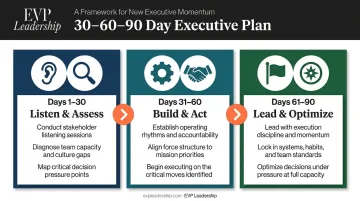
- The three phases serve distinct purposes: learn and listen (days 1-30), build and act (days 31-60), lead and optimize (days 61-90)
- Effective plans include stakeholder mapping, phased SMART goals, and defined success metrics for each phase
- Quick wins should solve a real problem — not just signal activity
- The most common failure: acting before fully assessing the organization you just inherited
What Is a 30-60-90 Day Plan for Executives?
At the executive level, a 30-60-90 day plan is a structured, time-bound document that maps strategic priorities, key actions, and measurable goals across the first three months in a new or expanded role. Think of it as a leadership launch strategy — one designed to compress the runway between arrival and real contribution.
This is not the same document a new manager builds on their first week. The stakes, visibility, and scope are fundamentally different.
Why the Executive Version Is Different
A standard onboarding plan focuses on learning workflows, meeting teammates, and getting up to speed on systems. An executive plan focuses on something harder: assessing an entire function or organization, building influence across multiple stakeholder groups, and delivering measurable strategic progress — often before you've fully learned the landscape.
McKinsey research found that 92% of external hires and 72% of internal hires take more than 90 days to reach full productivity, and 62% of external hires say it takes at least six months to make a real impact.
A 30-60-90 day plan is an acceleration and alignment tool — not a claim that full strategic contribution wraps up by day 90.
Three Contexts Where This Plan Is Used
- Stepping into a new executive role from outside the organization
- Being promoted to a higher leadership level within the same company
- Taking on a newly created executive position where no predecessor exists and no playbook is established
Each context requires a different starting posture. The new external hire is diagnosing an unfamiliar system; the internal promotee is managing a shift in identity and authority; the role-creator is building structure from scratch. What all three share is the need to plan deliberately before moving fast.
What to Include in Your Executive 30-60-90 Day Plan
The plan isn't just a calendar. It's a strategic document with several distinct components working together.
Situational Assessment
Before setting any goals, document the organizational context you're entering. This means:
- Current health of the function or business unit
- Team strengths, gaps, and dynamics
- Predecessor performance (and how their legacy is perceived)
- Active challenges and untapped opportunities
This assessment becomes the foundation for everything that follows. Skip it, and your strategy is built on guesswork rather than ground truth.
Stakeholder Mapping
Relationships are a strategic asset. Your plan should identify:
- Key internal stakeholders (direct reports, peers, the board or CEO)
- Key external stakeholders (clients, partners, regulators if relevant)
- Each person's priorities, influence, and level of alignment with your mandate
- A communication approach tailored to different audiences
McKinsey's transition framework identifies stakeholder engagement as one of the core dimensions of any successful leadership transition. Get this wrong, and your initiatives stall before they start — regardless of how sound the strategy is.
Phased SMART Goals
Set distinct goals for each 30-day window across three categories:
| Goal Type | Description |
|---|---|
| Learning goals | What must you understand by day 30, 60, 90? |
| Performance goals | What must you deliver or improve in each phase? |
| Leadership goals | How will you show up, build trust, and establish standards? |
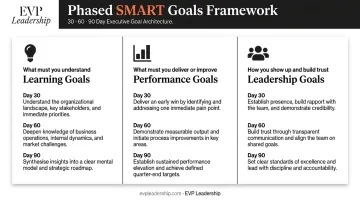
Each goal should connect directly to the organization's broader strategic objectives — not just your function's internal priorities.
Defined Success Metrics
Without measurable markers, you can't course-correct — or communicate progress to your CEO or board. Examples of executive-level KPIs include:
- Number of key stakeholder meetings completed by day 30
- Functional baseline assessment delivered by day 30
- First priority initiative scoped and launched by day 60
- Initial 6-12 month functional roadmap presented by day 90
Review and Feedback Cadence
Schedule check-ins with your CEO or direct manager, trusted peers, and key direct reports at regular intervals. These aren't optional. They surface blind spots, validate your direction, and demonstrate the kind of self-aware leadership that high-performing organizations need.
Spencer Stuart notes that formalized feedback sessions help separate outcomes from behaviors — and that structured check-ins at 60 and 90 days allow executives to address challenges before they become entrenched obstacles.
Phase-by-Phase Breakdown: Building Your Executive 30-60-90 Day Plan
Days 1-30: Listen, Assess, and Build the Foundation
The first 30 days have one primary job: understand before you act.
This is harder than it sounds. The pressure to demonstrate leadership through visible decisions is real — and it's one of the most common traps new executives fall into. HBR's 2024 research on leadership transition traps identifies failing to listen before acting as one of four patterns that derail otherwise capable leaders.
Priority actions in the first 30 days:
- One-on-one meetings with every direct report
- Review of existing functional metrics, KPIs, and strategy documents
- Assessment of the predecessor's legacy and how it shapes the team's expectations
- Informal conversations with peers to understand cross-functional dynamics
- Alignment session with the CEO or board to calibrate mutual expectations
The deliverable from this phase is a clear baseline assessment — a documented picture of where things stand, what's working, and where the real pressure points are. You cannot build an accurate strategy without it.
Days 31-60: Build Relationships, Develop Strategy, and Deliver Early Wins
This phase shifts from observation to informed action. You're now applying what you learned to begin shaping functional strategy and identifying where you can deliver early results.
What a strategic "quick win" actually looks like:
An executive-level quick win is a meaningful, visible improvement that:
- Aligns with organizational priorities
- Signals your values and approach
- Creates real momentum toward longer-term goals
- Resolves something specific: a known bottleneck, a fragmented reporting process, or a priority initiative the organization has been waiting on
Those early wins create the credibility that makes the strategy-building work below land with your stakeholders.
Strategy-building activities for this phase:
- Draft an initial functional roadmap with clear priorities
- Secure buy-in from key stakeholders before finalizing direction
- Begin aligning team roles and accountabilities to the new direction
- Develop your leadership narrative — a coherent story about where the function is going and why
By day 60, your key stakeholders should understand your direction, not just your intentions.
Days 61-90: Lead with Intention and Set the Long-Term Direction
The final phase is about ownership. You move from testing ideas to executing with confidence and establishing yourself as the clear strategic leader of your function.
Core activities in this phase:
- Execute on the functional strategy with measurable follow-through
- Present formal progress to the CEO or board — what's been delivered, what's in motion, and what's coming
- Begin setting 6-12 month strategic goals grounded in what you've learned
- Make any structural or personnel decisions that your first two months have clearly informed
This is also the time for honest self-assessment. What did you read correctly, and what needs to be adjusted going forward? The answer should produce something concrete — a revised priority, a changed approach, or a commitment to a specific habit. That discipline is what separates executives who perform at 90 days from those who perform past it.
Tips to Maximize the First 90 Days
Prioritize Consistency Over Intensity
The habits, communication patterns, and decision-making standards you establish in the first 90 days compound over time. This is the core premise behind EVP Leadership's 90-Day PressurePoint System — conditioning executives to perform consistently under pressure, not just during high-visibility moments.
Under pressure, leaders don't rise to expectations. They fall back on what they've already conditioned themselves to do. The first 90 days are when that conditioning either gets built — or gets skipped.
Focus on Depth, Not Volume
Three well-executed priorities build more credibility than ten half-finished initiatives. Use your plan as a filter — if an action doesn't serve a defined goal in this phase, it doesn't belong on your calendar.
A practical way to apply this:
- Identify 2-3 measurable outcomes for each 30-day phase
- Decline or defer any request that doesn't map to those outcomes
- Review your calendar weekly and cut low-impact commitments before they accumulate
Executives who signal leadership through sheer activity volume rarely earn the trust they're reaching for.
Seek Feedback Actively and Early
Create a culture of candid feedback in the first 90 days — not by asking once, but by asking consistently. This means requesting direct input from your reports, your peers, and your manager. Executives who wait for formal review cycles to surface problems often find those problems have already spread — and cost significantly more to fix.
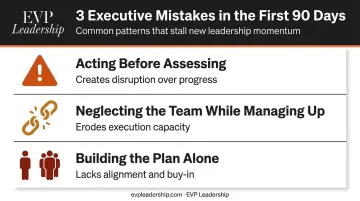
Common Mistakes Executives Make in Their First 90 Days
Acting Before Assessing
The pressure to demonstrate leadership through early decisions is real — but moving before you've actually understood the culture, team dynamics, and inherited challenges tends to create disruption rather than progress. Treat the first 30 days as a deliberate pause before strategic action, not a delay.
Neglecting the Team While Managing Up
Executives who focus exclusively on upward visibility — impressing the CEO, building board relationships — while failing to build real trust with their direct reports eventually hit a wall. When it comes time to execute, those teams don't follow. Downward trust is the actual foundation of strategic influence.
Building the Plan Alone
A 30-60-90 day plan built in isolation lacks the alignment it needs to work. Presenting a polished plan that doesn't reflect organizational reality erodes credibility quickly. Before finalizing anything, get input from:
- The CEO or hiring executive (strategic priorities and unspoken expectations)
- Direct reports (ground-level context and existing team dynamics)
- Key cross-functional stakeholders (dependencies and political landscape)
Collaboration at this stage isn't a courtesy — it's how executives build the buy-in that makes execution possible.
Frequently Asked Questions
What is the 30-60-90 strategy?
The 30-60-90 strategy divides the first three months of a new or elevated role into three phases, each with distinct priorities, goals, and success metrics. It moves leaders from onboarding to full strategic contribution in a disciplined, measurable way.
What should you include in a 30-60-90 day plan?
A complete executive plan covers:
- Situational assessment of the organization, team, and landscape
- Phased SMART goals across learning, performance, and leadership
- Stakeholder mapping and defined success metrics per phase
- Action items with clear owners, deadlines, and a review cadence
How is a 30-60-90 day plan for executives different from one for new employees?
Executive plans are less about learning workflows and more about strategic assessment, organizational influence, and aligning an entire function to business objectives. The expectations for measurable impact arrive faster, with significantly higher visibility — and the consequences of missteps are larger.
How do you balance quick wins with long-term strategic goals?
Quick wins should be chosen for strategic relevance, not just speed. They should signal your values, build credibility, and create momentum toward the longer-term direction you're building — not serve as cosmetic changes disconnected from your actual strategy.
What are the most common mistakes executives make in their first 90 days?
The most common mistakes include:
- Acting before fully assessing the organization
- Prioritizing upward visibility over building team trust
- Creating the plan in isolation without input from those who must execute it
Each one damages your credibility with the team before you've had a chance to earn it.