Introduction
Most small business owners are good at setting goals. The real problem is what comes after: without a strategic framework anchoring those goals to a clear direction, daily decisions pile up, priorities blur, and growth stalls somewhere between intention and execution.
A strategic business plan is a decision-making tool — it tells your leadership team where the organization is going, how you'll get there, and what trade-offs you're willing to make along the way. Done right, it creates the alignment that turns goals into results.
This guide covers what a strategic business plan actually is, how it differs from a traditional business plan, the core components it must include, how to write one step by step, and how to implement it so it actually sticks.
Key Takeaways
- A strategic business plan defines long-term direction and priorities, not daily operations
- Every effective plan includes mission and vision, a SWOT analysis, SMART goals, KPIs, and financial projections
- Start with internal clarity — mission, vision, values — before analyzing the market
- Plans only create results when they're reviewed regularly and used to drive real decisions
- Execution is a leadership problem — building the capacity to follow through under pressure is as important as the plan
What Is a Strategic Business Plan (and How It Differs from a Business Plan)
A strategic business plan is a forward-looking document that assesses where your business stands today, defines where you want it to be in three to five years, and maps the strategies and actions required to close that gap. The Balanced Scorecard Institute describes strategic planning as a structured process that clarifies mission and vision, sets priorities, and ties them to measurable goals.
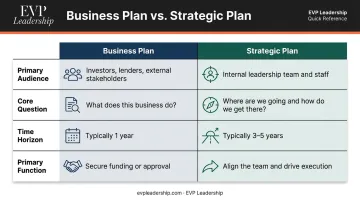
A traditional business plan serves a different purpose entirely. As the SBA's business planning guidance describes, a business plan covers company structure, product or service line, market analysis, and financial projections — primarily for external audiences like investors or lenders. It answers one question: What does this business do and how does it operate? A strategic plan answers a different one: Where is this business going, and how will leadership get it there?
The audience distinction is just as important as the content distinction:
| Business Plan | Strategic Plan | |
|---|---|---|
| Primary audience | Investors, lenders, external stakeholders | Leadership team, internal decision-makers |
| Core question | What does this business do? | Where is this business going? |
| Time horizon | Typically 1 year | 3–5 years |
| Primary function | Secure funding or approval | Build alignment and guide decisions |
Roger Martin captured the underlying logic clearly in HBR's strategy-versus-planning framework: a plan lists controllable activities and resources, while a strategy specifies a competitive outcome the organization intends to achieve. Understanding that difference is what makes a strategic plan worth building — and worth executing.
The Core Components of a Strategic Business Plan
Executive Summary
The executive summary is written last but placed first — it distills the entire plan into a concise overview that leadership and key stakeholders can read quickly. Its job isn't to explain everything — it's to communicate direction clearly enough that anyone reading it understands where the organization is headed and why the plan matters.
Mission, Vision, and Core Values
These three elements anchor every other component of the plan.
- Mission — What the business is trying to achieve; the purpose driving daily decisions
- Vision — Where the organization is headed long-term; the future state it's building toward
- Core values — The principles that govern how leadership makes decisions, especially under pressure
Without these defined clearly, every goal in the plan risks drifting. Leaders default to what's urgent rather than what's strategic — and the plan loses its grip the moment pressure hits.
SWOT Analysis
A SWOT analysis is the diagnostic framework of the plan. It maps internal Strengths and Weaknesses alongside external Opportunities and Threats — giving leadership a clear picture of where to focus, what to fix, and which opportunities are worth pursuing.
The four quadrants work together:
- Strengths — internal capabilities that create competitive advantage
- Weaknesses — internal gaps that limit performance or scalability
- Opportunities — external conditions the business can move on
- Threats — external forces that could erode position or momentum
The quality of a SWOT depends entirely on who's in the room. One person working alone for an hour produces a list of blind spots. A cross-functional group with honest input reveals mismatches between what the business believes it's good at and what the market actually rewards.
Strategic Goals and SMART Objectives
Goals must be layered:
- Long-term goals (3–5 years) — the strategic destinations
- Annual goals — what must be accomplished in Year 1 to be on track
- Quarterly and monthly milestones — the near-term targets that create accountability
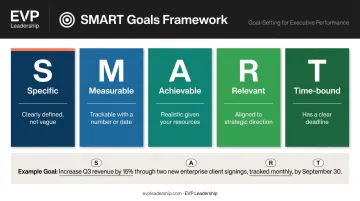
Each goal should follow the SMART framework: Specific, Measurable, Achievable, Relevant, and Time-bound. Vague goals like "grow revenue" give teams nothing to act on. "Increase recurring revenue by 20% by Q4 through two new service tiers" is something a team can execute.
Key Performance Indicators (KPIs)
KPIs are how you know whether the strategy is working. Include two types:
- Primary KPIs — headline metrics like revenue growth, gross margin, or customer retention
- Leading indicators — early-warning metrics like lead conversion rate or sales pipeline value that signal trouble before it shows up in revenue numbers
MIT Sloan research shows that adding metrics and frequent feedback to specific goals can move an average team to the 88th percentile of performance — a meaningful argument for measuring the right things, not just tracking what's easy.
Financial Projections and Resource Plan
This section connects strategy to financial reality. It should include:
- Projected revenue by source
- Cash flow outlook across the planning horizon
- Resource allocation — people, time, capital — tied directly to strategic initiatives
Skip this section and the plan becomes a wish list. Include it, and leaders can make real investment decisions — and spot resource constraints before they become crises.
How to Write a Strategic Business Plan: Step-by-Step
Step 1 — Start with Internal Clarity
Before analyzing the market or setting goals, define the mission, vision, and values that will anchor the plan. This step is frequently skipped when leaders are eager to jump to strategy — and skipping it produces a plan without a true north.
SCORE recommends starting with the company mission statement before moving to any situational analysis. This sequencing matters: if leadership can't agree on why the business exists and where it's headed, no amount of market analysis will produce a coherent strategy.
Step 2 — Conduct a SWOT Analysis
A rigorous SWOT is a team exercise, not a solo one. Gather input from key stakeholders across the organization. Assess:
- Internal factors: operational strengths, team capabilities, financial position, weaknesses in systems or capacity
- External factors: market trends, competitive landscape, economic conditions, regulatory environment
Use the output to identify the two or three strategic opportunities most worth pursuing — the ones that align with your strengths and address real market demand.
Step 3 — Set Strategic Goals and Define Priorities
Set three to five long-term goals aligned to the mission. Then work backward:
- What must be accomplished in Year 1 to be on track for each goal?
- What quarterly milestones will confirm you're moving in the right direction?
- Who owns each goal, and what does accountability look like?
Fewer, well-defined priorities outperform long lists of vague objectives. The strategic plan should force choices — what you're not doing matters as much as what you are.
Step 4 — Build Your Market and Competitive Analysis
Use this section to validate that your strategic direction is positioned to win in your specific market. Cover:
- Target customer segments — who they are, what they need, and what drives their decisions
- Competitive landscape — key competitors, their strengths and weaknesses, where gaps exist
- Market trends — shifts in demand, technology, regulation, or customer behavior
- Your competitive advantages — what your business does better or differently than alternatives
The SBA's market research guidance frames competitive analysis as identifying your market advantage by studying companies competing for the same customers. Porter's three positions — cost leadership, differentiation, or focus — give you a concrete framework for deciding where your strategy actually competes.
Step 5 — Develop Your Action and Financial Plans
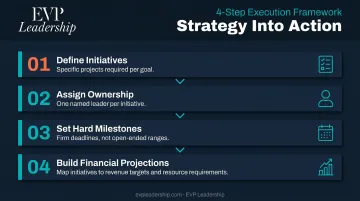
This is where strategy becomes management. For each goal:
- Define the specific initiatives and projects required
- Assign clear ownership — one name per initiative, not a team
- Set timelines with hard milestones, not open-ended targets
- Build financial projections that map each initiative to revenue targets and resource requirements
Done well, this section becomes the management tool leaders return to weekly — not a document filed after a planning retreat.
Common Mistakes Small Business Owners Make with Strategic Planning
Confusing Strategic Planning with Operational Planning
Many business owners write plans focused on tasks and tactics — marketing campaigns, hiring timelines, product launches. That's operational planning. Strategic planning asks different questions: Where are we trying to win competitively? What must be true about this organization in five years?
Plans built on tactics become obsolete quickly because tactics change. Strategy, built on durable competitive positioning, stays relevant longer and guides which tactics are worth pursuing.
Writing the Plan in Isolation
A strategic plan written by one person in one room reflects one person's perspective — including their blind spots. When the leadership team doesn't participate in building the plan, they don't own it. And plans that leaders don't own don't get executed.
HBS Online's analysis of strategy execution failures identifies lack of organizational support as one of the primary reasons strategies fail. Participation in the planning process is one of the most direct ways to build that support before execution begins.
Creating a Plan with No Accountability Structure
A strategic plan without defined ownership, review cadences, and KPIs is a well-formatted wish list. Every goal, initiative, and review cycle needs a clear owner:
- Each goal is assigned to a specific leader — not "the team"
- Every initiative carries a committed timeline, not a target range
- Every quarter includes a structured review with real accountability
That part is easy to write down. The harder work is conditioning a leadership team to actually follow through — to have the difficult conversations, hold each other to commitments, and make decisions under pressure. Gennifer Baker's strategic planning consulting at EVP Leadership focuses specifically on this gap: building both the plan and the leadership capacity to execute it.
Treating the Plan as a One-Time Document
Markets shift. Teams change. Financial realities diverge from projections. A strategic plan written once and filed away becomes wrong faster than most leaders expect. The businesses that use their strategic plans as management tools — reviewing them regularly, updating them when conditions change — are the ones that stay ahead of disruption rather than reacting to it.
How to Implement, Measure, and Update Your Strategic Business Plan
Build Around a 90-Day Execution Cycle
The most effective implementation rhythm is quarterly. A 90-day cycle creates four natural checkpoints per year where leadership can assess KPI progress, reallocate resources, and adjust priorities before small misalignments compound into serious problems.
Gallup research supports this cadence: employees with quarterly progress checks are 90% more likely to be engaged and more than twice as likely to say the performance management process is fair. At the organizational level, quarterly reviews keep strategy connected to execution in a way that annual reviews can't.
Gennifer Baker's strategic planning work at EVP Leadership is built around this kind of disciplined, iterative review — so leaders are consistently executing with intention rather than reacting to whatever pressure is loudest that week.
Run Effective Strategic Review Meetings
A quarterly strategic review is only useful if it's structured. Come in with the right people and the right data:
- Leadership team members and owners of key initiatives — anyone accountable for primary KPIs
- Financial actuals versus projections, KPI progress by owner, and initiative status updates
- A clear question for each goal: is it on track? If not, why — resources, strategy, or execution?
That third question is where most reviews go sideways. A goal that needs more time or budget calls for a resource decision. A goal that isn't working despite adequate resources calls for a strategy recalibration. Conflating the two leads to doubling down on approaches that aren't working.
Implementation Is a Leadership Problem
The plan itself is the easier part. What determines execution is whether the leadership team can make decisions aligned to the plan under pressure, communicate priorities clearly when things get complicated, and hold each other accountable when commitments slip.
EVP Leadership's PressurePoint System addresses this directly. The Diagnostic Layer — spanning Mission Clarity, Force Alignment, Problem Intelligence, Decision Integrity, Execution Discipline, and Momentum Control — conditions leaders to perform consistently against strategic priorities when stakes are high. As EVP Leadership's founding framework puts it: under pressure, leaders don't rise to expectations — they fall back on their conditioning.
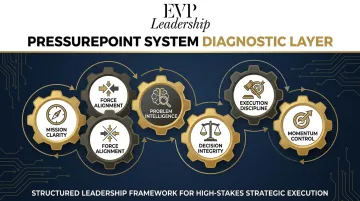
That conditioning is built incrementally, through repeated practice against real decisions — not through a single planning offsite.
Frequently Asked Questions
What is a strategic plan for a business?
A strategic business plan is a forward-looking document that defines where the business is headed, sets long-term goals, and outlines the strategies and actions needed to get there. It's distinct from a traditional business plan, which describes current operations for external audiences like investors or lenders.
What are the 5 components of a strategic plan?
The five core components are: mission and vision, SWOT analysis, strategic goals and objectives, key performance indicators (KPIs), and a financial and resource plan. Each builds on the previous — the mission anchors the goals, the SWOT informs the strategy, and the financial plan connects everything to execution.
What are the 5 C's of strategic planning?
The most widely applied version in business strategy analysis covers Company, Customers, Competitors, Collaborators, and Context. This 5Cs framework is used during situational analysis to validate strategic positioning before goals are set.
How is a strategic business plan different from a business plan?
A business plan describes the current business model for external audiences — investors, lenders, and partners. A strategic business plan is an internal roadmap focused on future growth, competitive positioning, and long-term direction.
How often should you update your strategic business plan?
Conduct a full review annually and run quarterly check-ins to assess KPI progress and goal status. Update the plan immediately when major market shifts, team changes, or significant financial variances make the current version no longer accurate.
How long should a strategic business plan be?
There's no fixed length. Most effective plans for small and mid-size businesses run between 10 and 20 pages — long enough to cover all key components clearly, short enough that leadership actually uses it. Clarity and actionability matter more than volume.