

That disconnect leads to real problems: underbudgeting, mismatched formats, or paying for conversation that never produces lasting change.
This guide breaks down the 2026 pricing landscape for executive coaching, the factors that push rates up or down, how different pricing models compare, and what to consider when budgeting — whether you're a small business owner, entrepreneur, or senior executive.
Key Takeaways
- Typical hourly rates run $200–$600 for most coaches; $1,000+ for C-suite specialists
- Main cost drivers: coach experience, leader seniority, program scope, and methodology depth
- Small business owners generally fall in the $200–$500/hr range or $5,000–$20,000 for structured multi-month programs
- Assessments and diagnostics are often billed separately, with 55% of organizations reporting them as a separate add-on cost
- Higher investment is justified when the engagement includes a structured framework, clear milestones, and outcomes tied to business performance
How Much Does Executive Coaching Cost Per Hour?
Executive coaching doesn't carry a fixed price tag. Rates shift based on who is being coached, who is doing the coaching, and what the engagement is designed to deliver. Going in without that context leads to budget mismatches, poor coach fit, and engagements that don't move the needle.
Three mistakes are especially common when cost is misunderstood:
- Underbudgeting leads to coaches without a proven methodology or accountability structure
- Buying a long program upfront before confirming the coach's approach fits their leadership goals
- Treating hourly rate as the primary filter instead of evaluating outcomes, frameworks, and fit
Typical Cost Ranges in 2026
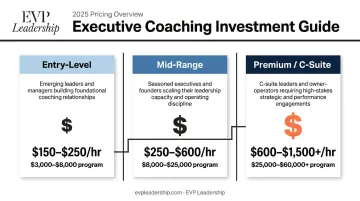
| Tier | Hourly Rate | Structured Program |
|---|---|---|
| Entry-level / newer coaches | $150–$250/hr | $3,000–$8,000 |
| Mid-range / experienced coaches | $250–$600/hr | $8,000–$25,000 |
| Premium / C-suite specialists | $600–$1,500+/hr | $25,000–$60,000+ |
The 2024 ICF-LA Executive Coaching SIG Pricing Survey, which surveyed 122 executive coaches, provides current benchmarking across hourly, package, and retainer models. For context on how seniority affects these rates specifically, the Conference Board's buyer-side data found a $425.50 median hourly rate for C-suite coaching, while 70% of organizations coaching leaders two to five levels below the CEO paid $201–$400/hour.
What Each Price Range Generally Includes
Entry-level range ($150–$250/hr): Typically includes scheduled sessions with limited structure, basic goal-setting, and minimal accountability infrastructure. Best suited for early-career managers or leaders working on discrete, well-defined skill gaps — not complex leadership transformation.
Mid-range ($250–$600/hr): Engagements at this tier usually include:
- Structured session cadence with defined milestones
- Leadership assessments or behavioral inventories
- Between-session accountability support
- A documented coaching framework
Best for experienced managers, directors, and small business owners pursuing meaningful leadership development.
Premium range ($600–$1,500+/hr): Justified by leadership diagnostics, stakeholder interviews, in-person delivery, and deep methodology customization — often with a former executive or industry background on the coach's side. Warranted for CEOs, founders navigating complex transitions, and C-suite leaders where decisions ripple across the entire organization.
Key Factors That Affect Executive Coaching Rates
Pricing is shaped by a combination of coach-side and client-side variables. Understanding each one helps buyers evaluate proposals accurately — rather than comparing hourly rates in isolation.
Coach Experience, Credentials, and Track Record
Years of coaching experience and ICF credential levels (ACC, PCC, MCC) both influence what a coach can charge. But credential level alone is a weak proxy for quality. What commands a significant rate premium is pattern recognition developed over decades — a coach who has seen the same leadership breakdowns play out across hundreds of organizations, and who has a structured system for addressing them.
A former C-suite executive turned coach, or a consultant with 30+ years of business strategy experience, brings a different category of insight than a generalist with a credential and a few years of practice.
Seniority of the Leader Being Coached
Coaching a CEO or business owner costs more than coaching a director. The stakes are higher, the complexity is greater, and measurable improvements at the top level affect every layer of the organization. The Conference Board's buyer-side data confirms this directly : C-suite coaching carried a median hourly rate of $425.50, while coaching at lower leadership levels averaged well under $300/hour.
Scope, Duration, and Format of the Engagement
The same coach may price very differently depending on:
- Shorter, high-frequency programs (3-month intensives) typically cost more per month than a 12-month engagement
- Weekly sessions run higher than bi-weekly across nearly every pricing model
- In-person delivery commands a premium over virtual, often 20–30% more
- Add-ons like executive offsites, team workshops, or real-time decision support increase total investment significantly
A 90-day intensive with high-frequency coaching contact will have a different total investment than bi-weekly sessions spread across a year.
Assessments, Diagnostics, and Stakeholder Alignment
Leadership assessments (360-degree feedback, behavioral inventories, stakeholder interviews) are often additional costs. The Center for Creative Leadership's 360 assessment, for example, starts at $2,000 in setup fees with participant fees of $380 each. Some programs bundle these; others don't.
Skipping assessments to reduce upfront cost is a common mistake. Without a diagnostic baseline, coaching often addresses symptoms rather than root causes and the investment rarely delivers its full return.
Methodology Depth: The Factor Most Buyers Overlook
The single most overlooked pricing driver is whether the coach operates from a structured, repeatable framework or relies on open-ended conversation.
A coach with a documented conditioning system that installs lasting leadership habits, tracks measurable milestones, and gives the leader a usable framework after the engagement ends will typically charge more. The higher cost reflects a fundamentally different outcome: leaders leave with a system they can apply independently, not just insights that fade after the final session.
This is how EVP Leadership structures its engagements. Rather than advice-and-accountability coaching, the firm's 90-Day PressurePoint System conditions leaders through three defined layers:
- Identity Layer: builds consistency, capacity, and character as a leadership foundation
- Diagnostic Layer: trains leaders across six components, including Mission Clarity, Decision Integrity, and Execution Discipline
- Execution Layer: a five-step protocol for performing under pressure, designed to be retained and applied independently
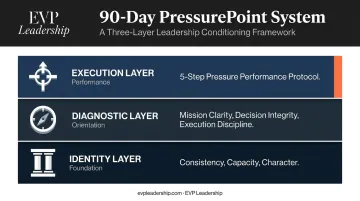
The framework doesn't exit with the coach. Leaders keep it.
Executive Coaching Pricing Models: How Coaches Structure Their Fees
Coaches price engagements in four primary models. The structure often signals something about the coach's philosophy: whether they're selling time or selling outcomes.
Per-Session / Hourly Billing
Flexible and accessible, hourly billing works well for targeted, short-term challenges. The key limitation: it can incentivize logging hours rather than driving measurable change. Without a defined roadmap, hourly coaching often drifts. Typical rates run $200–$600/hr depending on the coach's tier.
Program-Based Packages (3–12 Months)
Most serious coaching lives in structured programs. These packages typically include:
- A defined number of sessions over a fixed timeline
- Leadership assessments and diagnostic tools
- Accountability milestones and progress tracking
- A framework the leader keeps after the engagement
The flat investment model shifts the conversation from time spent to outcomes achieved. For small business owners and entrepreneurs, structured programs typically run $5,000–$25,000. Enterprise-level or C-suite programs can reach $30,000–$60,000+.
Monthly Retainers
Retainer-based coaching provides scheduled sessions plus on-demand access for high-stakes moments — decisions, conflicts, transitions. Best suited for senior executives who need a consistent thinking partner available in real time. Monthly retainers typically range from $2,000–$8,000/month depending on access level and coach tier.
Group and Cohort Coaching
Group coaching develops multiple leaders simultaneously at a lower per-person cost — typically $1,500–$5,000 per participant for a structured multi-month cohort. The per-person cost is lower than 1:1 coaching, but the deeper value is organizational. When a leadership team works through a shared framework together, they develop a common leadership language that compounds across the organization.
Individual coaching builds one leader. Cohort coaching can shift how an entire team operates. EVP Leadership's Leadership Development Programs take this approach — multi-month cohorts with custom curriculum built for small and mid-size business leadership teams at different growth stages.
Budget vs. Premium Executive Coaching: What's the Real Difference?
The question isn't whether to spend more or less. It's whether the coaching creates real, lasting change — or just a temporary boost in confidence.
| Dimension | Budget Coaching | Premium Coaching |
|---|---|---|
| Methodology | Open-ended conversation, reactive | Structured conditioning framework with defined milestones |
| Accountability | Periodic check-ins, self-reported | Built-in progress measurement, debriefs, behavioral tracking |
| Long-term value | Leader returns to old patterns | Leader retains a usable system beyond the engagement |
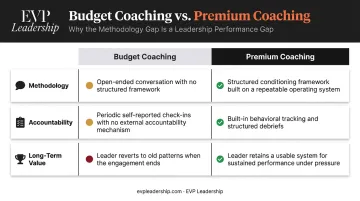
That last row — long-term value — is where the real cost difference lives. Without a structured system, leaders revisit the same challenges, organizational problems persist, and the ROI that justifies the spend never materializes.
The data on structured coaching supports this. Research published in the ICF Research Portal found that executive coaching ROI averaged nearly $100,000 — or 5.7 times the initial coaching investment — across a study of 100 executives in 6–12 month programs. A separate MetrixGlobal study found 529% ROI from executive coaching, excluding retention benefits. Neither figure is a guarantee — but both point to the same driver: a defined methodology with measurable outcomes, not open-ended conversation.
How to Budget for Executive Coaching — and What Most Buyers Get Wrong
The right budget isn't the lowest number that feels comfortable. It's the number that matches the scope required to achieve a specific leadership outcome.
Before committing to a budget, assess:
- The seniority and complexity of the leader's role
- The intended outcome — skill refinement vs. full leadership transformation
- Whether assessments and methodology tools are included or billed separately
- The total engagement cost, not just the per-session rate
What most buyers get wrong:
- Focusing only on hourly rate while ignoring whether the coach has a structured methodology
- Treating coaching as remedial rather than a proactive conditioning investment
- Choosing the cheapest option without evaluating what the leader will actually retain
- Failing to define measurable success criteria before signing
Those four mistakes share a common thread: they optimize for cost over outcome. A useful counterexample for small business owners and entrepreneurs is EVP Leadership's 90-Day PressurePoint System — a structured engagement designed specifically for founders, owner-operators, and small business executives. Rather than periodic conversation, it conditions leaders to perform under pressure and equips them with a repeatable leadership framework they keep. Pricing is scoped individually; it starts with a complimentary conversation to assess fit and define outcomes.
Frequently Asked Questions
What is the typical cost for executive coaching?
Most executive coaches charge $200–$600/hr, with C-suite specialists reaching $1,000+/hr. Program-based engagements typically range from $5,000 to $30,000 depending on scope, duration, and coach experience level.
How much does executive coaching cost per hour in 2026?
2026 hourly rates vary by coach credentials and leader seniority. Entry-level coaches start around $150–$250/hr; experienced executive coaches charge $300–$600/hr or more. Hourly rate alone tells you little about value. Methodology, structure, and measurable outcomes matter more than the number on the invoice.
Is executive coaching worth the investment for small business owners?
Multiple studies document coaching ROI of 5x–7x the initial investment for structured engagements. That return depends on whether the coach works from a defined framework with measurable outcomes — not just open-ended conversation.
What is the difference between hourly coaching and a coaching program package?
Hourly coaching offers flexibility but can become an open-ended expense without a roadmap. Program packages define outcomes, session structure, and accountability milestones upfront. That structure makes results easier to measure and the investment easier to justify.
How long does an executive coaching engagement typically last?
Most structured engagements run 3–12 months. Ninety-day intensives typically address a specific leadership challenge. Six-to-twelve month programs fit broader transformation work or engagements that include team-level development.
What should I look for when evaluating an executive coach's pricing?
Look beyond the hourly rate. Ask about the coach's methodology, what accountability structures are built into the program, whether assessments are included, and — critically — what the leader will retain and actively use after the engagement ends.