
Introduction
Most leaders think they communicate well — and most of them are wrong about it.
According to Axios HQ's 2025 research — surveying 813 employees and 457 leaders — 80% of leaders rate their internal communications as clear and engaging, while only 50% of employees agree. That 30-point gap isn't a minor discrepancy. It's a signal that leaders are working from a fundamentally different picture of how their communication actually lands.
This gap has real consequences. Misalignment, disengagement, stalled execution, and turnover often trace back to communication failures that leadership never recognized as failures at all.
This guide covers why specific communication skills matter in practice, what breaks down when they're absent, and how leaders can build these skills so they hold under pressure — not just in low-stakes situations where communication is easy.
Key Takeaways
- Leadership communication is a system of verbal, written, and nonverbal practices — not a single skill.
- The highest-leverage communication skills are active listening, clarity and directness, and transparent communication under pressure.
- Poor communication costs U.S. businesses an estimated $12,506 per employee per year in lost productivity.
- Communication skills aren't fixed — they're built through deliberate practice.
- Under pressure, leaders revert to conditioning — which is why communication must be trained, not assumed.
What Is Communication as a Leadership Skill?
Leadership communication is the full set of verbal, written, and nonverbal practices a leader uses to inform, align, motivate, and influence others. It's a system of interrelated abilities — not a single isolated skill — and it's active in every leadership interaction you have.
It applies everywhere:
- One-on-one performance conversations
- Team meetings and organizational updates
- Conflict resolution and difficult feedback
- Strategic pivots and change announcements
- Crisis moments and high-stakes decisions
- Public-facing representation of the organization
Communication is a means to outcomes, not an end in itself. Its value shows up in the trust you build, the alignment you create, and the execution it enables — not in how polished it sounds.
That distinction matters most when leaders confuse communication with performance. Treating it as a presentation skill rather than an operational one produces polished messages that don't move anyone. The real measure is whether your team understood, aligned, and acted.
Core Communication Skills Every Leader Must Develop
The three skills below are grounded in operational impact. Each one directly influences team performance, organizational alignment, and the trust that makes execution possible. They also represent the areas where leaders most commonly fall short — not because they lack awareness, but because these skills were never conditioned to hold under real pressure.
Skill 1: Active Listening
Active listening means being fully present during a conversation — not mentally drafting your response while the other person speaks, but genuinely absorbing what is said, including the emotions and concerns beneath the words.
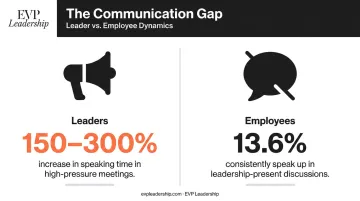
Research from the Center for Creative Leadership found that simply being labeled a leader increased speaking time by 150% to 300% in a team simulation. Leaders dominate airtime by default — and when leaders talk more, employees talk less. A study of 6,000 Microsoft employees found that only 13.6% consistently spoke up to managers across a broad range of work topics. That's not because employees have nothing to say. It's because most haven't been in conditions that made it safe to say it.
When employees don't feel heard, they stop surfacing problems early. Leaders then make decisions with incomplete information — and wonder why execution keeps breaking down.
KPIs impacted:
- Employee engagement scores
- Retention rates
- Time-to-conflict-resolution
- Decision quality (based on information available)
- Team morale indicators
Active listening has the highest impact in high-stakes conversations — performance reviews, change announcements, conflict resolution, and onboarding. These are precisely the moments when employees decide whether leadership is safe to be honest with. Leaders who listen well in these moments build the psychological safety that surfaces better information in every interaction that follows.
Skill 2: Clarity and Directness
Clarity means saying exactly what you mean, in plain language, without burying it in jargon, excessive context, or hedged phrasing — so the people receiving your message can act on it immediately.
The same Axios HQ research that revealed the communication perception gap applies directly here: 80% of leaders think their updates are clear and engaging; only 50% of employees agree. Leaders consistently overestimate how clear they are — which means they also consistently underestimate how much confusion they're generating downstream.
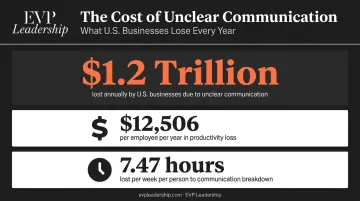
That confusion has a measurable price tag. Grammarly and The Harris Poll estimated that poor communication costs U.S. businesses up to $1.2 trillion annually — or roughly $12,506 per employee per year — based on 7.47 hours lost weekly to unclear communication. That's nearly a full workday per week, per person, spent chasing down context that should have been clear from the start.
KPIs impacted:
- Execution speed and project delivery accuracy
- Error rates from misunderstood instructions
- Volume of follow-up clarification requests
- Employee productivity
- Time lost to information-seeking
Clarity becomes critical during strategic pivots, complex delegations, and any written communication to distributed or remote teams — situations where ambiguity can't be resolved with a quick hallway conversation. In these contexts, a vague directive doesn't just slow things down. It sends teams in different directions entirely.
Skill 3: Transparent Communication Under Pressure
Clarity tells people how to act. Transparent communication determines whether they trust the direction at all. It means sharing relevant information — including difficult news, uncertain outcomes, and the reasoning behind decisions — rather than withholding it to protect comfort or buy time. This skill becomes far more important when pressure is highest.
Gallup's 2025 research found that 29% of U.S. employees say they lack clear, honest, or consistent communication from leaders — and U.S. employee engagement sat at just 32% in the same analysis. These numbers aren't coincidental.
Leaders who communicate transparently only when things are going well haven't built transparent communication — they've built conditional communication. When a crisis hits, employees notice immediately. The trust that erodes in those moments is far harder to rebuild than it would have been to maintain.
The instinct when stakes are high is to protect, delay, or soften information. Overriding that instinct requires a conditioned response — one built through repeated practice, honest self-evaluation, and a clear internal framework for how you respond when the pressure is real. That's the distinction between leaders who've trained communication and leaders who've conditioned it.
KPIs impacted:
- Employee trust index scores
- Retention during organizational change
- Alignment between leadership intent and team behavior
- Frequency of rumor-driven disruptions
Layoffs. Strategic pivots. Budget cuts. Leadership transitions. Market uncertainty. These are the moments that separate leaders who have conditioned their communication from those who have only practiced it in comfortable conditions.
What Happens When These Skills Are Missing
Communication gaps don't just create awkward meetings. They create measurable, compounding costs that are frequently misattributed to weak strategy or poor culture — when the actual source is leadership communication failure.
When active listening breaks down, leaders make decisions with incomplete information. Warning signs go undetected. Employees who raised concerns once and weren't heard simply stop raising them — and disengagement spreads before anyone notices the pattern.
When clarity breaks down, teams execute in different directions. Projects stall waiting for clarification that should have been embedded upfront. The leader who felt perfectly clear is suddenly managing a team that's confused, duplicating effort, and losing confidence in the direction.
When transparency breaks down under pressure, trust collapses fast. Prosci's benchmarking research across 2,600+ practitioners found that 88% of projects with excellent change management met or exceeded objectives, compared to just 13% with poor change management. Communication quality during high-pressure periods isn't a soft variable — it's a performance variable.
Left unaddressed, these failures compound into each other. Problems that could have been caught early become expensive crises, and scaling or delegating becomes nearly impossible when the team has no reliable communication infrastructure to operate within.
How to Build Leadership Communication Skills Through Conditioning
Here's the distinction that matters: training teaches a skill. Conditioning builds the capacity to execute that skill under pressure, consistently, without thinking about it.
Most leaders have attended communication training. Far fewer have conditioned communication habits that hold when a conversation gets hard, a decision is unpopular, or the stakes are high enough to trigger instinctive self-protection.
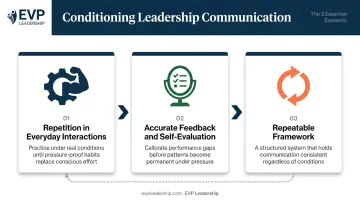
Conditioning requires three elements working together:
- Repetition in everyday interactions — the muscle memory that holds under pressure is built in lower-stakes situations first, not rehearsed only in high-visibility moments.
- Accurate feedback and honest self-evaluation — leaders need reliable information about how their communication lands, which requires actively seeking it rather than assuming.
- A repeatable framework that reinforces the right behaviors until they're instinctive — applied consistently across weeks and months, not introduced once at a seminar.
Practices leaders can start immediately:
- Commit to one meeting per day where you ask more questions than you answer
- Audit outgoing written communications for clarity before sending — does this message tell someone exactly what to do, or does it leave them guessing?
- Establish a consistent communication rhythm with your team that prevents information gaps from building into misalignment
The caveat: these practices work if they're sustained. A two-week streak followed by reversion doesn't build the habit — it just interrupts it.
That's the gap the 90-Day PressurePoint System is designed to close. EVP Leadership built it specifically to condition communication skills alongside decision-making, execution discipline, and leadership presence — so the habits hold when the pressure is real.
Conclusion
Strong leadership communication isn't built on eloquence or charisma. It's built on consistency — listening well, communicating directly, and staying transparent when pressure would make it easier to go quiet.
These skills compound when practiced as habits. They deteriorate when treated as one-time fixes. The leaders who perform best under pressure aren't the ones who took a communication course. They're the ones who conditioned their communication instincts through disciplined, repeated practice — until the right response became the automatic response.
Treat communication as an ongoing practice — something you build deliberately, assess honestly, and return to consistently. At EVP Leadership, the work of conditioning communication instincts sits at the center of how we develop leaders who perform when the pressure is highest. That's the work worth doing.
Frequently Asked Questions
What are the 5 important communication skills for leaders?
The five most critical communication skills are active listening, clarity and directness, transparency, empathy, and storytelling. All five matter — but their real value depends on how consistently a leader applies them under real-world conditions, not just when circumstances are favorable.
What is communication as a leadership skill?
Communication as a leadership skill encompasses the full range of verbal, written, and nonverbal practices leaders use to align, motivate, and build trust with their teams. It functions as the delivery mechanism for every other leadership competency — strategy, delegation, decision-making, and culture all depend on it.
What are the 4 communication styles in leadership?
The four primary styles are passive, aggressive, passive-aggressive, and assertive. Assertive communication — direct, honest, and respectful — is consistently the most effective for leaders, particularly in high-pressure or high-stakes situations where clarity and trust matter most.
Why do leaders struggle with communication under pressure?
Under pressure, leaders default to old habits — going silent, becoming vague, or overcorrecting with reactive over-communication. These patterns surface because most leaders trained their communication skills rather than conditioning them. Training builds knowledge; conditioning builds the instincts that hold when pressure is highest.
How can leaders improve their communication skills over time?
Improvement requires consistent practice in real situations — not one-off workshops. Pair that with honest feedback and a structured system that reinforces the right behaviors until they hold automatically under pressure.
What is the cost of poor communication in leadership?
The costs compound quickly. Grammarly and The Harris Poll estimated poor communication costs U.S. businesses roughly $12,506 per employee per year in lost productivity. Beyond the numbers, eroded trust and misaligned execution build into organizational failures that are far harder to reverse.