
Introduction
You have a clear direction. Your team is working hard. And yet, the results don't reflect either of those things.
This is one of the most frustrating experiences a leader can have — and it's more common than most will admit. Research from HBR found that two-thirds to three-quarters of large organizations struggle to implement their strategies, with 40% of managers citing failure to align as the primary cause.
The problem isn't effort or intent. It's the missing bridge between where leadership is pointing and how the team actually moves. Vision and execution are two distinct disciplines, and most organizations invest heavily in the first while treating execution as self-managing.
This guide covers the root causes of the vision-execution gap, how misalignment shows up in daily work, and a practical framework for building alignment that holds when business pressure is highest — not just during planning cycles when conditions are calm.
Key Takeaways
- A vision communicated once will be reinterpreted differently by every person who heard it
- Alignment means shared direction — not universal agreement on every decision
- Execution breakdowns are almost always a design and clarity problem, not a motivation problem
- Every strategic priority needs a single named owner responsible for the outcome
- Vision takes hold through decisions, feedback, and daily leadership behavior — not announcements
Why Most Leaders Struggle to Bridge Vision and Execution
Vision and execution operate on different timescales and different languages. Leadership thinks in strategy and future states. Teams operate in daily tasks, priorities, and deadlines. Without a deliberate translation layer between the two, teams fill in the gaps themselves — and they usually fill them incorrectly.
The Assumption Trap
Most leaders believe that communicating a vision once is enough. The data says otherwise.
Two findings illustrate how wide the gap actually is:
- MIT Sloan Management Review found that only 28% of executives and middle managers responsible for executing strategy could list three of their company's strategic priorities.
- In HBR's research, nearly 90% of middle managers believed top leaders communicated strategy frequently enough — yet only 55% could name a single one of the company's top five priorities.
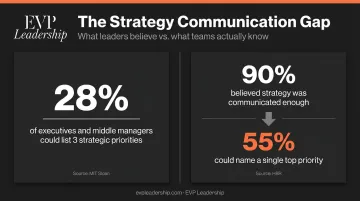
The problem isn't communication frequency. Each team member filters the vision through their own lens, producing fragmented effort across the organization.
Pressure Exposes What Was Never Structurally Built
Assumed alignment holds in calm conditions. Under pressure, it collapses — because it was never structurally reinforced.
This is the premise behind EVP Leadership's approach. Leaders don't rise to expectations; they fall back on their conditioning. The same logic applies to teams. When complexity spikes or business conditions shift, the gaps in clarity surface immediately — slow decisions, inconsistent execution, ownership confusion, and missed priorities.
The Founder Bottleneck
For small business owners and entrepreneurs, this gap is often invisible — masked by the leader's own involvement. The founder compensates by staying deep in operational details rather than delegating decisions down the organization.
EVP Leadership calls this the founder bottleneck: the leader becomes the operational constraint because the team hasn't been given the clarity or authority to self-direct. The result is a business that can't scale and a team that waits for direction on decisions it should be making independently.
Execution breakdowns in these contexts are rarely a motivation or talent problem. They're a design and clarity problem — unclear decision rights, ambiguous ownership, and priorities that shift without shared criteria for resolving trade-offs.
How to Recognize the Signs of Team Misalignment
Misalignment doesn't announce itself. It builds in the background until the cost becomes impossible to ignore.
Behavioral Indicators
Watch for these patterns in your team's day-to-day work:
- Recurring rework on the same issues — problems that get resolved in meetings and resurface the following week
- Meetings that produce agreement but not action — clear decisions that nobody owns after the room empties
- Visible busyness without clear priority — team members working hard on the wrong things
- Escalation dependency — routine decisions that require the leader to weigh in every time
The language patterns are equally telling. Phrases like "I thought you were handling that," "I didn't know this was still the priority," or "I was waiting for direction" aren't personality issues. They're symptoms of undefined clarity in the system.
Where Misalignment Shows Up at Each Level
| Level | What Misalignment Looks Like |
|---|---|
| Leadership | Competing interpretations of strategy among senior team members |
| Team | Inconsistent effort, low trust in direction, duplicate work |
| Individual | Disengagement or reliance on the leader for every decision |
MIT Sloan research found that nearly one-third of top executive team members reported senior executives were focused on their own agendas or that clear factions existed within the team. In the same study, only 27% of companies had two-thirds of their top executives aligned on the same strategic priorities — meaning misalignment at the top is the norm, not the exception.
The Downstream Cost
This isn't a culture issue — it's a measurable business problem. Gallup's 2025 State of the Global Workplace report found that global employee engagement fell to 20% in 2025, with the cost of low engagement estimated at $10 trillion in lost productivity — roughly 9% of global GDP.
Disengagement and misalignment are connected. Gallup's Q12 research found that only 45% of U.S. workers under 35 clearly knew what was expected of them at work. When people don't know what's expected, they can't execute toward a shared direction.
Recognizing these patterns is the first step. The next is understanding what's causing them — and what a structured alignment process looks like in practice.
A Practical Framework for Aligning Leadership Vision With Team Execution
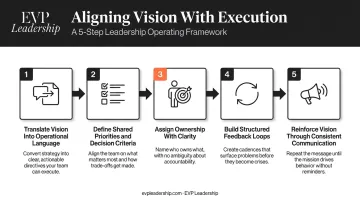
Five specific practices, applied consistently, are what turn leadership vision into actual team execution.
Step 1: Translate Vision Into Operational Language
"Be the market leader" doesn't tell anyone what to do on Monday morning. "Increase client retention by 15% and expand into two new verticals within 18 months" gives the team something to act on.
A well-formed operational vision includes three elements:
- A clear outcome (what success actually looks like)
- A time horizon (when you expect to get there)
- A measurable signal (how you'll know you've arrived)
EVP Leadership's strategic planning work centers on exactly this translation — aligning day-to-day operations to long-term business goals so that execution reflects strategy, not a team's best guess at it.
Step 2: Define Shared Priorities and Decision Criteria
When resources or attention are constrained, teams need to know what takes precedence. Without stated decision criteria, each person defaults to their own judgment — which produces inconsistent decisions across the organization.
Leaders must explicitly communicate:
- What the top three priorities are (not ten)
- What gets deprioritized when capacity is limited
- How trade-offs should be resolved when two priorities conflict
Step 3: Assign Ownership With Clarity
There's a critical difference between task ownership and outcome ownership.
Task ownership means someone completes specific work. Outcome ownership means someone is responsible for the result — regardless of who does what along the way. Every strategic priority needs a single named owner accountable for the outcome. Not a department. Not a committee. One person.
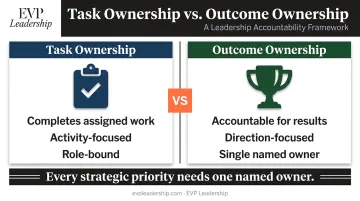
Bain's RAPID decision framework offers a practical structure for clarifying who recommends, who agrees, who performs, and who decides — a useful tool for organizations where accountability roles are currently blurred.
Step 4: Build Structured Feedback Loops
Once ownership is clear, feedback loops are what keep execution on track. Without them, misalignment compounds quietly until it's expensive to fix.
Gallup research found that 80% of employees who received meaningful feedback in the past week were fully engaged. Regular check-ins should assess more than task completion. The real question is: Are we moving in the right direction?
Effective check-ins include:
- Progress toward the stated outcome (not just activity)
- Early signals that priorities have drifted
- Decisions that got escalated unnecessarily — and why
Step 5: Reinforce Vision Through Consistent Communication
Vision isn't a one-time announcement. It's a pattern of consistent reference over time.
Leaders must connect daily decisions, team wins, and course corrections back to the larger direction. This means:
- Opening team meetings with a vision-connection statement
- Tying recognition to strategic outcomes, not just task completion
- Asking "does this decision move us toward or away from the priority?" as a standard prompt before committing resources
Building Systems That Sustain Alignment Under Pressure
Most alignment efforts work in calm conditions. They fall apart when urgency spikes — not because the effort was wrong, but because it was never structurally conditioned to hold under pressure.
Structural Conditions That Erode Alignment
Certain organizational patterns erode the alignment leaders think they've built:
- Metrics that reward individual contribution over shared outcomes push people to optimize for what gets measured, even when it fragments team direction
- Competing priority signals across departments force teams to fill the contradiction in unpredictable ways
- Escalation requirements for routine decisions slow execution and shrink ownership at every level
According to an HBR study, more than 80% of companies had at least one formal system for managing cross-functional commitments — but only 20% of managers believed those systems worked well most of the time. Structure alone isn't the answer. Behavior and structure have to reinforce each other — and that's where most organizations stop short.
Conditioning vs. Training
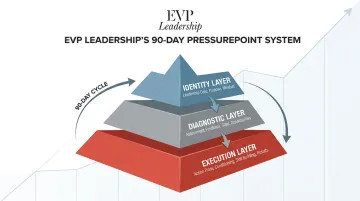
EVP Leadership's 90-Day PressurePoint System is built on a specific premise: under pressure, leaders don't rise to expectations. They fall back on their conditioning. Standard planning cycles and training interventions produce knowledge. Conditioning produces consistent behavior under pressure.
The PressurePoint System addresses this through three integrated layers: the Identity Layer (consistency, capacity, character), the Diagnostic Layer (Mission Clarity, Force Alignment, Decision Integrity, Execution Discipline, and others), and the Execution Layer. The goal is not to react better under pressure, but to build systems and leaders so that alignment doesn't require constant willpower to maintain.
How to Keep Vision Alive in Daily Operations
Vision-to-execution alignment isn't sustained in quarterly planning sessions. It lives or dies in how leaders show up day to day.
Micro-Habits That Connect Vision to Daily Work
Small, consistent behaviors create more durable alignment than any single initiative:
- Open team meetings with a vision-connection statement — one sentence that links today's agenda to the larger direction
- Tie performance feedback to strategic outcomes, not just task completion — "You completed the deliverable on time" is less powerful than "That work directly advanced our retention goal"
- Use "toward or away from the priority?" as a decision prompt before committing time or resources
These habits compound over time. The discipline to connect daily work to strategic direction — consistently, even when pressure mounts — is what separates leaders who sustain alignment from those who lose it the moment priorities shift.
The Leader as Translator
The leader's communication role is to constantly translate between two registers: strategic language for direction and team-relevant language for execution. Leaders who only speak in strategy lose their teams. Leaders who only speak in tasks lose the vision.
The most effective version of this in practice looks like: "Here's what we decided and why it matters for where we're headed" — not just "here's what we're doing."
Aligning Messages Across Multiple Leaders
Consistency of message across a leadership team matters as much as the message itself. When executives and managers signal different priorities, teams will make their own decisions about what matters — and those decisions won't always point the same direction.
One practical tool: establish a shared priority statement each quarter that every leader can reference in their own team contexts. It doesn't need to be scripted. It needs to be consistent.
McKinsey found that transformations were 6.3 times more likely to succeed when senior leaders shared aligned messages about the change effort — a finding that extends well beyond formal transformations into the routine work of strategic execution.
Frequently Asked Questions
How can leaders bridge the gap between vision and execution?
Bridging the gap starts with translating vision into operational language, then establishing clear ownership and shared decision criteria. From there, it requires consistent communication and structured feedback loops — not as a one-time effort, but as an ongoing leadership practice that must be conditioned.
What are some good leadership vision examples?
Operationally useful visions are specific and time-bound. For example: "Achieve 90% client retention across all active accounts by Q4 of next year." That's actionable. Vague statements like "become a trusted partner" give teams nothing to execute against.
Why do teams fail to execute on the leader's vision?
Execution failure is rarely about effort or capability. The most common causes are unclear priorities, ambiguous ownership, and the absence of shared decision criteria. When teams don't know what matters most or who owns what, they fill the gaps with their own interpretations — which won't align across the organization.
What is the difference between vision alignment and team execution?
Vision alignment is the shared understanding of direction and priorities among team members. Execution is the consistent action taken toward that direction. Alignment is the precondition; execution is the result. You can have execution without alignment — but it won't move the organization in the same direction.
How often should a leader communicate their vision to the team?
More frequently than most leaders assume. Vision communication works best when it's embedded in context — decisions, priorities, progress, and change — not delivered as a standalone announcement. That consistent reinforcement is what makes vision operational rather than decorative.