Introduction
Senior leaders spend a significant portion of their working hours making decisions — yet McKinsey research found that only 20% of organizations excel at decision-making, and just 37% of respondents said their decisions were both high quality and high velocity. That gap isn't a knowledge problem — most executives already know what good decision-making looks like.
The real issue is what happens when pressure hits. Under stress, leaders don't execute the framework they learned in a workshop — they fall back on whatever habits are most deeply ingrained. Reactive patterns and familiar shortcuts take over.
This guide gives senior leaders a practical executive decision-making framework built for real conditions: how to classify decisions before acting on them, avoid the cognitive traps that derail high-stakes choices, and build the decision-making capacity that holds under sustained pressure — not just in calm conditions.
Key Takeaways
- Not all decisions are equal — diagnosing which type you're facing is the critical first step
- A 6-step repeatable framework sharpens your judgment — it doesn't replace it
- Cognitive biases like confirmation bias and overconfidence distort executive decisions in predictable ways
- Pressure degrades decision quality by narrowing perspective and amplifying reactive instincts
- Conditioning builds the decision habits that hold under pressure — one-time training doesn't
What Is an Executive Decision-Making Framework?
An executive decision-making framework is a structured, repeatable process for evaluating options and choosing actions that align with organizational goals. For senior leaders, it's what separates a deliberate response from a reactive one — especially when time is compressed and consequences compound quickly.
Senior leaders face more consequential decisions per day than any other role in the organization. The downstream effects on team performance, strategy, and culture amplify every judgment call — and the margin for bias or reactive thinking is razor thin.
Operational vs. Executive Decisions
Not every decision requires the same level of deliberate process. Understanding the difference keeps leaders focused on what actually needs their attention.
Operational decisions are routine, repeatable, and largely delegable:
- Processing payroll and standard financial reporting cycles
- Reordering inventory based on preset thresholds
- Approving routine vendor contracts within established terms
- Approving routine vendor contracts within established terms
- Managing standard HR processes like scheduling, PTO approvals, and recurring performance reviews
Executive decisions are strategic, long-term, and high-consequence:
- Entering a new market or discontinuing a product line
- Restructuring the leadership team
- Deciding whether to pursue a major acquisition or exit opportunity
Knowing which category a decision belongs in — and staying out of operational decisions that belong to your team — is where executive discipline actually starts. A framework makes that distinction automatic rather than effortful.
Common Decision-Making Pitfalls Senior Leaders Must Avoid
McKinsey research found that 72% of senior executives said bad strategic decisions were either as frequent as good ones or the prevailing norm. The patterns behind that number are consistent.
Oversimplification
When leaders apply a proven solution to a problem that doesn't fit that mold, they skip the diagnostic step entirely. As Snowden and Boone note in their foundational HBR work on the Cynefin framework, overreliance on best practice creates complacency — what they call "entrained thinking." The real problem often isn't what it appears to be on the surface.
Analysis Paralysis
The opposite failure is equally costly. Gathering more information than a situation actually requires delays action — and in fast-moving environments, delay is itself a decision. Perfectionism in decision-making is a trap — it mistakes caution for rigor while the window for action closes.
Cognitive Biases
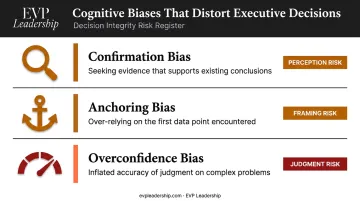
Three biases consistently distort executive judgment:
- Confirmation bias drives leaders to gather evidence that supports a conclusion already reached, rather than testing it against disconfirming data
- Anchoring bias causes over-reliance on the first data point encountered, crowding out better information that surfaces later
- Overconfidence bias inflates perceived accuracy of one's own judgment, particularly on complex or novel problems where past experience is a poor guide
Catching these patterns as a decision unfolds — not after the damage is done — is what separates leaders who learn from outcomes from those who simply repeat them. For founders and CEOs running without a structured decision framework, these biases tend to compound under pressure precisely when the stakes are highest.
The 4 Decision Contexts Every Senior Leader Must Recognize
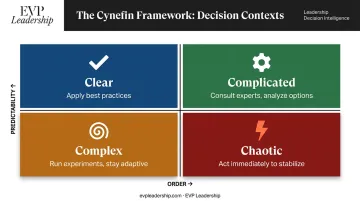
The most important move in any decision-making process comes before any analysis: diagnosing what kind of situation you're actually in. The Cynefin framework, developed by Dave Snowden and popularized for executive audiences through Harvard Business Review, maps four distinct contexts — and the decision approach each one demands.
Here's how each context works — and what it requires from you.
Clear Contexts: When the Answer Is Known
Clear situations have established cause-and-effect relationships. Best practices exist, patterns are recognizable, and the right action is straightforward once the situation is correctly categorized.
Examples:
- Standard hiring procedures for a well-defined role
- Recurring financial close processes
- Routine customer onboarding
The risk here is complacency — assuming everything is clear when the environment has quietly shifted.
Complicated Contexts: When Expertise Is Required
Complicated situations have multiple viable paths forward. No single best practice covers the ground, but analysis and expert input can identify the right approach. The key discipline is slowing down to compare options rather than grabbing the first familiar one.
Examples:
- Evaluating a major technology investment
- Diagnosing a sustained drop in team performance
- Restructuring compensation
Complex Contexts: When Experimentation Guides the Way
Complex situations — entering a new market, navigating a culture shift, managing organizational growth beyond current capacity — cannot be solved with a predetermined plan. Cause-and-effect relationships only become visible in retrospect.
The right approach is to run small experiments, observe what emerges, and adapt. Committing rigidly upfront is where many well-intentioned strategic decisions fail.
Examples:
- Entering an adjacent market without existing customer data
- Managing an organization that has outgrown its current structure
- Leading through a significant cultural shift post-merger
Chaotic Contexts: When Speed Overrides Analysis
In a crisis — sudden market disruption, leadership failure, reputational event — the goal is not the perfect decision. It's a fast decision that restores enough stability to assess the situation clearly. Analysis comes after stabilization, not before.
In chaotic contexts, the first move is containment. Once stability returns, diagnosis begins.
A Step-by-Step Executive Decision-Making Framework
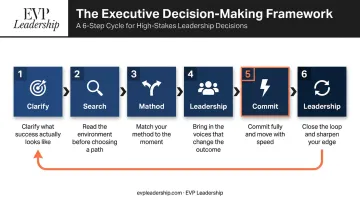
A repeatable process sharpens judgment. The value is ensuring nothing critical gets skipped when pressure is high and time is short. The following 6-step framework applies across all four decision contexts.
Step 1: Define the Desired Outcome
Before any analysis, articulate what success looks like. A clearly stated outcome anchors every subsequent step. Without it, decisions drift based on short-term pressures, competing voices, or whoever is loudest in the room.
Step 2: Diagnose the Decision Context
Use the four contexts above to categorize the situation. Most frameworks fail leaders here because they jump straight to solutions without asking what kind of problem they're actually solving. Misdiagnosing context is one of the most common reasons well-intentioned decisions produce poor results.
Step 3: Choose the Right Decision Approach
Match the approach to the context:
| Context | Appropriate Approach |
|---|---|
| Clear | Apply best practices; act decisively |
| Complicated | Consult experts; analyze options before committing |
| Complex | Run small experiments; stay adaptive |
| Chaotic | Act immediately to stabilize; analyze after |
Mixing these up (treating a complex situation like a clear one, or over-analyzing a chaotic moment) is a common and costly leadership error.
Step 4: Involve the Right People
The right people include those with relevant expertise, those who will be affected by the decision, and those responsible for executing it. Inclusive decision-making is not about consensus. It's about ensuring the leader has the full picture before deciding. HBR research found that cognitively diverse teams solve problems faster — the value is in the input, not the vote.
Step 5: Decide, Then Act
A decision without action is not a decision. Once committed, match the execution mode to the context:
- Clear situations: act boldly and move fast
- Complex situations: move incrementally and stay adaptive
- Chaotic situations: act decisively to stabilize first, then assess
What separates strong leaders from hesitant ones is the willingness to commit fully once the call is made. McKinsey found that decision-making "winners" were 6.8 times more likely to build commitment to execution among accountable stakeholders.
Step 6: Evaluate, Learn, and Adjust
Decision-making is a cycle. After acting, define success metrics in advance, review outcomes against original intentions, and document what worked and what didn't. This is where the next decision gets sharper.
A peer-reviewed meta-analysis of 46 studies found that structured after-action reviews improved individual and team effectiveness by 20–25%. Not because they feel productive, but because they force honest comparison between intent and reality.
Decision-Making Under Pressure: Why Conditioning Beats Training
Here's a distinction that most leadership development programs get wrong: knowing a framework and being able to execute it under pressure are not the same thing.
Under pressure, cognitive function shifts. A 2016 review in Neuroscience and Biobehavioral Reviews found that stress moves decision-making from slower analytical reasoning toward faster intuitive processing — increasing habitual responses and amplifying biases. Leaders don't become more rational under pressure. They become more automatic.
This is why EVP Leadership's approach to executive development centers on conditioning rather than training. Their core principle is direct: under pressure, leaders don't rise to expectations — they fall back on their conditioning. A one-day workshop can teach a framework. It cannot build the practiced reflexes that activate when a crisis lands.
What Conditioned Decision-Making Looks Like
Gary Klein's Recognition-Primed Decision model, developed through studying experienced fireground commanders and military leaders in real-time conditions, found that expert decision-makers don't generate and compare multiple options under pressure. They recognize patterns from prior experience and act on the first viable option: a capability built through repeated exposure, not classroom instruction.
The practical implication is straightforward. A leader who has rehearsed the diagnostic step across varied contexts — different stakes, different emotional conditions — can still assess the problem clearly when pressure is high. A leader who only learned the framework once cannot.
How the PressurePoint System Builds This Capacity
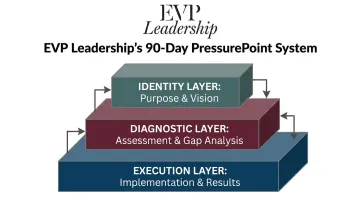
EVP Leadership's 90-Day PressurePoint System is structured specifically to build conditioned decision habits rather than transferred knowledge. It operates through three integrated layers:
- Identity Layer — develops consistency (acting in alignment with values under pressure), capacity (ability to carry complexity without degrading), and character (ensuring decisions remain grounded in integrity)
- Diagnostic Layer — trains six capabilities including Decision Integrity, which specifically addresses whether decisions are grounded in truth or distorted by noise and emotion
- Execution Layer — a five-step battle-tested protocol for critical moments: Pause the Noise → Locate the Pressure Point → Prioritize the Critical Move → Execute with Discipline → Lock in Momentum
Each layer is tested in real scenarios and embedded through repeated application across the full 90 days — not a single engagement. That structure matters. McKinsey's research on leadership development argues that behavioral change requires programs built around daily work and repeated practice, not isolated classroom learning. The PressurePoint System is designed around exactly that premise.
How to Continuously Strengthen Your Decision-Making Over Time
Decision-making capacity isn't fixed. It builds — or erodes — based on what leaders do consistently between high-stakes moments.
Build a Post-Decision Review Practice
The most direct way to improve decision-making over time is to review decisions systematically. Wharton Executive Education describes the after-action review structure around four questions: What was intended? What actually happened? Why was there a difference? What would be done differently?
This practice converts experience into learning. Without it, experience simply accumulates without insight.
Use Reflection as a Development Tool
HBS research found that call-center employees who spent 15 minutes in structured reflection at the end of each day performed 22.8% better on final training assessments than a control group. The mechanism applies beyond entry-level roles: reflection creates the cognitive processing that turns raw experience into refined judgment.
Brief, consistent practices compound over time in ways that sporadic intensive training does not:
- An end-of-day decision log to capture what you chose and why
- A weekly review of the major calls you made
- Dedicated structured thinking time built into your schedule
Seek Diverse Input and Stress-Test Decisions
Reflection sharpens your own lens. But it can't catch what you can't see — and that's where external challenge becomes essential.
Build your decision-making environment with that in mind:
- Develop a trusted circle of advisors who will tell you what they actually think
- Create norms where dissent is welcomed, not managed
- Stress-test major decisions against the strongest alternative perspective before committing
Research on devil's advocacy in managerial decisions consistently finds this kind of structured challenge improves decision quality — not because the dissenter is always right, but because the process surfaces assumptions you didn't know you were making.
Frequently Asked Questions
What is an executive decision-making framework?
It's a structured, repeatable process for evaluating options and choosing actions that align with organizational goals. Unlike reactive or instinct-driven decision-making, it ensures context is diagnosed, the right people are involved, and outcomes are defined before a course of action is chosen.
What are the 4 C's of decision-making?
One coaching model frames them as: Call it (decide), Close it (stop revisiting), Commit to it (align action behind the choice), and Communicate it (ensure everyone who needs to act understands what was decided). It's a practical execution framework, not a formal academic model.
What are the 7 steps of decision-making?
The standard model covers: identify the decision, gather information, identify alternatives, weigh the evidence, choose a course of action, implement it, and review the outcome. Most leaders skip that last step. The post-decision review is where real improvement happens.
What are the most common decision-making mistakes senior leaders make?
Oversimplifying complex situations by applying a familiar solution, stalling through excessive data-gathering, misdiagnosing the decision context entirely, and acting on confirmation bias or overconfidence without recognizing it in real-time.
How does pressure affect executive decision-making?
Pressure narrows cognitive perspective, shortens time horizons, and shifts processing toward faster intuitive responses — which amplifies existing biases. Pre-conditioned decision habits are more reliable under these conditions than any amount of in-the-moment analysis.
How can a senior leader improve their decision-making skills over time?
Build a consistent post-decision review practice and seek diverse input to counter blind spots. Repeat structured frameworks across real decisions until they become reflexive — conditioned habits outperform in-the-moment analysis every time. Working with a leadership development partner accelerates that process significantly.