Introduction
Many small business owners searching for outside help use "strategy consulting" and "business advice" as if they mean the same thing. They don't. That distinction has real consequences.
Hiring the wrong type of support can mean spending months producing a polished strategic plan that never gets executed, or optimizing operations that are pointed in the wrong direction. Both outcomes cost time and money you don't need to lose.
This guide defines each clearly, compares them across key dimensions, and helps you identify which one — or what combination — fits your situation.
Key Takeaways
- Strategy consulting addresses where to compete and how to grow — business advice addresses how to operate
- Start with one diagnostic: is the business missing direction, or does it know the direction but struggle to execute?
- Strategy consultants deliver structured roadmaps at the executive level; business advisors provide ongoing guidance across day-to-day functional areas
- Small and mid-size businesses often need both — but in sequence: direction before optimization
- Effective engagements build strategic clarity and leadership readiness together — so the plan gets executed, not shelved
Strategy Consulting vs. Business Advice: Quick Comparison
| Dimension | Strategy Consulting | Business Advice |
|---|---|---|
| Scope | Enterprise-wide direction, competitive positioning, 1–5 year horizon | Function-specific (finance, HR, marketing, operations), near-term problem solving |
| Engagement Style | Structured diagnostic, roadmap delivery, project-based | Ongoing guidance, advisory relationship, reactive or proactive |
| Who It Serves | C-suite executives, founders making directional decisions | Business owners and managers navigating day-to-day challenges |
| Typical Deliverable | Strategic roadmap, growth initiatives, positioning framework | Recommendations, action plans, functional coaching |
| Cost Structure | Project-based; fees typically range from $5,000–$75,000 depending on scope | Often retainer or hourly; typical advisory retainers range from $1,500–$5,000/month |
Project-based consulting fees shift considerably by scope. According to fee structure research from IMC USA, consultants should align with customary field practices — hourly, daily, project-based, or retainer — rather than defaulting to a single model. A Consulting Success survey of nearly 1,000 consultants found 30% used project-based rates, 29% used hourly rates, and 13% used monthly retainers.
That mix reflects how experienced practitioners tailor pricing to engagement type and client need. EVP Leadership follows the same logic: every engagement begins with a complimentary scoping conversation, and pricing is structured around the work — not a standard rate card.
What Is Strategy Consulting?
Strategy consulting helps organizations answer one foundational question before anything else: where should we compete, and how do we build a sustainable advantage there? It operates at the level of direction, not execution.
The Core Disciplines
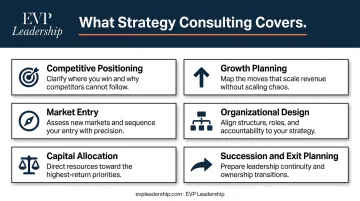
A strategy engagement typically covers:
- Competitive positioning — where the business stands relative to the market and where it should aim
- Growth planning — sequencing expansion moves in order of risk and return
- Market entry — analyzing new segments, geographies, or business models before committing capital
- Organizational design — building the structure and leadership capacity needed for the next stage of scale
- Capital allocation — deciding where resources go when trade-offs are unavoidable
- Succession and exit planning — preparing the organization for ownership or leadership transitions
These decisions shape everything the organization does downstream. Getting them right before investing in execution is the entire point.
How a Strategy Engagement Works
A strategy consultant typically runs a diagnostic first — reviewing competitive dynamics, organizational capabilities, financial performance, and leadership alignment. That analysis gets synthesized into a sequenced roadmap with clear priorities, decision points, and measurable outcomes.
The engagement is project-based, with a defined beginning and end. The most effective strategy partners stay connected through implementation — Gennifer Baker, EVP Leadership's founder, treats every engagement as an ongoing partnership rather than a handoff.
Who Strategy Consulting Is For
Strategy consulting delivers the most value at growth inflection points:
- Revenue has plateaued without a clear path forward
- Leadership is misaligned on the next move
- A major decision is on the table — new market, acquisition, new model, leadership transition
- The team is working hard but not moving toward a defined destination
Research published in HBR found that only 55% of middle managers could name even one of their company's top five strategic priorities, and only 11% believed all strategic priorities had the financial and human resources required. A strategy is only as good as the organization's ability to carry it. Closing that readiness gap — building the leadership capacity and operating discipline to execute — is where strategy work either pays off or falls apart.
What Is Business Advice?
Business advice is guidance that helps owners and leaders navigate specific operational, functional, or leadership challenges. It addresses how the business runs — not where it's going.
Domains Business Advice Covers
Most business advisors have deep expertise in one or more of these areas:
- Financial management and cash flow
- Marketing strategy and positioning
- HR and team structure
- Sales processes and pipeline management
- Operational workflows and process design
- Technology selection and implementation
The SBA's SCORE network is the most widely known example of structured business advisory services — providing no-cost ongoing advice to small businesses across financing, HR, and business planning. It illustrates what business advice looks like in practice: recurring, relationship-based, and responsive to whatever the owner is working through.
How Business Advisory Relationships Work
Unlike strategy consulting, business advisory relationships are typically ongoing. The owner turns to their advisor when a specific challenge surfaces, rather than engaging in a structured diagnostic. The relationship is less formal, more fluid, and often reactive — which is exactly what's needed when the problem is operational and contained. That fluidity is a feature — until the problem turns out to be directional rather than operational.
The Limits of Advice Without Strategic Grounding
That shift is where business advice can fall short. Business advice applied without strategic clarity can produce:
- A high-performing team built around a flawed business model
- Marketing optimization aimed at the wrong customer segment
- Cash flow improvements in a business that's profitable in the wrong direction
When a functional fix is applied to a strategic problem, the result is often a business that executes well in the wrong direction. The question isn't whether the advice is good — it's whether the business has clarity on where it's headed before acting on it.
Who Business Advice Is For
- Business owners who have strategic clarity and need functional help executing it
- Leaders who want an experienced outside perspective on a specific, contained decision
- Founders scaling an existing model who lack internal expertise in a particular function
Which One Does Your Business Actually Need?
Start with one question: is the business stuck because it doesn't know where to go, or because it knows the direction but can't execute it? These are different problems. Confusing them is one of the most expensive mistakes a growing business can make.
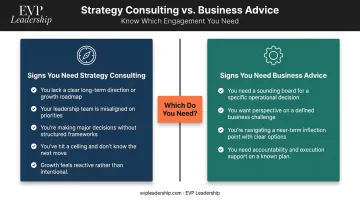
Signs You Need Strategy Consulting
- Revenue has plateaued despite operational efficiency
- Leadership disagrees on the next major move
- A significant decision (new market, restructuring, exit) is approaching without clear options
- The business has no coherent competitive positioning
- The team is busy but not making meaningful progress toward any defined goal
Signs You Need Business Advice
- The strategy is clear, but execution keeps falling short in a specific function
- Finance, marketing, or operations is underperforming in an identifiable, contained way
- You need an experienced outside perspective on a near-term operational decision
- A functional process needs redesign without requiring a directional change
The Harder Middle Case
Many growing businesses have a vague sense of direction and a shaky operational foundation at the same time. These businesses often cycle through consultants — hiring strategists who deliver plans that collect dust, then operational advisors who optimize toward the wrong goal. Neither engagement solves the real problem because neither addresses both layers at once.
The Integrated Model
For small and mid-size businesses, the most effective answer is strategic direction and execution readiness developed together, by a partner who stays accountable through implementation.
This is the model EVP Leadership uses. Gennifer Baker's C-level executive consulting work combines strategic planning with leadership capacity building, keeping operational alignment to long-term goals at the center of every engagement.
That work is reinforced by the PressurePoint System — EVP Leadership's proprietary 90-day leadership conditioning program — which builds the internal capacity leaders need to actually execute a strategy under real-world pressure.
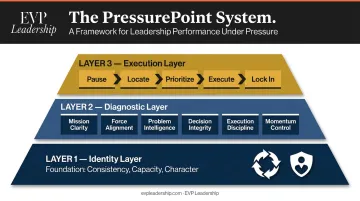
The system works through three layers that directly support strategic execution:
- Identity Layer: Leaders build the consistency and character needed to stay aligned with their standards when pressure is highest
- Diagnostic Layer: Six components — Mission Clarity, Force Alignment, Problem Intelligence, Decision Integrity, Execution Discipline, and Momentum Control — train leaders to see clearly and decide decisively
- Execution Layer: A five-step protocol for critical moments: Pause the Noise → Locate the Pressure Point → Prioritize the Critical Move → Execute with Discipline → Lock in Momentum
That integration addresses a documented gap: MIT Sloan research found only 28% of executives and middle managers could list three of their organization's strategic priorities. A roadmap only works when the people carrying it are built for the load.
Conclusion
Strategy consulting answers where to go. Business advice answers how to operate. Both are legitimate, and neither replaces the other.
The right choice depends on what's actually blocking the business — direction or execution. If you're unsure which one you need, that uncertainty usually points to a direction problem first.
Durable growth comes from leaders who can translate strategic clarity into consistent daily action. A strong plan without execution discipline stalls. Efficient operations without a clear destination drift. Both halves matter. If you're ready to assess honestly where your business stands, EVP Leadership offers a complimentary scoping conversation to identify what's actually blocking your next move.
Frequently Asked Questions
What is a business strategy consultant?
A business strategy consultant helps executives and owners make informed directional decisions by analyzing markets, competitive positioning, and organizational capabilities. The output is typically a structured roadmap with clear priorities for long-term growth — not just recommendations on how to operate better.
How much do business strategy consultants charge?
Fees vary by scope and model. Project-based engagements typically range from $5,000 to $75,000; advisory relationships run at lower ongoing monthly rates. EVP Leadership uses custom pricing — every engagement starts with a complimentary scoping conversation.
What is the difference between strategy consulting and business advice?
Strategy consulting addresses long-term competitive direction and organizational decisions — it determines where to compete. Business advice focuses on near-term operational and functional challenges — it determines how to operate. Both matter — the distinction is which problem you're actually trying to solve.
Do small businesses need strategy consulting?
Small businesses benefit most from strategy consulting at growth inflection points — when revenue plateaus, a major decision looms, or leadership is misaligned. The right engagement is scoped to the business's current stage and connected to execution, not just planning.
How long does a strategy consulting engagement typically last?
For small and mid-size companies, the diagnostic and roadmap phase typically runs three months. The most effective partners remain involved through implementation — often extending the relationship to six months or more depending on scope and complexity.
Can one consultant provide both strategy consulting and business advice?
Yes — and for growing businesses, this combination is often the most effective model. Gennifer Baker at EVP Leadership delivers both within a single engagement — connecting strategic direction to operational alignment and leadership capacity so clients don't have to manage two separate relationships.