Most CEOs understand this in theory. What's harder is building a team that actually performs when pressure hits, not just during quarterly reviews or annual planning sessions when everyone's on their best behavior. That's where most leaders fall short.
This guide covers the warning signs of a struggling executive team, what must be in place before you build, a clear step-by-step process, the factors that separate high-performing teams from functional-but-average ones, and the most costly mistakes to avoid.
Key Takeaways
- High-performance executive teams are built through intentional structure — not just by assembling talented people
- Executives who identify with the leadership team — not just their own department — perform at a higher level
- Role clarity, psychological safety, and shared decision-making protocols are the structural foundations that make everything else work
- Performance under pressure is conditioned over time, not guaranteed by impressive résumés
- The most common failure point is rushing to execute before the team has established trust, alignment, and shared purpose
Signs Your Executive Team Needs Rebuilding or Realignment
Most executive teams don't fall apart overnight — the warning signs accumulate quietly, long before the damage is obvious.
The dysfunction shows up gradually — in meetings that feel productive but produce no real decisions, in strategies that make sense on paper but stall at execution, in executives who work hard but primarily for their own department rather than the organization.
According to HBR, dysfunctional leadership teams hinder strategy execution and erode morale — two of the most expensive organizational problems a CEO can face.
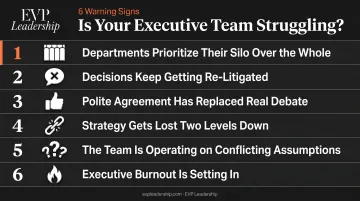
Watch for these specific warning signs:
- Executives who consistently prioritize their function's wins over cross-functional goals
- Decisions that get made in meetings, then re-litigated in hallways
- Absence of honest, challenging debate — replaced by polite agreement
- Strategy that's clear at the top but unrecognizable two levels down
- Executives operating from conflicting assumptions — with no shared ground to resolve them
- Burnout at the top, where executives are doing too much and delegating too little
Small business owners and growing companies face a compounding version of these patterns. The dysfunctions that feel manageable at $3M in revenue become structural constraints at $10M. Catching these signs early is itself a leadership skill.
What You Need Before Building a High-Performance Executive Team
The quality of your executive team build depends almost entirely on what's in place before you start. Talented people placed into an unclear, misaligned system become political rather than productive.
Organizational Clarity
Before assembling or restructuring any leadership group, the following must be defined:
- Company vision and mission — a concrete statement of where you're going and why, specific enough to guide decisions
- Core values — specific enough to use as decision filters, not just wall art
- Strategic direction — the 2-3 priorities the executive team is being built to execute
Teams cannot align around a moving target. Without these defined, no hiring decision or team development effort will hold.
Leader Readiness
Research from Harvard Business School identifies one of the most common root causes of ineffective executive teams: a leader who doesn't actually want to lead a team, lacks the skills to do so, or is unwilling to develop them.
Before redesigning your team, ask honestly:
- Am I willing to cede control over decisions that belong to my executives?
- Do I invite real dissent, or do I reward agreement?
- Am I investing in the team's development, or just managing their outputs?
EVP Leadership's work with small business owners frequently surfaces this pattern: burnout at the top, poor delegation habits, and leaders staying involved in functional decisions rather than giving executives real ownership.
The Identity Layer of EVP's 90-Day PressurePoint System addresses this directly — building the consistency, capacity, and character required before effective team leadership becomes possible.
Assessment of Current Team Dynamics
A baseline assessment should examine:
- Each executive's functional strengths and leadership gaps
- Current communication patterns — where information flows freely and where it gets stuck
- Trust levels — where collaboration is working and where it has eroded
- Role clarity — whether responsibilities are genuinely clear or just assumed to be
This isn't a performance review. It's a structural diagnosis. EVP Leadership's 6-point diagnostic framework evaluates Mission Clarity, Force Alignment, Problem Intelligence, Decision Integrity, Execution Discipline, and Momentum Control — mapping exactly where the team is gaining strength and where it's breaking down.
How to Build a High-Performance Executive Team
Step 1: Define the Team's Purpose and Shared Identity
The first structural question isn't who's on the team — it's what the team is actually for.
Many executives mentally associate "their team" with the department they lead. The VP of Sales manages the sales team. The CFO owns finance. That's accurate, but incomplete. As members of the executive team, they collectively own the organization's outcomes. Closing the gap between functional identity and enterprise identity is the first real work.
Start by creating a shared team charter that defines:
- What the executive team is responsible for together
- How decisions will be made (and which decisions belong to the full team vs. individuals)
- Behavioral standards expected from every member
This document doesn't have to be long. It has to be specific.
Step 2: Identify and Fill Key Roles Strategically
Role definition should be driven by strategy, not convention.
The team should reflect the capabilities required to deliver on your company's actual value proposition — not just replicate a traditional org chart. Deloitte found that Fortune 500 leadership teams grew 23% between 2018 and 2023, with ESG roles increasing 230% and strategy roles up 94%. The lesson isn't to copy that — it's that role composition should track where your business model is actually going.
On talent: individual excellence is not the same as executive team effectiveness. Research on star performers by Groysberg, Lee, and Nanda found that star analysts often saw their performance decline after moving firms — unless they moved with team members or to organizations with stronger supporting capabilities.
Individual performance depends on context, collaborators, and the decision-making systems around them. Hiring a high-pedigree executive as an isolated fix rarely works.
Step 3: Establish Clear Decision Rights and Processes
When decision authority is ambiguous, every decision becomes a political negotiation.
Categorize decisions explicitly:
| Decision Type | Who Owns It |
|---|---|
| Enterprise strategy and resource allocation | Full executive team |
| Cross-functional initiatives | Designated pairs or subgroups |
| Functional operations | Individual executive |
| Deadlocks | CEO as defined tiebreaker |
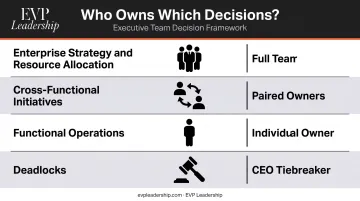
Define mandatory consultation protocols for cross-functional decisions. Set a clear process for when the CEO steps in. And commit to revisiting the framework as the team evolves — decision rights that made sense at 20 employees may not work at 80.
Step 4: Build a Culture of Trust and Productive Conflict
Trust in an executive team isn't built at an offsite. It's built through behavioral consistency over time — transparency about setbacks, acknowledgment of mistakes, and the willingness to have hard conversations without making them personal.
Karen Jehn's research distinguishes three types of conflict executive teams encounter:
- Task conflict: Disagreements about ideas and priorities — healthy when team norms support it
- Process conflict: Friction over how work gets done — manageable when surfaced early
- Relationship conflict: Interpersonal animosity — no research shows a positive performance effect
The goal is more task conflict, not less. But without psychological safety — the belief that speaking up won't result in ridicule or retaliation — task conflict collapses into either avoidance or destructive personal friction.
A 2022 study of 1,150 leaders across 160 management teams found that psychological safety had a significant indirect effect on both task performance and individual satisfaction through behavioral integration — specifically through collaboration, information sharing, and joint decision behavior. For executive teams, safety isn't about comfort. It's about whether people will share the information the team needs to make good decisions.
Step 5: Define Roles, Accountability, and Performance Metrics
Each executive should have three things in place:
- A clearly defined domain of responsibility (with no ambiguous overlap)
- Measurable goals that connect directly to organizational strategy
- A regular cadence for reviewing progress with the full team
Accountability culture doesn't come from pressure. It comes from clarity. When executives understand exactly what they own and how it connects to the company's larger objectives, ownership follows naturally.
What creates political behavior and gap-filling confusion is ambiguity — especially when the CEO remains deeply involved in functional decisions that should belong to individual executives.
Step 6: Invest in Ongoing Conditioning, Not One-Time Training
There's a meaningful difference between training and conditioning.
Training gives leaders knowledge. Conditioning builds the internal capacity to perform under pressure — consistently, not just immediately after a workshop. As EVP Leadership puts it: under pressure, leaders don't rise to expectations. They fall back on their conditioning.
This is why EVP Leadership's 90-Day PressurePoint System is structured as a conditioning program, not a retreat. It works through three layers: Identity (consistency, capacity, character), Diagnostic (a six-point assessment of where performance is breaking down), and Execution (a five-step protocol for high-stakes moments).
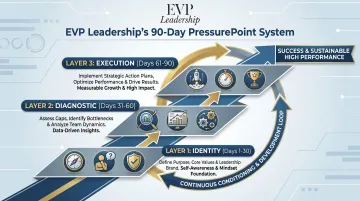
Each layer is embedded through repeated real-scenario practice across 90 days. The outcome isn't just better-trained executives — it's a team that holds its performance standards when the pressure is actually on.
Key Factors That Drive Executive Team Performance
Assembling the right people and following a good process is necessary but not sufficient. What separates genuinely high-performing teams is how consistently they maintain these drivers.
Communication Structure
Meeting frequency and quality directly affect team performance. MIT's Alex Pentland found that communication patterns — energy, engagement, and informal connection — are among the strongest predictors of team success.
At minimum, executive teams should:
- Meet weekly for operational alignment
- Meet separately for strategic reviews (quarterly, at minimum)
- Separate "run the business" conversations from "change the business" conversations
McKinsey reports that 61% of executives say at least half of their decision-making time is ineffective. Meeting structure is usually the culprit.
Psychological Safety
When psychological safety is absent, team members default to agreeable silence. Decisions get made without the information that's sitting in the room because no one feels safe putting it on the table. Google's Project Aristotle identified it as the single most important factor in effective teams.
For executive teams specifically, two diagnostic questions cut to the core:
- Do your executives share bad news as readily as good news?
- Do they challenge decisions in the room, or only in the hallway afterward?
If the answer to either is no, you have a safety problem.
Strategic Alignment
Alignment means more than knowing the company's goals. Each executive needs to articulate the trade-offs their function is making in service of organizational priorities — and be willing to set aside departmental wins when the larger strategy requires it.
When that willingness is missing, executives optimize locally. The strategy stays intact on paper and fragments in execution.
Accountability Rhythms
Accountability works when it's embedded in regular operations — not reserved for performance review cycles. The mechanics are straightforward:
- Consistent check-ins tied to specific commitments
- Transparent progress tracking visible to the full team
- A clear process for addressing non-performance before it compounds
That rhythm keeps the team honest without turning every interaction into an evaluation.
Leadership Capacity Under Pressure
High performance is tested not in normal conditions but in moments of complexity, uncertainty, and rapid change. Research by Staw, Sandelands, and Dutton on "threat rigidity" shows that stress can push organizations toward centralized, rigid decision-making — narrowing information flow at exactly the moment when broader input is needed.
Teams that haven't conditioned themselves to stay aligned under pressure tend to fragment precisely when coherence matters most. That conditioning doesn't happen by accident — it's built through repeated exposure to high-stakes scenarios before the real ones arrive.

Common Mistakes Leaders Make When Building Executive Teams
Prioritizing Individual Talent Over Team Fit
The most common trap: hiring the most impressive individual performer without evaluating how they'll function within a leadership team. Credentials and past functional results don't predict executive team effectiveness. The result is what researchers call a "collection of strong players but hardly a team" — differing agendas, self-centered behavior, and no shared purpose despite individual excellence.
The right question isn't whether someone is exceptional. It's whether their performance model fits the context, capabilities, and decision systems you actually operate within.
Skipping the Foundation Work
Many teams rush into execution without defining team purpose, decision-making protocols, or shared norms. The result is recurring problems with alignment, conflict, and accountability that feel unsolvable — but are actually structural. No amount of talent or effort compensates for missing foundations.
Failing to Differentiate Roles and Responsibilities
Ambiguity about who owns what creates political behavior, duplication, and gaps in execution. When the CEO stays involved in functional decisions rather than empowering executives with clear ownership, the costs compound quickly:
- Signals a lack of trust across the leadership team
- Slows decision-making at every level
- Prevents executives from developing genuine accountability
- Creates a bottleneck the organization can't scale past
Treating Team Development as a One-Time Event
A well-facilitated offsite creates momentum. It doesn't create lasting change. Without ongoing reinforcement, coaching, and accountability, teams revert to previous patterns within weeks. The conditioning philosophy matters here: behaviors practiced consistently get embedded. Behaviors covered once in a workshop get abandoned under pressure.
Frequently Asked Questions
What are the 5 C's of leadership development?
The 5 C's are Character, Commitment, Communication, Competence, and Courage. Each represents a foundational leadership quality — from the integrity that earns trust to the courage required to make unpopular but necessary decisions.
What are the 5 stages of team development?
Bruce Tuckman's model identifies Forming, Storming, Norming, Performing, and Adjourning. For executive teams, the Storming stage — where conflict and competition for influence peak — is where most teams either develop real cohesion or fracture into siloed functions.
What is the 70-20-10 rule in leadership development?
Attributed to CCL research, the model holds that 70% of leadership development comes from on-the-job experience, 20% from learning through others, and 10% from formal training — meaning real work, peer feedback, and coaching drive far more growth than workshops alone.
What is the difference between a leadership team and an executive team?
A leadership team can exist at any organizational level — a department head leading managers is running a leadership team. An executive team specifically refers to the senior-most group responsible for organizational strategy, cross-functional decisions, and company-wide performance. At the executive level, accountability is collective — decisions affect the whole organization, not just one function.
How long does it take to build a high-performance executive team?
CCL research suggests a new senior leadership team can take 6–12 months to become fully effective. For existing teams undergoing realignment, meaningful cohesion and performance typically develops over a similar period with consistent effort. Intensity alone won't accelerate it — consistent, deliberate effort over time is what actually produces change.
What are the most common signs of a dysfunctional executive team?
Watch for: strategy that's clear at the top but fails at execution, repeated re-litigation of decisions already made, executives defending their departments rather than the organization's goals, and a culture of avoidance where honest debate gets replaced by polite agreement. These patterns are rarely dramatic — they're gradual, quiet, and costly.