
Introduction
Most small business owners and entrepreneurs set goals for their companies with real discipline — revenue targets, hiring plans, product launches. When it comes to their own development as leaders, the rigor disappears.
That gap is costly. When a leader's communication is unclear, decisions stall. When delegation breaks down, the founder becomes the bottleneck. When pressure spikes and no conditioning exists, the team feels it first.
Leadership goal setting is the deliberate practice of identifying specific behaviors, skills, and capacities to develop — separate from business KPIs, and equally important to them.
This article covers what it means, how to approach it with a proven framework, which areas deserve your focus, and how to build accountability that actually holds.
Key Takeaways
- Leadership goals target specific behaviors and habits that make leaders more effective — distinct from revenue or growth targets
- The best leadership goals connect personal development directly to a business need
- The SMART framework is the most reliable structure for writing goals that actually get acted on
- Accountability structures, not willpower, determine whether goals stick
- Quarterly review cycles outperform annual planning for meaningful behavior change
What Is Leadership Goal Setting?
Leadership goal setting is the deliberate process of identifying specific skills, behaviors, or capacities to develop over a defined time horizon — distinct from setting business targets or organizational OKRs.
The contrast matters. Consider the difference:
- Business goal: "Grow revenue 20% this year."
- Leadership goal: "Improve how I communicate priorities to my team to reduce confusion and delays."
Both affect business outcomes. Only one develops the leader.
Three Categories of Leadership Goals
Leadership goals fall into three broad categories:
- Strategic thinking — how a leader sets direction, prioritizes, and makes decisions under uncertainty
- Interpersonal effectiveness — how a leader builds trust, communicates clearly, and influences others
- Personal capacity — how a leader manages energy, focus, and composure when pressure spikes
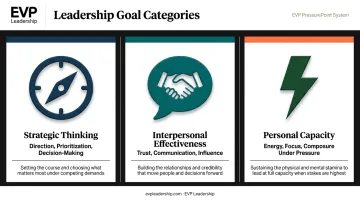
Most leaders need work in all three areas. The real work is identifying which category is generating the most friction right now — and going after that one first.
Why Leadership Goal Setting Is a Discipline, Not a Planning Exercise
Many leaders treat goal setting as an annual ritual — a January exercise that gets filed away by March. That approach doesn't produce behavior change. It produces a document.
EVP Leadership's core philosophy cuts to the reason: under pressure, leaders don't rise to expectations — they fall back on their conditioning. Aspirations written once a year don't create conditioning. Repeated, reviewed, practiced behaviors do.
A 2007 study by Dr. Gail Matthews at Dominican University of California found that participants who wrote their goals and sent weekly progress reports to a partner scored a mean achievement of 7.6, versus 4.28 for those who only thought about their goals. 76% of participants in the accountability group either accomplished their goals or were at least halfway there.
Writing goals and reviewing them consistently is what creates the conditioning. That conditioning is what holds under pressure.
The Organizational Ripple Effect
When a leader develops a clear goal and works it consistently, the impact doesn't stay contained.
- Teams receive clearer communication and fewer mixed signals
- Decisions move faster because the leader has sharper prioritization habits
- Trust builds as the leader demonstrates consistent behavior over time
- Execution quality improves as the leader models accountability
For small business owners, this matters more than it does in large enterprises. Gallup reports that managers account for 70% of variance in team engagement — and in a small business, the owner is the manager. The leader's capacity is often the primary ceiling on company growth.
How to Set Effective Leadership Goals
Step 1: Start With an Honest Self-Assessment
Before writing a single goal, identify where your current leadership behaviors are creating friction. Look at recurring problems — not just business problems, but patterns:
- Where does your team consistently need clarification?
- Which decisions take longer than they should?
- When do you find yourself reactive instead of composed?
Seek candid input from a trusted advisor or peer. The goal here isn't self-criticism — it's locating the gap that's creating the most friction right now.
Step 2: Anchor Each Goal to a Real Business Need
Leadership goals divorced from business priorities feel abstract and lose urgency fast. The filter is simple: How will developing this behavior change my business outcomes in the next 90 days?
If your business needs to scale a team, the relevant leadership goal isn't "become a better leader" — it's "improve delegation and talent development." The business context is what gives the goal weight.
Step 3: Apply the SMART Framework
Each leadership goal should pass through five tests:
| Element | What It Means | Leadership Example |
|---|---|---|
| Specific | Name the exact behavior | "Hold structured weekly one-on-ones with direct reports" |
| Measurable | Define how progress shows up | "Team reports feeling more informed in monthly pulse check" |
| Achievable | Stretch without paralyzing | Set a real challenge, not a fantasy |
| Relevant | Connect to the business need identified in Step 2 | Tied to scaling, execution, or team performance |
| Time-bound | Assign a 30/60/90-day review point | Not a year-end target — a near-term deadline |
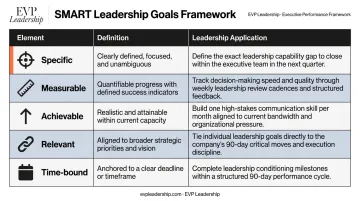
The 90-day window is deliberate — near-term review cycles reinforce behaviors more reliably than annual intentions reviewed once.
Step 4: Limit Active Goals to 2–3
Leaders who try to work on ten goals simultaneously make superficial progress on all of them. The fewer the active goals, the more likely they'll be executed with real discipline.
Work on 2–3 goals at a time. Complete, assess, and refresh on a quarterly rhythm — don't accumulate a growing list of half-finished development priorities.
Step 5: Build a Cadence of Accountability
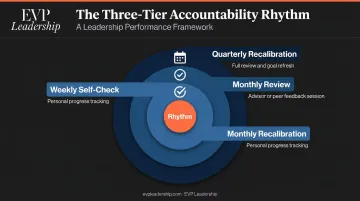
Keeping your goal list short only works if those goals are actively tracked. Build a three-tier accountability rhythm:
- Weekly self-check — Am I doing what I said I would do?
- Monthly review — With a trusted advisor, coach, or peer who can provide honest feedback
- Quarterly recalibration — What progress has been made? What has changed? What goal deserves renewed focus?
This rhythm is at the center of EVP Leadership's 90-Day PressurePoint System — because conditioning leadership behaviors requires repetition under real conditions, not just clarity on paper.
Key Areas for Meaningful Leadership Goals
Not every leader needs the same goals. But five areas produce the highest-leverage development for small business owners and executives. Each one below includes a concrete, time-bound sample goal you can adapt immediately.
Strategic Clarity and Decision-Making
Reactive decision-making is one of the most expensive leadership patterns in small businesses. A TAB survey found that business owners spend only 32% of their time working strategically on the business — while 73% say that's where they'd prefer to focus.
Sample goal: Within 60 days, implement a weekly priority-setting practice that identifies your top 3 strategic actions before the week begins.
Communication and Influence
Miscommunication is consistently cited as a root cause of execution failure. PMI research found that 56% of project budget risk is attributable to ineffective communications. Organizations with highly effective communicators are more than 5x as likely to be high-performing.
Sample goal: Over 90 days, reduce team requests for priority clarification by introducing a structured brief at every initiative kickoff.
Delegation and Team Development
Gallup research on 143 Inc. 500 CEOs found that entrepreneurs with high Delegator talent posted a 3-year growth rate of 1,751% — 112 percentage points higher than low-delegator CEOs. Yet only 1 in 4 entrepreneurs shows high Delegator talent naturally.
The move from doing everything yourself to leading through others is a skill — one that requires deliberate, sustained practice to build.
Sample goal: Delegate 3 recurring responsibilities within 60 days, with clear success criteria and defined follow-up points for each.
Trust-Building and Psychological Safety
Trust is measurable. Gallup reports that only 23% of U.S. employees strongly agree they trust their organization's leadership — and employees who do trust their leaders are 61% more likely to stay. High-trust cultures show 3x higher engagement than low-trust environments.
Leaders build trust through consistent behavior, genuine listening, and modeling accountability themselves — not through declarations.
Sample goal: Introduce a monthly team feedback loop within 30 days where you actively solicit and respond to input on how you can improve as a leader.
Resilience and Performance Under Pressure
Nearly half of small business owners — 48% — report experiencing burnout in the past month, according to Capital One's Fall 2022 Small Business Outlook. Burnout isn't just a personal problem; it degrades decision quality, communication, and team confidence.
Resilience is a conditioned capacity, not a fixed personality trait. The ability to maintain clear thinking and decisive action when complexity spikes is trainable — but only when it's practiced deliberately.
Sample goal: Identify 2 recurring high-pressure scenarios where your reactions undermine team confidence, and practice a structured response protocol for each over 90 days.
Best Practices for Staying Accountable to Your Leadership Goals
Write Goals Down and Keep Them Visible
The Matthews research showed that written goals produce measurably better outcomes than unwritten ones — but only when they're reviewed regularly. Keep your goals somewhere you see weekly, not archived after a planning session and forgotten until year-end.
Use a Review Partner, Not Just Self-Monitoring
Self-accountability fails for most leaders — not from lack of motivation, but because there's no external trigger to reassess. A trusted advisor, executive coach, or peer provides the feedback loop that keeps goals honest. In the Matthews study, participants who sent weekly progress reports to a partner outperformed every other group.
Evaluate and Adjust Quarterly — Don't Wait for Year-End
Leadership goals set in January may be irrelevant by April. Normalize quarterly recalibration by asking three questions: What progress has been made? What has shifted in the business? What goal deserves renewed focus?
Gallup data reinforces the urgency — only 14% of employees strongly agree that performance reviews inspire improvement, and annual reviews make performance worse about one-third of the time. Habits built in 90-day cycles are far more likely to stick than annual intentions revisited once.
Frequently Asked Questions
What is goal setting in leadership?
Leadership goal setting is the deliberate practice of identifying and working toward specific behaviors, skills, or capabilities that make a leader more effective. It's distinct from business targets — it focuses on how a leader shows up and performs, not just what the business achieves.
What are good goals for leadership?
Good leadership goals target strategic clarity, communication effectiveness, delegation, trust-building, or personal resilience — and are most useful when written using the SMART framework and connected to a specific business challenge the leader is currently navigating.
What are the 5 C's of goal setting?
Rooted in Locke and Latham's goal-setting research, the 5 C's are: Clarity (specific, unambiguous objectives), Challenge (goals that stretch performance), Commitment (genuine buy-in), Complexity (appropriate scope), and Feedback (regular progress signals). Together, they define what separates goals that drive behavior change from goals that get forgotten.
How do you write SMART goals for leadership?
Start by naming the specific behavior you're targeting and how you'll measure progress. From there, tie the goal to a real organizational need and assign a 30/60/90-day review deadline — not a vague year-end target.
How often should leaders review their goals?
A three-tier rhythm works best: a brief weekly self-check, a monthly review with an advisor or peer, and a full quarterly recalibration. Annual reviews alone are insufficient for meaningful behavior change.
What is the difference between leadership goals and business goals?
Business goals focus on outcomes the organization achieves — revenue, retention, growth. Leadership goals focus on how the leader behaves and develops. The two are connected: leaders who develop more effective behaviors consistently produce stronger business outcomes.