
Introduction
Every business leader will face a crisis. The real question is whether your preparation matches your confidence.
The range of what qualifies is broad: financial disruption, operational failures, sudden key-person loss, market shifts, or reputational events. What they share is that they arrive under pressure, with incomplete information and no ideal options.
Here's the uncomfortable truth: a 2024 U.S. Chamber Foundation survey found that 94% of small business leaders believed they were ready for a disaster — but only 26% actually had a plan. That gap between confidence and preparation is where most crisis failures happen.
The gap exists because most leaders assume they'll rise to the occasion when it counts. Under pressure, leaders fall back on their conditioning — not their intentions. What you've practiced is what you'll execute when the stakes are real.
This guide covers:
- A phase-by-phase crisis leadership framework
- What to prepare before a crisis hits
- The key variables that separate strong outcomes from poor ones
- The most common mistakes that compound damage instead of containing it
Key Takeaways
- Effective crisis leadership is built before the crisis, not improvised during it
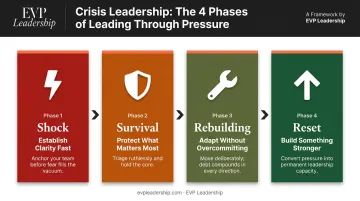
- Crisis response moves through four distinct phases (Shock, Survival, Rebuilding, Reset), each demanding different leadership behaviors
- Communication consistency, decisiveness, and emotional regulation are the highest-leverage actions available
- The most damaging mistakes are paralysis, communication delays, and abandoning core values under pressure
- Post-crisis reflection isn't optional; it determines whether the organization emerges stronger or more fragile
How to Lead Through a Crisis: A Phase-by-Phase Framework
Crises don't arrive as a single, contained event. They unfold in stages — and recognizing which stage you're in determines what leadership actions are most effective right now. Treating every phase identically is one of the more reliable ways to make things worse.
Phase 1: Shock — Establish Clarity Fast
The immediate onset of a crisis triggers fear, scattered action, and freeze responses across the team. Your first job is to interrupt that paralysis with structure.
"Establishing clarity" doesn't mean having a complete plan. It means:
- Communicate what you know — even if it's incomplete; silence is more damaging than an honest, partial update
- Define the immediate priority — one or two things that matter right now, not a list of ten
- Assemble a small go-forward team — a focused group that can look ahead while others stabilize current operations
- Stay present and visible — credibility in this phase comes from showing up calm and honest, not from having all the answers
EVP Leadership's PressurePoint System addresses this directly through its Execution Layer: Pause the Noise (control the moment before it controls you), then Locate the Pressure Point (identify where the situation is actually breaking down). These first two steps alone can interrupt the reactive spiral most leaders default to in the first hours.
Phase 2: Survival — Protect What Matters Most
Once immediate stability is partially restored, the survival phase demands sharp prioritization. Cut non-critical tasks. Pause lower-priority initiatives. Align the team around a small number of outcomes that actually determine whether the organization gets through this.
Individual check-ins matter here, and most leaders skip them. Gallup found that only about 30% of leaders had discussed with individual team members how organizational changes specifically affect them — and employees who feel supported by their managers are roughly 70% less likely to experience regular burnout.
Different people need different things in a crisis:
- Some need direct reassurance that their role is secure
- Some need more autonomy to act without constant check-ins
- Some need a clearer line of sight to what success looks like right now
Treating your team as a monolith during the survival phase is a missed opportunity.
Phase 3: Rebuilding in Uncertainty — Adapt Without Overcommitting
This is the most disorienting phase. The acute crisis has faded, but normalcy hasn't returned. There's pressure to have answers you don't yet have.
Two practices define effective leadership here:
- Keep communicating even when there's nothing definitive to say. Silence erodes trust faster than uncertainty does. "We don't know yet, but here's what we're watching" is a legitimate update.
- Use scenario planning. Rather than betting on one outcome, help the team prepare for multiple likely futures. MIT Sloan identifies scenario planning as a core tool for managing radical uncertainty — not to predict what will happen, but to reduce the shock when circumstances shift and identify trigger points that would change direction.
Phase 4: Reset and Recommit — Build Something Stronger
Once the team has navigated uncertainty, a brief window opens before the next pressure cycle begins. Most leaders close it by reverting to pre-crisis habits as quickly as possible — understandable, given the fatigue, but costly. The leaders who use this window deliberately come out with something their organizations didn't have before.
What the best leaders do in this phase:
- Catalog what worked and what didn't — formally, not just in conversation
- Redesign team operations around those lessons before the next pressure cycle begins
- Re-engage the team with renewed purpose — reconnect people to the mission, clarify roles in the new environment, and create opportunities for visible contribution
A peer-reviewed meta-analysis found that properly conducted debriefs improve individual and team performance by approximately 20–25%. That's a measurable resilience gain — built into the way the team operates going forward.
What You Need Before a Crisis Strikes
Most crisis failures aren't caused by a lack of courage in the moment. They're caused by a lack of preparation before the moment arrived. The goal here is a conditioning-based approach to readiness — not a binder that collects dust.
Leadership Readiness
Leaders must have practiced decision-making under pressure before a crisis arrives. That means running scenario-based exercises, stress-testing assumptions, and building the emotional capacity to stay regulated when stakes are high and information is incomplete.
Self-awareness is a prerequisite. Leaders who haven't examined how they respond to stress, ambiguity, and conflict will make their worst decisions at the worst time.
That's the gap EVP Leadership's 90-Day PressurePoint System is built to close — not just clarifying what to do under pressure, but developing the practiced capacity to actually do it when it counts.
Team and Operational Readiness
Three operational structures need to exist before a crisis, not during it:
- Clear decision-making authority at each level — who can decide what, without escalating everything
- Distributed leadership capability — operations shouldn't freeze because one key person is unavailable
- Documented crisis communication protocols — who communicates, to whom, on what cadence, through which channels
Psychological safety is also a pre-built condition, not something you create mid-crisis. Teams that already feel safe speaking up will surface problems earlier and respond more cohesively under pressure. EVP Leadership's executive team facilitation work focuses on building exactly this kind of trust before it's urgently needed.
Values and Vision Clarity
Leaders who have clearly defined and consistently communicated their organizational values before a crisis have an anchor when everything else feels destabilized. Values provide continuity to the team when circumstances are unpredictable.
Without that anchor, decisions get made based on whoever is loudest or whatever relieves pressure fastest — neither of which tends to age well.
Key Variables That Determine Crisis Leadership Outcomes
Two leaders can face the same crisis and get dramatically different outcomes. The difference usually comes down to how well they manage these four controllable variables.
Communication Consistency
In a crisis, information vacuums fill with fear and rumor. Harvard Business Publishing advises leaders to update employees no less than every other day during fast-moving crises — even when the message is "we don't know yet." That cadence matters.
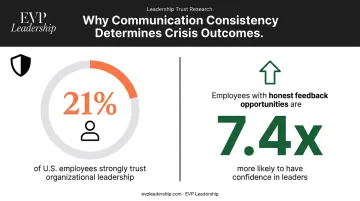
The stakes are real: Gallup found only 21% of U.S. employees strongly agreed they trusted organizational leadership — and employees who have opportunities to give honest feedback during changes are 7.4 times as likely to have confidence in their leaders. Two-way communication isn't a soft skill in a crisis. It's a trust requirement.
Decisiveness vs. Paralysis
Over-analyzing in a crisis is more dangerous than making an imperfect decision. The cost of inaction compounds rapidly while conditions shift around you.
Threat-rigidity research from organizational psychology supports this: under threat, leaders tend to restrict information processing, centralize control, and slow decision-making — exactly the opposite of what's needed.
McKinsey's crisis framework explicitly warns against a central hub that becomes a decision bottleneck. Leaders who take initiative with incomplete information maintain team confidence. Those who stall create a power vacuum that accelerates chaos.
Emotional Regulation
A leader's emotional state is contagious. Wharton researcher Sigal Barsade's work on emotional contagion is direct: leaders influence group mood, and that mood affects performance. Anxiety, volatility, or visible detachment at the top accelerates team destabilization.
McKinsey describes this as "deliberate calm and bounded optimism" — not false positivity, but a grounded presence that signals the organization can get through this.
That composure is only sustainable if the leader is actually functional. Research reviewed by the NIH confirms that sleep deprivation impairs attention, working memory, and decision-making. A leader running on empty makes worse decisions — and the team pays for it.
Maintaining Vision and Values Under Pressure
Crises create pressure to cut corners, compromise on transparency, or make short-term decisions that damage long-term trust. Two high-profile cases illustrate what happens when that pressure wins:
- Boeing: Safety culture disconnected from decision-making, with consequences that outlasted the original crisis by years
- Wells Fargo: Sales incentive systems overrode integrity, producing institutional damage no PR strategy could quickly repair
Leaders who hold their vision and values steady through a crisis emerge with stronger team loyalty and organizational cohesion than those who improvise their principles when it's inconvenient.

Common Mistakes Leaders Make in a Crisis
Waiting Too Long to Communicate
Leaders often delay messaging because they feel they need complete information first. That instinct is understandable and consistently wrong. The silence that feels protective to the leader reads as concealment or incompetence to the team. An honest, incomplete update is almost always better than no update.
Over-Centralizing the Response
The instinct to control everything in a crisis is natural — and self-defeating. It creates decision bottlenecks, signals to the team that they aren't trusted, and overloads the one person who is already carrying the most pressure.
Effective crisis leadership empowers others to act within clearly defined lanes. That means:
- Setting clear direction so people can move without waiting for approval
- Delegating decisions to those closest to the problem
- Removing obstacles instead of becoming one
The leader's job is to set direction and remove obstacles, not to touch every decision.
Neglecting Leader Wellbeing
Leaders who run at maximum output without recovery degrade their decision quality and emotional regulation over time. This isn't a wellness talking point — it's a performance risk. Cognitive decline under sustained sleep deprivation is well-documented, and every major decision made from a depleted state narrows your options and compounds the damage you're trying to contain. Executive burnout doesn't just hurt the leader — it weakens the entire response.
Abandoning Values for Short-Term Relief
Desperate moments create real pressure to compromise on integrity, transparency, or people-first principles. That short-term relief rarely holds. Trust, once damaged by a values violation during a crisis, takes significantly longer to rebuild than the original crisis required to manage. Teams notice when leaders protect their principles under pressure — and they notice when leaders don't. What you do in the hardest moment becomes the standard they measure everything else against.
Conclusion
Crisis leadership isn't a talent you either have or don't. It's a set of behaviors, habits, and decision-making patterns that must be built and practiced before the pressure arrives. What this guide covers — the phase-by-phase framework, preparation principles, and pressure variables — gives you a map. But knowing the map and having the conditioned capacity to navigate it under real pressure are two different things.
If you're ready to move from reactive to conditioned, EVP Leadership works with small business owners, founders, and executives to build that foundation through the 90-Day PressurePoint System. Start with a complimentary scoping conversation to see if it's the right fit for where you are now.
Frequently Asked Questions
How do you lead through a crisis?
Effective crisis leadership involves establishing clarity quickly, communicating consistently, prioritizing ruthlessly, and making decisions under pressure with incomplete information. These behaviors hold up under pressure when they've been conditioned in advance — not assembled on the fly when a crisis hits.
What are the 5 stages of a crisis?
Most crisis models identify five stages: pre-crisis, onset, acute phase, recovery, and post-crisis learning. The specific labels vary by framework, but the core principle holds: each stage demands a different leadership response.
What are the 5 C's of crisis leadership?
McKinsey identifies five core crisis leadership practices: organize via a network of teams, display deliberate calm and bounded optimism, make decisions amid uncertainty, demonstrate empathy, and communicate effectively. These practices are grounded in research and map directly to leadership outcomes during high-pressure situations.
What is the most important quality in a crisis leader?
Emotional regulation and decisiveness. Staying grounded sets the emotional tone for the entire organization, and making timely decisions even with imperfect information determines whether teams stabilize or spiral. Both are trainable, not fixed traits.
How should leaders communicate with employees during a crisis?
Early, honest, and consistent — across multiple channels, at least every other day during fast-moving situations. Acknowledge uncertainty while still providing direction. Create space for employees to ask questions and raise concerns. Two-way communication isn't optional; it's how trust survives a crisis.
How can small business owners prepare for a crisis before it happens?
Start with scenario planning, clarify decision-making authority at every level, and build psychological safety before pressure arrives. Most importantly, invest in leadership conditioning — the practiced capacity to execute clearly when exhaustion and instinct are working against you.