Introduction
Most leadership teams believe they are aligned. They sat in the same room, approved the same plan, and nodded at the same vision. Then execution begins — and the strategy quietly unravels.
Real alignment is rarely the problem with the strategy — it's the problem carrying the strategy forward. According to research published in MIT Sloan Management Review, only 28% of managers responsible for executing strategy could list three of their company's strategic priorities.
In one documented case, 97% of senior leaders reported understanding the strategy — yet roughly one-third couldn't name a single official priority.
That gap between perceived and actual alignment is where strategies die.
This article covers what leadership alignment actually means, the warning signs it's missing, what aligned teams do differently, and how to build alignment that holds under pressure.
Key Takeaways
- Approving a strategy and aligning around it are two different things — most teams do the first and skip the second
- Misalignment rarely surfaces as conflict — it shows up as leaders operating from different unspoken assumptions
- Five observable warning signs signal misalignment before it becomes a crisis
- Aligned teams maintain shared vocabulary, clear decision rights, and recurring strategy routines
- Training builds knowledge — but consistent behavior under pressure requires conditioning, not a single workshop
What Leadership Alignment Really Means
Agreeing on a goal in a planning meeting is not the same as sharing a consistent understanding of what that goal requires. Two leaders can sit in the same room, approve the same strategic plan, and walk out with genuinely different interpretations of what executing it demands — different priorities, different trade-offs, different assumptions about what "winning" looks like.
Leadership alignment means every leader on the team:
- Interprets the strategy the same way
- Communicates it consistently across different audiences
- Makes decisions that reinforce the same direction — even when priorities compete
The Center for Creative Leadership's Direction, Alignment, Commitment model defines alignment as coordinating and integrating different aspects of work so people can collaborate across boundaries. Harvard Business Publishing sharpens this further: senior leaders are aligned when they understand why the strategy is needed, what changes it requires, what benefits are expected, and what specific actions they personally must take to implement it.
That last element is where most teams fall short — they grasp the strategy conceptually but haven't thought through what it demands of them individually.
Why This Matters More for Small Businesses
In a lean leadership team, there's no buffer for misalignment. One misaligned voice at the top doesn't create a localized problem — it creates confusion across the entire organization. Employees watch what leaders do and how they make decisions, not what the plan document says. When leaders send mixed signals, the strategy loses — every time.
For small business owners and founders, misalignment tends to surface in the same exhausting ways:
- The owner is repeatedly pulled back into decisions the team should own
- Strategic initiatives stall without a clear cause
- High-performing individuals produce results that never compound into organizational progress
Why Strong Strategies Still Fail Without It
Misalignment doesn't announce itself. It doesn't look like open conflict or rejected plans. It looks like each leader executing a slightly different version of the strategy based on their own reasonable assumptions — and those small divergences compounding over time into stalled initiatives, duplicated effort, and competing priorities.
The Agreement Trap
Leadership teams frequently mistake a signed-off strategic plan for shared understanding. The MIT Sloan research makes this pattern concrete: senior leaders consistently overestimate organizational alignment, with the sharpest drop occurring between the C-suite and their direct reports. Everyone believes alignment exists. Far fewer can demonstrate it behaviorally.
Gennifer Baker, founder of EVP Leadership, has worked with thousands of entrepreneurial teams since 2009. Across that work, she identifies a consistent pattern: the difference between a leadership team that has agreed on a direction and one that has genuinely internalized what executing that direction requires from each person.
The Cost at the Small Business Level
That behavioral gap has a measurable price tag. PMI's 2018 Pulse of the Profession research found:
- Organizations wasted 9.9% of every dollar due to poor project performance
- 35% of organizations lacked strong alignment between strategic initiatives and the projects meant to deliver them
For small businesses, those percentages hit harder because there's no scale to absorb the waste. Misdirected investment, team friction, and eroded trust don't get averaged out across a large organization. They land directly on the owner.
Warning Signs Your Leadership Team Is Not Aligned
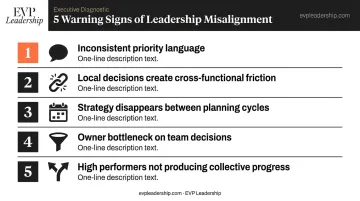
These five signals are observable before misalignment becomes a full execution crisis.
Warning Sign 1: Leaders describe priorities differently to different audiences. Inconsistent language is one of the earliest indicators. If your head of operations frames the strategy one way and your sales leader frames it another, teams downstream will default to the version that benefits them most, not the one that serves the organization.
Warning Sign 2: Decisions make sense locally but create friction elsewhere. When leaders lack a shared operating framework, decisions that look reasonable in isolation consistently create friction across the business. Each function is working from a different assumption about what the strategy actually requires.
Warning Sign 3: Strategy conversations disappear between planning cycles. Bridges Business Consultancy's 20-year research on strategy implementation found that only 20% of leaders reviewed implementation at least monthly, while 24% reviewed it once a year and 9% never reviewed it at all. If strategy only surfaces when problems arise, alignment is already eroding.
Warning Sign 4: The owner is repeatedly pulled into decisions the team should handle. This pattern — the founder bottleneck — signals that the leadership team hasn't truly internalized the strategic direction. They still need the founder or CEO to translate. Until that bottleneck breaks, strategy execution stalls at the top rather than moving through the organization.
Warning Sign 5: High performers aren't producing collective progress. When individual effort doesn't compound into organizational results, there's usually no shared framework connecting individual work to strategic outcomes. People are working hard in parallel rather than together.
What Leadership Teams With Strong Alignment Do Differently
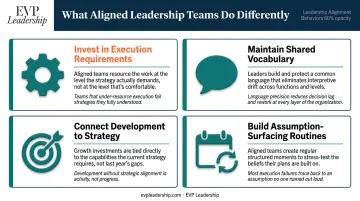
Aligned leadership teams don't achieve alignment once and maintain it passively. They treat it as something that can erode and must be actively rebuilt.
They Invest Time in What the Strategy Requires — Not Just What It Says
High-performing teams spend significant time discussing not just what the strategy is, but what executing it specifically demands: which behaviors, which decisions, which trade-offs. This isn't a one-time planning conversation. It's a recurring discipline.
They Maintain a Shared Vocabulary
Every leader using the same language across every audience prevents interpretive drift. When one leader uses different terminology or frames priorities differently depending on who they're talking to, they confuse their audience. Over time, they fracture organizational understanding.
They Connect Leadership Development to Strategic Execution
Generic leadership development rarely moves the needle. McKinsey's research found that successful leadership development programs were 8 times more likely to focus on behaviors identified as critical drivers of business performance — and 4 to 5 times more likely to require leaders to apply learning in real work settings. Yet only 11% of executives strongly agreed their leadership development interventions achieved and sustained desired results.
Leadership development disconnected from the specific behaviors your strategy requires won't improve how your team executes — no matter how well-designed the program.
They Build Routines That Surface Assumptions Before They Diverge
Weekly leadership syncs, quarterly strategy reviews, and structured operating rhythms serve a specific function: they create regular opportunities to catch interpretive drift before it becomes embedded in execution. By the time misalignment is visible in results, it's been compounding for months. The divergence rarely announces itself — it shows up quietly in decisions that seem reasonable to each leader individually, but pull the organization in different directions collectively.
How to Build Leadership Alignment That Holds Under Pressure
Step 1: Start With a Shared Definition of Success
Before execution begins, every leader on the team must be able to articulate — in plain terms — what "winning" looks like for this strategy. Vague objectives are the most common source of misalignment. Test this by asking each leader independently. Where answers diverge, you've found the gap.
Step 2: Surface Interpretive Gaps Through Structured Conversation
Run a structured conversation where each leader independently describes what the strategy requires from their function. Compare answers. This exercise surfaces where leaders have made different assumptions about priorities, success measures, and trade-offs — assumptions that will drive inconsistent decisions during execution if left unexamined.
Step 3: Translate Strategy Into Clear Decision Rights
Alignment breaks down most often not during planning, but when leaders face resource trade-offs or unexpected pressure. HBR's RAPID decision framework — clarifying who Recommends, Agrees, Performs, provides Input, and Decides — addresses a concrete problem: unclear decision roles slow execution and fracture momentum. Defining roles before pressure hits costs far less than rebuilding them mid-execution.
Step 4: Reinforce Alignment Through Behavior, Not Announcements
There's a critical difference between announcing a strategy and actually reinforcing it. Leaders reinforce alignment through how they handle exceptions, how they explain decisions, and whether their behavior under pressure matches their stated priorities. McKinsey's influence model identifies this as one of four essential building blocks of organizational change: reinforcing through formal mechanisms and visible role modeling, not just communication.
Step 5: Condition Alignment, Not Just Awareness
Training creates knowledge. Conditioning creates consistent behavior. That's EVP Leadership's core distinction.
A leader can understand alignment intellectually and still abandon it when they're tired, under fire, or facing a decision with no easy answer. Real alignment holds in those moments — not because the leader remembers the plan, but because the right behaviors have been conditioned into how they operate.
EVP Leadership's 90-Day PressurePoint System is built specifically for this. The Diagnostic Layer — which includes Force Alignment and Decision Integrity components — trains leaders to see clearly and act decisively when execution pressure is highest. The Execution Layer provides a structured protocol for high-stakes moments:
- Pause the Noise
- Locate the Pressure Point
- Prioritize the Critical Move
- Execute with Discipline
- Lock in Momentum
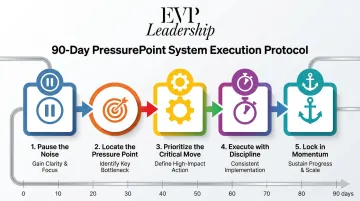
For small business and entrepreneurial leadership teams, this conditioning model addresses a specific reality: there's no enterprise buffer. When a small business leader defaults to reactive instinct under pressure, the cost is immediate and visible. The PressurePoint System builds the internal capacity to choose the aligned response instead.
Frequently Asked Questions
What is the strategic alignment process in leadership development?
The strategic alignment process connects an organization's strategy to the behaviors, decisions, and capabilities required to execute it. It ensures that development priorities are tied directly to strategic objectives — so the capabilities being built are the ones the strategy actually demands, not a parallel activity running alongside it.
Why do strategies fail even when leadership agrees on them?
Agreement on a goal doesn't equal shared understanding of what executing that goal requires. Leaders typically leave planning conversations with different interpretations of priorities, success measures, and trade-offs. Those differences then drive inconsistent decisions throughout execution — and the strategy fragments from the inside.
How do you know if your leadership team is truly aligned?
A practical test: ask each leader independently to describe what the strategy requires of them and what "winning" looks like. If the answers diverge significantly, you have agreement on paper but not the deeper alignment execution requires. That gap is more common than most leadership teams expect — and testing for it is usually the first surprise.
What are the 4 P's of strategic leadership for executive leaders?
Harvard Kennedy School's 4P Framework identifies Perception, Process, People, and Projection as the core dimensions. For alignment to produce results, each dimension must be addressed — from how leaders read the environment and structure decisions, to whether the right people are in the right roles and how leaders project direction under pressure.
What are the 5 C's of strategy implementation?
The 5 C's of strategy implementation vary by source, and no single universally adopted framework owns that label. Dr. Andrew MacLennan's strategy execution research emphasizes Causality and Criticality — ensuring efforts are tied to the right cause-and-effect relationships and focused on what is genuinely critical to success. If you've encountered a specific 5 C's model, confirming its source will clarify which framework applies to your context.
What are the 3 C's of executive leadership?
General Gus Perna's verified framework identifies Competence, Commitment, and Character as the three foundations. Each directly supports alignment: competence ensures leaders can execute, commitment sustains effort when pressure mounts, and character determines whether leaders hold to aligned behavior when no one is watching.