Introduction
Most leadership team dysfunction isn't caused by a shortage of talent or a flawed strategy. It's caused by a lack of trust — and that gap almost always starts at the top.
A common pattern: a CEO brings in outside help to "fix" the managers. But after a closer look, the real fracture is at the leadership team level. The senior team is misaligned, conflict is being avoided, and accountability only happens when the CEO personally intervenes. Everyone below can feel it — even when no one names it.
Trust and cohesion in a leadership team aren't soft skills. They're structural requirements. Without them, even a well-resourced, intelligent leadership team will underperform.
Harvard Business Review found that only 20% of executive teams are actually high-performing. The gap isn't talent — it's cohesion.
This article covers why trust matters specifically at the leadership level, what cohesion looks like in practice, and concrete steps to build and sustain it — even when pressure rises.
Key Takeaways
- Trust is a prerequisite for healthy conflict, real commitment, and accountability — not a byproduct of them.
- Dysfunction at the top cascades: misaligned leaders create confused managers and disengaged employees.
- Psychological safety — candid disagreement, admitted mistakes, direct conversation — is what defines a cohesive leadership team.
- Cohesion is built through repeated behavioral habits, not retreats or one-time workshops.
Why Leadership Team Trust Is a Business-Critical Issue
The Cascade Effect Is Real
When a leadership team is fractured, that fracture doesn't stay contained. It flows downward through every layer of the organization. Managers receive inconsistent direction from different executives. Employees receive mixed messages about priorities. Accountability disappears because no one is sure who owns what.
Gallup's research on manager engagement puts a number on this: employees supervised by highly engaged managers are 59% more likely to be engaged than those supervised by actively disengaged managers. The state of the leadership team directly shapes the state of everyone below it — which makes Gallup's 2025 finding hard to ignore: only 19% of employees strongly agree they trust their organization's leadership. That number originates at the top, not the front line.
Leadership Teams Carry Disproportionate Risk
Not all teams carry the same organizational weight. A project team that underperforms misses a deadline. A leadership team that underperforms misses the organization's direction entirely.
Leadership teams are responsible for:
- Setting and communicating strategic direction
- Modeling the culture the rest of the organization is expected to live
- Making high-stakes decisions under uncertainty and time pressure
- Creating the accountability environment managers operate within
When trust breaks down at this level, the damage spreads across the entire organization. A 2022 study of 1,150 leaders across 160 management teams found that psychological safety connects directly to management-team effectiveness through behavioral integration — how well teams collaborate, share information, and make joint decisions. Lose that, and every layer below it operates without a stable foundation.
What Trust and Cohesion Look Like in a High-Performing Leadership Team
Vulnerability-Based Trust vs. Surface-Level Collegiality
Patrick Lencioni's Five Dysfunctions of a Team defines the first — and foundational — dysfunction as the fear of vulnerability. The trust that matters on a leadership team isn't competence-based trust ("I trust you to do your job") or even predictability-based trust ("I know how you'll behave").
It's vulnerability-based trust: the kind where a leader can say, "I was wrong," "I don't know," or "I need help" — without fear of judgment or political consequence.
This is different from surface-level collegiality. A leadership team can be perfectly pleasant in a room together and still be dysfunctional. Politeness isn't trust. Agreeing in meetings and complaining in the hallway isn't cohesion.
The Progression That Gets Results
Lencioni's framework maps a clear sequence — and it only works in order:
- Trust → leaders are willing to be vulnerable with each other
- Productive conflict → honest debate about ideas is possible
- Commitment → decisions get made with genuine buy-in
- Accountability → peers hold each other to commitments
- Collective results → the team prioritizes organizational outcomes over departmental wins
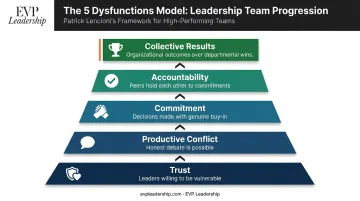
Skip trust, and the entire chain collapses. Every dysfunction downstream is a symptom of what wasn't built at the foundation.
Behavioral Signs of a Cohesive Leadership Team
You can observe cohesion without running a survey. Cohesive leadership teams:
- Debate ideas directly in meetings, not through back-channels afterward
- Leave meetings aligned, even when individual members disagreed during the discussion
- Hold each other accountable without the CEO having to referee
- Treat the leadership team — not their own department — as their primary team
- Acknowledge mistakes openly without fear of political fallout
These behaviors don't happen by accident. They're the product of psychological safety — a term Amy Edmondson coined to describe a shared belief that the team is safe for interpersonal risk-taking. When it's present, silence is not mistaken for agreement, dissenting views surface in the room instead of after it, and candor isn't a liability.
How to Build Trust and Cohesiveness in a Leadership Team
Establish Psychological Safety as a Non-Negotiable
The senior-most leader has to go first. McKinsey's research identifies positive team climate — shaped primarily by leaders demonstrating supportive, consultative behaviors — as the strongest driver of psychological safety. When a CEO or executive director models uncertainty, admits a mistake, or asks for input rather than broadcasting conclusions, it signals to the team that doing the same is safe.
One practical starting point: facilitate a session where the team identifies specifically what behaviors make them feel safe or unsafe to speak up. Name them explicitly. Turn them into shared norms. The act of making implicit rules explicit is itself a trust-building exercise.
Understand How Each Leader Is Wired
Behavioral style assessments — tools like Everything DiSC, which publishes validity documentation for its profiles — can give leadership teams a common language for understanding individual differences. The value isn't prediction; it's perspective.
When leaders understand why a peer communicates differently, asks certain questions, or moves at a different pace, they're less likely to attribute that behavior to incompetence or bad intentions. That shift — from judgment to understanding — is where empathy starts and conflict begins to reduce.
Build Personal Connection Beyond the Work
One of the most effective trust-building practices on a leadership team is also one of the simplest: structured personal sharing. Ask each leader to share one significant challenge they've faced or are currently navigating — not for therapy, but for humanization.
When leaders see each other as full people rather than titles, empathy deepens and the team's capacity for honest, uncomfortable conversations increases. This kind of personal connection isn't a prerequisite to getting work done — it's a prerequisite to getting hard work done well.
Master Productive Conflict (Not Artificial Harmony)
Artificial harmony looks functional. The meeting ends without incident. Everyone nods. Then the real conversations happen in the parking lot.
Productive ideological conflict is messier in the moment and healthier long-term. It means debating ideas directly — challenging assumptions, surfacing concerns, disagreeing on strategy — while keeping it free of personal attacks.
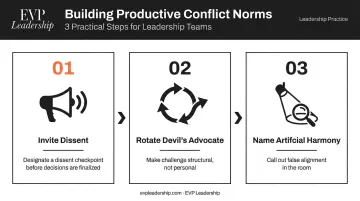
Practical steps for building this norm:
- Designate a specific point in each meeting where dissent is explicitly invited before decisions are finalized
- Rotate a "devil's advocate" role so challenge becomes structural, not personal
- Name artificial harmony when it appears — "I want to make sure we're actually aligned, not just quiet"
Commit Clearly and Publicly
Consensus and commitment are not the same thing. Consensus means everyone agrees. Commitment means every leader supports and executes a decision — even when they personally preferred a different outcome.
Before closing any significant decision in a meeting, each leader should state out loud what they're committing to. This practice surfaces passive resistance before it becomes passive sabotage. It also creates clarity: when a decision gets executed inconsistently downstream, the team can trace it back to whether the commitment was genuine.
Define Shared Values and Reinforce Them Through Behavior
Co-created values aren't a wall poster — they're a behavioral operating agreement. The difference between values that change a team and values that collect dust is whether the team holds each other to them publicly and consistently.
Reinforce values by recognizing behaviors, not just results. When a leader acknowledges a mistake in front of the team, name it. When a peer elevates a colleague's contribution rather than claiming credit, name that too. Recognition tied to trust-reinforcing behaviors — rather than outcomes alone — shapes the culture faster than any policy can.
This is the kind of work Teri Evans leads through EVP Leadership's team development facilitation — structured sessions with measurable objectives, designed specifically for executive teams navigating alignment, conflict, and shared accountability.
Sustaining Team Cohesion Under Pressure
Why Trust Built in Low-Stakes Moments Often Fails Under Pressure
Here's what happens when a business hits a real crisis: leaders revert. Deadlines compress, resources tighten, and the default behaviors come back — defensiveness, silo-thinking, information-hoarding, conflict avoidance. The trust that seemed solid in a facilitated offsite evaporates when the quarterly numbers are bad.
Cohesion isn't truly built until a team can maintain it under pressure. That requires conditioning, not a calendar event.
Leadership Conditioning vs. Episodic Team Building
EVP Leadership's core thesis is this: leaders don't rise to expectations under pressure — they fall back on their conditioning. The firm defines Leadership Conditioning as an approach that "builds the resilience, capacity, and discipline leaders need to navigate complexity, make confident decisions, and execute effectively in high-stakes situations" — distinct from traditional coaching or one-time team-building.
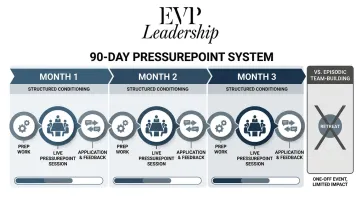
This distinction matters. Episodic events create temporary connection. Conditioning builds durable behaviors through repeated, structured practice over time. UCL's research on habit formation found that behavioral automaticity averages 66 days on average, ranging from 18 to 254 days — which means meaningful behavior change requires repetition in stable contexts, not a single retreat.
That's precisely what EVP Leadership's 90-Day PressurePoint System is built around: structured, recurring practice that develops pressure-tested leadership capacity before a crisis demands it.
Habits That Sustain Cohesion Between Sessions
Leadership teams that sustain cohesion do so through recurring practice, not periodic reminders. Four habits that work:
- Weekly team health check-ins — brief, structured conversations focused on team dynamics, not just task updates
- Peer feedback loops — regular, direct feedback between team members on behaviors, not just performance metrics
- Deliberate accountability conversations — checking in on commitments made in prior meetings before moving to new agenda items
- Periodic norm reassessment — revisiting behavioral agreements every quarter to address drift before it becomes dysfunction
Frequently Asked Questions
What are the key C's of building trust?
Five C's define trust at the leadership team level: Competence, Character, Consistency, Care, and Communication. The most critical two are consistency (following through on commitments) and character (behaving the same whether or not the CEO is watching).
How do you build team cohesiveness and trust?
Start with psychological safety, then build toward honest conflict, shared commitment, and peer accountability. The sequence matters — and it must be sustained as daily habit, not just demonstrated in a single workshop or offsite.
What are the signs of a cohesive leadership team?
Cohesive leadership teams debate ideas openly in meetings and leave aligned. They hold each other accountable without the CEO intervening, and they consistently prioritize organizational outcomes over individual department wins.
Why does trust break down in leadership teams?
Most commonly: leaders protect their turf, vulnerability feels politically risky, unresolved conflicts go underground, and commitments are made publicly but not followed through privately. Fear drives most trust breakdowns — not a lack of skill or intent.
How long does it take to build trust in a leadership team?
There's no fixed timeline. Initial working trust can develop quickly; durable, pressure-tested trust takes months of sustained, intentional effort. Behavioral research suggests habit formation averages 66 days — and trust requires more than behavioral repetition alone.
What is the difference between team building and leadership conditioning?
Team building creates temporary connection through episodic events. Leadership conditioning — the foundation of EVP Leadership's 90-Day PressurePoint System — develops durable behaviors through repeated, structured practice, so leaders perform consistently when pressure rises rather than reverting to default.