
Introduction
When a crisis hits, most executives discover something uncomfortable: the articulate, composed version of themselves they rely on in the boardroom doesn't automatically show up when cameras are rolling and stakeholders are watching.
The distance between knowing what to say and being able to say it clearly under extreme pressure is where reputations get damaged and trust erodes. That's not a knowledge problem. Communication under pressure is a conditioning problem — and conditioning can be built.
According to a 2023 Capterra survey of U.S. business leaders, only 49% of organizations have a formal, documented crisis communications plan. The number with genuinely prepared spokespeople is almost certainly lower.
This article covers why communication breaks down under pressure, what frameworks give leaders a usable structure, and — above all — how to build the kind of communication capability that holds up when the stakes are real.
Key Takeaways
- Stress physically narrows language access, causing even sharp executives to freeze, over-explain, or go defensive under pressure
- Knowing a crisis framework and being able to deliver it under pressure are two entirely different capabilities
- The first 60 minutes of a crisis shape stakeholder perception more than almost anything that follows
- Silence and over-communication are equally damaging — composure is the asset
- Crisis communication readiness is built through sustained conditioning, not a single training event
Why Executive Communication Breaks Down at the Worst Possible Moment
There's a physiological reason crisis communication fails even for capable, experienced leaders.
Research published in PMC found that greater physiological and emotional stress reactivity was directly linked to lower linguistic cognitive complexity during high-pressure speaking tasks. In plain terms: when your body reads a situation as threatening, your brain produces simpler, less organized speech — not because you don't know better, but because the stress response is narrowing your access to the language and structure you've rehearsed.
The Pressure Gap
A leader can perform well in a boardroom presentation, a difficult investor conversation, or a media interview on a good day. But crisis communication stacks multiple loads simultaneously:
- Emotional stakes (employees, customers, and reputation are all at risk)
- Time pressure (public expectation of an immediate response)
- Reputational scrutiny (every word will be analyzed and repeated)
- Factual uncertainty (you're often communicating before you have all the answers)
That combination overrides communication habits that haven't been deeply embedded through practice. The habits that do survive are the ones you've repeated enough times that they're nearly automatic.
What Failure Looks Like in Practice
Two failure patterns are equally destructive:
Silence or delay — often perceived as guilt or indifference. A 2019 case study found that avoiding or hiding silence typically intensified crises and damaged organizations' post-silence image when they finally did speak.
Over-communication without clarity — panicked statements, defensive language, or inconsistent messaging that escalates distrust rather than containing it.
Both patterns hit harder for small business owners and founder-CEOs precisely because there's no communications team to absorb the load. The owner is the spokesperson, the brand, and the decision-maker — and when crisis hits, those roles don't take turns. Without conditioned communication habits, the pressure doesn't just expose gaps; it locks them in.
Crisis Communication Frameworks Every Executive Should Understand
Frameworks give leaders a mental map to reach for when adrenaline is high and clear thinking is hard. They reduce cognitive load — something structured to organize around when instinct is pushing toward reaction.
The CDC's CERC Principles
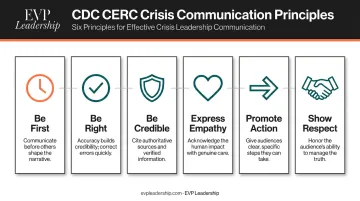
The most rigorously validated framework in crisis communication comes from the CDC's Crisis and Emergency Risk Communication (CERC) model, built around six principles:
- Be First — early communication, even with incomplete information, sets the frame
- Be Right — accuracy matters; don't speculate beyond what's confirmed
- Be Credible — honesty and transparency, even when facts are uncomfortable
- Express Empathy — acknowledge the human impact before stating facts
- Promote Action — give audiences something meaningful to do
- Show Respect — treat those affected with dignity throughout
Practitioner Heuristics
You'll also encounter practitioner frameworks in training materials — the 5 C's (Clarity, Compassion, Confidence, Consistency, Commitment), the 4 R's (Regret, Reform, Restitution, Responsibility), and the 5 P's (Predict, Prevent, Prepare, Perform, Post-action Review). These circulate widely in corporate training contexts and provide useful shorthand.
No framework, however, prepares you to deliver it with composure and credibility under real conditions. Memorizing a model is not the same as conditioning your response.
The executive who has read the 5 C's and the executive who has rehearsed them under simulated pressure perform very differently when the room is watching. That gap — between knowing a framework and executing it under stress — is exactly where leadership conditioning does its work.
Training vs. Conditioning: Why the Difference Matters When a Crisis Hits
This distinction is central to everything EVP Leadership does — and it's where most crisis preparation falls short.
Training tells you what to do. It's informational, instructional, and valuable as a starting point. A training session on crisis communication can teach you the frameworks, the sequencing, the structure of a holding statement.
Conditioning builds what you actually do under pressure. It's the result of deliberate, repeated practice in situations that simulate the real thing — creating communication habits that are automatic rather than effortful when stress is high.
EVP Leadership's core thesis applies directly here: leaders don't rise to the occasion — they fall back on their conditioning. The words, tone, pacing, and composure an executive defaults to in a crisis moment reflect what has been practiced repeatedly, not what was studied in a workshop.
What Conditioning Looks Like in Practice
The 90-Day PressurePoint System is structured specifically around this principle. Its three layers each address a distinct dimension of crisis performance:
- Identity Layer (Consistency, Capacity, Character) — the stable foundation that keeps a leader aligned with their values when pressure is high and emotions are pulling toward reaction
- Diagnostic Layer — six components including Mission Clarity and Decision Integrity that train leaders to think clearly through noise and emotion
- Execution Layer — a repeatable protocol: Pause the Noise → Locate the Pressure Point → Prioritize the Critical Move → Execute with Discipline → Lock in Momentum
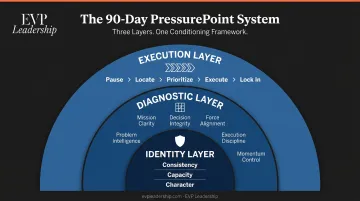
Applied to a crisis communication scenario, that sequence looks like this: before issuing any statement, a conditioned leader pauses the reactive impulse, identifies the real issue driving the crisis, determines the single most important message to deliver right now, communicates it clearly without over-complicating, and follows through consistently to rebuild trust.
Why Conditioning Produces a Different Result
With enough deliberate repetition, the stress response that narrows language access gets overridden by deeply embedded habits. Composure stops being situational — it becomes the default.
MIT Executive Education notes that crisis simulations let leaders practice decision-making under pressure, test their plans in controlled environments, and reveal communication breakdowns before real emergencies occur. That's the value of deliberate, pressure-tested rehearsal — it surfaces gaps you didn't know existed.
Those gaps matter most when there's no communications team standing between you and the microphone. Many executives assume crisis communication preparation is for PR professionals, not operational leaders. In small and mid-size businesses, that assumption is costly.
When you're the founder, the owner, or the CEO without a dedicated communications function, you are the spokesperson by default — prepared or not.
How to Build Crisis Communication Capability Before You Need It
Map Your Most Likely Scenarios
Start with the two or three crises most plausible for your organization. Common categories include:
- Operational failure (service disruption, product issue, supply chain breakdown)
- Financial distress or major customer loss
- Reputational event (social media incident, public complaint, media coverage)
- Leadership transition or key team member departure
For each scenario, build a working mental model: what's the core message, who needs to hear it first, what do you know versus what's still being investigated?
The First 60 Minutes
PRSA describes the first hour of a crisis as the period when actions directly influence the final outcome — with the caveat that in the social media era, the window may be shorter. Preparation means having a holding statement ready before you need one.
An effective opening statement follows this structure:
- Acknowledge the situation — confirm you're aware something has happened
- Express genuine concern — lead with empathy for those affected, before any explanation
- State what's confirmed — only facts; don't speculate
- Commit to a timeline — tell people when they'll hear more and how
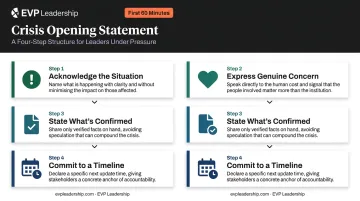
Leading with empathy — before facts, before explanation — is what determines whether stakeholders trust everything that comes after it.
Internal Before External
PRSA's guidance is clear: internal stakeholders — employees, board members, key partners — should hear from leadership directly before public statements reach the media. Gallup research found that only 13% of U.S. employees strongly agreed their organization's leadership communicates effectively — and that communication vacuums allow damaging rumors to spread.
For small businesses, this matters acutely. Employees who hear about a crisis through social media or outside channels disengage — and lose their effectiveness as organizational advocates at the moment you need them most.
Spokesperson Skills That Must Be Conditioned
Technical expertise and seniority don't automatically produce effective spokesperson performance. The specific skills that must be practiced, not just taught:
- Pacing and breath control when physical stress responses kick in
- Plain language over defensive or legalistic phrasing
- Physical composure and eye contact on camera
- Message bridging from a hostile question back to a core point
Build a continuous practice rhythm: quarterly scenario drills, post-crisis debriefs, and individual coaching on delivery. That repetition is what separates leaders who communicate clearly under pressure from those who don't. EVP Leadership's Crisis Leadership and Decision-Making Under Pressure intensives are designed specifically to build that conditioning — through structured accountability and deliberate practice, not one-time training.
Crisis Communication Mistakes That Cost Executives Their Credibility
The Three Most Damaging Patterns
1. Silence or delay: Gives the narrative to external sources. Without a statement from leadership, others define what happened and why. The perception of guilt or indifference sets in quickly and is difficult to reverse.
2. Defensive or blame-shifting language: Escalates the crisis rather than containing it. The United Airlines response in 2017 is a well-documented example: CEO Oscar Munoz initially apologized for "having to re-accommodate these customers" — language that read as dismissive — while an internal email simultaneously described the passenger as "disruptive and belligerent." The inconsistency compounded the reputational damage.
3. Inconsistent messaging across channels or audiences: Creates confusion and erodes confidence. When the statement to media differs from what employees hear internally, trust in leadership collapses on both sides.
The Over-Prepare the Statement, Under-Prepare the Delivery Trap
Most executives spend their preparation time on what they'll say, not on how they'll deliver it under pressure. Research on crisis spokesperson nonverbal behavior found that visual cues of deception — gaze aversion, posture shifts, physical adaptors — negatively affected consumer attitudes and purchase intentions during a crisis, and that these visual signals were more dominant than vocal cues.

A perfectly crafted statement delivered with visible discomfort, avoidance, or rigidity will undercut itself. Delivery is not secondary to content — it is part of the message.
The Founder Identity Trap
For small business owners and entrepreneurs, there's a mistake that's less discussed but particularly costly: conflating personal defensiveness with organizational accountability.
When a business is deeply personal — built over years, tied to identity and reputation — a crisis can feel like an attack on who you are. That emotional fusion is the problem.
It makes it much harder to separate the stimulus (an accusation, a public complaint, a media story) from the strategic communication response required.
This is exactly the gap EVP Leadership's Identity Layer addresses. Building the space between stimulus and response — developing the consistency, capacity, and character to lead clearly when it feels personal — is conditioning work. It doesn't happen by reading about it.
Frequently Asked Questions
What are the 5 C's of crisis communication?
The 5 C's — Clarity, Compassion, Confidence, Consistency, and Commitment — are practitioner principles guiding how executives communicate during a crisis. They work as a useful heuristic for structuring your message and presence, but only reliably when they've been rehearsed under pressure, not just memorized.
What are the 4 R's of crisis communication?
The 4 R's — Regret, Responsibility, Restitution, and Reform — frame how organizations demonstrate accountability after a crisis. Together they address empathy, ownership, making affected parties whole, and committing to change. The framework only lands when the leader delivering it has genuine credibility behind the words.
What are the 5 P's of crisis management?
The 5 P's — Predict, Prevent, Prepare, Perform, and Post-action Review — describe a lifecycle model for crisis readiness. "Prepare" and "Perform" are where communication conditioning matters most: preparation builds holding statements and scenario maps, while performance is where conditioned habits either hold or break under real pressure.
What should a leader say first in a crisis?
Lead with acknowledgment and empathy — before explaining, defending, or detailing facts. Confirm you're aware of the situation, express genuine concern for those affected, state only what's confirmed, and commit to a timeline for updates. Empathy before facts is the sequence that establishes trust; reversing it reads as defensive.
How is crisis communication coaching different from training?
Training teaches frameworks and structure. Coaching builds the composure, delivery habits, and automatic responses that training alone cannot create. One-time workshops build awareness; repeated practice under simulated pressure builds actual performance.
Can a small business owner prepare for crisis communication without a full communications team?
Yes — and for small business leaders who serve as their own spokespeople, individual communication conditioning is more essential, not less. Working with an executive coach to rehearse high-stakes scenarios and develop a personal communication framework closes the gap a communications team would otherwise fill. The absence of a team doesn't reduce the need; it concentrates the responsibility.