Introduction
Half your team is in the office. The other half is on a screen. And you're expected to lead both as if the distance doesn't exist.
That gap — between unified performance expectations and a physically divided team — is where hybrid leadership breaks down. The instincts that made you effective in a traditional office setting don't automatically transfer.
Catching someone in the hallway, noticing who's struggling before they say a word — none of that works when half your people are remote.
According to Gallup, hybrid employees show 38% engagement compared to 30% for fully on-site workers — but that advantage only holds when manager quality and clarity are high. The hybrid setup itself isn't the engagement driver. The leader is.
This guide covers the mindset shift hybrid leadership requires, the five core skills that separate effective hybrid leaders from struggling ones, and practical strategies for communication, trust-building, and performance management — all applicable to small and mid-size businesses where every team member's engagement directly affects results.
Key Takeaways
- Proximity bias is the #1 hidden threat in hybrid teams — it's unconscious, hard to detect, and quietly erodes team cohesion
- Effective hybrid leadership is built on outcomes, not office presence or visible effort
- Trust in distributed teams must be deliberately designed, not left to form organically
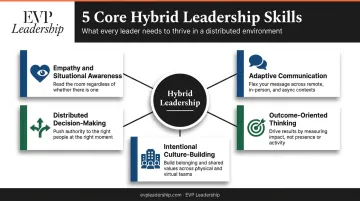
- The five core hybrid leadership skills — communication, outcome focus, culture-building, decision distribution, and empathy — are built through practice, not training events
- Under pressure, leaders fall back on conditioning — which is why building durable habits matters more than knowing the right answers
Why Hybrid Leadership Requires a Fundamental Shift
The Proximity Problem
Most leaders learned to manage by watching. You assessed effort by seeing who arrived early, read tension by body language in the conference room, and coached informally through spontaneous hallway conversations. That model assumes everyone is present — and in hybrid environments, they're not.
When half the team works remotely, those proximity-based instincts don't just become less useful. They actively work against you. Leaders unconsciously give more attention, recognition, and development opportunities to those they can physically see. This is proximity bias, and it's more damaging in small and mid-size businesses where every person's engagement and contribution directly shapes team performance.
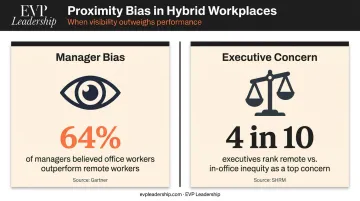
The data is stark: a Gartner survey cited by Future Forum found 64% of managers believed office workers outperform remote workers and should be prioritized for raises. SHRM reported that more than 4 in 10 executives ranked inequity between remote and in-office employees as their top concern. These aren't outlier perspectives — they reflect a widespread management default that hybrid leaders must consciously work against.
The Visibility and Information Gap
The confidence problem runs in both directions. Microsoft's 2022 Work Trend Index found that 85% of leaders say hybrid work makes it difficult to feel confident in employee productivity — even while 87% of employees report being productive.
That gap is structural, not personal. Hybrid managers reported lower visibility into employee work (54% vs. 38% for in-person managers) and more difficulty trusting employees (49% vs. 36%).
That confidence gap creates a dangerous management default: filling the uncertainty with presence checks, surveillance instincts, and decisions made without full remote-team input.
What This Actually Demands
The shift hybrid leadership requires isn't just operational. It's behavioral. Leaders need deliberate conditioning around:
- Communicating decisions to team members across different schedules
- Gathering input before deciding, not after
- Showing up consistently — same standards, same tone, same expectations — regardless of who's physically present
- Recognizing contributions they can't directly observe
A leader's consistency is the anchor for hybrid team performance. Distance doesn't create dysfunction — inconsistency does. And in hybrid environments, every gap in standards or presence gets amplified across the team faster than it would in a shared office.
The 5 Core Leadership Skills for Hybrid Team Success
These aren't competencies to check off in a workshop. They're capabilities built through repeated, deliberate practice — and they're what separates leaders who manage hybrid teams adequately from those who lead them well.
Adaptive Communication
Hybrid leaders must know when to use which channel — not default to constant synchronous communication because it feels more controlled.
- Synchronous (calls, live meetings): for decisions requiring discussion, conflict resolution, relationship-building moments
- Asynchronous (written updates, recorded video, decision logs): for information sharing, status updates, and decisions already made
- Written documentation: for anything the whole team needs to reference regardless of time zone or schedule
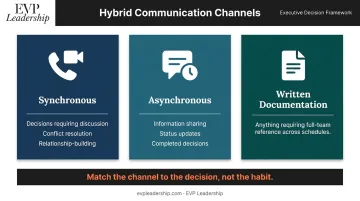
The goal isn't to eliminate real-time communication. It's to stop using it as a substitute for clear thinking and documented decisions.
Outcome-Oriented Thinking
If you're measuring effort, you're measuring the wrong thing. Hybrid teams can't be managed by visible activity — which means every role needs clearly defined deliverables and explicit success criteria.
This shift — from "are they working?" to "are they producing the right results?" — is also a fairness mechanism. When performance is anchored to outcomes, remote team members can be evaluated on the same terms as in-office peers.
Intentional Culture-Building
Culture doesn't form by accident in hybrid teams. In a traditional office, shared physical space creates incidental culture — the norms, rituals, and behaviors that accumulate through proximity. None of that happens automatically when the team is distributed.
Hybrid leaders must design culture deliberately. In small businesses especially, culture is a direct extension of how the leader shows up. That presence is now measured entirely through observable signals:
- Consistent rituals the team can rely on week to week
- Explicit values that get referenced in real decisions, not just hung on a wall
- The leader's own communication patterns as the primary behavioral model
- Follow-through that signals what's actually non-negotiable
Distributed Decision-Making
One of the fastest ways to bottleneck a hybrid team is to be the required approval point for decisions that team members could make themselves. When people work across different schedules and locations, waiting for the leader creates friction that compounds quickly.
Effective distributed decision-making isn't vague empowerment — it requires a clean protocol: what gets delegated, to whom, with what authority, and against what success criteria. EVP Leadership's delegation and accountability work frames this as "decisions moving down the org" — a structured approach that gives team members genuine authority rather than the appearance of it.
Empathy and Situational Awareness
Distance makes it harder to notice when someone is struggling. The remote employee who's quietly disengaging doesn't show up in the energy of a room — they show up in slower response times, shorter messages, and gradually decreasing participation that's easy to miss if you're not looking for it.
Hybrid leaders who catch this early share a few consistent habits:
- Check in with individuals directly, not just through team meetings
- Track participation patterns over time, not just in the moment
- Adjust their approach to the person — what one team member needs isn't what another does
- Create low-friction ways for people to signal when they're off without making it feel like a performance review
How to Build Trust and Psychological Safety Across a Distributed Team
Trust is harder to build at a distance — and easier to erode. Hybrid team members have fewer informal touchpoints, can't consistently read tone or intention, and may feel invisible compared to in-office colleagues. Building trust in this environment requires deliberate design.
Intentional Connection Rituals
The spontaneous relationship-building that happens in physical offices — shared lunches, hallway conversations, the five minutes before a meeting starts — doesn't happen by default in hybrid settings. Leaders need to create deliberate substitutes:
- Brief non-work check-ins at the start of team meetings
- Regular one-on-ones focused on the person, not just the project
- Virtual peer conversations that facilitate relationship-building across locations
- Consistent, predictable communication patterns that team members can rely on
Gallup research found that 80% of employees who received meaningful feedback in the past week were fully engaged — yet only 16% said their most recent manager conversation was extremely meaningful. The frequency isn't enough. The quality and focus of the interaction determines whether it builds trust or just checks a box.
Equitable Recognition
Remote team members' contributions are structurally less visible. When recognition only happens in moments the leader directly witnesses, remote employees consistently receive less of it — even when they're contributing just as much.
Hybrid leaders need recognition systems that make contributions visible to the whole team:
- Document accomplishments in shared team spaces, not just verbal mentions in live meetings
- Explicitly name the impact of work done asynchronously or independently
- Audit recognition patterns periodically — are in-office and remote team members being recognized at similar rates?
Psychological Safety Across Locations
Google's Project Aristotle studied 180 teams and identified psychological safety as the single most important factor in team effectiveness. In hybrid teams, safety is challenged by an additional layer: team members in different physical settings may feel unequal in how much their voice is heard or valued.
Psychological safety in a hybrid context means team members feel confident raising concerns, pushing back on decisions, or admitting mistakes — regardless of where they sit. That safety is modeled by the leader's response to candor and disagreement. If candor from the conference room gets rewarded while the same candor through chat or async video goes dismissed, the psychological safety you're trying to build collapses at the seams it was supposed to hold.
Practically, that means leaders need to actively close the loop on input that arrives outside live meetings:
- Acknowledge async contributions publicly, not just in private reply threads
- Follow up on concerns raised through written channels with the same seriousness as in-person ones
- Name when a remote team member's pushback led to a better decision — make that visible
Communication Frameworks That Bridge the Remote-In-Office Divide
Without explicit communication norms, hybrid teams default to the worst of both worlds. In-office employees make decisions in hallway conversations that remote teammates never hear about. Remote employees, meanwhile, send messages into a void with no clear expectation of when they'll get a response.
Establish a Clear Communication Protocol
Every hybrid team needs explicit answers to:
- Which channel carries which type of message? (Urgent decisions vs. project updates vs. social connection)
- What are the expected response windows? (Chat within 2 hours vs. email within 24 hours vs. no response required for async updates)
- When is synchronous discussion genuinely required? (vs. when an async update or documented decision is sufficient)
The protocol doesn't need to be complicated. It needs to be written down, agreed upon, and consistently followed — especially by the leader.
The "All-Remote" Meeting Principle
When any participant joins a meeting remotely, all participants should join via individual video connections rather than a room camera. This single norm does more than any meeting facilitation technique to equalize participation: it eliminates the dynamic where five in-office colleagues share a screen while one remote employee peers into a conference room.
That visual parity changes the actual dynamics of who speaks, who gets interrupted, and whose input shapes the decision.
Document Decisions
Written decision logs — brief records of what the team decided, why, and who owns it — solve three distinct problems:
- Keep members who missed a live meeting fully informed
- Prevent relitigating decisions that are already closed
- Create a shared source of truth that doesn't depend on anyone's memory or physical proximity
Performance Management Strategies for Hybrid Teams
Build Outcome-Based Performance Frameworks
Define what excellent performance looks like for each role in terms of specific, measurable deliverables — not hours logged or visible effort. When success criteria are explicit, remote and in-office team members are evaluated on the same terms, and performance conversations have a clear reference point.
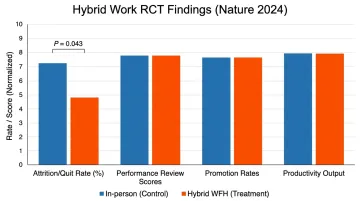
A 2024 randomized controlled trial published in Nature found hybrid work reduced quit rates by roughly one-third without damaging performance reviews, promotion rates, or code output. The mechanism wasn't a flexible schedule — it was managing workers by measured results rather than office presence.
Once the framework exists, the next challenge is making sure your coaching conversations actually use it.
Structure One-on-Ones Around Progress, Not Activity
In hybrid environments, the one-on-one replaces informal observation as the primary coaching mechanism. That shift only works if the conversation is structured around the right questions:
- What progress has the person made toward their key deliverables?
- What obstacles are getting in the way?
- What do they need from you to move forward?
- What does their career development look like right now?
Activity updates — "what did you work on this week?" — are not the same as a meaningful feedback conversation. The distinction matters because one builds accountability, and the other just creates a reporting loop.
Strong one-on-ones drive that accountability. So does removing the conditions that undermine it.
Avoid Surveillance-Based Management
The APA's 2023 Work in America survey found monitored workers were 42% more likely to intend to look for a new job (vs. 23% for non-monitored workers) and significantly more likely to report work negatively affecting their mental health. Activity tracking doesn't build trust — it signals you don't have any.
Conditioning Yourself to Lead Consistently Under Pressure
The Gap Between Knowing and Doing
Hybrid leadership exposes a specific vulnerability: when teams are distributed, a leader can't rely on physical presence to project calm, authority, or consistency. Every communication choice, every decision habit, every pattern of response under stress becomes amplified — because it's often the only signal the team receives.
Most leaders know what good hybrid leadership looks like in a planning conversation. The problem surfaces when conflict arises, a deadline is missed, or two team members in different locations are in tension. Under pressure, leaders revert to default patterns — often the proximity-based instincts that don't serve distributed teams.
Training vs. Conditioning
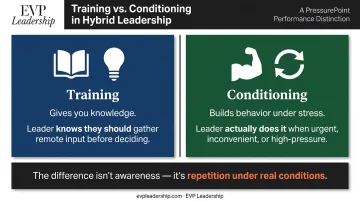
This is a meaningful distinction: training gives you knowledge. Conditioning builds the behavioral patterns that hold under stress.
Consider inclusive decision-making:
- A trained leader knows they should gather input from remote team members before deciding
- A conditioned leader actually does it — when the decision is urgent, when it's inconvenient, when the pressure to act is high
The difference isn't awareness. It's repetition under real conditions.
EVP Leadership's core thesis — leaders don't rise to expectations; they fall back on their conditioning — is exactly what's at stake in hybrid environments. The hybrid leadership behaviors that matter most (inclusive decision-making, consistent communication, equitable recognition) are precisely the behaviors most likely to collapse under pressure if they haven't been built through repeated practice.
Building Durable Hybrid Leadership Capacity
One-time training events don't produce lasting behavior change. CCL recommends a 3×3×3 model — three development goals, three supporting relationships, and three months of follow-through — as the minimum structure for leadership learning to transfer into real behavior.
For small business owners and executive teams navigating the specific demands of hybrid leadership, structured programs like EVP Leadership's 90-Day PressurePoint System provide the conditioning framework that leadership training alone doesn't deliver. It builds the decision-making consistency and communication discipline that hybrid leadership demands — not as concepts, but as ingrained behavior.
Frequently Asked Questions
How do you lead hybrid teams?
Effective hybrid leadership means moving beyond managing presence to leading by outcomes. Define clear deliverables for each role, build trust deliberately through structured check-ins and equitable recognition, and communicate consistently across both synchronous and asynchronous channels.
What is the biggest challenge of leading a hybrid team?
Proximity bias — unconsciously investing more in those physically present — is the most common and damaging challenge. It affects recognition, development opportunities, and decision-making in ways leaders often don't notice, quietly eroding remote employees' growth and overall team cohesion.
How do you build trust with a hybrid team?
Through intentional connection rituals — regular one-on-ones focused on the person, not just the project — equitable recognition systems that make remote contributions visible, and consistent leader behavior. At a distance, trust is built through predictable patterns, not proximity.
What skills do leaders need for hybrid work?
Five core skills stand out:
- Adaptive communication — knowing when sync vs. async channels fit the situation
- Outcome-oriented thinking — managing by deliverables, not presence
- Intentional culture-building — making connection deliberate, not accidental
- Distributed decision-making — establishing clear decision authority across locations
- Empathy and situational awareness — especially for remote team members
How do you measure performance in a hybrid work environment?
Define specific, measurable deliverables for each role and evaluate progress against those — not hours logged or visible activity. Pair outcome metrics with regular structured one-on-ones focused on progress, obstacle removal, and development rather than status reporting.
How do you prevent proximity bias in hybrid teams?
Use structured recognition systems that document contributions in shared spaces. Rotate who presents, leads, or contributes visibly in team meetings. Deliberately seek input from remote team members before finalizing decisions — not as a courtesy, but as a standard operating discipline.