
Introduction
Most leaders believe they communicate clearly. The research says otherwise.
MIT Sloan Management Review found that only 28% of executives and middle managers responsible for execution could list three of their company's strategic priorities — and one-third couldn't name even one. That's not a strategy problem. It's a communication clarity problem — and it's costing businesses real execution speed and alignment.
This guide is for small business owners, entrepreneurs, and C-suite executives who want to close the gap between what they intend to communicate and what their teams actually understand, act on, and trust. Communication clarity is a performance driver. It affects how fast decisions get made, how well teams stay aligned, and whether strategy translates into action at all.
The practical reality: most clarity breakdowns don't originate with the audience. They originate with the sender. Coaching builds the self-awareness and discipline to recognize that — and change it.
Key Takeaways
- Clarity is the leader's responsibility — not the audience's
- Poor communication has measurable downstream costs: misaligned teams, delayed decisions, and eroded trust across every level of the organization
- The 5 C's framework (Clear, Concise, Complete, Correct, Courteous) gives leaders a repeatable communication standard that holds across every channel
- Sustained coaching conditions communication habits over time — one-time training rarely changes how leaders communicate under pressure
- Lasting improvement means working on internal clarity and external clarity together, not just polishing delivery
What Is Clarity in Business Communication?
Clarity in business communication is the ability to deliver a message so that the intended meaning is received, understood, and actionable — without requiring the audience to interpret, guess, or fill gaps.
That definition matters because it puts responsibility squarely on the sender. The measure isn't whether you said it clearly — it's whether it landed clearly.
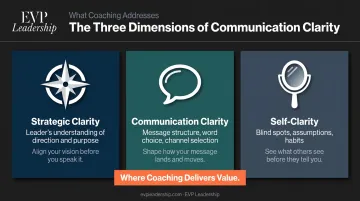
Three Dimensions Coaching Addresses
Most leaders think of communication clarity as a delivery problem. Coaching typically reveals it operates across three distinct dimensions:
- Strategic clarity — Does the leader know where the business is going and why? Leaders who haven't worked through their own strategic thinking produce communication that sounds vague or inconsistent, because it is.
- Communication clarity — What is actually said, and how does it land? This covers message structure, word choice, channel selection, and the receiver's ability to act.
- Self-clarity — What blind spots, assumptions, and habits distort the leader's messaging? This is where most communication coaching delivers its deepest value.
Clarity is not the same as brevity. A precise two-paragraph email that gives a team everything they need to act is clear. A three-sentence email that leaves out critical context is not — regardless of how short it is.
Why Business Leaders Struggle with Communication Clarity
The core mechanism behind most leadership communication breakdowns has a name: the Curse of Knowledge.
Camerer, Loewenstein, and Weber first described it as the tendency of better-informed people to ignore what less-informed people actually understand. HBR notes that executives often default to sweeping, abstract language after years of immersion in business logic — language that signals direction to them but translates into nothing actionable for teams.
When Clarity Breaks Down Most
Clarity doesn't fail evenly. It tends to collapse under specific conditions:
- High complexity — the more moving parts, the more leaders compress and abstract
- Time pressure — shortcuts feel efficient but strip out the context others need
- Remote and hybrid environments — Gallup found that hybrid and remote workers experienced double the decline in knowing what's expected of them compared with on-site workers
- The "talented people figure it out" assumption — experienced leaders often mistake high performers for mind-readers
Each of these conditions compounds the gap between what leaders intend and what teams receive — and the cost adds up. PMI research identified poor communication as a contributing factor in 56% of failed projects, making it one of the most direct and fixable drivers of execution failure.
This gap is a structural problem — one that responds directly to the kind of focused, behavioral work that coaching provides.
How Communication Clarity Coaching Works
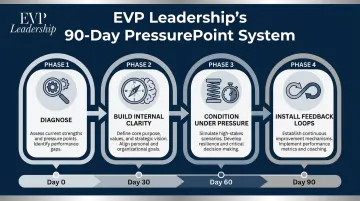
Communication clarity coaching follows a recognizable arc: it starts with diagnosing where and why communication breaks down, builds the internal clarity that precedes good delivery, and conditions skills under realistic pressure. The final phase installs feedback loops so leaders know whether messages are actually landing.
Each phase matters. Skipping the diagnostic means practicing the wrong things. Skipping the pressure-conditioning means skills that work in low-stakes conversations collapse in board rooms and difficult conversations — at the moments when clear communication has the highest consequences.
Step 1: Diagnose Communication Gaps
Coaching begins with assessment. A good diagnostic surfaces not just that a leader's communication is unclear, but where and why — whether it's lack of message structure, failure to close the loop, inconsistency under pressure, or poor audience adaptation.
Common diagnostic tools include:
- 360-degree feedback from direct reports, peers, and superiors — surfaces patterns the leader can't see from inside
- Communication audits of actual emails, meeting recordings, and written communications
- Observed interactions in the leader's natural working environment, not staged scenarios
Research on 360-degree feedback cautions that the feedback alone doesn't drive change. It's a starting point, not a solution.
Step 2: Build Internal Clarity First
Before working on delivery, coaching addresses whether the leader is actually clear on their own thinking. Key questions this phase surfaces:
- What is the core message in one sentence?
- What specific action or decision is expected from the audience?
- What context does the audience already have — and what are you assuming they have?
This internal clarity work is where many leaders discover the real source of their communication problems. The message isn't unclear because of poor delivery. It's unclear because the thinking behind it is still unresolved.
EVP Leadership's PressurePoint System addresses this through its Diagnostic Layer — particularly the Mission Clarity and Decision Integrity components, which train leaders to see clearly and ground their thinking before communicating.
Step 3: Condition Communication Skills Under Pressure
Once a leader's thinking is grounded, the work shifts from clarity of thought to clarity under fire. Effective communication coaching conditions leaders to perform when pressure is highest — not just in rehearsed, low-stakes scenarios. The high-stakes moments that matter most include:
- Board presentations and investor updates
- Difficult performance conversations
- Rapid decision-making exchanges
- Crisis communications where context is incomplete
EVP Leadership's 90-Day PressurePoint System is built on exactly this principle. One-time training produces knowledge. Conditioning produces reliable behavior — and that distinction is the foundation of how the 90-Day PressurePoint System is designed.
Step 4: Build Feedback Loops and Accountability
The final phase installs mechanisms so the leader knows whether communication is landing — before misalignment compounds.
This includes:
- Regular check-ins that surface clarification patterns from the team
- Message reviews that evaluate structure and completeness before sending
- Team calibration sessions that test strategic alignment
Without this feedback loop, leaders often discover communication breakdowns weeks after they occurred, at which point the cost — in delayed decisions, duplicated work, and eroded trust — has already accumulated.
Strategies to Ensure Clarity in Business Communication
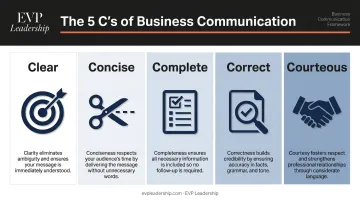
The 5 C's framework gives leaders a repeatable standard to evaluate any communication before it goes out. Drawn from the broader 7 C's business communication tradition, these five qualities cover the most common failure modes.
Clear: Lead With the Point
State the purpose or ask at the beginning of every message, email, or conversation. The audience should never have to reach the third paragraph to understand what the communication is about or what action is expected.
This principle — sometimes called BLUF (Bottom Line Up Front) — is well-supported. Princeton University Press argues that busy managers and clients consistently need the bottom line first, not a step-by-step build-up to it.
Concise: Serve the Receiver, Not Your Comfort
Conciseness isn't about being brief. It's about eliminating information that serves the sender's need to explain rather than the receiver's need to act. A useful test: does this sentence help them do something, or does it just make you feel thorough? Cut the latter.
Complete: Give Them Everything They Need to Act
A message is complete when the audience can act without following up. Every clarification request is evidence of incomplete communication.
The cost goes beyond the time spent asking. Repeated follow-up questions create delay, introduce doubt, and gradually erode trust — especially when the pattern becomes the norm.
Correct and Courteous: Match the Message to the Audience
- Correct means matching language to the audience's knowledge level — avoiding jargon when it creates barriers, explaining acronyms when they're not universal
- Courteous means respecting the receiver's time, context, and working reality — not just what you want to say, but how it lands for them
Active Listening as a Clarity Strategy
The 5 C's address how you construct a message. Active listening addresses whether you understood your audience well enough to construct it in the first place.
Leaders who listen actively — withholding judgment, seeking clarification, restating what they hear — produce better messages because they know their audience before they start writing.
HBR defines active listening as requiring attention, body-language and tone awareness, and responsive listening behavior — all of which are observable, coachable skills that improve with practice.
Common Misconceptions About Communication Clarity Coaching
"Clear communication is a natural talent"
It isn't. Harvard Business School treats leadership communication as a skill set. Active listening research describes mastery as requiring deliberate practice. A 2023 meta-analysis of workplace coaching found a medium positive effect (g = 0.43) on coaching outcomes — meaning structured coaching reliably moves the needle on behavior. What looks like a natural communicator is almost always a conditioned one.
"More communication will fix the problem"
Volume doesn't solve a clarity problem — it amplifies it. HBR's research on information overload directly challenges the always-on, more-is-better approach. The MIT Sloan data reinforces this: even leaders deeply familiar with their strategy couldn't recall stated priorities. Fewer, cleaner messages — tied to the right priorities — outperform a high volume of unfocused ones every time.
"A workshop is enough to create lasting change"
Training transfers knowledge. Conditioning builds habits. Baldwin and Ford's training-transfer research established that learned skills don't reliably move into job behavior without practice, reinforcement, and work-environment support. Leaders who leave a workshop without ongoing accountability typically revert to old patterns under pressure — the exact conditions where communication clarity matters most.
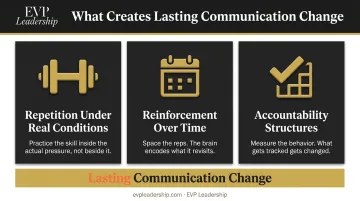
Lasting change requires three things a single workshop rarely provides:
- Repetition under real conditions — not just role-play scenarios in a conference room
- Reinforcement over time — spaced practice that cements new habits before pressure hits
- Accountability structures — someone tracking whether the behavior actually shows up on the job
The implication for leaders: seek coaching structures that extend past the training event and follow you into the work itself.
Frequently Asked Questions
What strategies can ensure clarity in business communication?
Lead with the main point before providing context, apply the 5 C's framework (Clear, Concise, Complete, Correct, Courteous) as a pre-send checklist, listen actively before responding, and build feedback loops that confirm the message was received as intended — not merely delivered.
What are the 5 C's of business communication?
Clear, Concise, Complete, Correct, and Courteous. Together, they create a practical standard for evaluating whether any business message is fit to send: structure, efficiency, completeness, accuracy, and tone.
What are signs that a leader lacks communication clarity?
Teams frequently ask for clarification on the same topics, decisions stall because expectations are misaligned, and the leader's messages are regularly interpreted differently than intended. A pattern of repeated follow-up questions is usually the clearest early signal.
How long does it take coaching to improve communication clarity?
Most leaders notice meaningful improvement within a focused 90-day engagement when habits are practiced consistently. Lasting change requires ongoing reinforcement, particularly in high-pressure contexts where old patterns tend to resurface.
How does poor communication clarity affect team performance and business results?
The downstream effects include misaligned teams, slower decisions, duplicated work, and revenue losses from missed follow-through. PMI identified poor communication as a factor in 56% of failed projects — one of the most preventable performance risks in any organization.
Can communication clarity coaching help with written communication as well as verbal?
Yes. The core principles apply regardless of format. Whether the challenge is email clarity, meeting communication, presentations, or difficult conversations, the same foundational approach — leading with the point, serving the receiver, closing the loop — works across every channel.