
Here's the problem most leaders don't see coming: poor decisions rarely stem from lack of intelligence. They stem from unexamined habits, cognitive blind spots, and no structured process to fall back on when pressure rises. McKinsey's research found that 61% of all respondents — including 57% of C-level executives — said most of their decision-making time was used ineffectively. That's not an intelligence problem. It's a process and conditioning problem.
This guide covers what decision-making skills actually are for leaders, the core competencies involved, a step-by-step improvement path, the variables that affect decision quality, and the traps that derail even experienced executives.
Key Takeaways
- Decision-making is a learnable, coachable skill — not a fixed trait
- Sound leadership decisions depend on analytical thinking, emotional intelligence, and a repeatable process
- Cognitive biases and decision fatigue undermine even experienced leaders without a structured framework
- Improvement requires deliberate practice and consistent reflection, not passive experience
- Leaders conditioned for pressure consistently outperform those who are only trained for it
What Are Decision-Making Skills in Leadership?
Decision-making skills in the leadership context are the ability to assess complex situations, weigh competing priorities, evaluate risk, and choose a course of action that serves both short-term needs and long-term organizational goals.
That scope is different from general workplace decision-making. A mid-level manager decides how to handle a project milestone. A founder-CEO decides whether to take on new capital, restructure a team, or exit a major client relationship — while simultaneously managing stakeholder expectations, resource constraints, and team dynamics.
The demands on a leader's decision-making include:
- Balancing short-term pressure against long-term strategic goals
- Weighing tradeoffs across people, finances, and organizational health
- Making calls with incomplete information and real consequences
- Staying grounded when identity and livelihood are directly on the line
EVP Leadership frames this through the lens of Decision Integrity: are decisions grounded in truth, or distorted by noise and emotion? For small business owners and founders especially, this matters because the stakes are personal. Identity, finances, team culture, and organizational survival can all hinge on a single call.
Effective decision-making isn't about always being right. It's about having a reliable process that produces sound, defensible choices under conditions that rarely feel ideal.
Key Decision-Making Skills Every Leader Needs
Analytical Thinking
The ability to break down complex problems, identify relevant data, and recognize patterns. Leaders who make decisions based on evidence rather than assumption make faster, better-supported calls. This doesn't require a data science background — it requires the discipline to ask "what do I actually know?" before acting on what feels true.
Critical Thinking and Bias Awareness
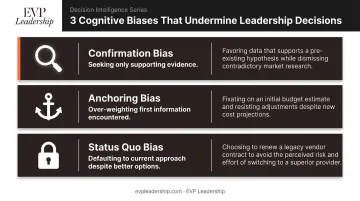
Three biases show up most often in leadership decisions:
- Confirmation bias — seeking information that supports what you already believe, ignoring contradictory evidence
- Anchoring bias — over-weighting the first piece of information encountered (a price, a number, an opinion)
- Status quo bias — defaulting to the current approach because change feels risky, even when it isn't
McKinsey's behavioral strategy research found that in a survey of over 2,000 executives, only 28% said strategic decision-making in their organization was generally good — and 60% said bad decisions were about as frequent as good ones. Bias is a primary driver of that gap.
Emotional Intelligence
Leaders with high EQ can separate emotional reactivity from sound judgment, understand how a decision affects team members, and communicate difficult choices in ways that build rather than erode trust.
That's not a soft claim. A cross-cultural meta-analysis published in the Journal of World Business confirmed that leader emotional intelligence has incremental predictive validity for subordinate performance — EQ is a measurable performance driver.
Risk Management
Risk management means identifying potential downsides, estimating likelihood and impact, and choosing an option whose risk profile aligns with what the organization can actually absorb. Leaders who conflate risk management with risk avoidance either stall on decisions or accept risks they haven't fully assessed — both are costly.
How to Improve Decision-Making Skills as a Leader
Decision-making improves through deliberate practice, not passive experience. The habits that matter most are the ones that hold up under complexity and pressure — not just in calm, low-stakes moments.
Step 1: Build Self-Awareness Around Your Decision Patterns
Before you can improve, you need to know how you currently decide. Most leaders have identifiable tendencies — a habit of deferring, overthinking, or rushing to resolve discomfort. None of these are character flaws. They're patterns, and patterns can be changed.
Start with a simple post-decision journaling habit:
- What information did I use?
- What did I ignore or dismiss?
- What assumptions drove my thinking?
- What would I do differently?
This takes five minutes. Over time, it converts individual decisions into a data set about yourself.
Step 2: Create a Structured Decision-Making Process
High-stakes decisions benefit from a repeatable framework. A clean one follows six steps:
- Define the actual problem — not the presenting symptom, but the root cause driving it
- Gather relevant information — set your criteria before you start collecting, not after
- Identify your options — resist stopping at the first viable solution
- Evaluate against your goals — short-term and long-term
- Decide — make the call and commit to it
- Review outcomes — close the loop
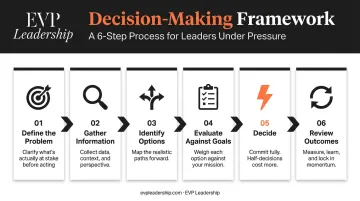
The distinction matters. Routine decisions should be fast and intuitive. Strategic decisions deserve this deliberate approach — and the more you run through it, the more automatically it activates when pressure rises.
Step 3: Gather and Evaluate Information Intentionally
Information overload is a real threat. Not all data is relevant, and chasing completeness is how leaders fall into analysis paralysis.
Effective information gathering means:
- Setting clear criteria for what you need before you start collecting
- Distinguishing facts from opinions and validating sources
- Actively seeking perspectives that challenge your initial read
The last point is the hardest. Most leaders avoid input that challenges their preferred direction. Knowing that tendency is the first step to countering it.
Step 4: Involve Your Team Strategically
Diverse input improves decision quality — but collaborative decision-making and diffused accountability are not the same thing. The leader still owns the final call.
Watch for groupthink: the tendency for social pressure to produce unchallenged consensus. Research comparing decision-making approaches found that dialectical inquiry and devil's advocacy produce higher-quality decisions than consensus-based methods. One practical technique: assign someone to argue against your proposed solution before you finalize it. Not to be contrarian — to surface what you might be missing.
Step 5: Reflect, Review, and Learn Consistently
Gathering input and evaluating options only improves your process if you close the loop afterward.
A meta-analysis published in Human Factors found that properly conducted debriefs improve individual and team performance by 20–25%. For a leadership team making dozens of consequential calls each quarter, that compound gain is significant.
After a decision plays out, spend ten minutes on three questions:
- What did I get right?
- What assumptions failed?
- What would I adjust?
This applies to successes too — not just failures. Reflection isn't rumination. It's a brief, structured practice that converts experience into decision-making capacity over time.
Key Factors That Affect the Quality of Leadership Decisions
Decision quality isn't determined by effort alone. Several controllable variables shape it.
Time Pressure and Decision Fatigue
The more decisions a leader makes, the more mental resources are depleted. A well-cited study of 1,112 judicial rulings found that favorable outcomes fell from roughly 65% at the start of sessions to nearly 0% just before breaks — a direct effect of accumulated decision load. While that's a legal setting, the implication for leaders is clear: judgment degrades without deliberate management.

Practical responses:
- Protect your highest-focus time for strategic decisions
- Batch routine decisions into defined windows
- Reduce the total number of decisions you make by delegating more aggressively
Information Quality and Completeness
A strong process applied to bad information still produces a bad decision. Leaders need reliable information channels — and the judgment to know when to decide with imperfect data versus when to wait for more.
That second skill is underrated. Waiting for perfect information is its own failure mode.
Organizational Culture and Psychological Safety
Research by Milliken, Morrison, and Hewlin found that 85% of employees felt unable to raise at least one important issue with their boss. When team members stay quiet, leaders receive filtered information — and filtered information produces structurally compromised decisions, regardless of how carefully the leader thinks them through.
Leaders who model transparent decision-making — showing their reasoning, acknowledging uncertainty — build cultures where better information actually reaches them.
Conditioning Under Pressure
There's a gap between how a leader decides in low-stakes environments and how they perform when stakes are high and time is short. This is where the difference between trained and conditioned leaders becomes visible.
EVP Leadership's core thesis: under pressure, leaders don't rise to expectations — they fall back on their conditioning. Traditional training transfers knowledge. Conditioning builds something different:
- Consistency — reliable judgment regardless of external chaos
- Resilience — the capacity to absorb pressure without degrading performance
- Decisiveness — acting clearly when clarity is hard to find
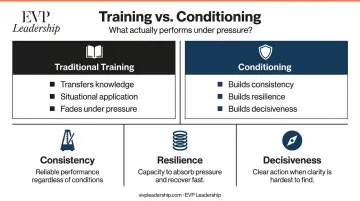
That internal capacity is what determines what actually happens when pressure arrives — and it's built through systematic conditioning, not classroom instruction.
Common Decision-Making Mistakes Leaders Make
Most decision-making failures trace back to a handful of recurring patterns. Recognizing them is the first step to breaking them.
Defaulting to consensus instead of making the call. When a leader waits for more alignment, more data, or more agreement before deciding, the team stalls and confidence erodes. A vendor contract, a hiring decision, a strategic pivot — none of these can move forward without a clear call. Decision-by-committee doesn't produce better outcomes; it produces ownership vacuums.
Confusing urgency with decisiveness. Rushing a decision without defining the actual problem first isn't the same as making a timely decision through an efficient process. Many leaders sacrifice quality in the name of looking decisive. Real decisiveness is about clarity of process — not pace of response.
Treating every decision as permanent. Refusing to revisit prior calls leads to sunk-cost thinking. Effective leaders build in review checkpoints and adjust when new information changes the picture. Updating a decision based on new evidence isn't weakness — it's what the review process is supposed to produce.
How to Make Better Decisions Under Pressure
Pressure is not an exception in leadership — it's the operating environment. The leaders who perform consistently under pressure have conditioned their decision-making process to function under stress, not just in ideal conditions.
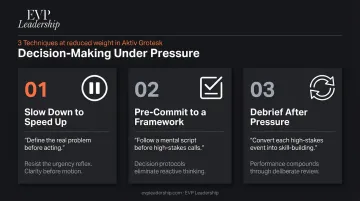
Three techniques that work:
Slow down to speed up. Before acting, pause to define the actual decision being made. Leaders under pressure frequently solve the wrong problem — addressing the symptom while the real issue compounds. A ten-second pause to name the problem correctly saves hours of misdirected effort.
Pre-commit to a decision framework. In high-pressure moments, there's no time to build a process from scratch. Leaders who pre-commit to a mental script — a sequence they follow before making calls — perform more consistently under stress. Research on implementation intentions confirms that if-then planning improves cognitive performance under acute stress.
Debrief after high-pressure decisions. Don't let the pressure event end there. A five-minute structured debrief after a high-stakes call converts the event into a conditioning opportunity — something that builds capacity rather than just depletes it.
That conditioning model is the foundation of EVP Leadership's 90-Day PressurePoint System. The Execution Layer follows a five-step sequence: Pause the Noise → Locate the Pressure Point → Prioritize the Critical Move → Execute with Discipline → Lock in Momentum. Each step is designed to replace reactive instinct with disciplined execution — so leaders arrive at high-stakes moments with a practiced protocol, not just a concept they've read about.
Frequently Asked Questions
What are decision-making skills in leadership?
Decision-making skills in leadership are the ability to assess complex situations, weigh options against organizational goals, and choose a course of action with confidence — even under pressure and with incomplete information. Leaders who do this well combine analytical thinking, bias awareness, and emotional regulation inside a repeatable process.
What are the most common decision-making mistakes leaders make?
The top three: avoiding the final call and waiting for consensus, rushing without properly defining the problem first, and failing to review and learn from past decisions. These patterns are habitual — which means they're correctable with structured practice.
How do cognitive biases affect leadership decision-making?
Biases like confirmation bias, anchoring, and groupthink distort how leaders interpret information and evaluate options — often without them realizing it. Awareness alone isn't enough; countering bias requires structured processes, designated challenge roles, and diverse input built directly into how decisions get made.
How long does it take to improve decision-making skills as a leader?
Most leaders notice real improvement within 30–90 days when they apply a structured conditioning approach — not a one-time training event. The habits have to be built and stress-tested under actual pressure, which is why conditioning over time outperforms any single workshop or course.
How can leaders make better decisions under pressure?
Pre-commit to a decision framework before pressure arrives. Practice pausing briefly to define the real problem before acting. And use post-pressure debriefs to extract a lesson from each high-stakes event — turning stress into skill-building over time.
What is the difference between intuitive and analytical decision-making for leaders?
Intuitive decisions rely on pattern recognition built from experience — appropriate for familiar, lower-stakes situations where the environment is predictable. Analytical decisions require deliberate data gathering and structured evaluation. Effective leaders know when each mode fits and can shift between them based on context.