](https://file-host.link/website/evpleadership-61bs4n/assets/blog-images/4b7bff97-a900-4203-bf07-586bef0377dc/1781265095575117_8ee624104c51443f94643493c43ccd0b/360.webp)
Introduction
Most organizational change efforts don't fail because the plan was wrong. They fail because the leaders responsible for executing the plan weren't actually aligned with it.
There's a meaningful difference between a leader who knows about a change initiative and one who genuinely believes in it. That difference shows up in how they prioritize, what they communicate when things get hard, and whether their teams feel a clear direction or a vacuum. When leaders operate on different assumptions or disengage, their teams notice. And that disengagement cascades.
According to McKinsey, 70% of change programs fail to achieve their goals, largely due to employee resistance and lack of management support. That's not a strategy problem. It's a leadership alignment problem.
This article covers four proven frameworks for aligning leadership with organizational change goals, how to choose between them, and why applying a framework is only half the equation—the other half is conditioning leaders to actually execute it when pressure is high.
Key Takeaways:
- Leadership alignment means actively championing change through behavior, not just approval
- Lewin, Kotter, ADKAR, and McKinsey 7-S each serve a distinct leadership alignment purpose
- SMB leaders face unique dual-role challenges that enterprise models don't fully account for
- Consistent application of a simpler framework beats inconsistent use of a sophisticated one
- Knowing a framework is not enough — leaders must be conditioned to apply it when stakes are high
Why Leadership Alignment Determines the Fate of Organizational Change
True leadership alignment means every decision-maker understands, believes in, and actively champions the same change goals. Not just in quarterly reviews—but in how they allocate budget, what they say to their teams when pressure builds, and how they respond when resistance surfaces in the room.
The stakes of getting this wrong are quantifiable. Prosci research shows that effective executive sponsorship can increase a project's chance of achieving its intended business outcomes from 25% to 85%. For most organizations, that gap is the entire initiative.
The Compounding Cost of Misalignment
When leaders send mixed signals—or silently step back from a change initiative while publicly endorsing it—teams detect it fast. People are acutely attuned to what their leaders actually prioritize versus what they say they prioritize.
What follows is difficult to reverse once it takes hold:
- Teams mirror their leaders' disengagement, reducing adoption speed
- Middle managers receive contradictory signals and hedge their own behavior
- Informal influence networks fill the communication vacuum with skepticism
- The change initiative becomes associated with leadership inconsistency, not strategic necessity
A 2022 Gartner survey found that 54% of technology decision-makers cited poor leadership as the most common obstacle during organizational change—above entrenched culture (51%) and inadequate resources. Leadership alignment isn't a soft variable. It's the primary operational risk in any change effort.
Key Frameworks for Aligning Leadership With Organizational Change Goals
No single framework covers everything. Each model addresses a different dimension of the alignment challenge—and understanding what each one does well is the first step toward using them effectively.
Lewin's 3-Step Model: Unfreeze, Change, Refreeze
Developed from Kurt Lewin's 1947 work on group dynamics, this model remains one of the most practical entry points for leaders because it's honest about how human change actually works.
The three stages—and what leadership must do in each:
| Stage | What It Means | Leadership Responsibility |
|---|---|---|
| Unfreeze | Disrupt the status quo; create readiness for change | Make the case for change credible and urgent—not just announce it |
| Change | Introduce new behaviors, processes, or structures | Model new behaviors visibly; don't delegate this to middle management |
| Refreeze | Anchor the new normal so it becomes standard practice | Reinforce through systems, recognition, and consistent decision-making |
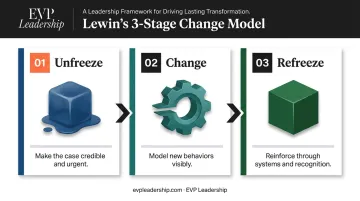
The Unfreeze stage is where most fast-moving organizations underinvest. In entrepreneurial and small business contexts, change often feels binary—people are either in or they're not—so leaders rush past the unfreezing work and wonder why adoption is slow. Building genuine readiness for change before implementing it isn't overhead. It's the actual work.
Kotter's 8-Step Change Model
John Kotter introduced this model in his 1995 Harvard Business Review article after studying more than 100 organizations navigating transformation. What makes it valuable for leadership alignment is this: the first four steps are entirely leadership-facing.
Steps 1–4 (the leadership work):
- Create a sense of urgency
- Build a guiding coalition
- Form a strategic vision
- Enlist a volunteer army
None of these involve changing a process or restructuring a team. They require the leader to do internal and relational work before any operational change can succeed.
On the guiding coalition specifically: Kotter is clear that a coalition needs members with titles, expertise, credibility, and genuine leadership capacity. The distinction between a credible coalition and a performative one matters enormously in SMB contexts.
- Cross-functional leaders who are genuinely bought in, have tested the logic of the change, and will advocate for it in rooms where the change sponsor isn't present
- Leaders who publicly agree to avoid conflict but privately hedge—creating the appearance of alignment without the substance
A useful test before cascading change downward: ask each coalition member to explain why this change is necessary in their own words. Rote recitation of the talking points is a warning sign.
The ADKAR Model
Developed by Jeff Hiatt at Prosci after studying patterns across more than 700 organizations, ADKAR's primary value for leadership alignment is diagnostic. When a change initiative is stalling, ADKAR helps identify exactly where the breakdown is occurring.
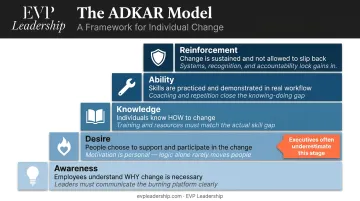
The five components:
- Awareness — Do people understand why the change is needed?
- Desire — Do they want to support it?
- Knowledge — Do they know how to change?
- Ability — Can they actually execute the required behaviors?
- Reinforcement — Are structures in place to sustain the change?
For executive teams specifically, the Desire component is frequently underestimated. Executives may intellectually support a change while harboring real concerns about role shifts, resource competition, or reduced influence. HBR has noted that every change involves an ending—and senior leaders aren't immune to the losses that accompany it.
Leaders who use ADKAR to surface Desire gaps within their own executive team—rather than assuming buy-in is automatic—catch misalignment early, before it erodes the initiative from the inside.
The McKinsey 7-S Framework
Introduced in the late 1970s and published in 1980 by Waterman, Peters, and Phillips, the 7-S Framework identifies seven interdependent organizational elements that must be aligned for any change strategy to work.
The seven elements:
- Hard elements: Strategy, Structure, Systems
- Soft elements: Shared Values, Skills, Style, Staff
The framework's diagnostic value lies in its insistence that hard-element changes (what's being restructured on paper) will be neutralized if the soft elements contradict them.
Consider a concrete example: a company announces a collaborative culture initiative as a core change goal. Leadership messages it consistently in formal communications. But the executive team operates in a command-and-control style—decisions are centralized, pushback is discouraged, and recognition flows only to individual performance. The Style element directly contradicts the Shared Values being espoused. No amount of structural redesign resolves that tension. The 7-S Framework surfaces this kind of contradiction before it takes the strategy down with it.
How to Choose the Right Framework for Your Organization
The right framework depends on three variables: the scale and urgency of the change, the maturity of the leadership team, and whether the primary barrier is strategic clarity, human resistance, or operational execution.
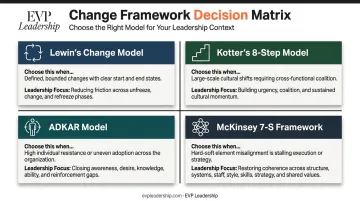
A practical decision guide:
| Framework | Best For |
|---|---|
| Lewin | Defined, bounded changes with a clear before/after state |
| Kotter | Large-scale cultural or strategic shifts requiring broad coalition building |
| ADKAR | Situations where individual resistance is high and adoption is stalling |
| McKinsey 7-S | Complex organizations where hard-soft element misalignment is the hidden barrier |
Avoid Framework Fatigue
Applying every framework simultaneously is counterproductive. Running four change models in parallel creates confusion: which signals matter, which metrics to track, which interventions to prioritize.
Choose one model as the strategic roadmap and use a second as a diagnostic lens. For example, Kotter provides the sequenced leadership roadmap for a major change effort, while ADKAR is applied in real time to troubleshoot specific adoption issues as they emerge. The two aren't in conflict—they operate at different levels of analysis.
The SMB Dual-Role Challenge
In small and mid-size businesses, the leader often functions simultaneously as the change sponsor (setting the vision and providing resources) and the primary change agent (executing the work). Enterprise change models don't account for this dual-role reality.
When the same person is setting direction and implementing it, objectivity becomes difficult. Blind spots in the sponsor role go unchallenged because the change agent is too close to execution to notice them. Structured peer accountability — through a trusted advisor, external coach, or leadership partner — becomes especially important to compensate for the role compression.
Prosci data shows that 59% of participants who used a structured methodology achieved good or excellent change management effectiveness. The best framework is the one a leadership team will actually use consistently under pressure, not the most theoretically complete one.
From Framework to Function: Building Leadership Alignment That Holds Under Pressure
Knowing a change framework and being able to execute it under real organizational pressure are two different things. Resistance from teams, resource constraints, competing priorities, and executive fatigue all erode alignment over time. Frameworks set the direction. What they can't do is build the capacity to hold that direction when everything is pulling against it.
What Behavioral Alignment Actually Looks Like
Alignment isn't a mindset statement. It's observable:
- Change-related activities appear in the leader's actual calendar, not just their stated priorities
- Change language is used in everyday communication, not just formal updates
- Decisions that contradict the change direction are explicitly flagged and reconsidered—even when the old approach would be easier
- Setbacks are acknowledged without retreating from the goal
Leaders who go quiet when change gets hard signal to their teams that the initiative is optional. Acknowledging difficulty while maintaining direction is a behavioral marker of real alignment.
Short Feedback Loops Sustain Alignment Over Time
Leaders who establish regular check-ins, measure leading indicators (not just lagging outcomes), and adjust their approach in real time are far more likely to maintain alignment across the full arc of a change initiative.
The 30-60-90 planning rhythm—setting specific priorities across 30-, 60-, and 90-day horizons—is a practical structure for this. It keeps long-term change objectives visible while managing short-term execution, and it creates natural correction points before misalignment hardens into organizational habit.
Leadership Conditioning vs. Framework Knowledge
At EVP Leadership, working with C-suite executives and small business owners has shown that frameworks alone don't determine change outcomes—the leader's capacity to execute them under pressure does.
EVP Leadership's position is direct: most organizations don't struggle with strategy; they struggle with readiness. Under pressure, leaders don't rise to expectations—they fall back on their conditioning. That's why the firm's 90-Day PressurePoint System focuses on building the habits, emotional capacity, and decision-making discipline leaders need to sustain alignment when the initiative gets difficult.
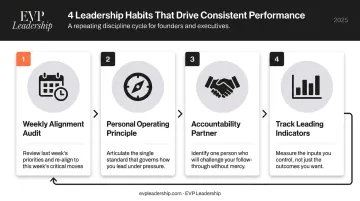
Four Habits to Build Now
- Schedule a weekly alignment audit — a 30-minute leadership team check-in focused on whether behavior matches change goals, not just whether tasks are complete
- Create a personal operating principle tied directly to the change goal — one sentence that serves as a decision filter when competing priorities surface
- Designate an accountability partner — an external advisor, peer, or coach who will call out misalignment without political risk
- Track leading indicators weekly — adoption speed, team utilization of new processes, and decision integrity under pressure, not just lagging outcome metrics
Warning Signs That Leadership Is Not Aligned With Change Goals
Leadership misalignment rarely announces itself. It shows up in behavior patterns that are easy to rationalize in the moment.
Four behavioral warning signs:
- Different leaders telling different stories about what the change means and why it matters
- Visible disengagement from the initiative's progress, even while maintaining public endorsement
- In 1:1 conversations or informal settings, expressing doubt or opposition that never surfaces in leadership discussions
- Making resource allocation or performance decisions using the old framework, even after leadership announced the new goals
What to Do When Misalignment Surfaces Mid-Initiative
The instinct is usually to push harder—more communication, more urgency, more accountability pressure. That often makes things worse by driving misalignment underground rather than resolving it.
The more effective sequence:
- Pause — stop adding momentum to a misaligned system
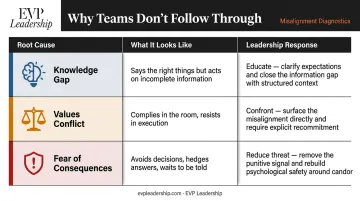
- Diagnose honestly — is this a knowledge gap (they don't understand the change), a values conflict (they don't believe in it), or a fear of personal consequences (they see risk to their role, influence, or relationships)?
- Address the root cause directly before restarting execution pressure
Each root cause calls for a different response:
| Root Cause | Response |
|---|---|
| Knowledge gap | Provide information and clarity on what the change actually requires |
| Values conflict | Open dialogue; make harder decisions about coalition composition if needed |
| Fear of consequences | Create psychological safety and have honest conversations about what the change means for each leader's role |
Amy Edmondson's research on psychological safety makes a directly relevant point: teams surface concerns and adapt most effectively when they feel safe raising them. Leaders who build that environment within their own executive teams produce more durable change cultures than those who project false confidence throughout the initiative.
Catching misalignment early and correcting it is a sign of leadership strength—not a signal that the change is failing.
Frequently Asked Questions
What is Lewin's 3-step model of organizational change?
Lewin's model breaks change into three stages: Unfreeze (disrupting the status quo and preparing people for change), Change (implementing new behaviors and processes), and Refreeze (anchoring the new normal so it becomes standard practice). It endures because it acknowledges that people need preparation before change can take hold, not just instruction.
What is the 7-S Framework for organizational change?
The McKinsey 7-S Framework identifies seven interdependent elements (Strategy, Structure, Systems, Shared Values, Skills, Style, and Staff) that must align for change to succeed. It works best as a diagnostic tool for pinpointing where alignment breaks down, especially when soft-element contradictions in culture or leadership behavior are undermining hard-element changes.
What are the 5 C's of change leadership?
The 5 C's: Clarity, Communication, Courage, Commitment, and Coaching — form a behavioral checklist for leaders to self-assess change readiness. If any of the five are weak before an initiative launches, that gap will surface under pressure.
What is the 30-60-90 rule in leadership?
The 30-60-90 approach is a structured planning convention where leaders set specific goals and priorities across 30-, 60-, and 90-day horizons. It enables leaders to maintain focus on long-term change objectives while managing short-term execution. It also creates built-in correction points to course-adjust before misalignment becomes entrenched.
Why do most organizational change initiatives fail?
Most change initiatives fail due to poor leadership alignment, insufficient sponsorship, and underestimating the human side of change. The IBM Global Making Change Work Study found that only 41% of projects met their time, budget, and quality objectives, and 92% of practitioners identified top-management sponsorship as the single most critical success factor. Employees follow what leaders do, not what they announce.
How can a small business leader align their team with organizational change goals?
Start with a clear and repeatable change narrativethat explains not just what is changing but why it matters now. Involve key team members in shaping the change, not just receiving it. Then hold yourself accountable to behavioral alignment: consistent decisions, visible prioritization, and honest acknowledgment of setbacks. In small businesses, leadership behavior is the change management infrastructure.