
The instinct to stay involved — to review the work, sit in the meeting, weigh in on the decision — feels responsible. It feels like leadership. But that instinct has a cost that compounds quietly: team members stop initiating, decisions pile up at the top, and the trust required for real performance never fully develops.
"Trust your team" is advice most leaders have heard. What's rarely explained is the mechanism: granting autonomy isn't the reward for trust — it's the act that creates it. Every time a leader hands over a decision and holds the line, they make a visible behavioral deposit that no verbal affirmation can replicate.
This guide breaks down exactly why autonomy builds trust, what it costs when leaders withhold it, and how to practice it in a way that actually sticks — especially under pressure, when the instinct to re-take control is strongest.
Key Takeaways
- Autonomy is a leadership behavior, not a policy — it signals trust through consistent daily action
- Teams with genuine autonomy show measurably higher engagement, ownership, and retention
- Withholding autonomy creates bottlenecks, disengagement, and burnout that compound over time
- Effective autonomy requires outcome clarity first, then freedom in execution
- Granting autonomy under pressure, not just in calm conditions, is where the deepest team trust is earned
What Is Autonomy in a Leadership Context?
Workplace autonomy is the freedom team members have to determine how they approach their work and solve problems — within clear organizational goals. It's not the absence of direction. It's the absence of unnecessary control.
This distinction matters because autonomy is frequently confused with abandonment. They're not the same:
| Autonomy | Abandonment |
|---|---|
| Clear outcomes defined upfront | Vague or no expectations set |
| Team owns the path to results | No support or structure available |
| Accountability for outcomes | No one responsible for anything |
| Leader available, not hovering | Leader disengaged entirely |
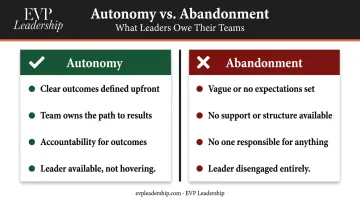
Autonomous teams still have defined outcomes, accountability structures, and access to leadership support. What they don't have is a leader managing every step of how they get there.
Autonomy isn't the end goal. It's the condition that makes genuine trust between leaders and teams possible — and that trust is what drives consistent performance.
Why Autonomy Builds Trust: 3 Key Advantages
These aren't abstract benefits. They map directly to the outcomes leaders and business owners track: retention, performance, decision-making speed, and organizational resilience.
Advantage 1: Autonomy Signals Belief, and Belief Creates Psychological Safety
When a leader grants autonomy, they make a visible behavioral statement: I trust your judgment. That signal lands more powerfully than any verbal affirmation, because it comes with real stakes attached.
The result is psychological safety — the shared team belief that speaking up, making decisions, and making mistakes won't be punished. Google's Project Aristotle, which studied 180 teams, found psychological safety to be the single most important factor in team effectiveness, outranking every other variable including talent composition.
McKinsey reinforced this with a measurable leadership link: consultative leadership behaviors — which include giving team members autonomy to make decisions — showed a direct coefficient of 0.54 on psychological safety in a 2021 survey of 1,223 employees.
KPIs impacted: Employee engagement scores, idea generation rates, rate of decisions escalated upward, voluntary turnover.
When this matters most: In high-complexity or high-pressure environments — exactly where most small and mid-size businesses operate — teams frequently need to make judgment calls without waiting for approval. Psychological safety is what makes that possible.
Advantage 2: Autonomy Creates Ownership, and Ownership Drives Accountability
People take greater responsibility for outcomes they were trusted to own than outcomes they were assigned and monitored. Autonomy shifts the psychological relationship to work from compliance to commitment — and that shift has a measurable business impact.
Gallup's 11th Q12 Meta-Analysis examined 183,806 business units across 347 organizations and found that top-quartile engaged teams delivered 23% higher profitability and 18% higher sales productivity than bottom-quartile units. Engagement and ownership are tightly linked — and autonomy is what activates both.
In practice, that engagement gap shows up in predictable ways:
- Fewer missed deadlines requiring manager follow-up
- Higher quality of output without constant review cycles
- Decisions made at the right level, not escalated upward by default
- Teams that notice and solve problems rather than waiting to be directed
Those bottlenecks carry a real cost. McKinsey found that 61% of respondents said decision-making time was used ineffectively — costing a typical Fortune 500 company roughly $250M in wasted annual labor. For smaller businesses, the math is proportionally as painful, and the bottleneck typically concentrates in one person: the leader.
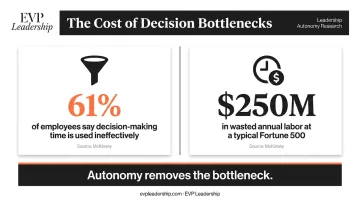
When autonomy is genuinely extended — not just assigned — people stop waiting for permission and start owning outcomes. That's when delegation actually works.
Advantage 3: Autonomy Improves Retention by Making People Feel Valued
McKinsey's Great Attrition research found that the most common reasons employees quit were relational: 54% didn't feel valued by their organization, 52% didn't feel valued by their manager, and 51% lacked a sense of belonging. Autonomy speaks directly to all three.
Gallup estimates that replacing a single employee costs between one-half and two times their annual salary. For small and mid-size businesses where one or two high performers carry disproportionate operational weight, that's not a HR statistic — it's a business risk.
Gallup also found that 42% of voluntary departures were preventable — meaning the manager or organization could have done something to keep that person. Granting meaningful autonomy is one of the highest-leverage, lowest-cost retention strategies available. It doesn't require a budget line. It requires a leadership decision.
KPIs impacted: Voluntary turnover rate, time-to-replace, team morale, continuity of institutional knowledge.
What Happens When Leaders Withhold Autonomy
Micromanagement rarely announces itself. Most leaders who fall into it believe they're being thorough, collaborative, or helpful. But checking every decision, sitting in every meeting, and second-guessing completed work sends an unmistakable message to the team: I don't trust you.
The downstream consequences don't stay contained:
- Team members stop bringing ideas. Why surface a solution if it'll be overridden?
- Decision bottlenecks form around the leader. Every judgment call requires approval, which means every delay is the leader's delay.
- Burnout accelerates on both sides. The leader is exhausted from being the decision point for everything. The team is disengaged from being the executor of nothing.
- Top performers leave first. They have options. They won't wait.
The numbers behind these patterns are hard to ignore. According to HBR's neuroscience of trust research, employees at high-trust companies reported 50% higher productivity, 76% more engagement, and 40% less burnout than those at low-trust companies. Gallup's 2024 State of the Global Workplace report found only 23% of employees worldwide were engaged, with disengagement costing an estimated $8.9 trillion in lost productivity globally.

For small businesses, these averages carry a multiplied risk. One disengaged team member represents a larger percentage of total capacity. One departure disrupts operations more acutely. Which means the case for building trust through autonomy isn't a culture preference — it's an operating necessity.
How Leaders Build Autonomy That Actually Builds Trust
Granting autonomy isn't a one-time decision. It's a behavioral practice that must be consistent — especially under pressure. Autonomy given only when things are going well doesn't build trust. It signals that trust is conditional, and people notice the difference.
Step 1: Start With Clarity
Unclear outcomes turn autonomy into anxiety. Leaders must define the what and the why before releasing the how.
This means establishing:
- Specific outcomes and success criteria upfront
- Who owns the decision and at what level
- What accountability looks like when it's done
EVP Leadership's Delegation, Accountability & Operating Discipline work builds this kind of foundation — establishing a delegation protocol that covers what gets delegated, to whom, with what authority, and against what success criteria. That structure is what separates empowering delegation from the kind that leaves people guessing.
Only 46% of U.S. employees in 2024 clearly knew what was expected of them, down from 56% in 2020. Autonomy on top of unclear expectations doesn't produce ownership — it produces anxiety.
Step 2: Make Trust Visible Through Action
Verbal trust statements don't move the needle. Behavioral trust signals do. Specific actions that signal trust:
- Letting a decision stand without requesting a review
- Publicly crediting team judgment when outcomes are good
- Resisting the urge to re-enter a delegated task when it gets uncomfortable
Contrast these with behaviors that erode trust even when well-intentioned:
- Asking for constant progress updates (signals doubt, not support)
- Overriding completed work (signals that delegation wasn't real)
- Attending every meeting as an observer (signals distrust of the process)
The pattern matters as much as any individual act. Leaders who grant autonomy and then quietly reclaim it under pressure teach their teams that autonomy is provisional — and provisional trust isn't trust.
Step 3: Create Psychological Safety for Mistakes
Autonomy will produce imperfect decisions. That's not a flaw in the approach — it's how judgment develops. Leaders who respond to mistakes with blame reverse the trust they built faster than they built it.
Leaders who respond with learning reinforce it instead. Walking through what happened, what it revealed, and what changes next — that response compounds over time into a culture where people take initiative because they trust the environment.
Step 4: Build Accountability Without Surveillance
Micromanagement and accountability are not the same thing. The difference:
- Micromanagement: Monitors activity and inputs — focused on controlling how work gets done
- Accountability: Reviews outcomes and holds people to agreed-upon results — focused on what was delivered
Practical formats that support accountability without surveillance:
- Outcome reviews, not status reports
- Agreed-upon check-in cadences established upfront — not ad hoc check-ins triggered by anxiety
- Scorecards tied to results, not to effort visibility
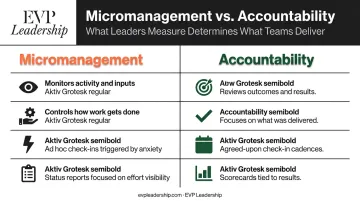
EVP Leadership's accountability operating rhythm — which includes structured 1:1 cadences, team operating rhythms, and performance conversations anchored to outcomes — gives leaders the structure to stay informed without becoming the bottleneck.
Granting autonomy consistently under pressure — not just when things are going well — is a conditioned behavior, not a default one. EVP Leadership's 90-Day PressurePoint System addresses this directly: it builds the behavioral habits that make trust a repeatable pattern, not a response to a low-stress day.
Conclusion
Autonomy builds trust because it's a behavioral signal — one that registers every time a leader grants it and holds the line. Every consistent repetition reinforces the message: I trust your judgment, and that trust doesn't disappear under pressure.
The payoff is operational. When autonomy is applied consistently, teams produce:
- Fewer decisions bottlenecked at the top
- Stronger retention and more initiative
- Faster execution without constant follow-up
Those gains erode quickly when autonomy gets pulled back the moment pressure rises.
Like all high-performance behaviors, the capacity to lead with autonomy is conditioned, not assumed. Intention doesn't hold under pressure — behavior does. The leaders who earn the deepest team trust are the ones who extend autonomy when it's easy and maintain it when circumstances make pulling back feel justified.
Frequently Asked Questions
Why does autonomy build trust in teams?
Autonomy builds trust because it's a visible behavioral signal that a leader believes in their team's judgment. That signal — applied consistently — creates psychological safety, ownership, and reciprocal loyalty that no verbal statement of trust can replicate. It works because it carries real stakes.
How do we actually build trust in our teams?
Building trust requires consistent action, not stated intention. Grant decision-making authority and let it stand, respond to mistakes with learning rather than blame, and make the reasoning behind decisions transparent so people feel included rather than directed.
What are the 3 elements of trust?
HBR's Zenger-Folkman research, based on analysis of 87,000 leaders, identifies three elements: Positive Relationships, Good Judgment and Expertise, and Consistency. Leaders scoring at or above the 60th percentile on all three reached the 80th percentile in overall trust; low consistency alone dropped trust scores by 17 points.
What is the difference between autonomy and accountability in teams?
Autonomy and accountability work together, not against each other. Autonomy defines freedom in how work gets done; accountability defines responsibility for outcomes. High-trust teams operate with both: freedom to choose their approach, full ownership of the results.
How much autonomy should a leader give their team?
Research suggests total autonomy is counterproductive. The most effective approach calibrates freedom to role, experience, and the stakes involved by starting with lower-risk decisions and expanding as trust is demonstrated on both sides. The goal is calibrated autonomy, not unlimited autonomy.
What are the signs that a team lacks autonomy?
Key indicators: all decisions flow upward to the leader, team members wait to be told rather than acting, idea-sharing is rare, and turnover runs disproportionately high among strong performers. When the leader is the bottleneck for every decision, that's not a team problem — it's a trust problem.