Introduction
Your leadership team agrees on the strategy. The org chart is clean. The goals are documented. Then pressure hits — and decisions stall, conversations go sideways, and execution fragments into competing priorities.
That gap between alignment on paper and performance under pressure is rarely a strategy problem. It's a trust problem.
Distrust at the leadership level doesn't announce itself. It shows up as political maneuvering, second-guessing after decisions are made, and the quiet withholding of honest opinions in the room.
Unlike front-line team dysfunction, leadership-level trust deficits cascade — shaping culture, slowing cross-functional execution, and eroding accountability at every level below.
Trust-building for leadership teams requires deliberate, repeated practice with exercises designed for high-stakes relational dynamics — not one-time retreats that lose traction within a week.
This guide covers the exercises that work, how to run them, and how to make trust a sustained conditioning practice rather than an occasional event.
Key Takeaways
- Leadership-level trust deficits undermine strategic execution, not just team morale
- Two types of trust matter: predictive trust (reliability) and vulnerability-based trust (openness)
- Sequence matters: start with low-risk connection exercises before moving to peer feedback
- Sustained trust requires repetition embedded in regular leadership rhythms, not one-time retreats
Why Trust Is the Foundation of High-Performing Leadership Teams
The Cascade Effect of Leadership Distrust
When trust breaks down among front-line employees, the damage is contained. When it breaks down at the leadership level, the entire organization absorbs the impact.
A leadership team without trust defaults to self-protection: guarded communication, siloed decisions, and accountability that only runs downward. Cross-functional alignment becomes difficult because no one wants to be exposed. Strategic execution slows because leaders hedge their commitments or route around each other without saying so.
Google's Project Aristotle research — which studied 180 teams — found psychological safety to be the single most important driver of team effectiveness. High-safety teams were rated effective twice as often by executives.
The study examined Google teams broadly, but the takeaway applies directly to leadership: the interpersonal conditions that allow people to take risks and speak honestly are foundational to performance.
Lencioni's Model: Trust Is the Floor, Not One Factor
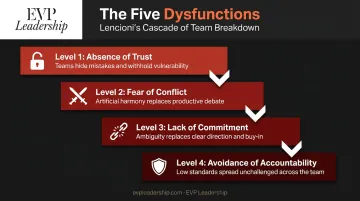
Patrick Lencioni's Five Dysfunctions of a Team framework makes the structural point plain: trust isn't one element of effective teamwork — it's the base layer. Without it, every other capability collapses.
- Absence of trust → leaders won't engage in honest conflict
- Fear of conflict → false consensus and weak commitment
- Lack of commitment → avoidance of accountability
- Avoidance of accountability → inattention to results
A leadership team can have technically skilled members, strong individual contributors, and aligned goals — and still underperform if the trust foundation is missing.
EVP Leadership's Conditioning Lens
EVP Leadership's core thesis: leaders don't rise to expectations — they fall back on their conditioning.
Trust is not a personality trait. It's not something some teams naturally have and others don't. It's a leadership competency that must be practiced deliberately and repeatedly — built in small, consistent moments over time, not in a single offsite.
This reframes what trust-building exercises are actually for. They're not team-building entertainment. They're conditioning reps — the repeated practice that determines how a leadership team behaves when real pressure arrives.
The Two Types of Trust Every Leadership Team Needs
Predictive Trust vs. Vulnerability-Based Trust
Most leadership teams develop one type of trust but not the other — and that gap creates a specific kind of dysfunction.
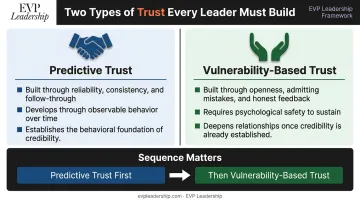
Predictive trust is confidence in a colleague's reliability. You trust them to follow through, meet commitments, and behave consistently. It's built through observable behavior over time — the foundation of the Trust Equation (Credibility + Reliability + Intimacy / Self-Orientation), developed by Maister, Green, and Galford in The Trusted Advisor.
Vulnerability-based trust works differently. It's the willingness to be genuinely open — to admit a mistake, ask for help when stuck, surface a blind spot, or challenge a colleague's thinking without fear of political damage. Lencioni identifies this as the specific type of trust that leadership teams most commonly lack.
Why the Gap Is Dangerous
A leadership team can appear high-functioning on predictive trust alone. Members deliver on commitments. Meetings run smoothly. There's no obvious conflict.
But without vulnerability-based trust, that same team will:
- Avoid real debate on strategic decisions, defaulting to polite consensus
- Withhold critical feedback until it's too late
- Protect their own functions rather than challenge each other constructively
- Struggle to adapt under pressure because no one is naming what's actually wrong
Research on cognition-based and affect-based trust among managers and professionals confirms this distinction: competence-based trust (reliability, dependability) and affect-based trust (care, honest engagement) are separate constructs that require different conditions to develop.
What This Means for Exercise Selection
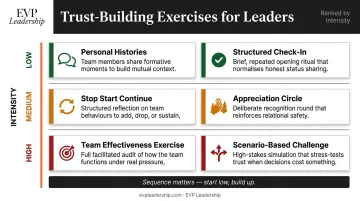
The exercises in this guide are designed to develop both trust types — but sequence matters. Start with lower-risk connection activities that build predictive trust and social familiarity. Only move to higher-vulnerability feedback exercises once baseline trust exists.
Skipping ahead backfires: asking leaders to give raw peer feedback before they've built interpersonal safety produces guarded, sanitized responses that deepen distrust rather than reduce it. The goal is earned openness, not forced exposure.
Top Trust-Building Exercises for Leadership Teams
These exercises are organized by purpose and intensity. Select based on where your team currently sits on the trust spectrum — don't open with the highest-vulnerability option.
Personal Connection and Vulnerability Exercises
Personal Histories Exercise
Developed by Lencioni and documented by The Table Group, this exercise asks each leader to answer a short set of questions about their background: hometown, number of siblings, a challenging childhood experience, and their first job. The goal is explicitly low-risk vulnerability — leaders share something real without exposing their deepest professional fears.
It works because it surfaces the human context behind each person's leadership style. A leader's drive for speed or habit of over-communicating usually has a backstory. That context doesn't excuse behavior — it builds the understanding that makes honest conversations possible.
- Group size: 6–10 people
- Time required: 30–45 minutes
- Trust type developed: Vulnerability-based (low intensity), predictive (through shared context)
Structured Check-In Questions
At the start of leadership meetings, each person answers one structured prompt — a recent personal win, a current professional challenge, or something they're carrying into the meeting. These run in under 10 minutes and build trust incrementally through consistent, normalized vulnerability. Over months of regular leadership meetings, check-ins shift the baseline of what it's acceptable to share.
- Time required: Under 10 minutes
- Trust type developed: Vulnerability-based (incremental), relational
Collaborative Problem-Solving Exercises
Team Effectiveness Exercise
This higher-stakes exercise, also from The Table Group, asks each leader to answer two questions about every colleague:
- What is the single most important behavioral quality this person contributes to the team's strength?
- What single behavioral characteristic do they most need to improve or stop doing for the team's benefit?
Responses are shared aloud. The result is direct, actionable feedback that no annual performance review captures — because it comes from peers rather than managers, in real time, about actual team dynamics.
Important caveat: This exercise should only be run after foundational trust is established. Run it too early and you'll get surface-level answers or defensiveness. Run it after the team has built genuine trust and it becomes one of the most useful conversations they'll have.
- Time required: One to two hours
Scenario-Based Challenge or Metaphoric Sculpture
Present the leadership team with a real or hypothetical organizational challenge and ask them to collaborate on a solution using limited information or creative constraints (props, objects, or a timed scenario).
The problem-solving matters less than what emerges during it: who defers, who dominates, who disengages, who checks assumptions versus charges ahead. These behaviors reveal how the team actually functions under uncertainty — not how they perform in prepared presentations.
Feedback and Recognition Exercises
Stop, Start, Continue
Each team member identifies one thing the team (or a specific colleague) should stop doing, one thing to start doing, and one thing to continue. Run in a group format rather than as a private 1:1 exchange, this distributes accountability and creates a shared container for honest feedback.
Most leadership teams have no structured peer-to-peer feedback practice at all. Stop, Start, Continue builds that habit — concrete enough to generate real input, structured enough that people actually use it.
Appreciation Circle
Each person takes a turn hearing specific appreciation from every other member of the team. This runs longer than it sounds — but the discomfort is itself the data.
Leaders routinely receive feedback on performance gaps. They rarely hear explicit, specific acknowledgment from peers about what their presence and contribution actually mean to the team. The Appreciation Circle corrects that imbalance — and often surfaces recognition that was genuinely felt but never said aloud.
Trust-Building Exercises for Remote and Hybrid Leadership Teams
Physical distance doesn't prevent trust development — but it does require more intentional design. Low-effort virtual icebreakers (trivia games, virtual happy hours) rarely build meaningful trust. What matters is structured vulnerability, even across screens.
Two Exercises That Adapt Well Virtually
Virtual Personal Histories Run in small breakout pairs via video call. Use a shared document to capture responses before the full-group debrief. Pairs of two or three feel less exposed than a full-group presentation, which lowers the barrier to honest disclosure. Rotate pairs across multiple sessions to build connection across the full team.
Virtual Stop, Start, Continue Use digital collaboration tools like Miro or FigJam so every participant contributes simultaneously in writing before any verbal discussion begins. This eliminates anchoring bias and gives quieter or more remote participants equal footing before the conversation opens up.
Non-Negotiable Norms for Virtual Trust Sessions
- Camera on — reading facial reactions is essential for trust-sensitive conversations
- Devices away — split attention signals that the conversation doesn't matter
- No recording — psychological safety drops when people know they're on record
These norms aren't optional — they're the container that makes honest conversation possible. For distributed teams, consistency also matters more than intensity. Brief trust-building practices embedded in weekly leadership meetings build more durable trust than infrequent all-day virtual retreats that lose momentum between sessions.
How to Run Trust-Building Exercises Effectively
Set Context Before You Start
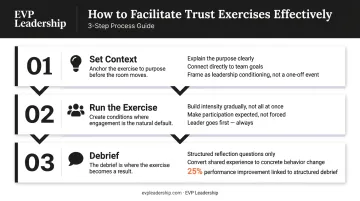
The facilitator must explain the purpose before any exercise begins. Connect it to team goals. Name it explicitly as a trust-building practice. Teams that understand why they're doing an exercise engage with more openness — those who feel ambushed by vulnerability activities disengage or comply superficially.
Avoid framing exercises as HR requirements or culture initiatives. Frame them as conditioning — the same way a leadership team would approach any other performance skill. That framing shift alone changes how seriously people show up.
Debrief: The Other Half of the Value
The exercise itself is 50% of the value. The debrief is where insight converts to behavior change. Without structured reflection, experience stays experience — it doesn't become learning.
Use questions like:
- What did you notice about yourself during that exercise?
- What surprised you about a colleague?
- What's one thing you'll do differently in how you engage this team going forward?
Research on team debriefs found that properly structured debriefs improve team performance by approximately 25%. The debrief isn't a courtesy — it's where the work happens.
Sequence and Participation
Two principles that most facilitators underweight:
- Build intensity gradually. Start low-risk — personal histories, check-ins — then move to higher-stakes exercises (team effectiveness, peer feedback) only after baseline trust is established. Jumping ahead produces guarded responses and can backfire.
- Make participation expected, not mandatory. Some leaders resist vulnerability exercises by nature. The facilitator's job is to go first, keep the environment judgment-free, and frame full participation as the team norm — not a requirement. Forcing it destroys the very trust you're conditioning.
- The leader sets the tone. When senior leaders engage openly, the rest of the team follows. When they disengage or perform compliance, so does everyone else.
Making Trust a Leadership Conditioning Practice
Trust Is Built Through Repetition, Not Events
Trust-building exercises are not events. They're repetitions. The leadership teams that develop durable, functional trust are those who embed small practices consistently into their rhythms — not those who run one powerful offsite and assume the work is done.
This mirrors EVP Leadership's core thesis on performance: conditioning through structured, repeatable practice outlasts any single training event. Team trust works the same way — it must be practiced, not assumed.
A Practical Cadence
| Frequency | Activity | Time |
|---|---|---|
| Every leadership meeting | Check-in question or appreciation round | 5–10 minutes |
| Quarterly | Structured exercise (Personal Histories, Stop/Start/Continue, Team Effectiveness) | 30–60 minutes |
| Annually or semi-annually | Leadership offsite with higher-vulnerability exercises and strategic reflection | Half-day to multi-day |
This tiered structure ensures trust-building stays present without consuming meeting time or becoming a burden. The brief weekly practices do the most cumulative work — the quarterly and annual sessions go deeper when the foundation is already there.
That foundation, though, has a ceiling when leaders try to build it alone.
When to Work with a Facilitation Partner
Internal facilitation has limits. When the senior leader is also the facilitator, the power dynamic shapes what people are willing to say. When the team is working through real conflict or post-merger alignment, neutrality matters. And when psychological safety is genuinely fragile, inexperienced facilitation can make things worse.
Teri Evans works with executive teams, nonprofit boards, healthcare leadership teams, and school district leadership groups to design and facilitate trust-building and team alignment work. She brings the structure, psychological safety framework, and facilitation experience that internal efforts often can't provide.
Frequently Asked Questions
What are good trust exercises for teams?
Strong starting points include the Personal Histories Exercise, Stop-Start-Continue, Appreciation Circle, and Team Effectiveness Exercise. The best choice depends on where your team currently sits on the trust spectrum — start with lower-vulnerability exercises and progress to peer feedback formats once a foundation is established.
What are the 5 C's of building trust?
The five C's are Competence, Consistency, Care, Communication, and Character. In leadership team contexts, competence and consistency build predictive trust, while care, communication, and character create the conditions for vulnerability-based trust. Lencioni's model and the Trust Equation offer more rigorous frameworks if you want deeper grounding.
How often should leadership teams do trust-building exercises?
Use a tiered cadence: a brief trust practice at every leadership meeting (5–10 minutes), a structured exercise quarterly (30–60 minutes), and a deeper session at least once per year. Frequency and consistency matter more than duration — small regular practices build more durable trust than infrequent intensive retreats.
Can trust-building exercises work for remote or hybrid leadership teams?
Yes, with intentional adaptation. Restructure exercises for virtual formats using camera-on norms, tools like Miro or FigJam, and small breakout groups. Brief trust rituals embedded in regular meeting cadences outperform rare all-day virtual events.
What is the difference between trust-building exercises and team-building activities?
Team-building activities (escape rooms, trivia nights) focus on fun and shared experience. Trust-building exercises are specifically designed to develop vulnerability, reliability, and interpersonal understanding. Leadership teams need the latter to perform under real pressure — shared fun doesn't develop the capacity for honest conflict or genuine peer accountability.
How do you know if trust-building exercises are working?
Observable signs include: leaders admit mistakes or ask for help in meetings without political maneuvering, conflict becomes more direct and less passive, decisions move faster with less second-guessing after the fact, and team members follow through on commitments more consistently without needing to be chased.