Introduction
Most senior leadership teams look cohesive from the outside. Inside, they're often something different — a collection of capable individuals each pulling in slightly different directions, misaligned on priorities, reluctant to challenge each other, and quietly competing rather than collaborating.
Harvard Business Review research found that only 20% of 1,250 executive teams studied were genuinely high-performing. That gap isn't a talent problem — it's a design problem.
This post is for small and mid-size business owners, C-suite executives, and founders who are building or restructuring their leadership teams. If the design is broken, the framework below shows you how to fix it — covering why teams fall short, what high-functioning ones actually look like, how to build one step by step, and what it takes to hold that performance when conditions get hard.
Key Takeaways
- Intentional design builds high-functioning senior leadership teams — talent alone doesn't create cohesion
- Trust, role clarity, and shared vision are non-negotiable foundations, not nice-to-haves
- Building a strong team is an ongoing conditioning process — one that compounds over time
- The CEO or founder must actively model the behaviors they want to see — the team's culture flows from the top
- Performance under pressure separates high-functioning teams from average ones — and that capacity is built, not inherited
Why Most Senior Leadership Teams Fall Short
Senior leadership teams exist to set strategic direction, align the organization, and model culture. In practice, they often operate in functional silos, defer on hard decisions, and protect their own turf — quietly, consistently, and at the organization's expense.
Jon Katzenbach's foundational HBR research puts it plainly: most top management groups aren't real teams at all. A real team requires common purpose, shared performance goals, a common approach, and mutual accountability. Most senior groups check none of those boxes consistently.
The Three Core Failure Modes
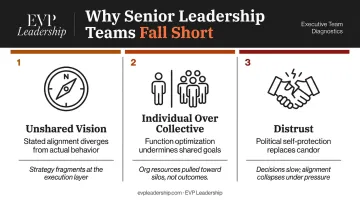
1. Unshared vision. Team members nod at the mission statement in planning sessions. Outside the boardroom, individual decisions reflect individual priorities. The gap between stated alignment and actual behavior is where organizational drift begins.
2. Individual over collective. When team members optimize for their own function rather than the organization's goals, the whole is never greater than the sum of its parts. Strong individual contributors don't automatically make strong teams.
3. Distrust. When political self-protection replaces candor, real collaboration becomes impossible. People say what's safe, not what's true. Problems surface too late — or not at all.
What Dysfunction Actually Looks Like
The pattern rarely announces itself loudly. Watch for:
- Slow or deferred decisions on issues everyone knows need addressing
- Vague ownership and diffused accountability
- Inconsistent messaging from senior leaders to their organizations
- Talented people quietly withdrawing from full engagement
These symptoms compound each other. McKinsey's State of Organizations research found that 40% of leaders cite unclear roles and responsibilities as a primary cause of organizational inefficiency — confusion, slow decisions, and duplication follow predictably. Recognizing the pattern matters. What to do about it matters more.
Characteristics of a High-Functioning Senior Leadership Team
High-functioning teams succeed on two dimensions simultaneously: practical needs and personal needs. Practical needs include unified purpose, clear decision-making processes, complementary capabilities, and structured operating rhythms. Personal needs include psychological safety, diverse contributions that are genuinely welcomed, and a shared growth mindset.
Average teams address one dimension and neglect the other. Strong teams build both intentionally.
Unified Purpose and Shared Vision
Shared vision goes well beyond agreeing on a mission statement once a year. McKinsey research shows that organizations whose top teams work toward a shared vision are 1.9x more likely to achieve above-median financial performance — and that gap reflects what genuine alignment actually produces.
Shared vision means team members actively support the team's direction in their individual decisions and communications, even when they personally disagree or face pressure from their own functions. Agreement in the room is easy. Alignment outside of it is what matters.
Complementary Capabilities and Role Balance
Strong teams aren't filled with similar people. They're built around deliberate diversity — different skills, experiences, and perspectives that create collective capability no single leader could produce alone.
The distinction matters: individual role expertise is what each person brings to their function. Collective team capability is what the group can accomplish together. Both must be intentionally built — and they're not the same thing.
Courageous Decision-Making
High-functioning teams surface difficult issues, debate with candor, and make decisions without excessive delay or consensus-seeking. Without this, the senior team becomes an information-sharing body rather than a direction-setting one.
The absence of productive conflict is often mistaken for harmony. In most cases, it signals something more specific: a team that has conditioned itself to avoid the conversations that carry the most risk.
An Established Operating Rhythm
Consistent performance requires consistent structure. That means:
- Regular meetings with clear, differentiated purposes
- Defined rules of engagement for how the team works together
- Shared performance metrics the team monitors collectively
- A distinction between operational reviews (what happened, what's blocked) and strategic sessions (where are we going, are our assumptions still right)
Rhythm creates accountability without requiring constant oversight. Teams that operate without it tend to mistake activity for progress — and often discover the gap too late to course-correct.
How to Build Your Senior Leadership Team Step by Step
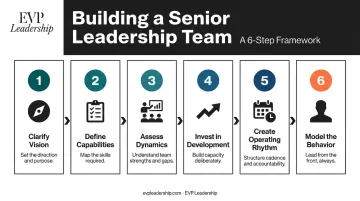
Step 1: Clarify Vision and Shared Purpose First
Team development starts with the leader, not the team. Before adding people or restructuring roles, the CEO or founder must articulate where the business is heading and what the leadership team must accomplish together — not just in their individual functions. Without this clarity, even talented leaders will optimize for their lane.
Step 2: Define Capabilities, Not Just Titles
Start with current strategic priorities, not the org chart. Define the specific competencies, mindsets, and experiences the team actually needs to execute — then evaluate whether your current roster delivers them.
Ask:
- Where do current team members complement each other, and where do they duplicate?
- What capabilities are missing entirely?
- What does the next phase of growth demand that the team can't currently deliver?
Step 3: Assess Individual Tendencies and Team Dynamics
Individual quality isn't the whole picture. Team composition shapes what's collectively possible.
Use behavioral assessment or structured evaluation to surface:
- Enabling qualities: relationship-building, adaptability, constructive conflict, collaborative problem-solving
- Derailing qualities: arrogance, rigidity, excessive self-promotion, avoidance of accountability
The chemistry of the group — who defers to whom, who dominates, whose ideas get dismissed — determines how the team functions under pressure.
Step 4: Invest in Each Person's Development
Assembling the right people is step one. Developing them is the ongoing work — through coaching, mentoring, stretch assignments, and cross-functional exposure.
Leaders who invest in their direct reports build a stronger team today and a deeper pipeline for tomorrow. That investment doesn't sit alongside the job; it's embedded in it.
Step 5: Create a Shared Operating Rhythm
Establish:
- A consistent meeting cadence with clearly differentiated purposes
- Communication norms across the team
- Decision-making protocols that define who has input, who has authority, and how disagreements get resolved
- Performance metrics the team owns collectively, not just by function
Rhythm creates the structure through which accountability happens naturally. Without it, performance management defaults to exceptions — conversations that happen when something goes wrong rather than as a normal operating norm.
Step 6: Model the Behavior You Want to See
The CEO or founder must be the most visible example of the culture they want the team to embody. That means demonstrating candor, admitting mistakes, inviting challenge, and solving problems collaboratively — not just communicating those expectations to others.
When the leader doesn't model these behaviors, the team won't either. Culture at this level is built through observable behavior. Stated values don't move people; consistent actions do.
Building Trust and Psychological Safety on the Team
Trust on a senior leadership team means something specific: team members believe their colleagues have the organization's best interests at heart, will follow through on commitments, and won't weaponize candid contributions against them politically.
Building that trust is active work. It happens through:
- Consistency over time — behaving the same way whether the stakes are high or low
- Transparent reasoning — explaining decisions, not just announcing them
- Constructive conflict — handling disagreement openly rather than suppressing it
- Feedback that flows both directions — leaders who can receive honest input create teams that can give it
Psychological safety isn't the same as comfortable agreement. It means people feel secure enough to challenge ideas, raise problems early, and admit mistakes without fear of judgment or political consequence.
The performance data backs this up. McKinsey's team effectiveness research found that teams with above-average trust scores were 3.3x more efficient and 5.1x more likely to produce results — which means trust isn't a culture initiative, it's a competitive one.
Teri Evans, EVP Leadership's facilitation lead, grounds team development engagements in exactly this foundation — structuring sessions around listening, psychological safety, and experiential growth. Her approach treats trust as a prerequisite for collaboration, not a byproduct of it.
Establishing Role Clarity and Accountability Within the Team
Role ambiguity at the senior level is more damaging than at any other level. When C-suite responsibilities overlap or remain undefined, the result is unclear ownership and duplicated effort.
Every senior leader should be able to articulate their specific lane and how it connects to the organization's larger goals — without referencing anyone else's responsibilities to define their own.
Building Accountability Without Micromanagement
Clear accountability requires:
- Defined deliverables and timelines — not vague ownership, but specific commitments
- Shared metrics — what the team is collectively accountable for, not just individual function metrics
- Performance conversations as the norm — not reserved for underperformance, but a regular part of how the team operates
The most important accountability norm is peer-to-peer accountability. When team members hold each other accountable — rather than waiting for the CEO to intervene — the team's capacity for self-correction grows measurably. That shift — from CEO-dependent correction to team-initiated accountability — is one of the clearest markers of a senior team that can function at full capacity.
From Training to Conditioning: Sustaining Leadership Performance Under Pressure
Most leadership development stops at training. Skills get built in a controlled environment. The program ends. Under real pressure — resource constraints, organizational change, interpersonal conflict, high-stakes decisions — the behavior that was trained often doesn't hold.
That's not a training failure. It's a conditioning gap.
The Training vs. Conditioning Distinction
Leaders don't rise to expectations — they fall back on their conditioning. The HBS working paper "The Great Training Robbery" makes the case directly: training frequently fails to change behavior when the surrounding organizational system doesn't reinforce the new behaviors. EVP Leadership's entire model is built on this premise.
Conditioning is different. It means:
- Deliberately repeating the right behaviors until they become instinctive
- Building small, consistent habits around communication, decision-making, and accountability
- Testing those behaviors under pressure, not just in ideal conditions
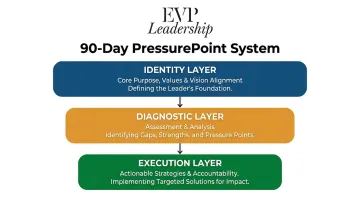
EVP Leadership's 90-Day PressurePoint System is built around this approach across three layers:
- Identity Layer — builds the core leadership pillars (consistency, capacity, and character) that determine how leaders show up when conditions get hard
- Diagnostic Layer — trains leaders to see clearly across six dimensions: Mission Clarity, Force Alignment, Problem Intelligence, Decision Integrity, Execution Discipline, and Momentum Control
- Execution Layer — gives teams a battle-tested protocol for high-stakes moments
Honest Feedback Loops
Conditioning also requires knowing where the gaps actually are. Regular, honest assessment of how the team is performing versus how it believes it is performing — and the willingness to close those gaps through targeted work — is what separates teams that improve from teams that plateau.
Frequently Asked Questions
What are the most common reasons senior leadership teams fail?
The three primary failure modes are unshared vision (alignment in name but not behavior), lack of collective ownership (individual interests override team goals), and distrust (political dynamics erode the candor and collaboration a real team requires). Most dysfunctional teams exhibit all three simultaneously.
How long does it take to build a high-functioning senior leadership team?
There's no fixed timeline. Development happens in stages, not on a calendar, and meaningful cohesion requires sustained, intentional investment. Even strong teams need continued work as strategy evolves and personnel change.
What is the difference between a senior leadership team and a management team?
A management team typically coordinates operations and ensures day-to-day execution. A senior leadership team is responsible for setting strategic direction, modeling organizational culture, and making high-stakes decisions that shape the company's future. The distinction is strategic scope, not just seniority.
How do you measure whether your senior leadership team is high-functioning?
Watch for: quality and speed of decision-making, whether members support team decisions outside the room, level of candor in discussions, clarity of shared goals, and consistency of performance under pressure. Dysfunction usually shows up in the gaps between these indicators.
What role does the CEO play in developing a senior leadership team?
The CEO must actively lead the process: setting the vision for how the team should function, modeling expected behaviors, and ensuring honest feedback flows in both directions. Bringing in HR or an outside partner works best when the CEO stays visibly engaged throughout.
How do you rebuild trust within a senior leadership team that has broken down?
Start with honest acknowledgment of the breakdown, without assigning blame, then establish new behavioral agreements as a full team. Build from there through low-stakes opportunities to demonstrate reliability. An outside facilitator can accelerate the process by providing the neutral structure most teams can't create on their own.