Introduction
Most conversations about leadership and team performance stall at the wrong level — debating personality types, management styles, or whether someone is a "natural" leader. The real question is more operational: what specific behaviors create the conditions under which a team can consistently perform, and which ones quietly erode those conditions over time?
Many business owners and executives know leadership matters. What's harder to pinpoint is where their own behavior — especially under pressure — is accelerating or limiting what their team can deliver. A confident presence in the room doesn't automatically mean the team has clarity on priorities. And the habits that work in calm conditions often break down exactly when the stakes are highest.
What follows examines how leadership shapes team performance — not in theory, but in the specific, observable ways that determine whether a team executes or stalls when it matters most.
Key Takeaways
- Leadership determines the conditions under which high performance becomes possible — and which conditions stay out of reach.
- The most measurable impacts show up through direction-setting, emotional climate, communication, psychological safety, and accountability.
- Leaders who react to performance gaps are already one step too late.
- High-performing teams reflect the quality and consistency of the leader above them — not just in easy conditions, but under stress and change.
- Lasting leadership impact comes from conditioning habits consistently over time — not from a single training event.
What "Leadership Impact" Actually Means
Leadership impact is not the same as leadership style or authority. Style describes how someone leads. Authority describes their position. Impact describes the measurable effect a leader's behavior, decisions, and presence has on a team's ability to execute, collaborate, and deliver results.
That distinction matters because leaders with strong charisma or positional power can still produce chronic confusion, misalignment, or burnout — if their structural decisions are poor or their communication breaks down under pressure.
The most important diagnostic shift: when team performance problems surface, the instinct is to look at the team. The more accurate place to look is at the environment the leader has created.
EVP Leadership sees this pattern consistently across founder, owner-operator, and C-suite engagements. Most organizations don't struggle with strategy — they struggle with readiness. Leaders have been trained, but not conditioned to execute with clarity when pressure is real and the team is watching.
How Leadership Shapes Team Performance: The Mechanism
Leadership impact doesn't happen through single dramatic moments. It operates through a chain of cause and effect that compounds over time. Four links in that chain carry the most weight.
Direction and Clarity
Performance begins where direction is set. When a leader communicates clear goals, defined priorities, and an understandable path forward, teams can allocate energy precisely. When direction is vague or frequently shifting, teams slow down, duplicate effort, and fill the void with assumptions — not because they lack talent, but because they lack a navigational signal.
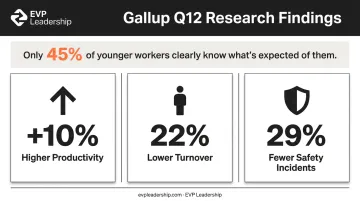
Gallup's Q12 research estimates that raising the share of employees who strongly agree they know what's expected of them from roughly half to eight in ten could correlate with 10% higher productivity, 22% lower turnover, and 29% fewer safety incidents. Yet in 2023, only 45% of younger workers clearly knew what was expected of them at work.
EVP Leadership's PressurePoint System treats Mission Clarity — "Do we know exactly what must be achieved, and why it matters now?" — as the diagnostic starting point. Everything else in the system builds from whether that question has a clean answer.
Emotional Climate and Second-Hand Stress
Leaders set the emotional tone of a team, consciously or not. Research published in the Journal of Applied Psychology found that a leader's mood directly affected group affective tone and group processes. A leader experiencing high stress who doesn't acknowledge it transfers that tension to the team — affecting decision-making quality, interpersonal friction, and output speed.
Some leaders manage tasks. Others manage energy. The difference matters: a team's capacity to perform depends not only on skill but on emotional bandwidth and sustained focus.
EVP Leadership's approach to executive burnout and emotional resilience is built on this premise — that when a leader carries chronic overload without building emotional capacity, the costs don't stay contained to the individual. They move through the team.
Communication and Trust
Communication is the mechanism through which direction, feedback, and expectations travel. Ineffective communication doesn't just cause misunderstandings — it erodes trust, which is the foundational resource that makes collaboration and risk-taking possible.
The trust-communication loop is specific:
- When leaders communicate openly, consistently, and with follow-through, trust builds
- When communication is irregular, withheld, or misaligned with action, trust erodes
- As trust erodes, performance degrades — people stop raising problems, disengage from initiative, and shift into self-protection
According to Gallup, employees who trust their leaders are 61% more likely to stay with their organization. When trust is absent, so is discretionary effort.
Accountability and Output
A leader's approach to accountability shapes what the team believes is actually expected of them. Leaders who hold expectations clearly, follow through on commitments, and address underperformance directly create cultures of ownership. Those who avoid accountability conversations produce drift — even among capable teams.
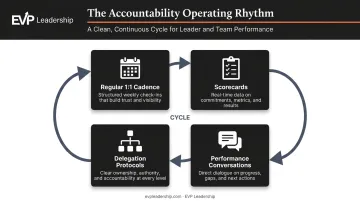
EVP Leadership's Delegation, Accountability & Operating Discipline work treats this as a structural issue, not a personality one. The solution isn't pressure — it's building a clean accountability operating rhythm: regular 1:1 cadence, scorecards, performance conversations, and delegation protocols that define authority and success criteria up front.
The Key Leadership Behaviors That Drive High Performance
Knowing that leadership shapes performance is useful. Knowing which behaviors move the needle — and which quietly erode it — is what actually changes outcomes.
Setting Expectations with Precision
High-performing teams are built on role clarity. Leaders who define what "done" looks like, what success is measured by, and what each person owns create conditions for autonomous execution.
Gallup reports that only about 1 in 2 employees globally strongly agree they know what's expected of them at work — a gap that limits output regardless of talent level.
Providing Consistent, High-Quality Feedback
Performance improves when feedback is timely, specific, and honest — not just at formal reviews but in real time. Gallup data shows that 80% of employees who received meaningful feedback in the past week are fully engaged, and teams whose managers provide weekly feedback are 5.2x more likely to strongly agree they receive meaningful input.
Leaders who avoid difficult feedback conversations allow performance gaps to become entrenched. Avoiding a hard conversation doesn't make the performance problem smaller — it gives it more time to compound.
Modeling Composure Under Pressure
Teams take behavioral cues from their leader, especially during high-stakes moments. A leader who can regulate their own response during setbacks or ambiguity signals to the team that the situation is manageable — preserving cognitive and emotional capacity for problem-solving.
EVP Leadership's Execution Layer addresses this directly. The first step — Pause the Noise — is designed to help leaders control the moment before the moment controls them. Without that pause, reactive decisions follow, and the team mirrors the instability.
Creating Psychological Safety
Google's Project Aristotle identified psychological safety as the single most important dynamic of effective teams. Teams perform at their highest when members feel safe to raise problems, challenge assumptions, and admit mistakes without fear.
Building it requires active, consistent effort — and even isolated moments of public criticism or punitive reaction to honest input can dismantle it quickly.
Teri Evans's facilitation work at EVP Leadership treats psychological safety as foundational, grounding team development in listening, trust-building, and experiential growth rather than top-down instruction.
Recognizing Progress and Contribution
Leaders who acknowledge effort and progress — not just final results — reinforce the behaviors that generate long-term performance. Gallup research found that when recognition hits the mark, employees are 4x as likely to be engaged and 45% less likely to have turned over after two years.
The gap between perception and reality here is striking:
- 67% of leaders say they provide recognition at least a few times per week
- 40% of employees report receiving it only a few times a year or less
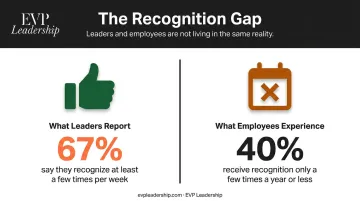
Closing that gap doesn't require a new program. It requires leaders who notice — and say something.
Where Leadership Impact Shows Up Most
While leadership affects every layer of an organization, its impact is most visible in two specific areas.
Engagement and Retention
Leadership quality is one of the primary drivers of whether employees stay or leave. Gallup research on manager influence found that managers account for at least 70% of the variance in employee engagement scores across business units.
A related Gallup study found that 1 in 2 adults had left a job specifically to get away from a manager. Gallup also estimates that 42% of employee turnover is preventable — and that replacement costs run roughly 200% of salary for leaders and managers.
The math is direct: a leader who builds trust and develops people creates a measurable retention advantage — one most hiring strategies can't offset once team cohesion starts to erode.
Performance Under Pressure
Retention data tells part of the story. The other part shows up when conditions get hard.
This is where the gap between trained leaders and conditioned leaders becomes most visible. A leader who holds the right behaviors in calm conditions but defaults to reactive, unclear, or avoidant patterns under stress will pull team performance down precisely when it needs to hold up.
The consistent pattern across small and mid-size businesses: organizations don't struggle with strategy — they struggle with readiness. When leadership breaks down under pressure, the results show up in operations, not just culture surveys:
- Slow or avoided decisions at critical moments
- Inconsistent execution across the team
- Missed opportunities during fast-moving conditions
- Revenue left on the table
The conditioning gap isn't abstract. It has a dollar figure attached to it.
How to Build Leadership That Consistently Elevates Your Team
Lasting leadership impact is not built through a single workshop. It's built through consistent practice of specific behaviors over time — particularly under demanding conditions. The goal isn't understanding what good leadership looks like. It's being able to execute it when conditions are difficult.
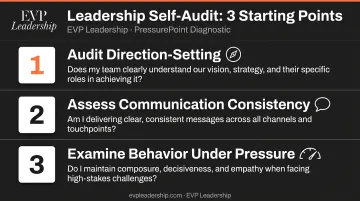
Three practical starting points:
- Audit your direction-setting — Can your team articulate current priorities without asking you? If not, the clarity gap is yours to close.
- Assess your communication consistency — Does your team feel informed, or do they operate on assumption? Do you follow through on what you say?
- Examine your behavior under pressure — In difficult moments, do your responses build or undermine team confidence? Are you pausing before reacting, or defaulting to whatever the pressure produces?
For executives and small business owners looking to close the gap between leadership intent and leadership impact, EVP Leadership's 90-Day PressurePoint System provides a structured conditioning framework designed to build the habits, decision-making clarity, and composure that drive consistent team performance — even when conditions are at their most demanding.
Conclusion
Leadership impacts team performance not as an abstract force, but through a traceable sequence: the clarity a leader provides, the emotional climate they set, the accountability structures they hold, and the feedback and recognition they deliver consistently. Each element compounds.
Understanding what good leadership looks like and executing it reliably under pressure are two different things. The leaders who build genuinely high-performing teams have done the work to condition their responses — not just study their options. That distinction sits at the center of EVP Leadership's operating principle: leaders don't rise to expectations. They fall back on their conditioning.
Frequently Asked Questions
What are the 4 pillars of team performance?
The four foundational pillars most consistently identified across research are trust, communication, coordination, and cooperation. Each is directly shaped by leadership behavior: a leader who communicates clearly, holds accountability, and creates psychological safety strengthens all four simultaneously.
What are the 5 C's of performance?
The 5 C's — Clarity, Commitment, Communication, Collaboration, and Coaching/Accountability — give leaders a practical diagnostic for pinpointing where performance breaks down. When output is inconsistent, one or more of these is typically weak at the leadership level first.
How does leadership style affect team performance?
Different styles produce different team climates. Authoritative styles accelerate direction-setting; coaching styles build ownership and initiative. The most effective leaders don't commit rigidly to one style. They read the situation and adapt to what the team actually requires.
What is the 70-20-10 rule for leaders?
Originated by the Center for Creative Leadership, the model suggests 70% of leadership development comes from on-the-job experience, 20% from coaching and feedback, and 10% from formal learning. That breakdown explains why real practice and accountability conditioning produce more durable results than classroom instruction alone.
What is the biggest factor that affects team performance?
Gallup's research points to manager and leader quality as the single most influential variable, accounting for at least 70% of the variance in team engagement scores. The clarity, consistency, and psychological safety a leader provides determines how much of a team's actual capability gets expressed.
What should I write in a leadership performance review?
Effective reviews should address both results and behaviors. Cover how the leader sets direction, communicates expectations, develops team members, models accountability, and responds under pressure. Results tell you what happened; behaviors tell you whether it's repeatable.