Introduction
Most new leaders walk into their first weeks carrying the same instinct: prove competence, establish authority, and move fast. The logic feels sound. You were hired to lead, so lead.
The problem is that authority is positional. Trust is earned. When you lead with one before building the other, you don't accelerate credibility. You erode it.
Research from DDI's Global Leadership Forecast shows trust in managers has dropped from 46% to just 29% since 2022. That's not a coincidence. It reflects a pattern of leaders who confuse role authority with relational credibility.
This guide is for founders, executives, and team leaders who want to build genuine trust rather than perform it. Trust is not given with a title, and it's not built through a single grand gesture. It's built through a pattern of small, deliberate behaviors, repeated consistently — especially under pressure.
What follows covers the two dimensions of trust every leader needs to understand, the specific behaviors that build and erode it, the unique challenge of inheriting versus building a team, and why trust is a matter of conditioning, not personality.
Key Takeaways
- Trust is a performance driver: employees who trust their leaders are 3x more likely to be engaged and 61% more likely to stay
- High-performing teams require both cognitive trust (competence) and affective trust (genuine care)
- The first 90 days set the tone — but trust is built through months of consistent behavior, not a single strong start
- Vulnerability, transparency, and full presence are among the fastest trust-building behaviors available to any leader
- Under pressure, leaders revert to ingrained behaviors — trust-building must be conditioned, not just intended
Why Trust Is Your Most Important Asset as a New Leader
Trust is a performance variable with direct operational consequences — and for new leaders, it's the first one that matters.
According to Gallup, employees who strongly trust their leaders are 3x more likely to be engaged at work. When trust is present, 1 in 2 employees is engaged. When it's absent, that ratio drops to 1 in 12. The same data shows employees who trust their leaders are 61% more likely to stay rather than look for another job.
PwC's 2024 Trust Survey adds harder numbers: 61% of employees said a perceived lack of trust from leadership negatively affects their job performance, and 22% said they left a company specifically because of trust issues. Executives ranked productivity as the biggest risk when trust breaks down — above service quality, above operational efficiency.
The Cost of Starting Without It
When a new leader arrives without established trust, the team doesn't rebel — they disengage quietly. They:
- Withhold honest feedback and surface only what feels safe to say
- Default to compliance rather than collaboration
- Withdraw discretionary effort — the extra work that's never in a job description but drives results
- Wait to see whether the new leader's behavior is consistent before investing relationally
This is the specific risk in the first 90 days. You're not just building a working relationship — you're establishing the pattern that will define how the team engages with you long-term.
Why This Matters More in Smaller Organizations
In small and mid-size businesses, there are fewer layers of management to absorb dysfunction — which means trust problems surface faster and spread further than they would in a large enterprise. Team dynamics are more visible, relationships are closer, and when a leader loses trust at a 50-person company, the whole organization feels it within weeks.
Great Place To Work reports that small companies in the top quartile of leadership scores grew revenue 7.5x faster than those in the bottom quartile. For small and mid-size businesses, trust isn't a culture initiative. It's a direct input to growth.
What Trust Actually Means: Two Dimensions Every Leader Should Understand
Most leaders think about trust as a single thing. It isn't. Research identifies two distinct forms, and effective leaders need both.
Cognitive Trust vs. Affective Trust
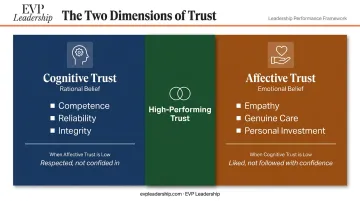
Cognitive trust is the rational belief that you are competent, reliable, and have integrity. The team trusts that you know what you're doing, that you follow through, and that you mean what you say.
Affective trust is the emotional belief that you genuinely care about them — not just as contributors, but as people. It's built through consistent demonstrations of empathy and genuine investment in each person's growth.
McAllister's research in organizational trust found that these two forms have different drivers and different behavioral consequences. You can have one without the other — and both gaps create problems.
| Gap | How It Shows Up |
|---|---|
| High cognitive, low affective | Competent but cold — respected, not confided in |
| High affective, low cognitive | Warm but ineffective — liked, not followed with confidence |
The Warmth and Competence Framework
Research by Amy Cuddy and colleagues at Wharton and Columbia identifies warmth and competence as the two central dimensions shaping how we judge leaders. Competence without warmth creates distance or fear. Warmth without competence raises doubts about your ability to lead.
New leaders tend to default to one or the other — usually competence, because that's what they feel they were hired to demonstrate. The real work is learning to project both at once.
One critical distinction: trust is not likability. Trying to be liked is one of the most common and damaging mistakes new leaders make. Likability is a popularity contest. Trust is built on credibility — and sometimes credibility requires decisions the team won't immediately appreciate.
How to Build Trust With a New Team: Core Leadership Behaviors
Trust is built in the small moments — not the big speeches. Following through on a minor commitment, listening without interrupting, being honest about what you don't know yet. These behaviors compound. So do their opposites: a broken promise, a dismissive reaction, or taking credit for the team's work can erase what took weeks to establish.
That's why trust is a daily practice, not a milestone event.
Demonstrate Vulnerability and Transparency
Leaders who project an image of perfect authority don't build trust — they suppress it. When people don't have information, they fill the gap with assumptions, and as Brené Brown describes, those assumptions are almost always fear-based.
Transparency costs less than most leaders think. It sounds like:
- "Here's what I know, here's what I don't know, and here's when I'll know more."
- "I don't have all the answers yet — and I want to hear yours before I form conclusions."
- "Here's why I'm making this decision, not just what I'm deciding."
DDI research found that leaders who regularly display vulnerability are 5.3x more likely to be trusted by their teams, and leaders who acknowledge their shortcomings are 7.5x more likely to maintain trust. When leaders are open about their limits, teams feel safer being honest in return.
Stay Consistent Under Pressure
Psychological safety — the team's belief that it's safe to speak up, take risks, and admit mistakes — isn't built through policy statements or values plaques. It's built through behavioral consistency.
Google's Project Aristotle identified psychological safety as the single most important predictor of team effectiveness. The mechanism is straightforward: if a leader reacts calmly to one mistake but explosively to another, the team concludes that silence is safer than honesty — and that conclusion is hard to undo.
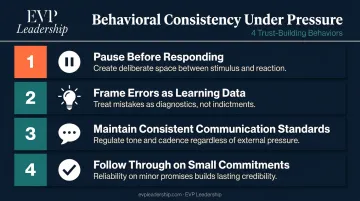
Behavioral consistency under pressure looks like:
- Pausing before responding to difficult news — even for five seconds
- Framing errors as learning data, not blame events
- Maintaining the same communication standards regardless of stress level
- Following through on small commitments — the ones that seem minor but signal whether you can be counted on
This is the work EVP Leadership's Diagnostic Layer focuses on — Decision Integrity keeps choices grounded when pressure distorts judgment, and Execution Discipline builds the follow-through that teams actually measure you by.
Show Genuine Care and Full Presence
One of the fastest trust-building behaviors available to any leader costs nothing. It's simply showing your team that you see them as whole people, not just contributors to your goals.
In one-on-ones, this means phone away, eye contact, and follow-up questions that demonstrate you actually listened last time. Wharton research on trust cites physical presence and direct engagement as cooperative signals — they communicate you are the most important thing happening right now.
In practice, that looks like:
- Asking each team member how they work best, not assuming
- Acknowledging personal realities when they intersect with work
- Remembering what people told you and referencing it later
Gallup research consistently links manager investment in employees as people to higher engagement and lower turnover. Presence isn't a courtesy — it's a performance variable.
The Unique Challenge of Being New: Inheriting vs. Building a Team
Most leadership guides treat this as a single scenario. It isn't. Inheriting an existing team and building a new one are fundamentally different trust challenges.
When You Inherit an Existing Team
You're not starting from zero. You may be starting from a deficit — stepping into an established culture, pre-existing relationships, and real skepticism about whether you'll be different from whoever came before.
The most effective approach in this scenario: listen before you act.
- Schedule individual conversations before making any structural changes
- Ask what's working and what isn't — and actually incorporate the answers
- Resist the urge to fix things immediately — the team is watching whether you diagnose before prescribing
- Acknowledge the transition explicitly — pretending there isn't one creates more anxiety than addressing it directly
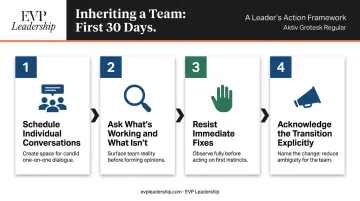
The team already has norms, relationships, and informal hierarchies. Your job in the first 30 days is to understand them, not override them.
When You're Building From Scratch
The challenge is different here: there's no inherited baggage, but also no established foundation. Trust has to be created from nothing under the pressure of getting work done simultaneously.
Set trust conditions from day one:
- Establish team norms collaboratively, not by decree
- Define explicitly how the group will communicate and handle disagreements
- State your commitments to the team, not only your expectations of them
The shared principle across both scenarios: in the first 90 days, your primary job is to create the conditions for trust to grow — not to perform for the people evaluating whether you belong.
What Quietly Erodes Trust: Mistakes New Leaders Must Avoid
These behaviors damage trust faster than almost anything else — and most leaders who engage in them don't realize they're doing it.
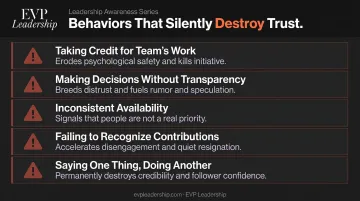
The most common trust-eroding patterns:
- Taking credit for the team's work — the team always knows, even when you think they don't
- Making decisions without transparency — people don't resent hard decisions; they resent unexplained ones
- Inconsistent availability — present when things are good, absent or distant when they're not
- Failing to recognize individual contributions — acknowledgment is not a bonus; its absence is a signal
- Saying one thing and doing another — this is the fastest path to trust collapse, and it compounds quickly
When the Leader's Ego Enters the Room
Leaders who need to speak first, counter every idea, or become defensive when challenged send a clear signal: this relationship is about the leader's agenda, not shared success. Competence rarely derails a leadership career. Relationship and trust failures do — consistently and quietly, long before anyone names it out loud.
The Micromanagement Signal
Micromanagement sends a specific message: I don't believe you're capable. That message damages both cognitive trust (it implies incompetence) and affective trust (it signals a lack of respect). A Robert Half survey found that among employees who had been micromanaged, 68% said it decreased morale and 55% said it hurt productivity. For a new leader, micromanagement is one of the fastest ways to confirm you don't yet trust your team. And teams that aren't trusted rarely extend trust in return.
Trust Building Is a Conditioning Practice, Not a Personality Trait
Here's the assumption most leaders carry into new roles: trust is something you either have naturally or you don't. It's a function of warmth, charisma, personality.
That belief is wrong, and believing it costs leaders more than they realize.
Trust is built through habits practiced consistently over time, especially when the pressure is on. EVP Leadership's foundational principle captures this directly: "Leaders don't rise to expectations — they fall back on their conditioning."
What "Conditioning for Trust" Actually Means
Conditioning means building repeatable behaviors — transparent communication, follow-through, presence under pressure — until they become automatic responses rather than conscious effort. A workshop on psychological safety doesn't get you there. Neither does reading about vulnerability. The behaviors have to be practiced until they hold without thinking.
The behaviors that build trust aren't difficult when conditions are easy. The test is whether they hold when a leader is overloaded, in conflict, or facing bad news. That's the moment conditioning either shows up or doesn't.
What Breaks Down Without It
Under pressure, unconditioned leaders default to self-protection. They become:
- Guarded — less transparent, more controlled in what they share
- Reactive — responding to stress rather than leading through it
- Controlling — micromanaging when they feel uncertain
- Inconsistent — their communication style and standards shift with their stress level
These are the behaviors that destroy trust fastest with a new team. A new team is already watching closely. When a leader shows up differently under pressure than they did in calm conditions, that gap is what people remember.
That's exactly the problem EVP Leadership's 90-Day PressurePoint System is designed to solve. It conditions leaders to maintain clarity and emotional discipline during the highest-pressure window of a new role — including the work of establishing trust before the team has any reason to extend it.
The Identity Layer's three pillars — Consistency, Capacity, and Character — address what trust actually requires: showing up aligned with your standards every day, carrying increasing responsibility without breaking down, and choosing integrity when circumstances make it inconvenient.
Frequently Asked Questions
What are the key C's for building trust in teams?
Common frameworks include Competence, Consistency, and Care (or variations like Credibility, Communication, and Commitment). These represent the behavioral pillars of trust: demonstrating capability, doing what you say, and showing genuine concern for the people you lead. EVP Leadership's model anchors on Consistency, Capacity, and Character as the foundational leadership identity.
How long does it take to build trust with a new team?
The critical trust-signaling window is the first 30 to 90 days — which is why EVP Leadership's conditioning work anchors on a 90-day framework. Deep trust follows months of consistent behavior after that. It can be damaged significantly faster than it is built.
What is the difference between cognitive trust and affective trust?
Cognitive trust is the rational belief that a leader is competent, reliable, and has integrity. Affective trust is the emotional belief that the leader genuinely cares. Both are required for high-performing team relationships : cognitive trust alone creates competent but cold leadership, while affective trust alone creates warm but ineffective leadership.
What are the biggest trust mistakes new leaders make?
The most damaging patterns: projecting authority before earning credibility, being inconsistent under pressure, failing to follow through on small commitments, and prioritizing being liked over being trustworthy. Taking credit for the team's work and making decisions without explaining the reasoning are close seconds.
How do you rebuild trust after it's been broken?
Take full ownership without deflecting or over-explaining. Renegotiate expectations so both parties share a clear understanding of what comes next. Then demonstrate sustained behavioral change over time — the best apology is consistent action, not a single conversation.