Introduction
You can have the right strategy, the right team, and the right market timing — and still feel like you're pushing through wet concrete every day. Decisions slow down. Information gets filtered before it reaches you. People execute, but without urgency or ownership.
Most leaders diagnose this as a process problem. It isn't. It's a trust deficit.
Research from HBR's neuroscience of trust study found that employees in high-trust companies report 50% higher productivity, 76% more engagement, and 40% less burnout compared to low-trust environments. Those are revenue, retention, and execution metrics — the variables that determine whether a business scales or stalls.
For small business owners, entrepreneurs, and C-suite leaders, the stakes are even higher. You don't have layers of institutional buffer — your credibility is the culture.
When trust is high, your organization compounds it. When it erodes, that erosion spreads fast.
This guide breaks down how trust actually functions as a performance lever — and what it takes to build it deliberately. You'll get concrete strategies, the behaviors that quietly destroy it, and a path toward conditioning trust as a leadership habit rather than treating it as a one-time initiative.
Key Takeaways
- Trust is a performance multiplier — high-trust teams execute faster, retain talent longer, and rebound from setbacks
- Leaders signal trustworthiness through both warmth (genuine care) and competence (reliability) — neither works without the other
- The most common trust destroyers are micro-inconsistencies: unmet commitments, avoidance of hard conversations, and unpredictable behavior under pressure
- Building trust is a conditioning practice, not a training event — it must hold under pressure, not just in calm conditions
- Coaches surface the trust-eroding blind spots leaders can't see themselves — which is why external accountability speeds up the work
Why Trust Is a Leadership Performance Multiplier
The Operational Case
When trust is high, something measurable happens: teams share information freely, escalate problems early, and make faster decisions. When it's low, energy quietly shifts from execution to self-protection. People hedge, wait for clearer signals, and cover themselves instead of moving forward.
Leaders typically misread this as a skills gap or a process failure. The real cause is relational infrastructure that has eroded — often without anyone naming it.
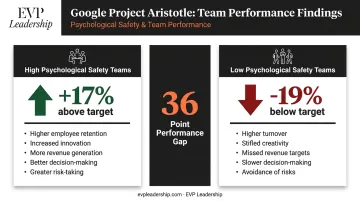
According to Google's Project Aristotle, which studied 200+ teams, how people interact matters more than who is on the team. High-psychological-safety sales teams beat their targets by 17%, while low-safety teams missed by 19% — a 36-point performance gap driven entirely by team climate.
Why SMBs Feel This More Acutely
In a large enterprise, a leader's credibility is buffered by management layers, institutional systems, and a distributed culture. In a small or mid-size business, there is no buffer. The founder or CEO's behavior is the culture employees experience daily.
Great Place To Work data makes this concrete: small businesses in the top quartile of leadership effectiveness grow revenue 7.5x faster than bottom-quartile peers. That gap is not explained by product, market, or capital. It's explained by what happens inside the organization every day.
The High-Growth Trust Trap
Scaling creates a specific trust vulnerability. Speed overtakes alignment. Communication becomes transactional. Leaders focus on hiring, expansion, and execution while the relational foundation goes unattended.
Teams mistake momentum for cultural health — until trust gaps surface as attrition, collaboration breakdowns, and slower decision cycles.
The core coaching reality: most leaders don't damage trust intentionally. They erode it through inconsistency, pressure-driven behavior, and emotional unpredictability. Trust is recoverable — but only through the same mechanism that built it: consistent, deliberate behavior repeated over time, not a single corrective conversation.
The Warmth-Competence Framework: How Leaders Signal Trustworthiness
The Two Dimensions That Create Trust
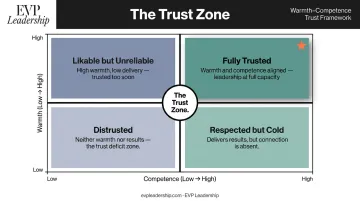
Decades of social psychology research — including Fiske, Cuddy, and Glick's Stereotype Content Model — show that people assess trustworthiness along two distinct dimensions:
- Warmth: Does this person genuinely care about me?
- Competence: Can this person actually deliver?
Both must be present. Competence without warmth reads as cold or self-serving. Warmth without competence reads as unreliable. Most leaders naturally lean toward one side, and that default shapes how their teams experience them long before they realize it.
Projecting Warmth
Warmth is communicated through behavior far more than words. Practical signals include:
- Remembering personal details about team members and following up on them
- Showing up for moments that matter (not just meetings that are on your calendar)
- Asking genuine questions — then listening without multitasking
- Following up on concerns rather than letting them drop
The trap is performative warmth: asking about someone's weekend while scrolling your phone. This backfires faster than no warmth at all, because people can distinguish attention from performance.
Projecting Competence — and Knowing When to Pull Back
Competence signals go beyond credentials. In practice, they include:
- Using language that fits the context (not showcasing vocabulary)
- Demonstrating working knowledge of your team's actual day-to-day challenges
- Making decisions with visible clarity — not endless deliberation
- Owning outcomes, including the ones that didn't land
The counterintuitive coaching move: when competence is already well-established but warmth is low, the fix isn't more demonstrations of expertise. It's strategic vulnerability — sharing a genuine failure, or simply saying "I don't have the answer yet." That kind of candor does what credentials can't: it makes you approachable, not just capable.
Coaching calibration exercise: Ask yourself which side of the warmth-competence spectrum you default to. Then identify one specific behavior you can add or adjust to strengthen the weaker dimension. Run this assessment quarterly. When you find a gap, act on it within the next two weeks — specificity and timing are what turn a self-assessment into an actual shift.
Six Trust-Building Strategies for Leaders
1. Develop Meaningful Relationships
Trust is built in the space between tasks. Leaders who treat team members purely as role-fillers miss the relational dimension that sustains loyalty and discretionary effort.
In practice: learn about people's lives outside work, recognize meaningful milestones, and make recognition specific rather than generic. "Great job this quarter" signals nothing. "The way you handled that client escalation last Thursday showed real judgment" signals that you're paying attention.
2. Set Clear, Shared Expectations
Ambiguity is a trust killer that rarely gets named as one. When people don't know what success looks like, they can't perform confidently — and they tend to assume the worst.
A leader's job is to co-create clarity: write expectations out explicitly, align on deliverables and timelines, and hold regular check-ins that remove guesswork. Clarity is also a form of respect. It signals that you take someone's work seriously enough to define what good looks like.
3. Follow Through on Every Commitment
Employees treat a leader's commitments as promises, not suggestions. When those promises break — even for legitimate reasons, without explanation — teams register it as unreliability, not circumstance.
Only commit to what you can actually deliver. When circumstances change, communicate proactively rather than quietly letting it lapse. Treat follow-through as a non-negotiable leadership behavior, not a best-effort aspiration.
4. Practice Radical Accountability
Nothing erodes team trust faster than a leader who deflects blame while accepting credit. Teams watch closely when things go wrong — and a leader who owns errors publicly, without hedging, builds enormous credibility precisely because it's rare.
What accountability looks like in practice:
- Admitting mistakes cleanly and quickly, without hedging language
- Giving credit generously and specifically to the team
- Responding to others' errors with problem-solving rather than blame
Leaders who admit mistakes are trusted more, not less. The behavior is rare enough that it stands out.
5. Create Psychological Safety Through Vulnerability
Psychological safety — the belief that team members can speak up, take risks, and disagree without punishment — doesn't emerge on its own. Leaders create it by going first.
This means modeling "I don't know yet," sharing a relevant past failure, and responding to dissenting input with curiosity rather than defensiveness.
For leaders with high-competence/low-warmth profiles, this is the most direct path from being respected to being trusted. Strategic vulnerability humanizes authority without undermining it.
6. Build a Feedback-Rich Environment
Gallup research found that employees who receive meaningful feedback and recognition are 61% engaged, compared to 38% for those who receive feedback alone — and employees who strongly agree they receive valuable feedback are 5x more likely to be engaged and 48% less likely to look for another job.
Two practices build a feedback-rich environment:
- Give specific, regular feedback that demonstrates you're paying attention
- Actively solicit input — then visibly act on it
Soliciting feedback with no follow-through is worse than not asking — it creates cynicism. The closed loop matters: ask, acknowledge, act where possible, and explain tradeoffs when you can't.
Silent Trust Killers: Behaviors That Erode Credibility Over Time
The Accumulation Problem
Trust is rarely destroyed by a single catastrophic event. It erodes through accumulated micro-inconsistencies that each seem minor on their own.
The most common silent trust killers coaches observe include:
- Canceling or deprioritizing one-on-ones repeatedly
- Shifting strategic direction without explanation
- Communicating warmth in public but urgency or coldness in private
- Reacting defensively to feedback
- Saying one thing while doing another
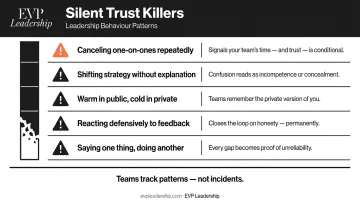
Each behavior feels isolated in the moment. Teams, however, track patterns — not incidents — and that distinction is where credibility quietly breaks down.
Behavioral Coherence: The Core Mechanism
The underlying concept is behavioral coherence — the alignment between a leader's words, decisions, and actions over time, particularly under pressure.
A Cornell University study of 76 hotels and nearly 7,000 employees found that behavioral integrity explained more than 12% of profit differences across properties. A 0.125-point improvement on a five-point integrity scale could lift profits by up to 2.5% of revenue. Those are measurable business outcomes, not abstract leadership ideals.
Employees don't need leaders to be perfect. They need leaders to be predictable and understandable. When behavior becomes inconsistent without explanation, uncertainty increases. That uncertainty erodes trust faster than almost any single leadership mistake.
The self-awareness gap compounds this: HBR research found that 95% of people think they are self-aware, but only 10–15% actually are. Trust-eroding patterns are often invisible to the leader but highly visible to the team.
The Three-Question Trust Audit
Leaders who want to quickly assess their trust health should sit with three questions:
- Do I do what I say I'm going to do, consistently?
- Do my team members feel safe bringing me bad news?
- When pressure increases, does my behavior become more consistent — or less?
These three questions surface the most common trust vulnerabilities quickly and create a clear starting point for behavioral change.
From Training to Conditioning: Embedding Trust Into Daily Leadership Practice
Why Training Isn't Enough
Most approaches to trust-building treat it as a training topic — something learned in a workshop and applied when remembered. The problem is transfer. Leaders don't become trusted because they understand trust concepts once; they become trusted when teams repeatedly observe better listening, promise keeping, and decision transparency.
EVP Leadership's approach starts from a different premise: trust-building behaviors must be conditioned until they become the default response, not the intentional one. Under pressure, leaders fall back on what they've practiced — not what they've learned in a room.
A 2017 meta-analysis of 335 independent samples published in the Journal of Applied Psychology confirmed this: leadership development programs that include needs analysis, spaced practice, feedback, and transfer support produce significantly stronger behavioral outcomes than one-time information delivery.
What Conditioning Looks Like in Practice
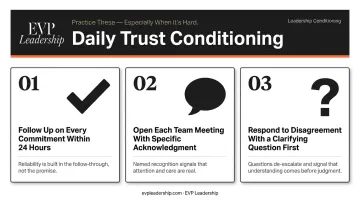
Pick two or three specific behaviors and practice them deliberately — not when convenient, but especially when it isn't:
- Follow up on every commitment within 24 hours
- Open each team meeting with one genuine, specific acknowledgment
- Respond to disagreement with a clarifying question before defending a position
EVP Leadership's 90-Day PressurePoint System is built around exactly this principle — structured, progressive conditioning cycles that develop behavioral consistency through the Identity Layer (consistency, capacity, character) and the Diagnostic Layer's six pressure dimensions, including Decision Integrity and Execution Discipline.
The Role of a Coach
That conditioning work is harder to sustain without someone holding up the mirror. Coaches help leaders see the patterns they can't see themselves — a tone that shifts under deadline pressure in ways that signal unreliability, or an avoidance of conflict that teams read as lack of direction.
Awareness precedes change, and self-awareness in this domain is difficult to develop alone. The conditioning only reaches its potential when an external accountability structure is holding it in place.
Frequently Asked Questions
How long does it take to build trust as a leader?
Trust develops at different speeds depending on the leader's consistency and starting point. Specific deliberate behaviors — warmth, follow-through, vulnerability — can accelerate formation, but sustainable trust is built through repeated, consistent action over time. There is no universal timeline, only a reliable direction: small, observable behaviors repeated daily.
Can trust be rebuilt after it has been broken?
Yes, but the repair must match the violation. Trust broken through inconsistency is restored through a sustained pattern of new behavior; trust damaged by deception is significantly harder to recover and rarely returns fully without deep relational repair and structural change.
What is the most common way leaders accidentally damage trust?
Inconsistency under pressure. When leaders behave differently during high-stress moments than during normal conditions, teams register this unpredictability as unreliability — and quietly revise their trust level downward, without naming it directly.
What is the difference between being liked and being trusted?
Being liked is about personal warmth and social appeal. Being trusted is about behavioral reliability and integrity. Leaders can be highly likable but untrustworthy, or less personally warm but deeply trusted. Long-term credibility runs on the latter.
How can a leader build trust quickly with a new team?
Demonstrate warmth and competence simultaneously: learn names quickly, make one clear promise and fulfill it immediately, and be transparent about what you're still learning. Admitting what you don't yet know signals safety — and safety builds trust faster than any display of authority.
How does vulnerability build trust rather than undermine authority?
Strategic vulnerability — admitting a genuine failure or saying "I don't know yet" — signals honesty and self-awareness rather than defensiveness. It humanizes authority and creates the psychological safety that makes teams willing to tell you the truth.