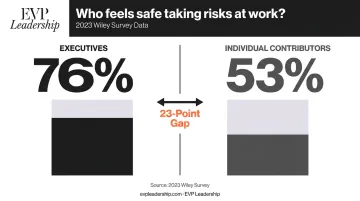
A 2023 Wiley survey found that 76% of executives felt safe taking risks at work — compared to just 53% of individual contributors. That gap isn't a perception problem. It's a behavior problem.
Psychological safety — defined by Harvard's Amy Edmondson as "a shared belief that the team is safe for interpersonal risk taking" — is the foundation of how high-performing teams actually function. It's not about keeping everyone comfortable or avoiding hard conversations. It's about creating conditions where honest, courageous communication becomes the norm rather than the exception.
Building it sounds straightforward. In practice, the results vary dramatically based on one thing: how leaders actually behave when the pressure is real. The steps below cover what psychological safety genuinely requires of leaders — prerequisites, daily behaviors, common failure points, and how to know if it's working.
Key Takeaways
- Psychological safety is built or eroded by daily behavior — not by programs, policy statements, or good intentions.
- Most leaders haven't specifically practiced staying composed and curious under pressure, which is exactly when safety gets tested.
- Self-awareness and communication clarity are prerequisites — without them, safety-building steps won't land credibly.
- How leaders respond to mistakes is the single behavior that most determines whether psychological safety holds or breaks down.
- Progress is observable. You don't need a formal survey to know if it's working.
How to Build Psychological Safety: A Step-by-Step Approach
Psychological safety isn't built in a single team meeting or an annual offsite. It's a set of behaviors leaders must practice until they become default responses, particularly when stakes are high, timelines are tight, and patience is short.
Step 1: Make It an Explicit Priority
Teams don't assume psychological safety exists. Leaders have to name it.
That means directly telling your team that honesty, questions, and concerns are expected (not just tolerated) and connecting it to something concrete: better decisions, faster problem-solving, stronger trust. Abstract values don't stick. Specific intent does.
Then model it immediately. Ask for feedback on a recent decision. Acknowledge where you're uncertain. Invite pushback on something you've already committed to. What you do in the 48 hours after making this declaration matters more than the declaration itself.
Step 2: Set Norms Around Mistakes
Edmondson's foundational research found that psychological safety directly enables learning behaviors — seeking feedback, discussing errors, experimenting — and that these behaviors mediate the relationship between safety and team performance. The enemy of performance isn't mistakes. It's mistakes that never get discussed.
Leaders can create this norm concretely:
- Introduce a brief "lessons learned" debrief after failures or near-misses
- Separate accountability from punishment — mistakes warrant reflection, not humiliation
- Name what happened, ask what was learned, and move forward without attaching blame to the person
The first time a mistake happens after you've declared psychological safety as a value, your team is watching. How you respond in that moment sets the actual norm.
Step 3: Practice Active Listening
Most leaders listen to respond. The shift to listening to understand is where psychological safety actually gets built. Nembhard and Edmondson define leader inclusiveness as words and deeds that invite and appreciate others' contributions — and their research links it directly to psychological safety and team improvement.
In practice, this looks like:
- Asking open-ended questions: "What are we missing?" or "How do you see it?"
- Resisting the urge to fill silence immediately after someone finishes speaking
- Validating the act of speaking up before evaluating what was said
Curiosity has to replace judgment — especially during disagreement. That's precisely when most leaders default back to defensive or dismissive patterns, often without realizing it.
Step 4: Create Multiple Channels for Input
Some team members need different conditions to feel safe contributing. Designing for only one format — the open-floor discussion — guarantees you're missing voices.
Alternatives worth building:
- Anonymous input tools for sensitive topics
- One-on-one check-ins as a consistent structure, not a crisis response
- Written channels (Slack, shared docs, email) for those who process before speaking
- Post-meeting reflection prompts that give people time to formulate thoughts
Offering choice signals respect. It also gives quieter team members a path that doesn't require them to perform confidence they don't feel.
Step 5: Respond Consistently — Especially Under Pressure
This is where most leaders lose ground. A 2021 study found that leader behavioral integrity — the perceived alignment between what leaders say and what they do — had a direct positive effect on psychological safety (β = 0.562) and employee voice (β = 0.313). Consistency functions as a structural trust signal, not a personality trait.
When stakes are high, the instinct to dismiss concerns, make unilateral decisions, or communicate through tone and body language rather than words is strong. Acting on that instinct once can undo weeks of trust-building.
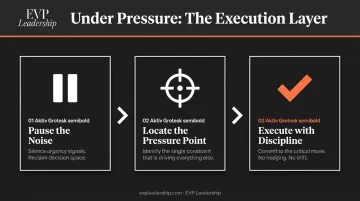
This is the core of EVP Leadership's conditioning philosophy: under pressure, leaders don't rise to expectations — they fall back on their conditioning. The PressurePoint System's Execution Layer is built specifically for these moments, training leaders to respond with discipline rather than instinct:
- Pause the Noise — stop before reacting to pressure or surface symptoms
- Locate the Pressure Point — identify what's actually driving the situation
- Execute with Discipline — communicate consistently, even when everything is going wrong
The goal isn't perfection. It's making composed responses the default rather than the exception.
What Leaders Must Establish Before Taking Action
Most how-to frameworks skip this foundational step. Leaders can follow every instruction correctly and still fail if these conditions aren't in place first.
Self-Awareness and Emotional Regulation
Leaders who don't know how they come across under stress will undermine safety while trying to build it. The tone used in a moment of frustration, a quick dismissive reaction, or a brief silence after bad news — these communicate louder than any stated commitment.
Seek honest feedback about how you behave when challenged, frustrated, or under time pressure. Not how you behave when things are going well. That's the version of yourself that rarely tests anyone's safety. The version that matters is the one that shows up when a meeting goes sideways or a project fails.
EVP Leadership's PressurePoint Identity Layer addresses this directly — developing the consistency, capacity, and character that determine how a leader shows up when pressure is highest.
Genuine Tolerance for Uncomfortable Truths
Leaders who ask for candor but subtly punish it train their teams quickly. Punishment doesn't have to be overt. Dismissiveness, defensiveness, a visible change in mood — these are enough.
What genuine tolerance actually looks like:
- Acknowledging strong points that contradict your own position
- Changing course based on team input, and saying so
- Saying "I was wrong" publicly when warranted
Without these behaviors, meeting structure and anonymous surveys signal the right intentions — but they won't move the needle on actual safety.
Communication Clarity First
Psychological safety cannot thrive in an environment of unclear expectations or inconsistent information. Before trust-building practices can take hold, get the basics right:
- Who gets heard — and in what settings
- How decisions are made and communicated
- How information flows through the team
Leaders who skip this step often find that silence isn't about fear of judgment. It's confusion about whether input even matters.
Key Behaviors That Determine Whether Safety Takes Root
The steps above create the structure. What follows determines whether people actually use it — or stay quiet.
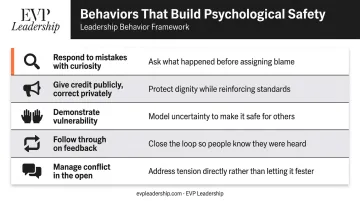
Respond to mistakes with curiosity, not consequences. A 2023 study of 924 nurses found that psychological safety significantly predicted error reporting (slope = 0.28, p < 0.01), and leader inclusiveness predicted psychological safety. Translation: how leaders respond to what goes wrong directly influences whether problems get surfaced early or discovered late.
In practice: name what happened, ask what was learned, separate the person from the problem.
Give credit publicly. Deliver corrections privately. This asymmetry builds the belief that honesty is rewarded and dignity is protected. Violating it once — publicly criticizing someone in a stressed moment — can undo weeks of progress. Teams track these moments closely, even when leaders don't.
Demonstrate your own vulnerability. Leaders who only ask for transparency without modeling it create an unequal dynamic. Admitting uncertainty, sharing a past mistake and its lesson, or acknowledging when a plan didn't work normalizes imperfection. This doesn't mean oversharing. It means showing that admitting uncertainty doesn't cost you credibility.
Follow through on feedback received. Gallup's research on employee voice emphasizes that involving employees in decisions and closing the loop on input drives ownership and engagement. When leaders invite input and never act on it — or don't acknowledge why they didn't — employees stop contributing. Even "I heard you, here's why we're going a different direction" keeps the channel open.
Manage conflict in the open, not around it. Productive conflict, handled with respect, models the environment leaders are trying to create. Leaders who smooth over tension or let disagreements fester signal that honesty has limits.
Constructive conflict facilitation means naming the tension, inviting each perspective, and working toward resolution — not forcing consensus or avoiding the conversation entirely.
These behaviors share a common thread: they're all visible to the team. Consistency here builds trust faster than any stated policy. A single public correction, an ignored suggestion, or a smoothed-over conflict sends a signal that lasts far longer than the moment itself.
Common Mistakes Leaders Make
Treating it as a one-time event. Many leaders introduce psychological safety in a team meeting and consider the work done. It isn't. The half-life of a single good moment is short when leaders revert to reactive patterns under pressure. Safety is a climate — it requires continuous reinforcement through behavior, not a program you launch and move on from.
The harder mistake to catch is subtler. Asking for honesty but punishing it quietly. Punishment doesn't need to be overt. A dismissive tone, a brief visible pause before responding, or rewarding only the loudest voices — these communicate that honesty carries a cost. Teams calibrate to these signals fast. By the second or third interaction after a leader says "you can tell me anything," the team has already drawn its conclusions.
Both of those mistakes share a common root: treating psychological safety as universal. Applying the same approach to everyone ignores who the environment is actually working for. Some individuals need one-on-one conversations over group settings. Some need more explicit permission. Research from Catalyst and HBS indicates that psychological safety's protective effects are stronger for women and people of color, who face higher baseline risk when speaking up. The real diagnostic question isn't whether people are speaking — it's who isn't.
How to Know If It's Working
You don't need a formal survey to track progress. Observable signals tell the story clearly.
Signs psychological safety is growing:
- Team members flag problems before they escalate, not after
- People push back on the leader's own ideas — not just each other's
- Mistakes get surfaced quickly rather than discovered late
- Different voices contribute across meetings, not just the usual ones
Warning signs it's eroding:
- Consistent silence during meetings, followed by private skepticism
- Reluctance to ask for help
- Public agreement that doesn't match private behavior
- High turnover concentrated in specific roles or demographic groups
If warning signs keep surfacing despite your best efforts, the issue is usually conditioning — not intention. EVP Leadership's PressurePoint System works with founders, CEOs, and executive teams to build the specific behaviors that create safety under pressure, practiced consistently until they hold when it counts.
Frequently Asked Questions
Frequently Asked Questions
What is psychologically safe leadership?
Psychologically safe leadership is a leader's consistent ability to create conditions where team members feel safe to speak up, take risks, and admit mistakes without fear of punishment. It's defined by observable behavior: what a leader consistently does, not what they intend.
What are the core principles of psychologically safe leadership?
The key principles: consistent communication and transparency, composure in high-stress moments, fair and inclusive conflict management, and a genuine commitment to treating honesty as a value rather than a liability.
What behaviors destroy psychological safety at work?
The most common trust-eroding behaviors: punishing dissent (even subtly), dismissing concerns, assigning blame publicly while taking credit privately, and inviting input that is never acknowledged or acted on.
How long does it take to build psychological safety on a team?
It builds gradually through repeated consistent behaviors and can be fragile. A single significant breach of trust can erode months of progress. Consistency over time matters far more than any single positive action.
What's the difference between psychological safety and being nice to everyone?
Psychological safety is not about avoiding conflict or keeping everything positive. It's about creating conditions where honest, sometimes uncomfortable conversations happen with respect and without fear of reprisal.
Can psychological safety coexist with high performance standards?
Yes. Google's Project Aristotle identified psychological safety as the most critical dynamic of effective teams. It enables people to surface problems early and challenge bad decisions — which supports accountability rather than softening it.