That gap between expectation and conditioning is where organizational performance breaks down. For small and mid-size businesses especially, the stakes are high. Every leader carries outsized influence, and when the team isn't aligned or can't execute under pressure, the effects ripple fast.
A high-performing leadership team looks like this: unified direction, clear role ownership, shared accountability, and the ability to execute when things get hard. Not just during strategic planning season — consistently.
The 4-step framework below is a practical roadmap for building that kind of team. It's not a retreat agenda or a one-time training. It's a conditioning approach that builds repeatable habits at the team level — the kind leaders actually fall back on when pressure rises.
Key Takeaways
- High-performing teams are built through deliberate, consistent practice — not periodic off-sites.
- Shared direction and role clarity are the non-negotiable foundation before any other team-level work can succeed.
- Blind spots require outside-in feedback; internal perception is reliably optimistic.
- Behavior alignment — not just goal alignment — separates teams that execute from those that stall.
- Conditioning for consistency under pressure is the long-term differentiator that separates good teams from durable ones.
Why High-Performing Leadership Teams Are a Business Imperative
Leadership quality isn't a soft variable. Gallup research shows managers account for at least 70% of variance in employee engagement scores across business units. That's a dominant effect — not a rounding error.
The downstream cost of weak leadership compounds quickly. Voluntary turnover alone costs U.S. businesses an estimated $1 trillion annually, with replacement costs running 50%–200% of salary. For a 100-person company at a $50,000 average salary, that's $660,000 to $2.6 million in potential annual losses — much of it preventable through stronger leadership.
Then there's execution. Across industries, 50%–90% of strategies fail to execute as designed. The most frequent culprit isn't a bad strategy. It's a leadership team that can't execute one — because misaligned priorities, unclear ownership, and poor decisions under pressure erode even well-designed plans.
Training vs. Conditioning
Traditional leadership training creates momentary awareness. A workshop, a framework, a retreat conversation — these can generate insight. But insight isn't performance.
EVP Leadership's approach draws a direct line here: most leaders haven't been conditioned to think clearly, stay focused in complexity, or execute with discipline when it matters most. They've been trained, but not prepared for real pressure.
Conditioning is different. It builds the habits leaders fall back on — the automatic responses, the decision patterns, the behavioral defaults — so that pressure doesn't degrade performance. For small and mid-size businesses, leadership teams operate without the structural buffers large enterprises rely on. When pressure hits, there's no layer of middle management to absorb it. That's why conditioning isn't optional — it's what determines whether the team holds or fractures.
Step 1: Define a Shared Direction and Clarify Roles
Before team dynamics can improve, every member of the leadership team needs genuine commitment to the strategic vision, not just awareness of it. Surface-level goal-setting doesn't produce alignment. What produces alignment is shared understanding that actually changes behavior.
Leadership teams frequently confuse consensus in a meeting with actual strategic alignment. People nod, take notes, and then return to their functional silos and optimize for their own area. Without a mechanism to sustain direction outside the meeting room, alignment dissolves the moment the agenda closes.
The Practical Work of Direction and Roles
Direction-setting and role clarity are distinct but inseparable — both need to be in place before a team can function as a unit:
Strategic direction: Every leader must be able to articulate where the organization is going, why it matters, and how their work connects to that destination — not as a rehearsed answer, but as a genuine operating belief.
Role clarity: Each leader must understand not just their own function but how it interfaces with every other leader on the team. Most team dysfunction doesn't come from personality clashes. It comes from ownership gaps and overlapping accountability.
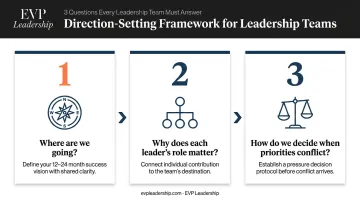
A practical way to facilitate this is a structured team session built around three questions:
- Where are we going — and what does success actually look like in 12–24 months?
- Why does each leader's role matter specifically to that destination?
- How do we make decisions when priorities conflict?
Most teams skip the third question. That's a mistake — how a team navigates competing priorities under pressure determines whether strategy holds or collapses when execution gets hard.
Keep the Team Small
Team size matters more than most organizations acknowledge. J. Richard Hackman, whose research on team effectiveness is foundational in organizational behavior, advised that no work team should reach double digits — his preferred size was six. Research confirms that individuals in larger teams perform worse than those in smaller ones, as coordination costs and accountability diffusion rise with headcount.
For leadership teams, this is especially relevant. Adding members for political inclusion at the expense of functional coherence is a common mistake — and it makes direction-setting far harder to sustain.
Step 2: Assess Your Team's Blind Spots Honestly
You cannot fix what you cannot see, and leadership teams are reliably optimistic about how well they actually function.
PwC data highlights this gap sharply: 97% of HR leaders believe their organizations effectively develop talent, compared to 50% of business leaders and just 30% of employees. The higher you sit in the organization, the more filtered your view becomes. Leadership teams are not immune to this.
Methods for Honest Assessment
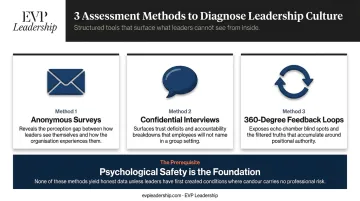
Structured assessment methods that surface real patterns include:
- Anonymous surveys sent to direct reports to reveal how the leadership team is perceived vs. how it perceives itself
- Confidential interviews that allow people to speak candidly about communication breakdowns, accountability gaps, and trust issues
- Facilitated 360-degree feedback loops that give leaders data they couldn't generate from within their own echo chamber
The goal isn't a performance review. It's identifying the gap between how the team believes it operates and how it actually operates.
What Good Assessment Actually Reveals
Here's a common pattern: a leadership team identifies a persistent tension between two leaders as an interpersonal conflict. The proposed solution is communication coaching or a mediated conversation.
But deeper assessment often reveals something different: the real issue is strategic misalignment or the absence of shared accountability. The two leaders are each optimizing for different priorities because no one has clearly resolved which priority wins when they conflict. The interpersonal friction is a symptom, not the source.
Surfacing the real issue changes what needs to be fixed — and it also changes what the team needs to feel safe enough to name it honestly.
Psychological Safety as a Prerequisite
None of this works without psychological safety: the shared belief that it's safe to speak up, raise concerns, and acknowledge failure without penalty. Amy Edmondson's research on team psychological safety found it to be the single strongest predictor of team learning and performance — above individual talent or experience.
The fastest way to create it is for the most senior leader in the room to model it first — acknowledging a blind spot of their own before asking others to do the same. Teri Evans, EVP Leadership's Leadership Facilitator, opens every team alignment engagement this way: the leader goes first, so the room knows it's safe to follow.
Step 3: Align Collective Behaviors to Strategic Goals
Most leadership teams align on goals. Far fewer align on the specific behaviors required to achieve them.
That gap is where strategies die. McKinsey's influence model identifies role modeling as one of the four mechanisms through which organizational change actually takes hold — not communication campaigns, not policy updates. Visible, repeated behavior from leaders at the top.
From Goals to Behaviors
The translation process is straightforward, but most teams skip it. Once strategic priorities are set, ask the team: What does this strategy require us to do differently as a team?
Then convert the answers into specific, observable behaviors — not values statements, not aspirational phrases. Specific behaviors that can be seen, practiced, and measured.
For example:
- "We need to collaborate better" → Before escalating a conflict, each leader speaks directly to the other leader first
- "We need to move faster" → Decisions within each leader's domain don't require full-team approval
- "We need to hold each other accountable" → Every leader reports progress on their commitments at each team meeting — no exceptions
Own the Change Internally
One principle EVP Leadership holds consistently: behavioral change is not an HR program. When the leadership team designs and owns the behavioral commitments they want to hold themselves to, accountability follows. When it's delegated to HR or an external program, it becomes someone else's initiative — and compliance replaces ownership.
When the leadership team visibly models the behaviors they expect across the organization, it communicates cultural expectations more powerfully than any policy document. What the team does consistently becomes what the organization believes is acceptable — and that's a more durable culture lever than any onboarding deck or values poster.
Step 4: Condition Your Team for Consistency Under Pressure
This is where most teams lose momentum — not because the alignment wasn't real, but because conditioning never followed.
Training is episodic. A workshop, a retreat, a facilitated session — these create awareness and, at best, intention. Conditioning is something different: the daily and weekly practice of specific behaviors until they become automatic. What the team defaults to when stakes are highest, not what they perform during a structured session.
EVP Leadership's core thesis applies here directly. Under pressure, leaders don't rise to expectations. They fall back on their conditioning. If the team hasn't built those habits through consistent, deliberate practice, pressure will expose the gap.
What Conditioning Looks Like in Practice
Conditioning doesn't require a new agenda. It requires a consistent one:
- Dedicate 5–10 minutes in every leadership meeting to review behavioral commitments and name what's working or breaking down
- Use structured debriefs after major decisions, project completions, or crises — research across 46 samples found properly conducted debriefs improve team performance by 20%–25%
- Revisit team effectiveness assessments quarterly to keep the team honest about progress
- Build peer accountability structures so the conditioning doesn't depend on any single leader
The Most Common Failure Point
Teams align quickly. Momentum is harder to hold.
The pattern is predictable: urgency fades, individual priorities compete, and the behavioral commitments that felt important in the alignment session get dropped. Within 60–90 days, the team has largely reverted.
Preventing this requires structure, not willpower:
- Tie shared team behaviors to shared goals with shared visibility
- Make the senior leader's modeling of new habits visible and consistent — not performative, but real
- Build review cadence into the operating rhythm so it's a standing expectation, not an add-on
The 90-Day PressurePoint System
For leadership teams that need this conditioning work to be structured and sustained, EVP Leadership's 90-Day PressurePoint System was built for exactly this context. It's not a training program. It's a conditioning engagement — designed to build the habits, decision capacity, and behavioral discipline that leadership teams need to perform consistently under the pressures of growth, complexity, and change.
The system works through three layers:
- Identity Layer — builds consistency, capacity, and character at the individual leader level
- Diagnostic Layer — trains leaders to see clearly and think decisively across six dimensions
- Execution Layer — installs a repeatable protocol for high-stakes moments
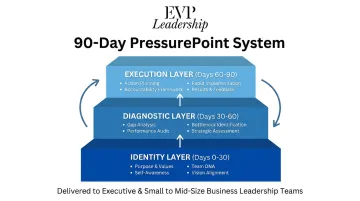
Delivered to executive teams and small/mid-size business leadership groups by Gennifer Baker and Teri Evans, the program ends with habits and decision frameworks the team owns — and keeps using.
Frequently Asked Questions
What are the key traits and principles for developing leadership teams?
High-performing leadership teams share four fundamentals: shared direction, trust, behavioral discipline, and the ability to execute consistently under pressure. None of these are personality traits. All of them must be practiced and conditioned — which is why one-off retreats rarely produce lasting change.
How long does it take to build a high-performing leadership team?
Meaningful team cohesion and behavioral alignment typically takes months of sustained effort, not weeks. The 90-Day PressurePoint System represents a strong foundation, but the most effective teams treat development as ongoing conditioning rather than a fixed-duration program.
What is the difference between a leadership team and a management team?
A management team focuses on operational execution and functional oversight. A leadership team is accountable for setting strategic direction, aligning the organization, and modeling the behaviors and culture that drive long-term performance. The distinction isn't just semantic — it changes what the team needs to focus on together.
How do you measure the performance of a leadership team?
Key indicators include strategic alignment across the team, consistency of decision-making, employee engagement levels, execution against strategic priorities, and qualitative feedback from direct reports. Regular structured reviews and team effectiveness surveys track these over time.
What are the most common mistakes leaders make when building a leadership team?
The most frequent mistakes: prioritizing individual skills over team dynamics, skipping honest assessment, delegating behavioral change to HR rather than owning it, and treating team development as a one-time event — the most costly error of all, because alignment without conditioning always fades.
How often should a leadership team assess its own effectiveness?
Quarterly formal assessments work well for most teams, supplemented by lighter check-ins built into the regular meeting rhythm. The cadence matters less than making it non-negotiable — skipped reviews are the first sign a team has stopped holding itself accountable.