McKinsey's 2021 transformation research found that only about 30% of organizational transformations improve and sustain performance. The often-quoted 70% failure rate traces to Beer and Nohria's 2000 HBR article, though peer-reviewed research cautions that figure lacks hard empirical backing. Either way, the message is the same: the odds are against you unless you build transformation differently.
Making change stick requires more than a solid plan. It demands leadership alignment before anyone else is asked to move, genuine stakeholder buy-in before the rollout, disciplined execution habits over months—and leaders who are conditioned, not just trained, to hold the line when pressure builds.
This guide covers when transformation is genuinely needed, what must be in place before you start, a five-step leadership approach, and the variables that determine whether change lasts.
Key Takeaways
- Lasting transformation requires a unified leadership vision, not announcements alone
- Stakeholder engagement before the rollout reduces resistance and builds lasting buy-in
- Change management and strategy implementation are separate disciplines—both are required
- Leadership capacity gaps—not flawed plans—are the most common reason transformation fails
- Consistent conditioning habits—not one-time training events—are what make change last
When Transformation Is the Right Move—and When It Isn't
Not every business problem calls for transformation. Transformation means fundamental shifts in strategy, structure, culture, or operating model—not a process tweak or a team restructure.
Signals That Transformation Is Genuinely Needed
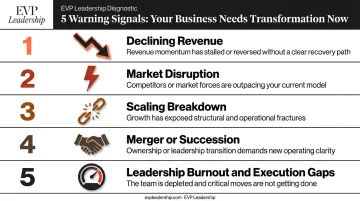
These are conditions where incremental improvement won't close the gap:
- Revenue has declined for multiple periods and staying the course is no longer defensible
- Market or technology disruption has eroded competitive position
- Systems that worked at 20 people are collapsing at 80 — scaling has outrun structure
- A merger, acquisition, or leadership succession requires a fundamentally different operating model
- Burnout and bottlenecks at the top are compounding with low ownership and inconsistent execution throughout the organization
EVP Leadership sees this pattern regularly in small and mid-size businesses. The strategy is often sound — what's missing is readiness. Leaders haven't been conditioned to think clearly or execute with discipline under sustained pressure. That gap signals a need for transformation, not incremental coaching.
When Transformation Is the Wrong Call
Transformation is expensive in resources, attention, and organizational trust. Launching it prematurely creates resistance that makes future change harder.
Consider operational fixes, team coaching, or process improvement when:
- The core issue is isolated to one function or team
- Leadership is aligned and capable but execution is inconsistent
- The problem has a clear, bounded solution that doesn't require restructuring how the organization operates
Prosci's change management research identifies the real cost of poorly managed change: resistance, disengagement, lower productivity, project delays, and loss of valued employees. Those costs compound when leaders launch transformation before the organization is ready.
What Leaders Must Have in Place Before Transformation Begins
Preparation is the most underestimated variable in transformation success. Leaders who skip this phase find themselves mid-initiative with no shared language, eroded stakeholder trust, and no clear ownership. According to McKinsey, 25% of transformation value is lost during target setting alone—before implementation even begins.
Leadership Alignment and Self-Assessment
Think of a leadership team as a crew rowing toward the same destination. If even two people are pulling toward different shores, the boat circles. Conflicting priorities at the top create communication silos, mixed messages, and teams that stall waiting for clarity.
McKinsey reports that transformations are 6.3x more likely to succeed when senior leader messages are aligned, and 5.3x more likely when senior leaders actively role-model desired changes. Alignment isn't agreement on the vision statement—it's agreement on priorities, success metrics, and what each leader will do differently starting Monday.
Leaders also need to honestly assess their own capacity to operate under transformation pressure. This is where the distinction between training and conditioning matters. EVP Leadership's 90-Day PressurePoint System is built on this principle: under pressure, leaders don't rise to expectations—they fall back on their conditioning.
The system's Identity Layer develops three pillars leaders need before transformation demands them:
- Consistency — acting in alignment with values over time
- Capacity — handling complexity, responsibility, and pressure without reverting
- Character — ensuring those strengths are applied with integrity
Building this foundation before a transformation rollout is what separates leaders who hold the line from those who revert.
Stakeholder Mapping and Baseline Assessment
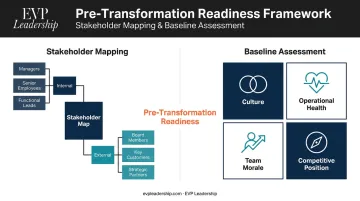
Stakeholder mapping identifies who has input, who is affected, and who can accelerate or block progress. Done before strategic planning begins, it prevents late-stage resistance that derails execution. Stakeholders typically fall into two categories:
- Internal: managers, senior employees, and functional leads
- External: board members, key customers, and strategic partners
Alongside mapping, leaders need an honest baseline across four dimensions: current culture, operational health, team morale, and competitive position. Internal surveys, third-party evaluations, and leadership interviews surface reality that internal optimism obscures. That baseline makes goal-setting grounded rather than aspirational—and serves as the reference point for measuring progress throughout the transformation.
How to Lead Organizational Transformation That Sticks
Transformation with staying power follows a defined sequence. Skipping or rushing any phase increases the likelihood that change reverses once pressure builds.
Step 1: Align Your Leadership Team Around One Clear Destination
Surface agreement is not alignment. Teams must align on vision, priorities, and what success looks like in concrete, measurable terms—not just a shared slide deck.
The risk is what might be called the multiple destination trap: each leader pursues their own interpretation of the change. One pushes operational efficiency, another prioritizes culture, a third focuses on revenue targets. The organization receives three different signals and picks the path of least resistance, which is typically the one that requires no change at all.
Close this gap through facilitated alignment sessions that produce a singular agreed-upon future state. Every leader should be able to communicate the transformation destination in the same language, with the same priorities, before anyone else in the organization is asked to move.
Teri Evans at EVP Leadership facilitates this kind of executive alignment work across healthcare, education, nonprofit, and business leadership teams. The explicit goal: moving teams from surface agreement to genuine shared direction.
Step 2: Engage Stakeholders Before You Roll Out the Plan
Buy-in must be built before the plan is announced, not after. Pre-rollout engagement should include:
- Employee surveys to surface concerns and questions before decisions are final
- Small group sessions with managers and functional leads
- One-on-one conversations with high-influence stakeholders
- Board-level briefings where governance is involved
McKinsey's research puts a sharp number on what happens when this step is skipped: transformations that fail to engage line managers and frontline employees succeed only 3% of the time. When people feel heard before decisions are made, they are far more likely to support the change when it directly affects them.
Step 3: Build a Strategic Roadmap with Focused, Measurable Goals
A transformation roadmap includes:
- Current state assessment (the honest baseline from Step 0)
- Future state vision with specific, measurable outcomes
- Identified risks and dependencies
- A limited set of ranked strategic priorities
- SMART goals within each priority with clear ownership and timelines
- Early wins that signal momentum to the broader organization
Research on transformation failure points to the same pattern repeatedly: organizations that pursue too many priorities simultaneously stall out. The discipline of choosing what not to focus on is where most roadmaps collapse under their own weight—and where most organizations underinvest their planning time.
Step 4: Manage the Human Side of Change
Structural changes move faster than people do. Effective transformation requires deliberate change management that addresses how people experience uncertainty, loss of familiar routines, and shifts in authority.
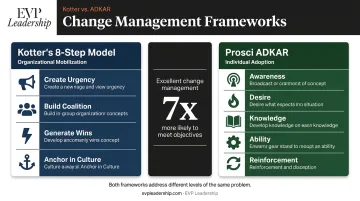
Two established frameworks offer practical structure:
- Kotter's 8-Step Model focuses on organizational mobilization—creating urgency, building a guiding coalition, generating short-term wins, and anchoring change in culture
- Prosci ADKAR focuses on individual adoption—moving each person through Awareness, Desire, Knowledge, Ability, and Reinforcement
Both are useful; they address different levels of the same problem. Prosci's research is direct on the stakes: initiatives with excellent change management are 7x more likely to meet objectives and 4.6x more likely to stay on schedule.
Cascading buy-in requires the leadership team to communicate consistently, equip managers to answer questions and model the change, and ensure every employee understands not just what is changing—but why it matters to them specifically.
Step 5: Sustain Transformation Through Consistent Implementation Habits
Most organizations invest heavily in planning and underinvest in implementation. The plan takes weeks to build. Sustained execution takes years—and that's where transformations quietly stall.
Disciplined implementation looks like:
- Regular strategy reviews (weekly or bi-weekly at minimum)
- Progress tracked against defined metrics, not anecdotal updates
- Clear accountability: named owners for each priority, not shared ownership that becomes no ownership
- Willingness to course-correct without abandoning the direction
- Leadership behaviors that model the new normal consistently
Transformation takes hold when it moves from a leadership initiative to an organizational operating habit. The PressurePoint System's Momentum Control diagnostic addresses this directly—asking whether the organization is making measurable progress on what actually matters, and building the consistency required to sustain it.
Key Variables That Determine Whether Transformation Lasts
Two organizations can follow the same transformation process and get very different results. The difference is in variables that must be actively managed.
Leadership Capacity Under Pressure
This is the most critical and most overlooked variable. Research on threat rigidity (Staw, Sandelands, and Dutton, 1981) established that individuals, groups, and organizations under threat restrict information processing, centralize control, and revert to well-learned responses. When leaders revert under stress, the signal sent to the organization is clear: this change isn't real.
The distinction between training and conditioning determines whether leaders hold the line. Training tells leaders what to do. Conditioning builds the internal capacity to do it consistently when the stakes are highest.
EVP Leadership's PressurePoint System addresses this directly—conditioning leaders to carry transformation through sustained pressure rather than reverting to instinct when the environment gets hard.
Communication Consistency and Cultural Alignment
Transformation dies in communication gaps. Inconsistent messaging from different leaders, delayed updates, or unexplained decisions erode trust faster than almost any other factor. McKinsey's 6.3x success multiplier for aligned senior messaging makes communication discipline a measurable lever, not a soft skill.
Communication discipline and cultural alignment are connected. Values and behaviors that contradict the new direction will quietly undermine even well-designed plans. Leaders must diagnose and address cultural misalignment during the transformation process—not wait until rollout is complete and wonder why behaviors haven't changed.
Accountability Structures and Progress Tracking
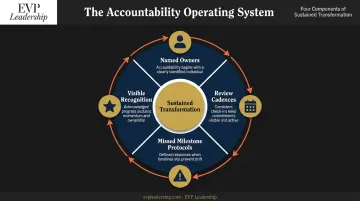
Transformation without a tracking system is optimism with a deadline. Functional accountability requires:
- Named owners for each strategic priority
- Regular review cadences with defined agendas
- Clear protocols for what happens when milestones are missed
- Visible recognition when milestones are hit
EVP Leadership's work on delegation, accountability, and operating discipline treats these elements as a connected operating system—not isolated skills. A scorecard and a 1:1 cadence aren't bureaucracy. They're what separates transformations that sustain from ones that stall quietly after the launch energy fades.
Common Mistakes Leaders Make That Kill Transformation
Most transformation failures aren't strategic — they're behavioral. The same three mistakes surface repeatedly across organizations of every size.
Launching without leadership alignment. Misaligned leaders send competing signals that confuse teams and stall momentum. It's the most common failure point, and often invisible until the damage is done. According to Harvard Business Publishing, 47% of executives said they should have spent more time aligning the top team before launching strategic change.
Treating change management as optional. Leaders who focus entirely on strategy and roadmap while skipping deliberate people-side management consistently face resistance, quiet disengagement, and eventual rollback. Prosci research shows that excellent change management makes success 7x more likely.
Declaring victory too early. Kotter is explicit: premature victory declarations are catastrophic because new behaviors are fragile until they sink into culture. Short-term wins should be planned within 12–24 months, but anchoring change in culture can take 5–10 years.
When leaders celebrate early momentum and pull back focus before new behaviors are fully embedded, the organization reverts — often faster than the change was built.
Frequently Asked Questions
What are the 5 stages of strategic planning?
The five commonly cited stages are: current state assessment, vision/future state definition, strategic goal setting, action plan development, and monitoring and adjustment. Transformation-focused planning adds a deliberate change management layer to each stage to address adoption alongside execution.
What are the 3 types of strategic planning?
The three most widely recognized types are operational, tactical, and strategic. Transformational planning is the approach most relevant when fundamental shifts in culture, structure, or business model are required—it operates at a longer horizon and demands higher leadership commitment than the others.
What are the 4 pillars of digital transformation?
A well-established digital transformation framework identifies four pillars: IT infrastructure uplift, digitizing operations, digital marketing, and new ventures. Whether digital or broader in scope, effective transformation requires all four addressed in parallel—technology changes alone, without people, process, and strategy alignment, rarely hold.
What is the difference between organizational change and organizational transformation?
Change is typically incremental—it adjusts existing processes or structures. Transformation is a fundamental reimagining of how an organization operates, competes, or delivers value. Transformation requires a longer implementation horizon, deeper leadership commitment, and deliberate attention to culture—not just operational redesign.
Why do most organizational transformations fail?
The most common root causes are lack of leadership alignment, insufficient change management, inconsistent communication, and the gap between a well-designed plan and the leadership capacity to execute it under sustained pressure. Strategy quality is rarely the problem. Leadership readiness almost always is.
How long does organizational transformation typically take?
Kotter's research provides the most grounded anchors: short-term wins should be visible within 12–24 months, but anchoring change in culture typically requires 5–10 years. Transformation is better understood as an ongoing leadership discipline than a project with a fixed end date.