Introduction
Most change management initiatives stall for the same reason: the rollout plan is solid, the communications calendar is built, the training is scheduled — and then nothing takes hold. Not because employees pushed back, but because the leaders driving the change were never genuinely aligned with where it needed to go.
Leadership misalignment is one of the most common — and least acknowledged — reasons organizational change fails. According to McKinsey, large-scale transformations fail roughly 70% of the time, with leadership-related pitfalls consistently at the center: unclear direction, consensus-based decisions over fact-based ones, and failure to sustain performance disciplines.
Change management consulting for leadership realignment addresses this gap directly. The focus is on the leaders steering the transition — ensuring they have the clarity, behavioral consistency, and communication discipline the change actually requires. For small business owners, entrepreneurs, and C-suite leaders at mid-size organizations, where the leader's behavior shapes everything, that alignment isn't optional.
This article covers the warning signs that leadership realignment is needed, what a consultant actually does, what the process looks like, and how to choose the right partner.
Key Takeaways
- Leadership realignment consulting reshapes how leaders show up, make decisions, and drive performance — not just how their teams respond.
- Misaligned leadership is a structural problem, not a personality issue — and it's addressable with the right process.
- Effective realignment requires behavioral conditioning over time, not one-time training events.
- The right consulting partner builds leadership capacity that holds after the engagement ends — no ongoing dependency required.
What Is Change Management Consulting for Leadership Realignment?
Change management consulting helps organizations plan, execute, and embed transitions with minimal disruption. Most discussions center on employee adoption. Leadership realignment consulting focuses upstream: it zeroes in on the executives and owners who are supposed to drive the change.
Leadership realignment is distinct from standard leadership development. A specific organizational shift triggers it — scaling, restructuring, a strategic pivot, significant team changes. The work is about closing the gap between how a leader currently operates and what the new direction actually demands from them.
Why This Matters Most at the Small and Mid-Size Scale
At large enterprises, misaligned leadership creates friction. At small and mid-size businesses, it creates failure. The reasons are structural:
- The leader's behavior is the culture. There's no thick management layer to absorb or correct it.
- Decision velocity depends on the leader's clarity. When that clarity is absent, teams stall.
- Communication travels faster in smaller organizations — which means inconsistency at the top spreads faster too.
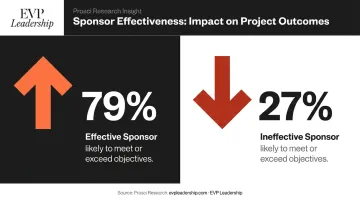
Prosci research puts numbers to what many leaders sense intuitively: projects with extremely effective sponsors are 79% likely to meet or exceed objectives, compared to 27% for those with ineffective sponsors. The sponsor — the senior leader driving the change — is the variable that matters most. And in small and mid-size businesses, that sponsor is almost always the owner, founder, or CEO.
That's what separates leadership realignment consulting from generic change management work. The leader isn't just sponsoring the transition — they're inside it. The engagement is designed to address both roles simultaneously.
Signs Your Leadership Team Needs Realignment
Leaders rarely self-diagnose misalignment. The signs tend to surface elsewhere — in team performance, communication patterns, and decision quality. Here are four that consistently indicate a leadership realignment problem.
Strategic Decisions Keep Stalling or Reversing
When leadership hasn't genuinely internalized a new direction, decision-making becomes inconsistent. Priorities shift without explanation, teams receive conflicting signals, and momentum that builds one week dies the next.
The leader is still operating from an older mental model while trying to execute a new one. That gap shows up directly in their decisions — and the team feels it.
Communication Is Creating Confusion Instead of Clarity
Misaligned leaders often say the right things in meetings. The problem is what happens outside of them:
- Resource allocation decisions that contradict stated priorities
- Reactions under pressure that reveal the old model is still the real one
- Inconsistent messaging as the initiative moves through different layers of the organization
Prosci identifies that key change messages need to be repeated five to seven times to land. But repetition doesn't help if the message being repeated isn't consistent. Communication clarity is a leadership conditioning challenge, not just a messaging problem.
Resistance Is Coming from the Top, Not Just the Team
Organizations typically focus on employee resistance to change. But the more consequential resistance in small and mid-size businesses often sits in the leadership layer itself — showing up as:
- Avoidance of difficult decisions the new direction requires
- Reversion to micromanagement when the transition creates pressure
- Unconscious protection of the old operating model through resource and priority choices
Prosci reports that 43% of organizations identify mid-level managers as the group most resistant to change. In smaller organizations, that resistance often extends into — or originates from — the ownership and executive layer.
Growth or Transition Has Outpaced Leadership Capacity
Scaling, restructuring, or entering new market complexity doesn't automatically expand a leader's capacity to lead through it. There's often a real gap between where a leader's current operating patterns sit and what the role now demands.
The business has grown; the leadership system simply hasn't kept pace. Realignment consulting exists to close that gap — systematically, not symbolically.
What a Change Management Consultant Does for Leaders
The scope of a leadership realignment engagement goes well beyond training delivery. Here's what effective consultants actually do.
Conduct a Leadership Readiness and Alignment Assessment
Before any strategy is built, the consultant maps the current state: where leadership mindsets, behaviors, and communication patterns are today versus what the change initiative requires. This diagnostic work typically includes stakeholder input, communication audits, and strategic clarity interviews.
At EVP Leadership, this phase draws on structured frameworks — examining mission clarity, decision integrity, force alignment, and execution discipline — to pinpoint exactly where the gap lives before any conditioning work begins.
Develop a Customized Realignment Strategy
The result isn't a generic framework applied to the client's situation. It's a plan tied to the organization's actual transition, the leader's existing strengths, and the specific decision-making and communication patterns that need to shift.
Generic leadership development programs skip this step — realignment work can't afford to. The behavioral objectives have to be specific to the change the organization is making, which means they typically address:
- Decision-making patterns that break down under pressure
- Communication habits that create ambiguity at lower levels
- Execution gaps between stated strategy and day-to-day behavior
- Leadership identity shifts required by the transition itself
Provide Behavioral Conditioning, Not Just Information Transfer
This is the critical differentiator. Harvard Business Review's analysis of why leadership training fails points to a consistent culprit: training is treated as a standalone event rather than connected to the organizational context and role demands where behavior actually needs to change.
Effective consultants work with leaders repeatedly and deliberately — applying frameworks under realistic business pressure so new behaviors become conditioned responses, not conscious recall exercises.
EVP Leadership's 90-Day PressurePoint System is built on exactly this principle. The firm's positioning is direct: leaders don't rise to expectations under pressure — they fall back on their conditioning. The 90-day structure conditions new leadership habits through real scenarios, not simulated training environments.
Align Executive Messaging Across Organizational Levels
During a transition, executives need messaging that holds at every level — what's said in the boardroom must mirror how managers communicate change to their teams. Consultants build that alignment deliberately and reinforce it throughout the engagement.
McKinsey's research found that transformations are 8x more likely to succeed when senior managers communicate openly about progress — and 12.4x more likely to succeed in enterprise-wide efforts with continual communication from senior leaders. The leverage point is at the top.
Measure Progress and Reinforce Adoption Over Time
Sustainable realignment requires feedback loops — not a one-time debrief. Effective consultants track behavioral indicators throughout the engagement, identify backsliding patterns, and course-correct in real time. The goal is durable change, not temporary improvement.
The Leadership Realignment Process: What to Expect
A structured leadership realignment engagement typically moves through four phases.
Phase 1 — Assess and Diagnose
The consultant maps the gap between current leadership behavior and what the transition demands. This includes stakeholder interviews, communication audits, and strategic clarity sessions. The output is a clear picture of where leadership is misaligned and what that misalignment is costing the organization — specific enough to act on immediately.
Phase 2 — Build the Realignment Plan
The consultant develops a structured plan with specific behavioral objectives, communication frameworks, and a timeline. Leaders get a concrete system to execute against, not a vague collection of development goals.
Phase 3 — Condition and Execute
This is the active work phase, and it's where most consulting engagements fall short. The consultant works alongside the leader through real-world scenarios, applying frameworks under actual business pressure. The conditioning has to happen in context, not in a classroom.
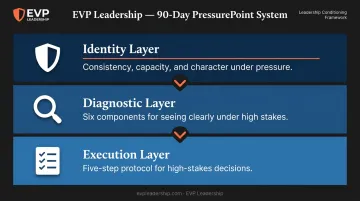
EVP Leadership's 90-Day PressurePoint System is designed for this phase. It moves leaders through three structured layers:
- Identity Layer — consistency, capacity, and character under pressure
- Diagnostic Layer — six components for seeing clearly when the stakes are high
- Execution Layer — a five-step protocol for high-stakes decisions
The 90-day timeframe is deliberate. Long enough to condition new habits. Short enough to keep the work focused.
Phase 4 — Reinforce and Sustain
The final phase focuses on embedding new behavior so realigned leadership continues beyond the engagement. This means building internal systems the leader can maintain independently:
- Decision-making frameworks and operating rituals
- Communication cadences and accountability structures
- Delegation protocols and execution rhythms
- A leadership resilience system that doesn't require ongoing external support to function
The goal is leadership capacity that holds long after the engagement ends.
Benefits of Leadership-Focused Change Management Consulting
Faster, More Durable Organizational Change
When leadership is genuinely aligned, change moves through the organization with far less friction. Employees take behavioral cues from leadership — when those cues are consistent, adoption accelerates. When they're inconsistent, skepticism fills the gap.
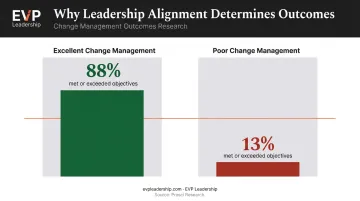
Prosci's research shows that 88% of projects with excellent change management met or exceeded their objectives, compared to 13% with poor change management. Leadership alignment is the upstream variable that determines where on that spectrum a change initiative lands.
Stronger Decision-Making Under Complexity and Pressure
The conditioning work translates directly into executive performance in high-stakes decisions and high-pressure moments. Leaders who have been conditioned — not just trained — show up differently in those moments: clearer, more decisive, less reactive. That composure prevents the reactive decisions that derail strategy.
Reduced Burnout and Unsustainable Leadership Patterns
Many small business owners and C-suite leaders who seek change management help are also experiencing the symptoms of an unsustainable operating model: decision fatigue, chronic overload, declining capacity.
EVP Leadership treats burnout as a systemic operational issue, not a personal failing. The realignment process targets the root causes directly:
- Over-scope and the absence of clear priorities
- Poor delegation and weak accountability structures
- No recovery cadence built into the leadership operating model
Addressing these patterns restores leadership capacity — and keeps it sustainable beyond the engagement.
How to Choose the Right Change Management Consultant for Leadership Realignment
Look for Conditioning-Focused Methodology, Not Just Training Delivery
Ask prospective consultants a direct question: How do you build and reinforce new leadership habits over time, not just in a workshop?
Consultants who deliver models and frameworks but don't work with leaders long enough to change actual behavior under pressure are selling information, not realignment. The Center for Creative Leadership's research on the 70-20-10 model is relevant here: roughly 70% of leadership learning comes from challenging on-the-job experiences, not coursework.
Prioritize Strategic Partnership Over Project-Based Engagements
The best realignment outcomes come from consultants embedded in the leader's real business context — who understand the goals, culture, team dynamics, and specific pressure points. A curriculum delivered to your leadership team is not the same as a partner working alongside you through the actual transition.
Gennifer Baker, founder of EVP Leadership, brings more than 30 years of experience advising C-suite executives and small business owners. Her executive consulting work integrates strategic planning with leadership conditioning — addressing both the business direction and the leader's capacity to execute it at the same time.
Evaluate Track Record with Similar Organizational Contexts
Small and mid-size businesses face different leadership pressures than large corporations. Founder identity fusion with the business, concentrated decision-making, limited management layers, and resource constraints all shape what leadership realignment work needs to look like.
Seek consultants with specific experience at your stage and scale. Enterprise case studies don't reliably translate to a 50-person company navigating a strategic pivot. When evaluating fit, look for:
- Direct experience with founder-led or owner-operated businesses
- Engagements that addressed decision-making under real operational pressure
- Track record at your revenue range or headcount stage — not just Fortune 500 references
Frequently Asked Questions
What is leadership realignment in change management?
Leadership realignment is the process of shifting a leader's mindset, communication patterns, and operating behaviors to align with a new organizational direction. The goal is to ensure the people driving the change aren't inadvertently creating the biggest obstacle to it.
How do I know if my leadership team needs realignment?
The most telling signs: inconsistent or reversing decisions, communication that creates confusion rather than confidence, team-wide resistance that traces back to unclear direction from the top, and leadership capacity that hasn't scaled with the organization's growth or complexity.
How much does a change management consultant cost?
Costs vary based on engagement scope, number of leaders, duration, and firm size. The more useful calculation, though, is the cost of a failed change initiative weighed against the investment in preventing it. EVP Leadership offers a complimentary scoping conversation before any engagement is priced.
What are the key C's of change management?
Most versions include: Clarity, Communication, Commitment, Capacity, and Culture. For leadership realignment specifically, Commitment and Consistency are where most gaps live — and where the work tends to be hardest.
What are the 5 P's of change management?
A common version includes: Purpose, People, Process, Platforms, and Progress. When leaders are the primary subject of the change effort, Purpose and People demand the most attention — and the most honest assessment.