Most organizations recognize this. The problem is that recognition rarely translates into results. Leaders attend workshops, run off-sites, and bring in facilitators — then watch the same dysfunction resurface six weeks later. The issue isn't effort. It's approach.
According to Gallup's 2026 State of the Global Workplace report, only 20% of employees worldwide were engaged in 2025, costing the global economy an estimated $10 trillion in lost productivity. For small and mid-size business leaders, that number lands closer to home than most Fortune 500 statistics do.
This article walks through a practical, step-by-step approach to building a cohesive, high-performing team — covering what conditions must be in place before training begins, which variables most affect outcomes, and what common mistakes leaders need to stop making.
Key Takeaways
- Team development produces lasting results only when it's treated as ongoing conditioning — not a single workshop
- Leaders must assess team dynamics and build psychological safety before formal development begins
- High-performing teams share clear goals, defined roles, open communication, and mutual accountability
- The leader's own behavior is the single biggest variable in whether team development sticks
- Proactive investment outperforms reactive intervention — dysfunction is far harder to reverse than it is to prevent
How to Build a Cohesive, High-Performing Team
Step 1: Assess Your Team's Current Stage and Dynamics
Before any intervention, you need an honest read on where your team actually stands.
Bruce Tuckman's four-stage model — published in the Psychological Bulletin in 1965 after reviewing 50 studies on group development — remains the most practical diagnostic framework for this. The four stages are:
| Stage | What's Happening | Leader's Priority |
|---|---|---|
| Forming | Orientation, testing, dependence | Clarify purpose, roles, authority |
| Storming | Conflict, resistance to structure | Surface issues, create safety |
| Norming | Cohesion and norms emerging | Codify standards, reinforce trust |
| Performing | Focused execution and adaptability | Remove friction, sustain momentum |
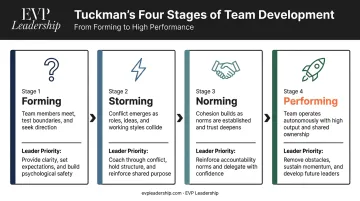
Why does this matter? A team in storming needs conflict navigation and trust-building. A team in norming needs structure reinforcement. The same intervention applied to both produces different results — often poor ones when mismatched.
When assessing team health, look specifically for:
- Recurring conflict that doesn't resolve
- Communication breakdowns between functions or roles
- Accountability gaps where outcomes have no clear owner
- Misalignment between team behavior and organizational priorities
- High turnover or persistent disengagement
Step 2: Establish Shared Goals, Roles, and Expectations
Unclear expectations are one of the most measurable causes of underperformance. Gallup reports that only about half of employees strongly agree they know what is expected of them at work — and improving clarity to best-practice levels can produce a 9% increase in profitability and an 11% improvement in work quality.
Training efforts without shared direction are almost always wasted effort. Before any skill-building begins, align the team on:
- Where the team is going — specific, measurable goals tied to organizational priorities
- Who owns what — defined roles with clear decision-making authority
- How the team will work together — behavioral standards, communication norms, conflict resolution protocols
A team charter or team agreement is a practical tool for capturing this alignment. Co-created with the team rather than handed down, it functions as a behavioral contract — covering how success will be measured, how disagreements will be resolved, and what accountability looks like in practice.
EVP Leadership's facilitation engagements typically begin with this alignment work, delivered as half-day or full-day sessions for executive and leadership teams.
Step 3: Build Psychological Safety and Trust Intentionally
Google's Project Aristotle studied hundreds of teams and found that psychological safety was the single most important factor in team effectiveness — ranking above dependability, structure, meaning, and impact.
Psychological safety is the shared belief that team members can speak up, challenge ideas, and take risks without fear of punishment or embarrassment. It's not comfort. It's the confidence to be honest.
Leaders build or erode it through consistent, daily behavior. Specifically:
- Consistency between words and actions — saying one thing and doing another destroys trust faster than almost anything else
- Active listening without defensiveness — when a leader reacts poorly to pushback, the team stops pushing back
- Transparency in difficult moments — withholding information creates speculation and anxiety
- Creating space for dissenting opinions — the best decisions usually come after disagreement, not despite it
Teri Evans, EVP Leadership's Leadership Facilitator, developed this approach through early work in music therapy and pediatric care settings — environments where psychological safety wasn't a framework concept; it was a clinical prerequisite. That grounding shapes how she sequences team development: trust first, everything else second.
Step 4: Condition Consistent Behaviors Through Structured Practice
This is where most team development programs fail.
Training transfers knowledge in a single event. Conditioning changes how people respond when the pressure is real — built through repetition, reinforcement, and structured accountability over time. As EVP Leadership's core philosophy states: leaders don't rise to expectations — they fall back on conditioning.
Awareness isn't behavior change. The gap between the two is what most programs never close.
Structure ongoing development using these mechanisms:
- Regular feedback loops — structured conversations about what's working and what isn't, built into normal operating rhythm
- Team retrospectives — post-project or post-quarter reviews focused on how the team performed, not just what was delivered
- Accountability check-ins — recurring checkpoints where progress against behavioral commitments is measured
- Reinforcement between sessions — practicing key behaviors in real work contexts, not just in training environments
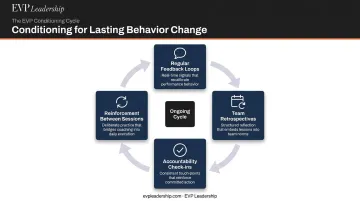
The EVP Leadership 90-Day PressurePoint System applies this conditioning logic to executive teams — building leadership muscle through repetition, diagnostic clarity, and structured accountability rather than relying on a single workshop to produce lasting change.
Signs Your Team Needs Development Training
Team development isn't reserved for teams in crisis. It's for any team that has grown, changed, or is being asked to perform at a higher level than before.
Signals that suggest structured development is overdue:
- Frequent miscommunication between team members or functions
- Siloed work with limited cross-functional collaboration
- Low accountability — outcomes without clear owners
- Difficulty executing plans consistently
- Conflict within the leadership team that isn't being addressed
- High turnover or growing disengagement
- New team forming after organizational change, merger, or leadership transition
Timing matters as much as intent. Gallup research found that 42% of voluntary employee exits were preventable — and that 45% of those who left said no leader had proactively discussed their job satisfaction or future in the three months before departure.
By the time dysfunction becomes visible, the costs in turnover, lost productivity, and broken trust are already compounding. Development works best as a proactive investment, not a last resort.
What to Prepare Before Starting Team Development Training
Preparation determines whether training sticks. Teams that enter development programs without leadership clarity, organizational readiness, or psychological safety often leave with new information and no behavioral change. Three conditions matter most.
Leadership Readiness
The leader must be prepared to model the behaviors they want the team to develop. Self-awareness, emotional capacity, and consistency under pressure are prerequisites, not soft skills. A leader who communicates one set of expectations and behaves differently under stress will undermine training outcomes regardless of program quality.
Team Alignment and Context
Before training begins, the team needs a shared understanding of current organizational goals and priorities. Development that is disconnected from real strategic challenges is perceived as optional — and optional behaviors don't get reinforced through daily work.
Structure and Follow-Through Plan
Define what accountability looks like after the formal sessions end:
- Who will reinforce new behaviors?
- How will progress be tracked?
- What does success look like at 30, 60, and 90 days post-training?
Without this structure, even strong development programs decay. EVP Leadership's accountability operating rhythm addresses this directly: scorecards, performance conversations, and execution discipline frameworks keep behavioral change from stalling once formal sessions end.
Key Factors That Determine Team Development Outcomes
Well-designed programs can still underperform. Outcomes depend on controllable variables that leaders consistently overlook.
Leader Behavior and Consistency
Gallup research shows managers account for at least 70% of the variance in employee engagement scores across business units. Teams mirror their leader — if the leader is inconsistent, conflict-avoidant, or reactive under pressure, the team will reproduce those patterns regardless of what was covered in training.
Frequency and Reinforcement
Skills introduced but not reinforced decay. Small, consistent behaviors practiced repeatedly in real work contexts outperform intensive but isolated training events.
McKinsey reports that senior-leader role modeling makes transformations 5.3 times more likely to succeed. Organizations that engaged at least 10% of employees in ongoing capability-building were twice as likely to improve organizational health scores.
Psychological Safety Level
Teams with low psychological safety withhold ideas, avoid accountability conversations, and disengage. Google's Project Aristotle placed psychological safety above every other factor in team effectiveness — including dependability and clarity. Amy Edmondson's foundational 1999 research confirmed the same: teams that feel safe enough to speak up learn faster — and teams that learn faster outperform those that don't.
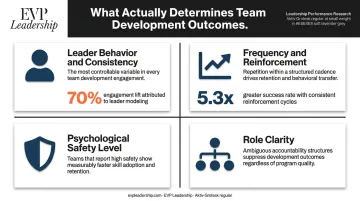
Team Composition and Role Clarity
Unclear roles create overlap, resentment, and wasted effort. When scope of authority is ambiguous, even motivated teams stall. Clarifying decision rights and role boundaries often improves execution immediately — no additional skill-building required.
Common role clarity gaps that slow teams down:
- Overlapping ownership of key decisions
- No defined escalation path when disagreements arise
- Confusion between advisory input and final authority
- Misaligned expectations on deliverable ownership
Common Mistakes Leaders Make in Team Development Training
Treating development as a one-time event. A single offsite produces awareness. Lasting change requires reinforcement, accountability, and repeated practice over time. Without follow-through structure, new behaviors revert within weeks.
Avoiding the leader's own examination. Many leaders invest in their team's development while avoiding honest examination of how their own behavior under pressure — how they communicate, tolerate poor performance, or sidestep conflict — is contributing to the dysfunction they're trying to fix.
Designing for the wrong problem. Designing a communication training when the real issue is role ambiguity. Running a conflict workshop when the actual problem is that the leader tolerates poor performance. Getting the diagnosis wrong doesn't just waste the investment — it reinforces the belief that development doesn't work.
Disconnecting development from strategic priorities. Training that feels unrelated to the team's actual challenges is perceived as optional. When development is anchored to real goals, the daily work itself becomes the reinforcement.
Conclusion
Building a cohesive, high-performing team requires more than a good training program. It requires conditioning consistent behaviors, establishing the right structural conditions, and maintaining accountability long after formal sessions end.
The strongest teams are built by leaders who practiced intentional, repeatable habits under real pressure — and who recognized that their own behavior was always the biggest variable in the room. That's not a training outcome. It's a conditioning outcome.
If your executive team is ready for that kind of structured development, EVP Leadership's team development facilitation and 90-Day PressurePoint System are designed for exactly that work. Schedule a complimentary scoping conversation to see where the gaps are and what structured development would look like for your team.
Frequently Asked Questions
What are the 5 C's of teamwork?
The 5 C's — commonly listed as Communication, Collaboration, Coordination, Cooperation, and Commitment — are a practitioner framework for describing the behaviors that strengthen team cohesion. The key point is that these behaviors must be practiced consistently, not just understood conceptually, to produce any real change in how a team operates.
What are the 4 C's of team development?
One widely used version of the 4 C's includes Clarity, Commitment, Contribution, and Concerns. Leaders can use this as a quick diagnostic for identifying whether roles are clear, members are bought in, and obstacles are being surfaced before they stall progress.
What are the 5 P's of a team?
The 5 P's — Purpose, Plan, People, Process, and Progress — are a practitioner model for evaluating whether a team has the structural foundations for high performance. Each element represents a condition that must be in place before a team can execute consistently.
What are the stages of team development?
Tuckman's four stages — forming, storming, norming, and performing — describe the developmental sequence most teams move through. Knowing which stage a team is in helps leaders choose the right interventions, since storming requires very different support than norming or performing.
What is the difference between team building and team development?
Team building refers to activities that strengthen relationships and improve morale — typically event-based. Team development is a broader, ongoing process focused on improving how a team functions, communicates, and performs against real strategic goals.
How long does team development training take to show results?
Initial awareness can shift quickly, but meaningful behavioral change typically requires sustained practice over 60–90 days. Results depend heavily on reinforcement from leadership throughout — without consistent follow-through, even well-designed programs produce awareness rather than lasting behavior change.