
A high-performing team has a specific, recognizable quality: members are aligned on purpose, accountable to each other, adaptive when circumstances change, and consistently delivering results beyond what most teams produce. That combination doesn't emerge on its own.
This article covers what actually defines a high-performing team, what a high-performance leader does differently, and the strategies that build and sustain that standard over time.
Key Takeaways
- High-performing teams run on trust, shared purpose, clear roles, and mutual accountability — not just individual skill.
- The leader's job is to create conditions where high performance happens consistently, not just in good weeks.
- Building this kind of team takes deliberate, repeatable behavior — not one-time workshops.
- Common mistakes like unclear expectations, conflict avoidance, and missing recognition steadily undercut performance.
- Sustained excellence requires conditioning leadership habits — because under pressure, leaders don't rise to expectations, they fall back on what they've practiced.
What Does a High-Performance Team Leader Actually Do?
There's a meaningful gap between managing tasks and leading performance. Managers direct work. High-performance leaders set the standard, model the behaviors, and build the environment where a team can operate at its best — not just on good weeks, but consistently.
Establish Shared Purpose (Most Leaders Skip This)
MIT Sloan Management Review found that only 28% of executives and middle managers responsible for executing strategy could name three of their organization's strategic priorities. Kaplan and Norton put the employee picture in sharper focus: 95% of employees either weren't aware of or didn't understand their company's strategy.
People can't perform at a high level toward a destination they can't see. High-performance leaders make purpose explicit, specific, and connected to each person's actual work.
Build Trust Deliberately
Trust doesn't accumulate passively. High-performance leaders build it through:
- Consistency — showing up the same way regardless of circumstances
- Transparency — communicating what they know, what they don't, and why decisions get made
- Follow-through — doing what they said they'd do, especially when it's inconvenient
Assumptions that trust will develop on its own are how leaders end up with teams that are polite but not honest with each other.
Lead Differently Under Pressure
The real test of a high-performance leader isn't how they behave on a good week. It's what happens when the deadline moves, a key person leaves, or a plan falls apart. Leaders who have built the right habits respond with clarity. Leaders who haven't revert to panic, avoidance, or micromanagement.
This distinction — between training and conditioning — defines EVP Leadership's framework. Training transfers knowledge; conditioning builds the habitual responses that actually hold up under pressure. As EVP Leadership's guiding principle states: leaders don't rise to expectations — they fall back on their conditioning.
The 90-Day PressurePoint System is built on exactly this premise: consistent practice of leadership behaviors, not occasional development events, determines how a leader performs when the stakes are high.
Key Characteristics of High-Performing Teams
Shared Purpose and Goal Clarity
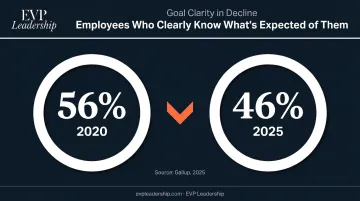
Every member understands the team's priorities, how success is measured, and how their contribution connects to the bigger picture. Ambiguity around goals is one of the most reliable predictors of underperformance. Gallup reported in 2025 that only 46% of U.S. employees clearly knew what was expected of them at work — down from 56% in 2020.
When that clarity is absent, effort gets scattered across the wrong things.
Clear Roles and Mutual Accountability
Clarity doesn't mean rigidity — it means everyone knows how the work fits together. When roles are unclear:
- Tasks get duplicated or dropped entirely
- Accountability becomes diffuse ("I thought someone else had it")
- Inter-team friction increases as people step on each other
Each member should know their own responsibilities and have a working understanding of their teammates'. That shared picture is what allows real accountability to function.
Psychological Safety and Trust
Google's Project Aristotle, which analyzed 180 teams across engineering and sales, identified psychological safety as the single most important factor in team effectiveness. Teams with higher psychological safety brought in more revenue, were rated effective twice as often by executives, and were less likely to leave the organization.
Psychological safety means people can raise concerns, admit mistakes, and challenge ideas without fear of retaliation. In its absence, teams become performative — people manage appearances instead of solving real problems.
Open, Consistent Communication
Strong teams establish communication rhythms that keep people aligned without waiting for a formal review cycle to surface problems. That typically includes:
- Regular check-ins with a clear agenda
- Transparent progress updates visible to the full team
- Real-time feedback loops between leaders and direct reports
The goal isn't more meetings — it's fewer surprises.
Adaptability Under Pressure
Teams that perform under pressure don't just survive disruption — they absorb it without losing momentum. That capacity starts at the top. Leaders who model calm, deliberate pivots make adaptability a team norm; those who freeze or overreact make anxiety the norm instead.
Constructive Conflict
Top-performing teams normalize productive disagreement. A 2012 meta-analysis across 116 studies found that task-focused conflict — particularly in leadership teams — was positively associated with decision quality and financial performance. Leaders set this tone by encouraging debate and ensuring disagreements stay focused on the work, not the people.
Strategies to Build and Lead a High-Performance Team
Invest in Consistent Development — Not Just Annual Offsites
One workshop won't build a high-performing team. High performance is built through repeated, deliberate investment in team behaviors over time. Practically, this can look like:
- A focused 30 minutes at the start of weekly leadership meetings
- Quarterly in-person working sessions with clear objectives
- Structured reflection after major projects to extract what worked and what didn't
The format matters as much as the frequency. EVP Leadership's facilitation work — led by Teri Evans — is built for exactly this kind of structured, ongoing development. Half-day, full-day, and multi-day formats help executive teams build trust, strengthen communication, and get aligned on purpose and execution.
Use Feedback as a Leadership Practice, Not a Review Event
Gallup found that employees receiving daily feedback were 3.6 times more likely to strongly agree they were motivated to do outstanding work than those receiving only annual feedback. Separately, 80% of employees who received meaningful feedback in the past week were fully engaged.
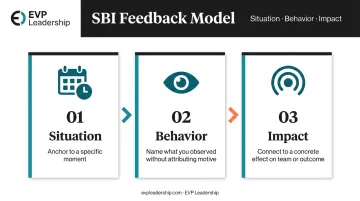
The SBI model (Situation–Behavior–Impact) gives leaders a practical structure for real-time feedback:
- Situation — anchor the feedback to a specific moment or event, not a general pattern
- Behavior — name what you actually observed, without attributing motive or character
- Impact — connect that behavior to a concrete effect on the team, the project, or the outcome
This shifts feedback from a corrective tool used reactively into a developmental practice used proactively.
Align Around a Small Number of High-Priority Goals
When every priority is urgent, nothing is. High-performance leaders identify the handful of goals that actually drive results — and make sure every team member is pointed in the same direction.
Locke and Latham's foundational goal-setting research, summarizing 35 years of empirical studies, found that specific, difficult goals consistently outperform "do your best" goals, with effect sizes ranging from .42 to .80. Google's OKR framework recommends three to five objectives maximum, with three key results per objective. More than that, and teams begin spreading effort too thin across too many directions to move decisively on any of them.
EVP Leadership's PressurePoint System addresses this directly through its Mission Clarity and Momentum Control diagnostics — both designed to help leaders cut through competing priorities and focus teams on what actually matters now.
Build Recognition Into the Leadership Rhythm
Recognition isn't a courtesy — it reinforces the behaviors that make high performance repeatable. Gallup and Workhuman found that well-recognized employees were 45% less likely to have changed organizations two years later, and employees receiving high-quality recognition were nine times more likely to be engaged than those receiving none.
Recognition doesn't require a formal program. It requires:
- Calling out specific behaviors publicly, not just outcomes
- Making the why visible — explaining what the behavior demonstrated and why it matters
- Doing it consistently, not just when performance is exceptional
Done consistently, this turns recognition into a signal — teams learn which behaviors are valued, and those behaviors spread.
Condition Leadership Habits, Not Just Skills
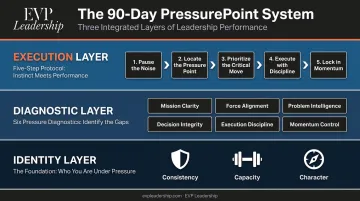
Strategies and frameworks only work if the leader has internalized the habits to execute under pressure. That's the distinction EVP Leadership builds through the 90-Day PressurePoint System — a structured conditioning program for small business owners and executives that develops decision-making consistency, communication clarity, and accountability practices that hold up when stakes are high.
The system works through three integrated layers:
- Identity Layer — consistency, capacity, and character as the leadership foundation
- Diagnostic Layer — six diagnostics (Mission Clarity, Force Alignment, Problem Intelligence, Decision Integrity, Execution Discipline, Momentum Control) that surface where pressure actually breaks down
- Execution Layer — a five-step protocol for critical moments, practiced until it becomes instinct
The goal is leaders who hold strong under pressure — not just when conditions are favorable.
How Leaders Sustain High Performance Over Time
Momentum is the most fragile part of team performance. Teams often launch well and drift when priorities shift, members turn over, or early wins breed complacency. Sustaining performance requires systems, not just willpower.
The best leaders build:
- Regular progress reviews — not just status updates, but honest assessments of whether the team is actually improving
- Visible goal tracking — making progress tangible so the team can see where they stand
- Recurring conversations about how the team is working together, not only what it's producing
Sustaining performance also means watching for early warning signs before they become visible problems. The patterns EVP Leadership encounters most often include:
- Communication breakdowns that go unaddressed
- Declining accountability at the individual or team level
- Low ownership culture where problems belong to "someone else"
- Inconsistent execution despite clear priorities
These rarely announce themselves loudly. They show up as drift — small degradations that accumulate unnoticed until performance is visibly off track.
Leaders who catch these signals early don't wait for a formal review cycle to confirm what they already sense. They name the pattern, address it directly, and course-correct before drift becomes a performance problem.
Common Mistakes That Undermine High Team Performance
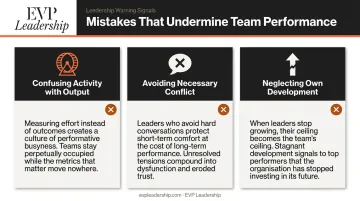
Three patterns show up repeatedly in teams that are working hard but not performing well:
Confusing activity with output. Busy teams and high-performing teams look very different. Leaders who mistake motion for progress end up managing teams that are always working but rarely moving toward what actually matters. Clarity about what "winning" looks like — specifically and measurably — is the corrective.
Avoiding necessary conflict. When leaders smooth over disagreements to keep the peace, they suppress the honest dialogue that produces better decisions. Conflict avoidance is often mistaken for psychological safety, but it's the opposite. Teams that can't disagree openly can't solve hard problems well.
Neglecting their own development. Leaders who invest entirely in team development without investing in their own leadership capacity become the ceiling on the team's growth. How a leader communicates, decides, and behaves under pressure sets the performance standard for everyone around them — intended or not.
Frequently Asked Questions
What are the 5 elements of high-performance teams?
The five most commonly cited elements are shared purpose, clear roles and mutual accountability, open communication, psychological safety and trust, and a results orientation. High-performing teams don't stumble into these — they build and reinforce all five deliberately over time.
What is a high-performing team leader?
A high-performing team leader creates the conditions for consistent excellence: clear direction, accountable behavior, genuine trust, and habits that hold up under pressure. The job isn't to be the best individual performer — it's to make the team consistently better.
What's the difference between a high-performing team and a regular team?
Regular teams share tasks and general goals. High-performing teams are deeply aligned on purpose, hold each other mutually accountable — not just to the leader — and consistently exceed expectations rather than just meeting them occasionally. The difference is mostly cultural, and that culture is shaped by how the leader operates day to day.
How do you measure whether a team is high-performing?
Watch for these signals:
- Consistent goal attainment over multiple cycles
- Low turnover and strong engagement scores
- High-quality collaboration and communication under pressure
- Output that measurably improves over time
What leadership style works best for high-performance teams?
No single style is universally best. The most effective leaders combine clear direction with genuine trust in their team, adapting their approach to what the situation requires. Rigidly defaulting to one mode limits the team's ability to respond when conditions change.