According to Deloitte's 2022 C-suite survey, nearly 70% of C-suite leaders were seriously considering leaving their roles for positions that better support well-being. That's not a wellness statistic — it's a warning about what happens when resilience runs out at the top.
Executive resilience isn't something you're born with. It's built. And how it's built determines whether it holds when the pressure is real and the room is watching. This article covers what executive resilience actually means, why it matters most at the leadership level, and the specific coaching strategies that develop it in a lasting way.
Key Takeaways
- Executive resilience is a conditioned capacity — built through deliberate, repeated practice, not personality
- Resilient executives maintain strategic clarity and team stability during disruption, not just after it
- Effective coaching builds resilience by developing emotional regulation, cognitive reframing, and structured accountability — not through motivation alone
- Durable resilience is built through small habits practiced consistently over time, not one-time training events
- Progress is measured through observable behavioral indicators, not self-reported confidence alone
What Executive Resilience Really Means
Executive resilience is the capacity to maintain decision-making quality, leadership presence, and performance under sustained pressure — while still supporting the people around you. That last part matters. This isn't just about the leader surviving a difficult quarter. It's about staying grounded enough to lead others through it.
Beyond "Bouncing Back"
The phrase "bouncing back" is too passive for what executives actually need. Bouncing back implies the storm is over before recovery begins. But most organizational disruption is prolonged : a slow market shift, a leadership transition, a restructuring that drags on for months. Resilience at the executive level means staying functional and directional while the disruption is still unfolding.
For founders, CEOs, and owner-operators, the stakes compound this demand. The isolation is greater, the decisions are weightier, and the leader's emotional state shapes organizational culture. A CEO who is visibly destabilized by setbacks doesn't just affect their own performance. That instability radiates outward.
The Misconception About Appearing Strong
A persistent myth in leadership culture holds that resilience means appearing unaffected. It doesn't. What leaders actually model matters:
- Suppressing difficulty signals disconnection — and teams notice
- Acknowledging what's hard while maintaining direction builds trust and psychological safety
That combination of honesty and steadiness is itself a leadership act.
EVP Leadership's PressurePoint System is built around this principle. The Identity Layer focuses on consistency, capacity, and character: developing the internal capacity to handle responsibility, complexity, and sustained pressure — not performing toughness, but conditioning it.
Why Resilience Matters Most at the Executive Level
The pressure on executives isn't linear — it compounds. They're simultaneously responsible for strategy, culture, operations, and team morale. When organizational change accelerates, all of those responsibilities intensify at once.
The Scale of the Problem
HBR, citing Gartner research, found that the average employee experienced 10 planned enterprise changes in 2022, up from just 2 in 2016. That's a fivefold increase in change load over six years — and executives are absorbing that pressure at the epicenter. Meanwhile, Gartner's 2025 research found that only 32% of mid-to-senior business leaders reported their last change initiative achieved healthy employee adoption.
That gap — between change being launched and change actually sticking — often comes down to leadership resilience. When the leader at the top is running on fumes, reactive decision-making fills the void that strategy should occupy.
The Cascade Effect on Teams
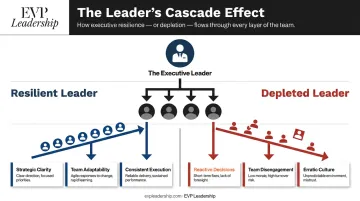
Teams mirror their leader. Research on emotional contagion shows that positive leader mood lifts group coordination and performance; a leader who is visibly overwhelmed or erratic during change spreads that instability downward through the same mechanism.
This isn't abstract theory. A depleted leader actively degrades their team's adaptability — at exactly the moment when adaptability matters most.
Without resilience, executives default to short-term reactive decisions — prioritizing fires over strategic direction. This is a pattern EVP Leadership sees across C-suite and small business clients: leaders who are technically capable but operationally depleted, making increasingly reactive choices precisely when their teams need clear-headed direction most.
Core Coaching Strategies for Building Executive Resilience
Emotional Regulation and Self-Awareness
Resilience coaching starts here. Before any strategy or framework can hold under pressure, a leader needs to understand what happens to their thinking, communication, and decision-making when stress spikes.
Executive coaching focused on emotional regulation begins by helping leaders identify their habitual stress responses — the patterns they fall back on when pressure rises. This goes beyond introspection. It's recognizing, in real time, how emotional states distort decisions and damage team dynamics before the leader is even aware it's happening.
Research from Frontiers in Psychology found that cognitive reappraisal and situation modification were positively associated with leadership performance, while emotional suppression was negatively related to performance. This distinction is critical for coaching: the goal isn't to push emotions aside, but to regulate them constructively.
Practical techniques include:
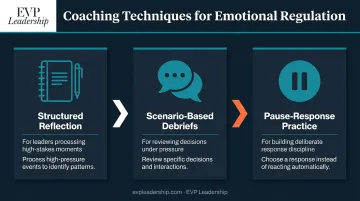
- Structured reflection — processing high-pressure events after they occur to identify patterns
- Scenario-based debriefs — reviewing how a leader responded to a specific decision or interaction
- Pause-response practice — building the habit of choosing a response rather than reacting automatically
The PressurePoint System's Execution Layer opens with exactly this: "Pause the Noise — control the moment before the moment controls you." That pause is a trainable behavior, not a personality trait.
Flexible Thinking and Cognitive Reframing
Stress biologically narrows thinking. Research in decision neuroscience shows that stress shifts cognition away from prefrontal, deliberate processing toward faster, reflexive responses. Under sustained pressure, leaders become more threat-focused and less strategically oriented — the opposite of what high-stakes decisions require.
Cognitive reframing is the practice of deliberately shifting the interpretive lens on a difficult situation. Instead of "this acquisition failed" — a fixed, threat-focused interpretation — a reframe might be "we now have clearer information about our market position." Both are true. The second is more useful.
Scenario planning extends this work by reducing the cognitive load of unexpected disruption:
- Pre-mapped futures — considering multiple scenarios in advance shrinks the shock response when disruption arrives
- Faster recovery — when a situation has already been loosely considered, decision-making accelerates
- Strategic readiness — this is preparation, not pessimism
Values Alignment and Anchoring
Values clarification gives leaders an internal anchor when external conditions become unstable. Leaders who have clearly defined what they stand for make faster, more consistent decisions under pressure. Leaders who haven't default to whatever feels most urgent — which is rarely most important.
Over time, leaders who consistently act against their values lose decision-making clarity and energy. The erosion is cumulative. Coaching addresses this by helping an executive:
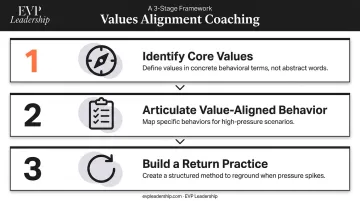
- Identify their core values with specificity — not generic words like "integrity," but concrete descriptions of what those values look like in action
- Articulate value-aligned behavior for high-pressure scenarios specifically
- Build a return practice — a structured way to reground in values when pressure spikes
In the PressurePoint System, this connects directly to the Identity Layer's consistency component: acting in alignment with values and expectations over time. Consistency isn't willpower — it's the result of having done the values clarification work in advance.
Accountability and Proactive Behavior
Values work clarifies the what. Accountability work builds the habit of following through on it. Rather than developing responses only after a crisis hits, coaches help executives anticipate likely stressors and pre-determine how they will respond.
The structured coaching relationship itself creates the accountability that makes this work durable. A leader who has articulated a specific behavioral commitment — and knows they'll be checking in on it — practices that behavior more consistently than one who reflects casually and intermittently.
The Conditioning Mindset: Why Resilience Must Be Built, Not Just Learned
There's a distinction worth drawing carefully here: training is an event; conditioning is a process.
Training transfers knowledge. An executive attends a leadership seminar, learns a resilience framework, and leaves with new concepts. Conditioning repeats behaviors until they become automatic, accessible under pressure, without conscious effort.
Athletes don't perform well in high-stakes moments because they've studied technique. They perform because they've rehearsed until the skill is embedded. Leadership works the same way.
A 2017 meta-analysis on leadership training confirmed this: spaced training programs showed stronger effects for behavioral transfer than massed, one-time sessions, with weekly-spaced programs producing effect sizes more than twice those of daily-intensive formats.
This is why EVP Leadership's 90-Day PressurePoint System is structured as longitudinal conditioning rather than a workshop or intensive. The 90-day format works because:
- The Identity Layer builds the internal foundation first — consistency, capacity, character
- The Diagnostic Layer trains leaders to see clearly and think decisively across six dimensions: Mission Clarity, Force Alignment, Problem Intelligence, Decision Integrity, Execution Discipline, and Momentum Control
- The Execution Layer provides a repeatable five-step protocol for critical moments, practiced until it becomes automatic
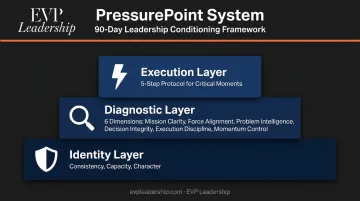
The system doesn't just teach executives what to do under pressure. It conditions them to do it — so that when the moment arrives, the response is already there.
Small habits practiced consistently over time produce more durable leadership change than dramatic overhauls. Behavioral psychology backs this up: behaviors rehearsed frequently in a consistent context become embedded in default response patterns. That's the mechanism EVP Leadership's system is built on — and why the conditioning approach outlasts any single workshop or training event.
Practical Techniques Used in Executive Resilience Coaching
Several specific techniques show up consistently in high-quality executive resilience coaching:
Structured reflection and journaling — Regular written processing of high-pressure events helps executives identify patterns in their responses before those patterns calcify. This prevents stress from accumulating unexamined and builds metacognitive awareness over time.
Scenario-based practice — Role-playing difficult conversations, stress-testing decisions before they need to be made, and rehearsing specific leadership responses in a low-stakes environment. The goal is to make the response accessible when the real situation arrives.
Brief regulation practices — Tracking physical stress signals — tension, shallow breathing, cognitive narrowing — gives executives an early-warning system before emotional reactivity takes hold. Note that a 2023 review found reliable physiological effects from breathing interventions generally required more than five minutes, so brief practices work best as cognitive interruption tools, not guaranteed performance resets.
Feedback loops — Executives often have the least access to honest feedback in any organization. A structured coaching relationship creates a confidential channel for 360-degree input, behavioral observation, and blind spot identification — the kind that rarely surfaces on its own. One Deloitte finding illustrates the gap precisely: 91% of C-suite leaders believed employees felt cared for, but only 56% of employees agreed.
Measuring the Impact of Resilience Coaching
Skepticism about resilience coaching ROI is fair. Resilience isn't a line item — it's a capacity. But the impact shows up in observable behaviors if you know what to track.
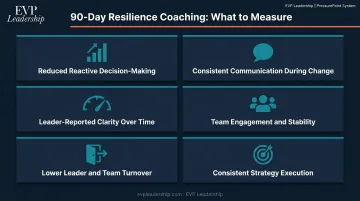
Key indicators to monitor across a 90-day engagement:
- Reduced frequency of reactive decision-making episodes under pressure
- Improved consistency of communication during organizational change
- Leader-reported clarity during high-pressure periods (tracked over time, not one-off)
- Team engagement and stability correlated with leadership state
- Lower leader and team turnover
- More consistent execution of strategy during disruption
For organizations wanting a benchmark, ICF has documented cases where structured coaching programs produced measurable organizational returns — including a Microsoft coaching program that generated $77M in savings and a 670.4% ROI. These are specific case outcomes, not universal guarantees, but they show that resilience development can be quantified when organizations track the right outputs.
On measurement: assess over time, not after a single coaching cycle. Resilience, as a conditioned capacity, reveals itself most clearly across 90 days or more of structured engagement. A single feedback snapshot tells you where a leader stood on one day. Behavioral data tracked across a quarter tells you whether the capacity is actually building.
Frequently Asked Questions
What are the 5 C's of resilience?
Several resilience frameworks use a "C" structure, though no single version is universally codified for executive leadership. Commonly cited components include Commitment, Control, Challenge, Confidence, and Connection — drawn from the mental toughness and resilience literature. Coaches adapt these as practical pillars that leaders can develop systematically, rather than treating resilience as a single, fixed trait.
What is the average cost for an executive coach?
According to the 2025 ICF Global Coaching Study, the global average for a one-hour coaching session is $234 USD, though coaches working with executives command the highest fees in the profession. Program-based engagements vary widely depending on scope, duration, and coach experience. ROI is the more meaningful measure: reduced leader turnover, faster decision-making, and more consistent execution typically return far more than the coaching investment.
What is the 70/30 rule in coaching?
The 70/30 rule is an informal coaching heuristic — not a codified ICF standard — suggesting the client should speak approximately 70% of the time while the coach facilitates through questions and reflection. The intent is to support self-discovery rather than directive advice, reflecting one of the core distinctions between coaching and consulting: the insight comes from the client, not the coach.
How long does it take to build executive resilience through coaching?
Meaningful resilience development typically requires a sustained engagement of 90 days or more — not arbitrarily, but because resilience depends on repeated behavioral practice, not a single learning event. The 90-Day PressurePoint System is built on this premise: conditioning behaviors progressively until they hold under real pressure.
What is the difference between resilience training and resilience conditioning?
Training transfers knowledge — frameworks, concepts, strategies. Conditioning builds automatic responses through repeated practice. For executive resilience to hold under real pressure, it must be conditioned — rehearsed until it becomes a default response, not just a concept recalled from a workshop.
How do I know if I need executive resilience coaching?
Common indicators include:
- Reactive decision-making that you recognize in hindsight but can't interrupt in the moment
- Difficulty maintaining strategic focus during periods of significant change
- Team instability or disengagement that tracks with your own emotional state
- A persistent sense of being in survival mode rather than leading with intention
- Decision fatigue, chronic overload, or the gradual erosion of leadership capacity over time