Introduction
Most executives believe they think strategically. The data tells a different story.
A McKinsey survey of nearly 1,400 executives found that almost 50% didn't spend enough time on strategic priorities — and only 9% were fully satisfied with how they spent their time. The gap between valuing strategy and actually practicing it is wide, persistent, and costly.
This guide is for leaders who want to close that gap. You'll find a clear definition of what strategic thinking actually is, the core components that make it work, the most common traps that derail it, and a practical playbook for building it as a consistent leadership behavior — not just an occasional flash of insight.
Key Takeaways
- Strategic thinking is an ongoing mental discipline, not a planning document or annual event
- Holding complexity without rushing to conclusions separates anticipators from reactors
- Most leaders confuse busyness with strategy, and organizations drift as a result
- Protected time for big-picture thinking is a structural requirement, not a luxury
- Strategic thinking is conditioned through repeated practice, not learned through a single exposure
What Strategic Thinking Really Is (and What It's Not)
Strategy vs. Tactical Thinking
Harvard Business Publishing defines strategy as a plan to create value — not simply a planning document. That difference has real consequences for how leaders allocate attention, make decisions, and respond to change.
Strategic thinking is an intentional, future-focused thought process. It evaluates long-term opportunities, threats, and resource trade-offs. Tactical thinking, by contrast, manages present-day execution. Both are necessary.
The problem is when leaders default permanently to the tactical and lose the strategic perspective entirely.
Strategic thinking requires:
- Holding complexity and uncertainty without rushing to premature conclusions
- Asking probing questions rather than accepting the first plausible answer
- Recognizing patterns across disparate data points
- Evaluating decisions within the broader competitive and organizational context
Strategic Thinking vs. Strategic Planning
These are not the same thing, and conflating them produces polished plans that miss the market entirely.
Strategic planning is the structured process of mapping goals, timelines, and milestones — it produces documents, roadmaps, and scorecards. Strategic thinking is the ongoing mental discipline that makes those documents worth anything.
A leader can run a rigorous annual planning process and still be a poor strategic thinker — producing polished plans that don't survive contact with a shifting market. The gap between the quality of thinking that precedes the plan and the quality of the plan itself is where most execution failures begin.
Why Strategic Thinking Is Non-Negotiable for Today's Leaders
The environment small and mid-size business owners operate in doesn't reward reactive leadership. It punishes it.
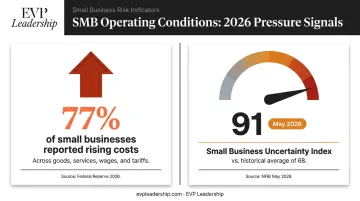
According to the Federal Reserve's 2026 Report on Employer Firms, 77% of small businesses reported rising costs from goods, services, wages, or tariff-related expenses. Small firms' revenue expectations fell year over year. Meanwhile, NFIB's May 2026 data showed the Small Business Uncertainty Index at 91 — well above its historical average of 68. These aren't short-term fluctuations. They're the new operating conditions.
Why Founders and Owners Face a Different Challenge
Large enterprises have dedicated strategy teams, chief strategy officers, and planning departments. Founders and owner-operators usually don't.
In most small and mid-size businesses, the leader is the strategy function. There's no one whose job it is to:
- Monitor competitive shifts before they become crises
- Evaluate emerging threats while there's still room to respond
- Pressure-test assumptions before committing resources
The quality of the owner's strategic thinking directly determines the trajectory of the organization. For small and mid-size business leaders, developing that capacity isn't optional — it's the difference between leading proactively and getting led by circumstance.
The Core Components of Strategic Thinking
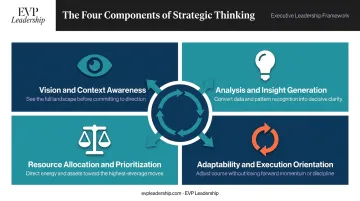
Strategic thinking isn't a single skill. It's a set of interconnected disciplines that work together. Here's what the full picture looks like:
Vision and Context Awareness
Strategic thinkers maintain a wide-lens view — where the organization is, where it's headed, and how external forces interact with internal realities. This panoramic awareness is what separates leaders who anticipate from those who react.
It means tracking market trends, competitive moves, regulatory shifts, and technology changes — not as background noise, but as active inputs into how decisions get made.
Analysis and Insight Generation
Consuming information is passive. Synthesizing insight — drawing conclusions that change how you act — is the actual work of strategic thinking.
Strategic leaders evaluate financial metrics, customer behavior, and competitive signals — not to accumulate data, but to generate conclusions that drive action. The question isn't "what do I know?" It's "what does this mean, and what should I do differently?"
Resource Allocation and Prioritization
This is where strategic thinking gets uncomfortable. Every resource allocation decision is also a decision about what you're not doing.
Saying no to a good idea — because a better one deserves those resources — is one of the hardest practical tests of strategic thinking. EVP Leadership's PressurePoint System addresses this directly through Mission Clarity (knowing exactly what must be achieved and why) and the execution principle of "Prioritize the Critical Move: what matters most right now — not everything."
Adaptability and Execution Orientation
Strategic thinking doesn't stay in the planning phase. It has to move — and adjust as it moves. That requires two things working in tandem:
- Adaptability means revisiting assumptions when circumstances change — treating a strategic plan as a living guide, not a fixed document. The discipline here is adjusting tactics while holding the vision, rather than abandoning direction under pressure.
- Execution orientation means strategic thinking must connect to action. PMI's 2025 research found only half of projects meet a modern definition of success that includes delivering value exceeding effort and expense. Without measurable goals, clear ownership, and accountability, big-picture thinking stays theoretical — and theoretical doesn't move organizations forward.
Common Strategic Thinking Mistakes Leaders Make
Confusing Busyness with Strategy
Many leaders operate in permanent execution mode — handling urgent tasks, responding to immediate demands, and never carving out time to think ahead. It's the most pervasive strategic trap there is.
When strategic thinking gets crowded out by operations, organizations drift tactically. They address symptoms instead of root causes. The team stays busy; the business stays stuck.
Thinking in Isolation
Strategic thinking conducted only at the top — without input from those closest to customers, operations, and frontline challenges — produces plans disconnected from organizational reality.
The strongest strategic thinkers actively seek diverse perspectives, including dissenting views. They use those perspectives to stress-test assumptions before committing to a direction.
Mistaking Confidence for Clarity
Conviction isn't the same as soundness. Strong strategic thinkers regularly interrogate their own biases, question their information sources, and pressure-test assumptions. McKinsey identifies confirmation bias and excessive optimism as recurring risks in executive decision-making — and both are especially dangerous because they masquerade as clarity rather than announcing themselves as risk.
Best Practices for Strategic Thinking: A Leader's Playbook
Clarify and Communicate Vision Consistently
Strategic thinking begins with a clear organizational vision — not just as a destination, but as the lens through which every decision gets evaluated. Leaders must be able to articulate not just what the organization is doing, but why those choices serve the long-term direction.
Most leaders underestimate how frequently vision needs to be communicated for teams to genuinely internalize it. Saying it once isn't enough. To create real alignment, vision needs to show up:
- Repeatedly, not just at annual planning sessions
- In different contexts — team meetings, one-on-ones, project kickoffs
- Connected to specific decisions, so the why behind choices is explicit
Create Dedicated Time for Strategic Reflection
Without structural protection, strategic thinking reliably gets displaced by urgency. That's not a discipline problem — it's a scheduling problem.
The practice: protect non-negotiable time — weekly or bi-weekly — specifically for big-picture thinking:
- Reviewing market trends and competitive signals
- Evaluating whether current priorities still serve the strategic direction
- Stress-testing assumptions that underpin major decisions
This time must be guarded. When it competes with operational demands, it loses — every time, unless it's treated as non-negotiable.
Seek External Perspectives and Diverse Data
Strategic thinking sharpens when leaders expose themselves to perspectives outside their own industry, experience base, and organization. Without outside input, thinking becomes an echo chamber of unexamined assumptions.
Sources worth cultivating:
- Peer advisors and executive mentors
- Competitive intelligence and customer data
- Cross-industry research and market trends
- Advisors who will push back, not just validate
The goal isn't more information — it's exposing the assumptions you didn't know you were making.
Set Goals That Align Day-to-Day Operations with Long-Term Direction
A leader can think strategically all day — but without alignment at every level, that thinking stays theoretical. The practical work is connecting near-term SMART goals to long-term strategic objectives, so teams understand exactly how their daily work advances the bigger picture.
Without that connection, execution drifts. People optimize for what's in front of them, not what matters most.
Gennifer Baker, founder of EVP Leadership, has built this alignment work into her consulting practice for over 30 years: "aligning day-to-day operations to long-term business goals so organizations are prepared not just to grow, but to adapt."
Build a Culture That Values Strategic Thinking
Culture is built through repeated behavior, not policy documents. Leaders model strategic thinking by:
- Praising questions over quick answers
- Rewarding foresight as much as execution speed
- Making it safe to raise dissenting perspectives — not just tolerating them, but inviting them
- Treating "I don't know yet — let me think about that" as a sign of strength, not weakness
Continuously Develop Strategic Acumen
The Harvard Kennedy School's research on strategic leadership frames it directly: strategic leadership is a learning journey achieved through practice, deliberation, repetition, and growth. It is not a fixed trait.
Maintaining that capacity in practice means:
- Reading across disciplines, not just within your industry
- Engaging with other strategic thinkers and seeking honest feedback
- Regularly evaluating what's working and what isn't — in your thinking, not just your operations
Conditioning Strategic Thinking — From Occasional Insight to Daily Habit
Most leaders have been exposed to strategic thinking through books, courses, or workshops. Exposure alone doesn't build capacity — especially under pressure, when the brain defaults to familiar patterns.
This is EVP Leadership's core thesis: leaders don't rise to expectations — they fall back on conditioning. The goal isn't to teach strategic thinking as a concept. It's to condition it as a behavior that holds under pressure.
What Daily Strategic Conditioning Looks Like
Small, consistent habits compound into genuine strategic capacity over time:
| Cadence | Practice |
|---|---|
| Daily | Pause to ask whether today's priorities connect to the organization's long-term direction |
| Weekly | Scan for market signals — competitor moves, customer shifts, economic indicators |
| Monthly | Review the strategic assumptions underlying your major commitments |
| Quarterly | Recalibrate resource allocation against what's actually working |
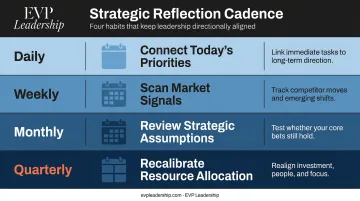
None of these require dedicated time blocks. They require repetition — and that's precisely where most leaders stall without a supporting structure.
Why Accountability and Structure Matter
Most leaders know what they should be doing strategically. The struggle is sustaining the practice without a disciplined structure.
EVP Leadership's 90-Day PressurePoint System is built specifically for this challenge. Rather than one-time training, it conditions strategic performance through repeated, structured application in real leadership contexts.
The program works through three reinforcing layers:
- Identity — consistency, capacity, and character as the foundation of reliable performance
- Diagnostic — six dimensions including Mission Clarity, Force Alignment, Problem Intelligence, Decision Integrity, Execution Discipline, and Momentum Control
- Execution — a five-step protocol for maintaining strategic clarity in high-pressure moments
Together, these layers make strategic thinking a repeatable behavior, not an occasional capability.
The test of strategic thinking isn't how a leader thinks in calm, unhurried moments. It's how they think under pressure, in complexity, with incomplete information. Leaders who have conditioned that response — not just learned about it — are the ones who make sound decisions when the stakes are highest.
Frequently Asked Questions
What are the 5 C's of strategic thinking?
The 5 C's aren't a single standardized framework, but common versions include Clarity, Creativity, Critical Thinking, Communication, and Collaboration. Together, they represent the mental and interpersonal skills strategic leaders build to think clearly and turn insight into action.
What are the 5 P's of strategic thinking?
Henry Mintzberg's foundational framework defines the 5 P's as Plan, Ploy, Pattern, Position, and Perspective. Each offers a different lens on strategy: deliberate intention, competitive maneuvering, emergent behavior, market positioning, and organizational worldview.
What are the 4 P's of strategic leadership?
Harvard Kennedy School's research identifies the 4 P's as Perception, Process, People, and Projection. This framework helps leaders align how they read their environment (Perception), how they operate (Process), how they develop others (People), and how they communicate direction (Projection).
What is the difference between strategic thinking and strategic planning?
Strategic thinking is the ongoing mental habit of evaluating long-term direction. Strategic planning is the formal process of translating that thinking into documented goals and roadmaps. Without strong thinking driving it, even well-structured plans tend to miss the mark.
Can strategic thinking be learned, or is it an innate talent?
It's a developable skill. Harvard Kennedy School's research is explicit: strategic capacity is built through practice, repetition, and deliberate conditioning — not discovered through innate talent.
How do you apply strategic thinking in day-to-day leadership decisions?
Pause before decisions to ask how they connect to your long-term goals. Review your priorities against your strategic direction regularly. Even brief, consistent reflection time — kept separate from operational work — builds stronger strategic instincts over time.