
Introduction
Most small business owners aren't short on effort. The problem is that effort without direction produces activity, not progress. You end up working harder each quarter while the gap between where you are and where you want to be stays stubbornly wide.
That's the core problem a strategic growth plan solves.
A strategic growth plan is a forward-looking, written framework that connects where your business stands today to where you want it to be in three to five years — with clear milestones, defined priorities, and accountability built in from the start. Unlike a business plan written for a lender, this is a management tool built for you to actually use.
This article covers:
- The difference between a strategic growth plan and a traditional business plan
- The seven core elements every effective plan needs
- A step-by-step process for building one
- The leadership capacity required to actually execute it
Key Takeaways
- A strategic growth plan is a living framework, not a one-time document — it connects daily operations to long-term goals.
- Every effective plan combines market data and financials with clear tactics, owners, and deadlines.
- Harvard Business Review research found that formal planners are 16% more likely to achieve viability than those who skip the process.
- Strategy without leadership capacity to execute it is just a wish list.
- Revisiting your plan regularly isn't a sign of weakness — it's a sign of discipline.
Strategic Growth Plan vs. Business Plan: Know the Difference
If you're already running a business and focused on growth, you've likely asked whether you need a new business plan — or something different entirely. The answer matters, because these two documents solve different problems at different stages.
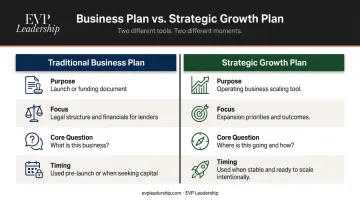
A traditional business plan is primarily a launch or funding document. It covers legal structure, product descriptions, market summaries, and financial projections designed to satisfy lenders or investors. The SBA describes it as "the foundation of the business and a roadmap for how to structure, run, and grow it" — language that signals a foundational, not directional, purpose.
A strategic growth plan is built for an operating business that wants to scale. Where a business plan answers "what is this business," a strategic growth plan answers "where is this business going and how." It's focused on expansion priorities, market opportunities, resource allocation, and measurable outcomes — not foundational structure.
When to use each:
| Situation | Right Tool |
|---|---|
| Pre-launch or seeking funding | Traditional business plan |
| Stable operations, growth has stalled | Strategic growth plan |
| Recovering from a setback | Traditional plan first, then growth plan |
| Ready to scale intentionally | Strategic growth plan |
If your business is operational and growth is the goal, a strategic growth plan is the right tool — and the sections below walk through exactly how to build one.
The 7 Core Elements of a Strategic Growth Plan
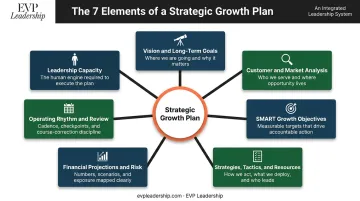
These elements work as an integrated system. Each one feeds the next — skip one and the whole plan loses structural integrity.
1. Clarity of Vision and Long-Term Goals
Every strong growth plan starts with a written, specific vision of where the business will be in three to five years. Not vague aspiration: defined outcomes — revenue targets, market position, team size. Without this anchor, the rest of the plan has no direction to organize around.
2. Customer and Market Analysis
This section requires honesty. Who is your ideal customer, what problems do you actually solve for them, and what's changing in your market? A 2024 study of 229 Scottish SMEs found market orientation had a statistically significant positive link with firm performance (beta 0.21, p < 0.01). Customer and competitor intelligence, in other words, isn't just useful context — it's a measurable performance driver.
Your market analysis should include:
- Ideal customer profile and buying behavior
- Key competitors and their positioning gaps
- Emerging industry trends
- White-space opportunities your business can own
3. SMART Growth Objectives
"Grow revenue" is not a goal — it's a hope. Every objective needs to pass the SMART test: Specific, Measurable, Achievable, Relevant, and Time-bound. Each objective should also have a named owner and a clear deadline. Without those elements, accountability dissolves.
4. Strategies, Tactics, and Resource Requirements
For each growth objective, this section translates intent into assigned action. Identify:
- The specific initiative that will drive it
- Who owns that initiative (a person, not a department)
- What budget and team capacity it requires
- The timeline for each milestone
5. Financial Projections and Risk Assessment
Your financial section must cover revenue targets, cost estimates, expected ROI, and cash flow assumptions. Per the 2025 Small Business Credit Survey, 46% of small employer firms sought financing for expansion — and only 42% received the full amount they applied for. Build contingency scenarios. A growth plan without a fallback funding assumption is fragile.
The risk section should address economic shifts, competitive responses, and internal constraints. Leaders who document risks in advance cut decision lag when pressure hits.
6. Operating Rhythm and Review Cadence
The plan needs a built-in heartbeat: monthly KPI check-ins, quarterly strategic reviews, and an annual reset. Without a review schedule, even a strong plan goes dark within 90 days.
7. Leadership Capacity Assessment
Most plans omit this entirely. It belongs here because execution is a leadership function. A realistic assessment covers three areas:
- Delegation: Can leaders hand off work cleanly and hold others accountable for outcomes?
- Decision quality under pressure: Do leaders have a repeatable process for high-stakes calls?
- Accountability structures: Are there operating rhythms that reinforce follow-through?
These aren't soft factors. They determine whether the plan executes or stalls at the first obstacle.
How to Create a Strategic Growth Plan: Step-by-Step
Step 1: Conduct an Honest Internal Audit
Before you build strategy, you need an honest picture of where you stand. Assess:
- Current financials (revenue trends, margins, cash position)
- Operational capacity and constraints
- Team strengths and gaps
- What's working and what's limiting growth
A SWOT analysis (Strengths, Weaknesses, Opportunities, Threats) is the right starting framework here. The tool is simple by design — its value comes from the honesty of the inputs, not the complexity of the framework.
Step 2: Define Your Vision and Prioritize Growth Goals
Establish your three-to-five year vision, then identify the two to three highest-leverage priorities for the next 12 months. This constraint is intentional. Small businesses with limited resources must prioritize depth over breadth. Pursuing five growth initiatives simultaneously usually means executing none of them well.
Step 3: Build Your Strategy and Assign Ownership
Match each priority to a concrete strategy, break it into tactics with deadlines, and assign ownership to a named individual. Growth plans fail when accountability is diffuse — a named person with a hard deadline is the only version that holds.
Step 4: Create a Financial Framework
Project costs and revenue for each growth initiative and build a basic budget tied to the plan. Then stress-test your assumptions. What happens if revenue comes in 20% below projection, or a key hire takes three months longer than expected? Most small businesses skip this step — and it's exactly where plans fall apart.
Identify your funding approach upfront:
- Internal cash flow — most conservative, but limits speed
- Business loan or line of credit — requires clean financials and a clear repayment plan
- Outside capital — introduces other stakeholders and timeline pressure
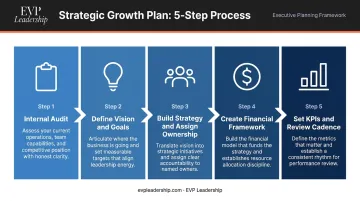
Step 5: Set Your KPIs and Review Cadence
Choose four to six key performance indicators that cover both growth progress and operational health. A balanced KPI set might include:
- Revenue growth (month-over-month, year-over-year)
- Customer acquisition rate and cost
- Gross margin percentage
- Cash flow from operations
- Team capacity utilization
- Lead conversion rate
Build your review rhythm into the plan from day one: monthly KPI dashboards, quarterly strategy reviews, and an annual full reset.
The Leadership Factor: Why Most Growth Plans Stall Before They Scale
Most small business growth plans don't collapse because the strategy was flawed. They stall because the leader wasn't conditioned to execute consistently once the pressure of growth set in.
Reactive decision-making, burnout, and loss of clarity don't arrive with a warning. They erode execution gradually, quietly, until the plan exists on paper but produces nothing in practice. Capital One's 2022 research found 48% of small business owners experienced burnout in the prior month, with 72% reporting mental exhaustion. Those numbers reflect direct execution risk, not just personal wellbeing concerns.
EVP Leadership describes this as a readiness problem: "Most organizations don't struggle with strategy. They struggle with readiness. Under pressure, leaders don't rise to expectations — they fall back on their conditioning."
The leadership gaps that most commonly stall growth plans include:
- Communication breakdowns between owner and team
- Lack of accountability structures (everyone is responsible, so no one is)
- Poor delegation habits that create founder bottlenecks
- Decision fatigue that produces reactive choices instead of strategic ones
- No operating rhythm to sustain execution between quarterly reviews

A well-written growth plan demands specific leadership competencies: staying anchored to long-term goals while managing daily pressure, delegating with clarity, holding the team accountable without micromanaging, and maintaining consistent decision quality under stress. None of those are fixed personality traits. They're conditioned behaviors — which means they can be built.
That gap — between a plan that's documented and one that actually gets executed — is exactly where EVP Leadership focuses. Gennifer Baker, who has spent 30+ years in business strategy, built the firm's approach around combining strategic planning with leadership capacity work. The premise is straightforward: aligning day-to-day operations to long-term goals requires both a sound plan and a leader conditioned to carry it.
Common Mistakes Small Business Owners Make With Growth Planning
Most small business growth plans fail not because the strategy was wrong, but because of how the plan was built and used. Three patterns show up repeatedly:
Planning in a vacuum. Owners write the plan alone, without input from the people responsible for executing it. The result is a strategy that's technically sound but organizationally disconnected. Without cross-functional buy-in, implementation stalls before it starts.
Confusing activity with progress. Staying busy is not the same as advancing strategic objectives. This is why KPIs matter — they make the distinction between operational output and strategic movement visible. Without measurement, it's easy to spend an entire quarter running hard while going sideways.
Treating the plan as a one-time document. A growth plan that isn't revisited becomes irrelevant within months. Markets shift, team capacity changes, and assumptions accurate in January may not hold in Q3. The plan needs to function as a living management system, reviewed and adjusted on a regular cadence.
How to Track Progress and Keep Your Growth Plan on Course
Build a three-tier review structure into the plan from the beginning:
- Monthly — KPI dashboard review. Are leading indicators trending in the right direction? Where is execution lagging?
- Quarterly — Strategic check-in. Are your growth priorities still the right priorities? Have market conditions shifted enough to warrant a tactical adjustment?
- Annual — Full plan reset. Recalibrate the vision, reset 12-month objectives, and update financial projections based on actual performance.
When the plan needs adjustment, distinguish between two very different situations:
- Adjusting strategy — a tactic isn't producing results, market conditions have changed, or new information changes the calculus. This is healthy and expected.
- Abandoning goals prematurely — discomfort, short-term pressure, or lack of discipline is driving the decision. This is a leadership issue, not a strategy issue.
Making that distinction consistently requires clear data and honest reflection — and often, a structured conversation with someone outside the day-to-day who can call the difference between a real strategic shift and a pressure-driven retreat. That's precisely what the review cadence is designed to force: a deliberate pause before resources are wasted on the wrong response.
Frequently Asked Questions
What is the difference between a strategic growth plan and a business plan?
A business plan is primarily a launch or funding document — used to structure a new business or secure financing. A strategic growth plan is built for an existing, operational business ready to scale. It focuses on expansion goals, market opportunities, and executable strategies rather than foundational business setup.
What are the 7 basic elements of a strategic plan?
The seven elements are: vision and long-term goals, customer and market analysis, SMART growth objectives, strategies and tactics, resource requirements, financial projections with risk assessment, and an operating rhythm with review cadence. Together, they form an integrated system where each element reinforces the others.
What are the 3 C's of strategy?
The 3 C's come from Kenichi Ohmae's strategic triangle: Customer, Company, and Competitor. Each lens helps a business identify where differentiated value can be created — by understanding what customers need, what the company does well, and where competitors fall short.
How often should a small business revisit its strategic growth plan?
Monthly for KPI reviews, quarterly for strategic check-ins, and annually for a full plan reset. In high-growth or high-disruption periods, more frequent reviews are warranted. Let business conditions drive the cadence, not the calendar alone.
How long does it take to create a strategic growth plan for a small business?
A meaningful strategic growth plan typically takes four to eight weeks to develop properly, including the internal audit, goal-setting, market analysis, and financial modeling. The quality of the inputs (especially the internal audit) largely determines the quality of the output.
What is the first step in creating a strategic growth plan?
An honest internal audit — assessing where the business currently stands financially, operationally, and competitively. Strategy built on unclear or incomplete data produces unclear results, so grounding the process in an accurate baseline is the most important work you can do before building anything else.