Introduction
Most leaders know strategic planning matters. Few actually do it consistently.
Research from Bridges Business Consultancy's 20-year strategy implementation survey found that 48% of leaders spend less than one day per month discussing strategy implementation. The downstream effect is predictable: the Brightline Initiative and Economist Intelligence Unit reported that nearly 90% of global executives admit they fail to achieve all strategic goals, largely due to poor implementation.
Most organizations treat strategic planning as an annual event: a document produced in Q4, filed away, and revisited only when something goes wrong. The problem isn't intent — it's the habit.
The real value of strategic planning shows up when it's treated as an ongoing operational discipline, not a calendar obligation.
This article breaks down why that distinction matters in practice: how consistent planning creates direction, sharpens resource decisions, builds resilience, and why the gap between creating a plan and executing it is where most businesses lose ground.
Key Takeaways
- Strategic planning is an ongoing practice, not a once-a-year document exercise
- Leaders without a plan default to reactive decisions — and priorities drift accordingly
- Direction, smarter resource allocation, and risk resilience all build on each other over time
- Most failures happen in execution, not planning — leadership discipline is what holds the strategy together
- Small business owners and founders have the most to gain from structured planning
What Is Strategic Planning?
Strategic planning is the structured, ongoing process through which a business documents its long-term goals and builds the operational roadmap to achieve them. Annual budgeting and short-term operational planning are components of execution. Strategic planning determines what the business is executing toward — and why.
It applies at every stage and scale:
- A founder setting 90-day priorities
- A leadership team stress-testing a three-year growth initiative
- An owner-operator deciding which markets to exit
The scope changes; the discipline is the same.
The common misconception is that the value is in the document. It isn't. A strategic plan that sits in a folder delivers nothing. The value shows up in the clarity it creates, the decisions it informs, and the alignment it produces across the organization.
Key Advantages of Strategic Planning for Business Success
The advantages below aren't theoretical — they're operational outcomes businesses can observe and measure. Clarity, efficiency, alignment, and resilience. Each one is only as strong as its consistent application.
Advantage 1: It Creates Direction and Organizational Alignment
Without a strategic plan, teams default to local priorities. Marketing optimizes for one metric; operations optimizes for another; leadership chases a third. No one is doing anything wrong. They're just not doing the same thing.
A strategic plan gives everyone, from leadership to front-line teams, a shared understanding of where the organization is headed and why. At the leadership level, goals cascade into team-level KPIs, project priorities, and resource decisions. Every action connects to a broader outcome rather than floating as an isolated effort.
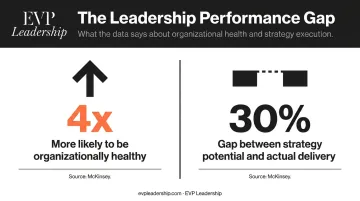
The performance impact of alignment is significant. McKinsey research found that organizations with sharp alignment are more than four times more likely to be organizationally healthy than those without it. The inverse is equally telling: McKinsey also reported a 30% gap between a strategy's full potential and its actual delivery — often caused by operating-model shortcomings that misalignment accelerates.
This advantage matters most during:
- Growth phases where coordination across teams becomes more complex
- Leadership transitions where institutional knowledge and shared direction need to be explicit
- Market expansions where new teams or functions are being integrated
- Any period where the gap between what different parts of the business are optimizing for is widening
Primary metrics impacted: goal completion rates, team productivity, and resource utilization.
Advantage 2: It Drives Smarter Resource Allocation and Decision-Making
Most budget and talent decisions — absent a strategic plan — get made based on urgency. Whatever is loudest wins. That's a reliable path to misallocation: resources chasing the most recent problem rather than the most important opportunity.
Strategic planning creates a decision-making filter. Every major choice gets evaluated against long-term goals, which separates genuinely strategic investments from reactive spending.
It also addresses something leaders rarely discuss: cognitive bias. McKinsey's research found that 72% of senior executives said bad strategic decisions were either as frequent as good ones, or the prevailing norm in their organizations. Anchoring, confirmation bias, and loss aversion all distort decision quality in real time. A strategic framework forces decisions through data, defined objectives, and structured analysis — which doesn't eliminate bias but substantially reduces its influence.
The time cost compounds this further. McKinsey's 2019 research found that 61% of managers believe at least half of their decision-making time is ineffective. Strategic planning doesn't just improve decision quality — it frees up leadership capacity by reducing the volume of reactive decisions that consume it.
EVP Leadership's PressurePoint System addresses this directly through its Decision Integrity component, which trains leaders to evaluate whether decisions are grounded in objective assessment or distorted by pressure and emotion — a practical mechanism for maintaining decision discipline during high-stakes moments.
This advantage is most visible when:
- Leadership spends the majority of time firefighting rather than steering
- Priorities shift frequently mid-year without clear rationale
- Budget accuracy is consistently off, or ROI on initiatives is difficult to measure
Primary metrics impacted: budget accuracy, initiative ROI, and ratio of strategic to reactive work.
Advantage 3: It Builds Proactive Risk Management and Long-Term Resilience
Strategic planning requires businesses to look ahead — to examine external threats, market shifts, and internal vulnerabilities before they become crises. Tools like SWOT analysis and scenario planning are practical mechanisms within this process. Neither tool predicts the future. Both prepare the organization to respond to it.
Research documents the performance gap between future-prepared and unprepared firms. A 2018 longitudinal study found that future-prepared firms had 33% higher profitability and 200% higher market-capitalization growth than average firms. Those with strategic foresight deficiencies experienced a 37% to 108% performance discount by comparison.
In practice, this comes down to early warning recognition. Businesses that review their strategic plans regularly can spot leading indicators — slipping margins, shifting customer behavior, competitive moves — and adjust before small issues become costly disruptions. Those without a plan tend to recognize the same signals later, and with far less room to act.
This advantage is especially high-value for:
- Businesses in competitive or rapidly changing industries
- Founders and owner-operators navigating growth without large operational safety nets
- Organizations approaching key transitions — scale-up, new market entry, ownership succession
Strategic planning doesn't guarantee smooth conditions. It ensures the organization is positioned to navigate rough ones.
What Happens When Strategic Planning Is Ignored
The consequences of operating without a strategic plan don't all arrive at once — they accumulate quietly, then hit all at once.
Without a strategic framework in place, the warning signs are predictable:
- Teams produce inconsistent results because they're each optimizing for different things
- Leadership gets pulled into operational details that should sit lower in the organization
- Resource decisions get made reactively — budgets drift toward urgency, not priority
- Delegation breaks down, decision-making authority doesn't distribute cleanly, and the business becomes dependent on the leader's individual judgment
This isn't a pattern exclusive to new or undisciplined companies. Bridges Business Consultancy's research shows the recognition-execution gap persists even among experienced leaders. In their 2020 results, 64% of leaders believed they had the skills and knowledge to succeed with strategy implementation — yet still failed, primarily due to lack of discipline, poor communication, and unclear direction for employees.
The leadership cost deserves specific attention. EVP Leadership's work with founders and owner-operators surfaces this dynamic: when there's no strategic plan, the founder becomes the plan. Every decision flows upward, every priority competes for their attention, and the transition from operator to strategic leader never fully happens.
The result is a founder bottleneck — where growth stalls not because of market conditions, but because the leader can't delegate or operate at a strategic level. That bottleneck is almost always a direct consequence of the absence of a structured planning framework.
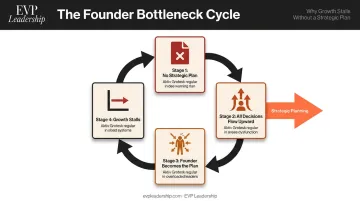
Growth becomes difficult not because the market isn't there, but because the organization has no system to pursue it consistently.
How to Get the Most Value from Your Strategic Plan
A strategic plan earns its value through consistent application, not through the act of writing it. The document is the starting point, not the destination.
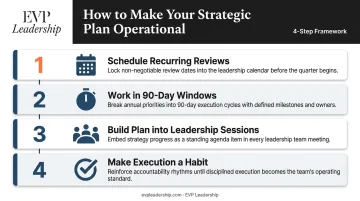
To make a strategic plan operational rather than ornamental:
- Schedule recurring reviews: Quarterly check-ins work well for most businesses — assess progress against defined metrics and adjust when conditions shift
- Work in 90-day windows: Annual goals are too distant to drive daily decisions. Quarterly milestones create urgency and accountability without losing sight of the long-term view
- Build the plan into leadership sessions: Strategic goals should inform performance conversations and shape how resource decisions get made — not sit separate from them
- Make execution a habit, not an event: Strategy that lives only in a document has no operational weight. The behaviors that execute the plan must become routine, not occasional
For small and mid-size business owners who struggle to close the gap between planning and execution, the missing piece is usually structure, not strategy. Gennifer Baker's C-level executive consulting practice at EVP Leadership addresses exactly that: building the leadership systems, operating rhythms, and accountability structures that keep a strategic plan off the shelf and in motion.
Conclusion
Strategic planning doesn't deliver a one-time win. Its advantages compound: alignment strengthens as teams develop shared direction, decision quality improves as the framework becomes habitual, and resilience builds as the organization gets better at anticipating rather than reacting.
The businesses that benefit most aren't necessarily the ones with the most sophisticated plans — they're the ones that treat strategic planning as an ongoing leadership discipline — one that shapes how decisions are made, how resources are deployed, and how the organization responds when conditions shift.
That discipline doesn't always develop in isolation. Many small and mid-size business leaders find that working with an experienced strategic partner accelerates the process, bringing structure and accountability to what might otherwise stay aspirational. Whether built internally or with outside support, the real measure of a strategic planning practice isn't the quality of the document — it's whether it actively guides how the organization operates, month after month.
Frequently Asked Questions
What are the 5 key components of a strategic plan?
The five core components are: vision (long-term direction), mission (core purpose), core values (guiding principles), strategic objectives (specific, measurable long-term goals), and tactical plans (the concrete actions and timelines to achieve those objectives). Together, these translate intention into executable direction.
What is the difference between strategic planning and operational planning?
Strategic planning sets long-term direction and defines what the organization is trying to achieve. Operational planning details the specific steps, resources, and timelines departments use to achieve those goals. Both are necessary, but they operate at different levels — one defines the destination, the other manages the route.
How often should a business update its strategic plan?
Most plans run on a 1–3 year horizon but require quarterly review at minimum. Industry research consistently shows that organizations reviewing strategy only once a year see significantly higher rates of execution failure — markets shift too fast for annual check-ins to catch course corrections in time.
Who should be involved in the strategic planning process?
Senior leadership must drive the process, but input from department heads strengthens the plan significantly. External advisors with direct strategic planning experience reduce blind spots and improve execution buy-in by bringing objectivity that internal teams often can't provide on their own.
What happens to a business without a strategic plan?
Businesses without a strategic plan tend to operate reactively, misallocate resources, and struggle to scale. Decisions get made on urgency rather than long-term impact, teams lose alignment, and leadership gets trapped in operational execution rather than strategic direction. Over time, those patterns quietly erode both profitability and organizational resilience.
How is strategic planning different for small businesses versus large enterprises?
The fundamentals are the same, but small businesses benefit from simpler, more focused plans — typically 1–3 strategic goals rather than comprehensive multi-division frameworks. They also need to iterate faster, given leaner resources and less organizational buffer when conditions shift. The planning discipline matters just as much; the scope and structure adapt to the context.