That gap between knowing where you want to go and actually getting there isn't a strategy problem for most organizations. It's an execution problem rooted in a leadership capacity problem. And it starts with a fundamental confusion: treating strategy, planning, and execution as the same discipline.
They aren't. Each serves a distinct purpose, requires different skills, and fails in different ways. Confusing them is one of the most reliable ways a business stalls — not because the direction was wrong, but because the disciplines needed to move in that direction were never clearly separated or deliberately built.
This article breaks down what each term actually means, where the real differences lie, and — critically — what it takes to close the gap between a strong plan and consistent results.
Key Takeaways
- Strategy is your direction; planning is your roadmap; execution is the daily discipline that moves you forward.
- Most businesses fail not because of a bad strategy, but because of weak execution habits and leadership gaps.
- Businesses that deliver consistent results align all three — strategy, planning, and execution — under clear leadership.
- Build execution capacity in your leaders, and the systems and processes will follow.
What Are Strategy, Planning, and Execution?
These three concepts are deeply connected, but each one does a different job. When leaders conflate them, the result is confusion about ownership, blurred priorities, and no one clearly accountable when things stall.
What Is Strategy?
Strategy is the core theory of how your business will win. As Michael Porter defined it in 1996, strategy is about choosing a unique and valuable position — making deliberate choices about where to compete, what you stand for, and what trade-offs you're willing to make.
It's directional, not operational.
What strategy is not:
- A list of revenue targets
- A budget or a hiring plan
- A task list or initiative backlog
A real strategic choice looks like this: deciding to serve one specific niche market exceptionally well rather than chasing every opportunity. That deliberate trade-off is strategy.
What Is Strategic Planning?
Strategic planning is the structured process of translating strategy into concrete objectives, timelines, resource requirements, and performance indicators. It answers how you'll pursue the direction strategy sets.
This is where strategy becomes measurable — KPIs, milestones, and clear accountabilities are defined here. Without this bridge, strategy stays aspirational. As Roger Martin has argued, the trap is when planning substitutes a list of controllable activities for actual competitive choices.
What Is Execution?
Execution is the day-to-day discipline of carrying out the plan. The decisions made, the actions taken, the behaviors sustained — these determine whether strategic goals actually get realized.
Lawrence Hrebiniak defines execution as a disciplined, adaptive process involving more people and a longer timeline than most leaders expect. It's the hardest of the three because it isn't a leadership-team activity. It touches every person in the organization, every day.
Where execution most often breaks down:
- Accountability stops at the leadership team instead of cascading down
- Daily behaviors drift from stated priorities under pressure
- The plan is treated as fixed rather than adaptive
Key Differences Between Strategy, Planning, and Execution
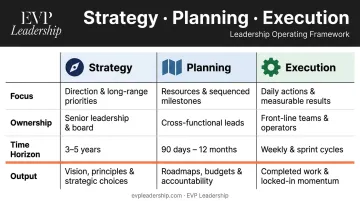
Here's how the three disciplines compare across the dimensions that matter most:
| Dimension | Strategy | Planning | Execution |
|---|---|---|---|
| Focus | What / where to compete | How to pursue the direction | Doing the work daily |
| Ownership | Senior leadership | Cross-functional teams | Everyone |
| Time Horizon | Long-term | Medium-term | Daily / weekly |
| Output | Direction | Roadmap | Results |
The Critical Distinction Most Leaders Miss
Planning produces a document. Execution produces results. Yet organizations routinely invest heavily in planning sessions while investing almost nothing in the habits, rhythms, and accountability structures that make execution stick.
Strategy sets the destination. Planning maps the route. Execution is what actually gets you there — and most organizations are far better at the first two than the third.
The Most Dangerous Misconception
A strong plan does not naturally produce strong execution. This assumption is where most organizations get into trouble.
Consider two businesses with nearly identical strategies and plans:
- Business A invests in the planning process, assigns shared ownership to a committee, and revisits the plan at the next annual cycle. Execution slows, milestones slip, and the initiative quietly dies.
- Business B treats execution as its own discipline — assigns single named owners, builds weekly accountability rhythms, and cascades strategic context to every team level. It outperforms Business A within 18 months, not because its strategy was better, but because execution was treated as a system worth building.
Organizations that outperform their peers treat execution as a distinct, leadership-driven discipline — one that requires its own structure, ownership, and accountability rhythms.
Why Execution Is Where Most Organizations Fall Short
The numbers are striking. Kaplan and Norton cited implementation failure rates of 60–90%, and Bridges Business Consultancy's longitudinal research found 90% of implementations failed in its earliest survey. Even when strategies are well-formulated, Mankins and Steele found companies typically realize only 63% of the financial performance their strategies promise.
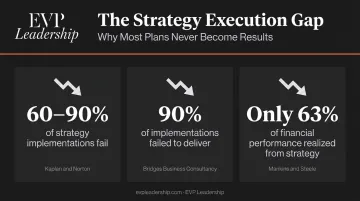
That gap between what's planned and what's delivered doesn't happen by accident. Four structural problems explain most of it.
1. No Single Owner for Strategic Initiatives
When accountability is distributed across a committee or shared among leadership, initiatives become organizational orphans. They're discussed in meetings, referenced in presentations, and quietly abandoned when day-to-day pressure mounts. Progress stalls, milestones slip, and no one is clearly responsible for the outcome.
2. Unrealistic Resource Allocation
Leadership teams regularly approve ambitious strategic plans while assuming existing teams can absorb the new work alongside daily operations. The math simply doesn't work. When capacity gets tight — and it always does — revenue-generating operational work wins. Strategic initiatives lose.
3. Strategy Doesn't Cascade Past Leadership
Kaplan and Norton reported that 95% of employees are unaware of or don't understand their organization's strategy. A separate study by Sull, Homkes, and Sull found that only 55% of middle managers could name even one of their company's top five strategic priorities.
Middle managers caught between executive directives and frontline demands tend to translate strategy into task lists — not shared understanding. What leadership intended and what the organization actually executes drift further apart with every level of translation.
4. Treating the Plan as a Finished Product
When the strategic plan lives in a shared drive and gets reviewed only at the next annual cycle, there is no mechanism for detecting drift early. By the time misalignment is visible, significant resources have already been wasted on the wrong priorities.
The Leadership Factor: Why Execution Requires More Than a Plan
Reframe the execution challenge correctly: most execution failures aren't caused by flawed processes. They're caused by leaders who haven't built the habits, discipline, and communication behaviors needed to sustain momentum when pressure rises.
EVP Leadership's core thesis applies directly here: leaders don't rise to expectations — they fall back on their conditioning. Most leaders have been trained, but not prepared for the sustained pressure that real execution demands.
What "Execution-Ready" Leadership Looks Like
Leaders who execute consistently demonstrate specific, observable behaviors:
- Clarity upfront on ownership, authority, and success criteria removes the need for constant oversight — accountability holds without micromanaging
- Communicate strategic context to every level of the organization, not just the leadership team
- Make timely decisions when momentum stalls rather than waiting for perfect information
- Stay consistent even when competing priorities emerge, without abandoning the core direction
Conditioning vs. Training
Those behaviors don't emerge from a single workshop or planning retreat. Just as athletes don't perform under pressure because they trained once, leaders don't execute consistently from a one-time event. Execution capacity is built through consistent habits and deliberate conditioning over time.
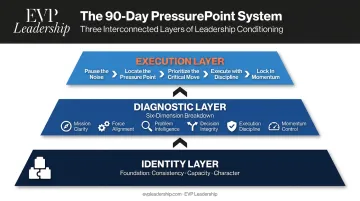
This is the foundation of EVP Leadership's 90-Day PressurePoint System — a structured conditioning program for small business owners and executive teams. It builds the leadership habits that turn a solid strategic plan into consistent execution. The system works through three interconnected layers:
- Identity Layer — builds consistency, capacity, and character as a foundation
- Diagnostic Layer — trains leaders to see clearly through six dimensions: Mission Clarity, Force Alignment, Problem Intelligence, Decision Integrity, Execution Discipline, and Momentum Control
- Execution Layer — provides a repeatable five-step protocol for critical moments: Pause the Noise → Locate the Pressure Point → Prioritize the Critical Move → Execute with Discipline → Lock in Momentum
The difference between this approach and a single strategy session is the difference between reading about swimming and learning to swim. The conditioning becomes internalized — sustainable beyond any single engagement.
Practical Steps to Connect Strategy, Planning, and Execution
Most execution breakdowns aren't strategy failures — they're structure failures. These steps build the operating structure that turns strategic intent into consistent action.
Assign a single named owner to every strategic initiative. Not a team. Not shared leadership. One person who is accountable for the outcome, with clear authority and defined success criteria.
Build a review cadence that keeps strategy visible. Weekly, monthly, and quarterly check-ins replace the annual conversation. Strategy should be a standing agenda item, not an annual event.
Translate high-level goals into role-specific actions. Every team member should be able to answer: What am I personally responsible for delivering that connects to our strategic priorities? If they can't answer that, the cascade has broken down.
Design your accountability operating rhythm. One-on-ones with clear performance conversations, team-level scorecards, and predictable feedback loops create accountability without micromanagement.
Small habits practiced consistently compound into the operating discipline that separates teams that execute from teams that drift. Building this rhythm takes deliberate leadership — and it doesn't happen once. It gets reinforced every week, every review cycle, every time a leader chooses the harder conversation over the easier silence.
Frequently Asked Questions
What is the difference between strategy and planning?
Strategy is the directional choice of where and how to compete — the trade-offs you make about your market position. Planning is the structured process of mapping specific objectives, timelines, and resources to pursue that direction. Strategy sets the destination; planning builds the route.
Why do most strategic plans fail during execution?
The most common causes are unclear ownership of initiatives, unrealistic assumptions about team capacity, poor cascading of strategic context beyond the leadership layer, and treating the plan as a static document rather than a living guide that requires ongoing review.
What are the 5 pillars of strategy execution?
Kaplan and Norton's Strategy-Focused Organization identifies five: translate strategy into operational terms, align the organization to the strategy, make strategy everyone's everyday job, make strategy a continual process, and mobilize leadership for change.
How do small business owners build a strategy without a dedicated strategy team?
Start with a clear diagnosis of where the business stands, then define 2-3 priorities for the next 12 months rather than trying to tackle everything at once. Assign ownership for each priority and build in a monthly review rhythm. A lean strategy process run by the owner-operator is more effective than an elaborate plan no one has capacity to execute.
What role does leadership play in strategy execution?
Leadership is the single most important variable in execution. Leaders set accountability structures, model the behaviors required to sustain momentum, and ensure strategic context reaches every level of the organization — not just the executive team.
How do you align your team around a strategic plan?
Translate high-level goals into role-specific responsibilities, build regular review rhythms to reinforce alignment, and ensure every team member can articulate how their daily work connects to the organization's strategic priorities. Alignment is maintained through consistent communication, not a single kickoff meeting.