Introduction
Most entrepreneurs are running hard — solving today's problems, managing their team, chasing revenue. What often gets sacrificed is time spent on the business: thinking clearly about direction, priorities, and what actually needs to change to reach the goals they set.
That gap — between daily hustle and long-term direction — is precisely where strategic planning becomes critical.
This guide is built for entrepreneurs and small business owners who need practical clarity — not corporate frameworks designed for organizations with dedicated strategy departments. By the end, you'll know:
- What strategic planning actually is (and what it isn't)
- How it differs from a business plan
- The five core steps to build one
- What it takes to keep it working over time
The evidence backs this up. According to HBR's review of research by Francis Greene and Christian Hopp, entrepreneurs who write formal plans are 16% more likely to achieve viability than otherwise similar non-planners. The difference isn't working harder — it's building a clear plan and executing against it.
Key Takeaways
- Strategic planning defines direction and priorities — separate from the operational decisions that keep daily work moving.
- Five core steps guide the process: clarify mission and values, assess your current position, set goals, build action plans, and review regularly.
- A strategic plan only delivers value when reviewed and adjusted as conditions change.
- Execution is where most entrepreneurs fall short; leadership capacity matters as much as the plan itself.
What Is Strategic Planning for Entrepreneurs?
Strategic planning is the process of determining your business's long-term direction, setting clear priorities, and deciding what actions are needed to achieve sustainable growth. It's distinct from tactical, day-to-day decision-making: the reactive problem-solving that consumes most of a founder's week.
Without a strategic framework, business owners tend to optimize for urgency rather than importance. Every fire gets attention; long-term positioning gets none.
Why It Matters for Small Business
The SBA Office of Advocacy reports that only 49.2% of new employer establishments survive five years. While no single cause explains that number, businesses operating without clear direction are more exposed to market shifts they didn't see coming and opportunities they weren't positioned to capture.
The gap in intentionality is measurable. A survey by The Alternative Board found:
- 22% of small business owners had no written strategic plan
- Only 4 out of 10 rated their existing plan as good or excellent
Strategic planning isn't reserved for corporations with strategy departments. A one-page framework built for a 5-person team is just as valid and just as valuable as a 50-page enterprise document. The goal is intentional, aligned action — and a smaller business has every reason to get there first.
Strategic Plan vs. Business Plan: Key Differences
Entrepreneurs frequently treat these two documents as interchangeable — but they serve fundamentally different purposes at different stages of growth.
What a Business Plan Does
A business plan is an operational document built to launch or structure a business. It covers:
- Market analysis and competitive landscape
- Product or service descriptions
- Financial projections and funding requirements
- Organizational structure and management
Per the SBA's guidance on business planning, a traditional business plan answers: "What is this business and how will it function?" It's the foundation — a roadmap for how to structure, run, and grow a business at the outset.
What a Strategic Plan Does
A strategic plan, by contrast, focuses on long-term organizational direction and competitive positioning. SCORE describes it as "a dynamic roadmap for long-term goals and for gauging performance over time." It answers: "Where are we going and how will we get there?"
| Dimension | Business Plan | Strategic Plan |
|---|---|---|
| Primary purpose | Launch/structure the business | Guide growth and long-term direction |
| Focus | Operations, financials, product | Priorities, positioning, evolution |
| Audience | Lenders, investors, founders | Leadership team, internal stakeholders |
| Review frequency | Annually or when raising capital | Quarterly, with annual full refresh |
Most entrepreneurs need both — written at different times, for different audiences, and revisited on different schedules. Conflating them is where strategic drift begins: you end up with a plan built to impress a lender rather than one built to guide your next three years.
The 5 Steps of Strategic Planning for Entrepreneurs
Strategic planning is a cyclical process — not a one-time event. The most effective entrepreneurs revisit these steps regularly, treating the plan as something to work with, not file away.
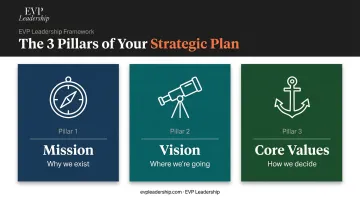
Step 1: Define Your Mission, Vision, and Core Values
Three distinct questions live here:
- Mission: Why does this business exist? What problem does it solve and for whom?
- Vision: Where do you want the business to be in 3–5 years? What does success look like?
- Core values: What principles guide decisions when things get hard?
Clarity here shapes every subsequent decision. If your team doesn't know what you're building or why, they can't align to it. This is the foundation Gennifer Baker focuses on in EVP Leadership's strategic planning work — connecting day-to-day operations to the long-term direction leaders are actually trying to reach.
Step 2: Conduct a Situational Analysis
Before deciding where to go, you need an honest picture of where you stand.
SWOT analysis — Strengths, Weaknesses, Opportunities, Threats — is the most practical tool for this:
- Strengths and weaknesses are internal (what you control)
- Opportunities and threats are external (market conditions, competition, economic forces)
Layer in basic competitor analysis and market trend research. The goal isn't exhaustive research. You need enough clarity to make decisions grounded in reality, not assumptions.
Step 3: Set Strategic Goals and Objectives
Vision without measurable goals stays abstract. This step translates direction into specific targets.
Use the SMART framework — goals that are:
- Specific — clearly defined, not vague
- Measurable — with a number or outcome you can track
- Achievable — ambitious but realistic given your resources
- Relevant — connected to your strategic priorities
- Time-Bound — with a defined deadline
Prioritize 3–5 goals. Spreading focus across 10 strategic priorities produces the same result as having no priorities at all.
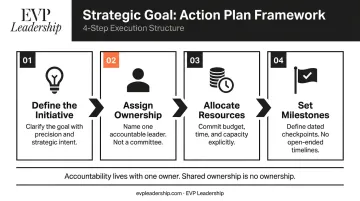
Step 4: Build Your Action Plans
This is the bridge between strategy and execution — and where most plans stall.
For each strategic goal:
- Define the initiative — the specific project or work stream that advances the goal
- Assign ownership — one person accountable, not a committee
- Allocate resources — time, budget, and people committed to it
- Set milestones — checkpoints to track progress, not just a final deadline
Without accountability structures built in, execution defaults to whoever shouts loudest. Scorecards, operating rhythms, and regular performance conversations aren't overhead — they're what separate plans that get executed from plans that get forgotten.
Step 5: Monitor Progress and Adapt
A plan reviewed once a year isn't a strategic tool. It's a document.
Build a review rhythm:
- Monthly: Brief KPI check-ins — are the leading indicators moving?
- Quarterly: Review goal progress, diagnose what's working and what isn't
- Annually: Full strategic refresh — revisit mission, situational factors, and priorities
Adjusting your approach when conditions shift isn't failure — it's what strategic maturity looks like. The distinction matters: course corrections adjust tactics while keeping strategic goals intact; pivots redefine the priorities themselves in response to major internal or external changes. Knowing which one you're doing keeps the team anchored rather than reactive.
Key Components of a Strong Entrepreneurial Strategic Plan
Format matters less than completeness. An effective entrepreneurial strategic plan should include at minimum:
- Mission and vision statement — the anchor for all decisions
- Situational analysis summary — SWOT findings and key market context
- Strategic priorities and goals — 3–5 measurable objectives with timeframes
- Action plans — initiatives, owners, resource commitments, and milestones
- KPIs — the specific metrics tied to each goal
Budget Your Strategy Before You Commit to It
Strategic goals without resource backing are wishful thinking. Map your priorities against your actual budget and capacity constraints before committing. Overcommitting strategically — trying to pursue five initiatives with resources for two — is one of the fastest ways to generate organizational exhaustion and zero results.
Define What Makes You the Right Choice
Your plan should articulate what makes your business distinctly valuable: who your ideal customers are, what advantage you're building over time, and why clients choose you over alternatives. Positioning is a strategic discipline, not a marketing one. It informs which opportunities to pursue and which to decline.
Build a Plan the Leader Can Actually Execute
A strategic plan that doesn't reflect the actual capacity of the leader running the business will struggle in execution. That means building personal systems, communication routines, and decision-making disciplines that reinforce strategic priorities under pressure — not just at planning time, but consistently.
Gennifer Baker's work at EVP Leadership, grounded in 30+ years of business strategy and leadership consulting, focuses specifically on this gap: closing the distance between what an entrepreneur commits to on paper and what they can sustain in practice.
For entrepreneurs working with an advisor, building the plan collaboratively accelerates clarity, surfaces blind spots, and creates external accountability. That's what makes the planning process itself a leadership development exercise — not just an output.
Common Strategic Planning Mistakes Entrepreneurs Make
Confusing Activity with Strategy
The most common mistake: creating an elaborate to-do list and calling it a strategic plan. Activity-focused planning looks busy but doesn't necessarily advance long-term position. A real strategic framework asks what must change — not just what you're already doing.
HBR estimates that 67% of well-formulated strategies fail due to poor execution — not poor planning. The plan rarely fails. The follow-through does.
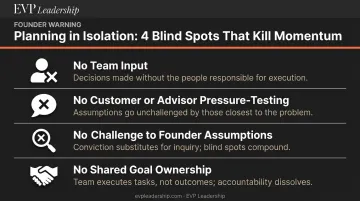
Planning in Isolation
Strategic plans built solely by the founder — without input from team members, key customers, or an outside perspective — tend to lack realism. They also fail to generate organizational buy-in. If the people responsible for execution had no voice in the planning process, don't be surprised when they feel no ownership of the outcome.
Common sources of blind spots in isolated planning:
- No input from the team members who will execute the plan
- No pressure-testing from customers or external advisors
- No challenge to the founder's assumptions or priorities
- No shared ownership of goals among the people accountable for them
Treating the Plan as a One-Time Event
Developing a strategic plan once and never revisiting it is one of the most reliable ways to waste the effort it took to build. TAB's survey data found that only 16% of business owners reviewed and updated their plans monthly — and non-members of TAB typically reviewed theirs just once a year.
Strategy isn't a document — it's a discipline. Quarterly reviews, mid-year recalibrations, and honest progress checks are what separate plans that drive results from plans that collect dust.
How to Keep Your Strategic Plan Alive
Building a Review Rhythm
Consistency in reviews determines whether the plan stays relevant or becomes a relic. A practical cadence:
- Monthly: 30–60 minute KPI review — are the metrics moving? What's blocking progress?
- Quarterly: 2–4 hour goal review — assess progress, identify stalls, adjust tactics as needed
- Annually: Full strategic refresh — revisit the situational analysis, adjust priorities, reset goals
Keep these sessions focused. Bring data, not opinions. Assign specific agenda items in advance so time isn't spent determining what to discuss.
When to Course Correct vs. When to Pivot
Not every adjustment is a pivot. Most adjustments shouldn't be.
- Course correction: Tactics change; strategic goals stay intact. The direction is right; the path needs adjustment.
- Strategic pivot: A major market shift, internal disruption, or failed assumption requires redefining priorities altogether.
Distinguish between the two before making changes. Premature pivots often reflect discomfort with execution difficulty, not genuine strategic insight.
Leadership Conditioning for Sustained Execution
Keeping a strategic plan alive requires more than calendar reminders. It requires leaders who don't abandon their priorities when the quarter gets hard — who can execute consistently under pressure, not just plan confidently in a conference room.
That gap between planning and execution is where most strategic plans die. EVP Leadership's PressurePoint System addresses this directly, conditioning leaders to maintain decision clarity and execution discipline when conditions get difficult — not just when they're comfortable.

Strategic planning is a document exercise. It becomes a leadership exercise the moment execution begins.
Frequently Asked Questions
What are the 5 steps of strategic planning?
Define your mission, vision, and core values; conduct a situational analysis; set SMART strategic goals; build action plans with owners and milestones; and monitor progress and adapt. Think of it as a continuous cycle — you return to these steps regularly as your business evolves.
What is the difference between a business plan and a strategic plan?
A business plan covers the operational details needed to launch or run a business — financials, market analysis, product descriptions. A strategic plan focuses on long-term direction, competitive positioning, and growth priorities. Most well-run businesses need both.
How often should entrepreneurs review and update their strategic plan?
At minimum, a monthly KPI check-in, a quarterly goal review, and an annual full strategic refresh. Major market shifts or significant internal changes should trigger an immediate reassessment — schedule doesn't override circumstance.
What tools or frameworks are most useful for small business strategic planning?
SWOT analysis for situational assessment, SMART goals for objective-setting, and KPI dashboards for performance tracking cover most of what entrepreneurs need. Simple frameworks applied consistently outperform complex systems that get abandoned after the first quarter.
How long does it take to create a strategic plan?
A first strategic plan can take anywhere from a few days to several weeks, depending on depth of analysis and team size. The goal is an actionable plan you'll actually use — not a perfect document you won't.
Can a solo entrepreneur or small team benefit from strategic planning?
Yes — and the smaller the team, the more strategic clarity matters. Limited resources make prioritization critical. A one-page strategic plan provides enormous clarity for a business of any size, and the discipline of planning increases the likelihood of achieving the outcomes you're working toward.