

Self-awareness gets mentioned constantly in leadership circles. It shows up in books, workshops, and keynote talks. What's rarely explained is how it actually functions inside a coaching relationship — and what it produces that's concrete and measurable.
This article covers three things: what self-awareness in leadership coaching actually means in practice, the specific advantages it creates for leaders running small and mid-size businesses, and what the absence of it costs over time.
Key Takeaways
- Self-awareness in leadership coaching is the real-time capacity to recognize how your emotions, assumptions, and patterns are shaping decisions and people around you
- Authentic team trust is built through behavioral consistency, not authority or title
- Leaders without self-awareness tend to repeat the same relationship and performance mistakes
- Structured coaching with feedback loops and repeated practice produces measurably better behavioral outcomes than one-off insight
- Self-awareness is a conditioned behavior, not a personality trait — and the 90-day window to build it is non-negotiable
What Self-Awareness in Leadership Coaching Actually Means
Self-awareness, as HBR researcher Tasha Eurich defines it, has two dimensions: internal knowledge of your own values, reactions, and patterns, and external awareness of how others actually perceive you. Here's the gap: 95% of people believe they are self-aware, while only 10–15% meet the research standard.
In a leadership coaching context, self-awareness isn't about journaling or personality assessments. It shows up in the moments that actually matter:
- A difficult performance conversation where your tone reads as dismissiveness rather than urgency
- A team conflict that requires resolution without losing key people
- A financial pressure pivot where your anxiety is quietly distorting the decision
The Center for Creative Leadership identifies self-awareness as one of the four fundamental core leadership skills — not a soft add-on, but a structural requirement for effective leadership.
Self-Awareness as an Operational Foundation
Self-awareness is an operational requirement. Every external leadership skill — communication, delegation, decision-making, influence — depends on internal clarity to function consistently. Without it, those skills degrade under pressure.
EVP Leadership's PressurePoint System frames this through the Identity Layer — three pillars that determine how a leader holds together when conditions get hard:
- Consistency — acting in alignment with your values over time, not just when it's easy
- Capacity — handling responsibility and complexity without breaking down
- Character — how both are used when pressure peaks
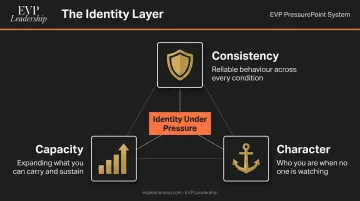
Self-awareness is the thread running through all three. A leader who can't accurately read their own internal state can't act consistently. They can't build capacity. And their character under pressure becomes reactive rather than deliberate.
Three Advantages of Self-Awareness in Leadership Coaching
Advantage 1: It Builds Authentic, Durable Trust with Your Team
Trust isn't transferred by title. It's built through repeated, predictable behavior — and self-aware leaders accelerate that process because they can course-correct before trust erodes rather than after.
The numbers here are hard to ignore. Gallup research shows that only 23% of U.S. employees strongly agree they trust their organization's leadership. Employees who do trust their leaders are three times as likely to be engaged and 61% more likely to stay.
What causes that gap? Often, it's behavioral inconsistency — leaders who show up differently under pressure than they do on calm days. Teams notice. The gap between how a leader behaves and what they say they value is exactly where trust breaks down.
Self-awareness coaching addresses this directly. When a coach surfaces a blind spot — say, that a leader's clipped tone during stressful weeks reads as anger to their team rather than focus — that leader can choose a different response next time. Not because they've changed who they are, but because they now see what others see.
Leadership metrics this improves:
- Team retention rates
- Employee engagement scores
- Quality of upward feedback
- Effectiveness of delegation
This advantage is most visible during organizational stress, rapid growth, or leadership transitions — when teams are watching closely to see if the leader's behavior matches their stated values. Self-aware leaders pass that test more consistently.

Advantage 2: It Sharpens Decision-Making Under Pressure
Here's a problem that doesn't get named often enough: most leaders can't tell when their decisions are driven by sound judgment versus unresolved anxiety, ego, or stress. The two feel identical from the inside.
MIT Sloan research found that 58% of leaders experienced anxiety during critical decision-making moments. Research on organizational decision-making confirms that decision makers are unlikely to regulate incidental emotion when they're unaware of its influence — meaning the leader who doesn't recognize their own stress state is the most vulnerable to reactive choices.
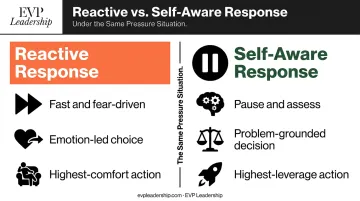
That gap between awareness and reaction is exactly what EVP Leadership's PressurePoint System is built to close. The Execution Layer opens with a deliberate first step: Pause the Noise — a structured checkpoint that interrupts the reactive loop before a decision gets made. The Diagnostic Layer builds on this through Decision Integrity: grounding choices in the actual problem rather than the emotional noise surrounding it.
What This Looks Like in Practice
Consider a founder facing a cash-flow shortfall. The reactive move is fast and fear-driven: hire quickly, cut a key team member, or over-promise to a client. The self-aware move is different — pause, run Problem Intelligence on the actual constraint, and identify the highest-leverage action rather than the most emotionally satisfying one.
The difference isn't intelligence or experience. It's the capacity to see the emotional signal clearly enough to choose a response rather than default to a reaction.
Leadership metrics this improves:
- Speed to resolution on team conflicts
- Consistency of strategic execution
- Leadership credibility during periods of change
Advantage 3: It Strengthens Communication and Reduces Conflict
Most workplace conflict doesn't start with a disagreement. It starts with a misread signal from leadership — a tone that landed wrong, a decision that felt arbitrary, a message that meant one thing to the sender and something else to the room.
CPP's global research found that 85% of employees experience workplace conflict, with U.S. workers spending an average of 2.8 hours per week managing it. That's a real operational cost — and much of it is preventable.
Self-aware leaders close the gap between message sent and message received. They notice when their own tone, pace, or body language is misaligned with their intent. They model transparency about their own state — something as simple as "I'm under pressure this week; if I seem short, it's not about the work" — which reduces the amount of energy teams spend decoding and second-guessing.
Gallup's role-clarity research reinforces this: about half of workers are not completely clear about what's expected of them. Teams with high role clarity regularly see 5–10% productivity gains. That clarity doesn't come from better slide decks. It comes from leaders who communicate with precision and self-awareness.
Leadership metrics this improves:
- Frequency and resolution time of team conflicts
- Clarity of role expectations
- Meeting effectiveness
- Quality of cross-functional collaboration
This advantage is most pronounced during rapid scaling, when managing multi-generational or diverse teams, or when a leader is transitioning from operator to executive and must shift from doing to directing.
What Happens When Self-Awareness Is Missing
The absence of self-awareness in leadership doesn't announce itself. It accumulates in patterns that compound slowly, limiting both performance and growth.
The trust gap: Leaders who lack self-awareness often believe they're communicating clearly and leading effectively. Their teams experience something different. This misalignment is persistent and invisible to the person causing it. No strategy, system, or new hire can close a gap the leader doesn't know exists.
The pressure failure pattern: Without self-awareness, leaders fall back on reactive habits when stress peaks. Micromanaging instead of delegating. Avoiding difficult conversations until they become crises. Making decisions from emotion while believing they're being rational. These habits surface precisely when steady leadership matters most — and they go unexamined because the leader never sees them as the problem.
The scaling ceiling: This is the pattern EVP Leadership sees in founder-CEOs and owner-operators trying to grow beyond their direct involvement. When a leader can't accurately assess their own strengths and gaps, delegation fails — not because the team is incapable, but because trust hasn't been built and accountability structures haven't been built. Gallup's study of 143 Inc. 500 CEOs found that leaders with high Delegator talent generated 33% greater revenue and 112 percentage points higher three-year growth than those without it. The bottleneck isn't the business model. It's the leader's internal capacity.
How to Build Self-Awareness That Actually Sticks
One workshop won't do it. Neither will a personality assessment, a single coaching session, or a leadership book. Insight without repetition doesn't produce behavioral change. It produces a more articulate version of the same patterns.
A 2023 meta-analysis of randomized controlled executive-coaching studies found that coaching effects were strongest for behavioral outcomes — not attitudes, not self-perception, but observable behavior that others can verify and trust.
What makes self-awareness development durable:
- Asking "what" and "how" questions during structured reflection — not "why," which tends to reinforce existing narratives rather than challenge them
- Seeking 360-style input from direct reports, peers, or mentors that calibrates self-perception against how others actually experience the leader
- Reviewing patterns across multiple coaching cycles — not just session-to-session takeaways, but recurring themes across weeks and months
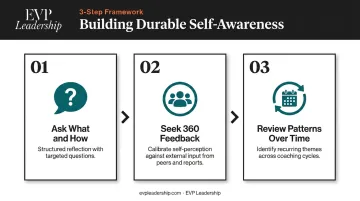
EVP Leadership's 90-Day PressurePoint System is built around this model. It moves leaders through three structured layers — Identity, Diagnostic, and Execution — in repeated cycles until clear thinking and trust-building behavior hold under pressure. The 90-day timeframe reflects the minimum threshold for behavioral change that the people around a leader can actually observe and rely on.
Conclusion
Self-awareness in leadership coaching is not a soft outcome. It's the operational foundation for durable trust, reliable decision-making under pressure, and communication that actually lands with the people responsible for executing on it.
The advantages compound — but only with structured practice. A leader who understands this doesn't approach self-awareness work as a personal development exercise. They treat it as a performance system: built deliberately, tested under real conditions, and maintained over time.
Leaders who do this work develop the internal capacity to lead through complexity without losing the trust of the people around them. That capacity isn't discovered in a single insight — it's conditioned through deliberate, repeated practice over time. That's the work.
Frequently Asked Questions
What are the core pillars of self-awareness in leadership coaching?
The three domains are emotional awareness (recognizing your internal state), behavioral awareness (understanding how your actions impact others), and external awareness (how others actually perceive you). Effective leadership coaching addresses all three through structured reflection, real-scenario testing, and calibrated external feedback — not just internal self-assessment.
What is an example of self-awareness in leadership coaching?
A leader discovers through coaching that they consistently withdraw during team conflict — a conditioned stress response, not an intentional choice. Through structured work, they replace that pattern with a prepared, direct communication approach. The shift isn't just an insight; it becomes a behavior their team can observe and rely on.
How does self-awareness in leadership coaching differ from regular self-reflection?
Self-reflection is internal and unverified — you assess yourself against your own standard. Self-awareness developed through coaching is calibrated against external feedback, structured over time, and tested under real leadership conditions. That calibration is what makes it actionable rather than aspirational.
Can self-awareness be developed, or is it an innate trait?
It's developable. Research in emotional intelligence consistently shows that self-awareness can be built through deliberate practice, structured feedback, and guided reflection. EVP Leadership's design is built on exactly that premise: consistent leadership behavior is conditioned, not a personality trait — and coaching provides the structure to condition it.
How does a lack of self-awareness affect team performance?
Leaders without self-awareness tend to create unpredictable, low-trust environments. Teams spend energy managing around the leader's reactions rather than executing on work. Over time, this erodes both performance and retention — often without the leader recognizing they're the source of the friction.
How long does it take to see results from self-awareness work in leadership coaching?
Initial shifts in self-perception typically appear within the first few weeks. Behavioral change that others notice and trust — the kind that actually builds credibility — requires a minimum of 90 days of consistent, structured work. That's not an arbitrary number; it's the threshold where conditioned behavior replaces reactive habit.