
Introduction
You've told yourself — maybe more than once — that you're going to delegate more. Be more strategic. Stop jumping into execution mode when the team needs you in the room as a leader.
And you genuinely mean it. Then a high-stakes client situation hits, a deadline compresses, or a team conflict surfaces, and the old patterns are back before you've had time to think.
That pattern has a name. Research published in the Journal of Applied Psychology found that leader identity is a direct antecedent of leadership behavior — not a byproduct of it. The gap most leaders experience isn't a knowledge gap. It's an identity-behavior gap: a misalignment between who they believe themselves to be as a leader and how they actually show up when the pressure is real.
This article covers what leadership identity means, how to recognize when it's out of sync with behavior, why skill-based training alone won't close that gap, and the specific coaching strategies that build lasting alignment — alignment that holds under pressure, not just during calm operations.
Key Takeaways
- Leadership identity — the internalized answer to "Who am I as a leader?" — drives behavior more directly than skills or training
- Misalignment between identity and behavior surfaces most visibly under pressure, not during normal operations
- Narrative mapping, values clarification, and behavioral experimentation are the coaching strategies that produce genuine identity-behavior alignment
- Alignment builds through small, consistent practices repeated over time — not through a single moment of clarity
What Leadership Identity Really Means (and Why It Shapes Everything You Do)
Leadership identity isn't your title, your years of experience, or the org chart position you hold. It's the internalized answer to the question: Who am I as a leader? It encompasses the beliefs, values, and self-narratives you carry into every interaction — most of them operating well below conscious awareness.
Identity as an Operating System
Identity functions as an invisible operating system. Leaders don't act purely from skills — they act from who they believe themselves to be. A leader who internally identifies as "the fixer" will instinctively reclaim tasks even after learning every delegation framework available. The skill is there. The identity hasn't caught up.
This distinction matters practically. Kragt and Day (2020) tracked high-potential executives through a longitudinal leadership development program and found that leader identity strength was significantly associated with development across key competencies — and 56.3% of participants were promoted within a year of completing the program. Seeing yourself as a leader is a prerequisite for consistently leading, not a byproduct of it.
The Neuroscience Behind the Identity-Behavior Link
Self-identity is processed in the brain's cortical midline structures — the same regions involved in narrative, meaning-making, and self-referential thought. Northoff et al. (2006) confirmed through neuroimaging meta-analysis that self-referential processing consistently activates these areas across emotional, verbal, and social domains.
When identity and intention align, both the meaning-making system and the goal-execution system engage together. That's why aligned leaders report stronger intrinsic motivation and less decision fatigue — the internal and behavioral signal point the same way.
That neurological alignment is exactly what EVP Leadership's core principle captures: "Who you are at your core determines the health of your leadership." Leadership capacity cannot outgrow leadership identity — which is why identity conditioning has to run alongside skill development, not after it.
The Telltale Signs of Identity-Behavior Misalignment
Misalignment rarely announces itself through poor performance metrics. More often, it hides behind adequate results while the leader's internal experience degrades — and their ceiling for influence drops with it.
What It Looks Like in Practice
The most common pattern: strong external results alongside persistent discomfort, avoidance, or inconsistency. This gap doesn't surface when things are easy. It surfaces in high-pressure meetings, during hard conversations, or when the team is watching closely.
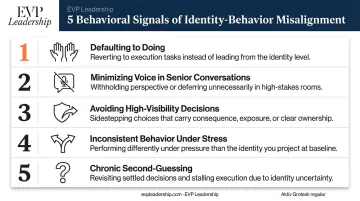
Recognizable behavioral signals include:
- Defaulting to doing — the "I'll just handle it" reflex that surfaces even after committing to delegate
- Minimizing one's voice in senior conversations despite clear expertise
- Avoiding high-visibility decisions or opportunities for organizational influence
- Inconsistent behavior under stress — reacting in ways that contradict stated values when stakes rise
- Chronic second-guessing on decisions that should fall clearly within their authority
Imposter Syndrome Through the Identity Lens
Imposter syndrome in high-performing executives runs deeper than most leaders acknowledge. A Korn Ferry survey found that 71% of U.S. CEOs reported experiencing signs of imposter syndrome during their careers. The pattern is consistent: their external role has outpaced their internal self-concept.
Some self-doubt can sharpen interpersonal sensitivity. Chronic misalignment is different: it narrows influence, creates decision hesitation, and erodes the consistency teams depend on.
The Organizational Cost
That erosion doesn't stay internal for long. When a leader's behavior is inconsistent with their stated identity, teams don't just notice — they respond. Palanski and Yammarino (2011) found that leader behavioral integrity was indirectly related to follower job performance through trust and satisfaction. When word and deed fall out of alignment, trust erodes first — and measurable performance gaps follow shortly after.
Why Training Alone Won't Close the Identity-Behavior Gap
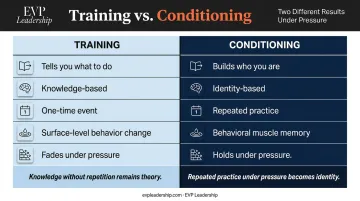
Skill-based training delivers knowledge and techniques. Identity is shaped by repeated lived experience, narrative, and belief — and those operate through entirely different mechanisms.
A leader can complete a delegation workshop, understand the framework, and still default to micromanaging — because their identity still says "I'm the one who makes sure things get done right." The technique didn't fail. The identity layer was never touched.
Role Expansion Without Identity Work
When businesses scale, a leader's responsibilities often expand faster than their internal narrative updates. The capability grows. The self-concept lags. Under pressure, behavior reverts to the identity that feels most familiar — not the role that's been assigned.
Founders carry a specific version of this challenge. EVP Leadership describes it as identity-fusion with the business — where the company's growth and the founder's personal leadership identity diverge, creating behavioral gaps that no amount of skills training can close on its own.
Kragt and Guenter (2018) found that leader identity mediated the relationship between leadership training and leader effectiveness. Translation: training works when it's supported by identity work. Without that foundation, transfer to real-world behavior is unlikely to stick.
Common signs the identity layer hasn't caught up with a leader's expanded role:
- Reclaiming tasks they've already delegated when stakes feel high
- Avoiding direct accountability conversations to preserve relationships
- Defaulting to doing rather than directing under pressure
- Measuring their value by output rather than team performance
The Conditioning Distinction
This is the core distinction EVP Leadership draws between training and conditioning. As they frame it: "Most leaders have been trained, but not prepared for real pressure." Training tells you what to do. Conditioning prepares you to perform as the leader you intend to be — specifically in the moments that test your defaults.
A one-time training event doesn't reach that layer. A structured, repeated conditioning approach does — because it builds the behavioral muscle memory that holds when pressure hits.
Coaching Strategies to Align Leadership Identity and Behavior
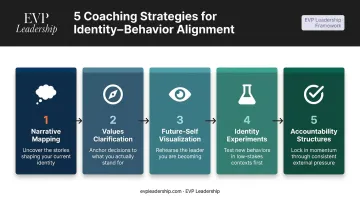
These are the specific approaches that bridge the gap between who a leader is and how they show up — through structured identity work combined with behavioral practice.
Strategy 1: Narrative Mapping
Surface and examine the internal stories driving behavior. Leaders carry unconscious labels for themselves: "I'm the one who figures things out," "I'm not a political player," "I have to earn my seat at this table."
The coaching work involves:
- Identifying those labels explicitly
- Tracing where each narrative originated
- Evaluating whether it still serves the leader's current role
A clarifying coaching question: "What would you have to believe about yourself to keep acting this way?" That question often surfaces the identity assumption faster than any assessment tool.
Strategy 2: Values Clarification and Behavioral Anchoring
Most leaders can list their values in thirty seconds. Far fewer can explain what each value requires of them behaviorally in a specific high-stakes situation.
The goal is to anchor identity to two or three core values, then examine actual behavior against those anchors. When values and behavior conflict, the coach treats that tension as a navigation point — a signal worth examining, not a verdict on the leader. EVP Leadership's Identity Layer applies this directly: consistency is defined as "acting in alignment with your values and expectations over time."
Strategy 3: Future-Self Visualization
Structured visualization helps leaders mentally rehearse acting from their intended identity in high-pressure scenarios. The practice is specific: leaders picture, in concrete detail, how their best adaptive self enters a difficult room, handles a conflict, or responds when challenged publicly.
The neuroscience supports this approach. Mulder (2007) confirmed that motor imagery activates many of the same brain areas as actual movement. Mental rehearsal of behavioral scenarios strengthens the neural bridge between current and intended self. Performance athletes have used this for decades. The mechanism transfers directly to leadership.
Strategy 4: Identity Experiments (Low-Stakes Behavioral Testing)
Rather than attempting wholesale transformation, coaches guide leaders to try small, deliberate behaviors aligned with their intended identity:
- Speaking first in a meeting they usually defer in
- Coaching a team member through a decision instead of solving it
- Handing over a high-stakes task and observing the outcome without intervening
These experiments generate firsthand evidence that the new identity is viable. Once a leader has proof (from their own experience) that acting from the intended identity produces real outcomes, internal belief begins to shift. EVP Leadership describes testing leaders "in real scenarios" as a core element of their conditioning approach.
Strategy 5: Accountability Structures with Reflection Loops
Alignment isn't sustained through insight. It requires structured follow-through.
Effective coaching builds in regular reflection prompts such as "How did I live my stated values this week?" and accountability checkpoints that reinforce the identity-behavior connection over time. EVP Leadership's delegation and accountability work builds this into a concrete operating rhythm:
- Weekly 1:1 cadences that keep commitments visible
- Performance conversations tied to stated values, not just outcomes
- Scorecards that anchor identity-aligned behaviors to observable results
When reflection and accountability run in parallel, leaders stop relying on motivation to sustain change. The behavior becomes the standard.
Building the Conditioning Loop: Making Alignment a Leadership Habit
Sustainable alignment is built the same way athletic conditioning works: not through a single breakthrough, but through consistent, deliberate practice of small behaviors over time.
Lally et al. (2010) found that habit automaticity developed over an average of 66 days in real-world settings, with a range of 18 to 254 days depending on the behavior and individual. That range matters: meaningful shifts can appear in weeks when practice is consistent, but deeper identity rewiring typically unfolds over 60–90 days of structured work.
What the Conditioning Loop Looks Like
Leaders don't wait for a crisis to test their alignment — they practice their intended identity in daily micro-moments:
- How they open a difficult conversation
- How they respond to a setback in front of the team
- How they make a decision without perfect information
Each repetition closes the gap between who they intend to be and how they actually show up under pressure. EVP Leadership's core value captures this directly: "Actionable change starts with small habits practiced consistently over time."
Pressure as a Diagnostic
Pressure doesn't create misalignment. It reveals it. Leaders who invest in conditioning their identity-behavior alignment develop the capacity to fall back on their best self — not their most stressed self — when it matters most.
EVP Leadership's tagline puts it plainly: "Because leaders don't rise to expectations — they fall back on their conditioning." The 90-Day PressurePoint System is built around this principle, with the Identity Layer (consistency, capacity, character) forming the foundation that the Diagnostic and Execution layers depend on.
When pressure arrives, conditioned leaders fall back on practiced identity — consistency, capacity, and character they've built through structured repetition, not crisis response.
Frequently Asked Questions
What is leadership identity, and how is it different from a leadership style?
Leadership identity is your internal sense of who you are as a leader — the beliefs, values, and narratives that drive how you show up. Leadership style refers to observable behavioral patterns. Identity drives style; when identity is unclear or misaligned, style becomes inconsistent and unreliable under pressure.
What are the most common signs that a leader's identity and behavior are misaligned?
Common signals include:
- Reverting to micromanagement despite knowing how to delegate
- Inconsistent behavior under pressure
- Avoiding high-stakes visibility or sponsorship opportunities
- A persistent gap between stated values and actual decisions
How does coaching specifically help close the identity-behavior gap?
Coaching creates a structured, reflective space where leaders can surface the narratives driving their behavior, test new identity-aligned behaviors in low-risk ways, and build accountability systems that make alignment a practice rather than a one-time realization.
Can leadership identity change, or is it fixed?
Leadership identity is not fixed — it evolves through intentional reflection, repeated behavior, and external feedback. Shifts accelerate when leaders combine self-awareness work with consistent behavioral practice. In practice, sustained behavior change reshapes identity over time — not the other way around.
How long does it take to see results from identity-behavior alignment coaching?
Meaningful shifts often become noticeable within weeks when leaders engage in consistent daily practices. Deeper identity rewiring typically unfolds over 60–90 days of structured conditioning work, which is the foundation behind EVP Leadership's 90-day PressurePoint System.
Is identity-behavior alignment coaching only for leaders who are struggling?
This work is most valuable for high-performing leaders whose external results are strong but whose internal alignment is limiting their next level of influence, resilience, or team impact. The leaders who benefit most often look fine from the outside — and know something important is capped on the inside.