What separates a manager who knows the work from a leader who moves people is rarely strategy. It's emotional intelligence (EI). Not the soft, feel-good version of that phrase, but a specific, measurable set of skills that determine how a leader performs under pressure, how their team experiences them, and whether talented people stay or leave.
Research by Miao et al. — a meta-analysis across 2,764 participants — found that leader EI predicts subordinate task performance and organizational citizenship behavior beyond cognitive ability and personality alone. These aren't personality traits. They're conditioned capacities.
This article breaks down the five EI skills great leaders possess, what they look like in practice, and how to actually build them — not just understand them.
Key Takeaways
- Emotional intelligence is made up of distinct, learnable skills — not fixed personality traits
- The five core EI skills are: self-awareness, self-regulation, empathy, social awareness, and relationship management
- Leaders with high EI make better decisions under pressure, retain talent, and build stronger teams
- EI develops through consistent practice under real conditions, not one-time training events
- Investing in EI conditioning gives small business owners and executives a compounding leadership edge
What Is Emotional Intelligence in Leadership?
Emotional intelligence is the ability to recognize, understand, and manage your own emotions — and recognize, understand, and influence the emotions of others — in service of better leadership outcomes.
The framework originated with Salovey and Mayer in 1990 and was later popularized by Daniel Goleman. His 1998 Harvard Business Review work identified five EI leadership components — self-awareness, self-regulation, motivation, empathy, and social skill. Goleman's position: IQ and technical skills are threshold capabilities. EI is what separates excellent leaders from average ones.
Why does this matter specifically for leaders, not just employees? Because leaders set the emotional tone for their entire organization. How a leader responds under pressure — composed or reactive, clear or scattered — ripples through every layer of the organization. A leader's internal state becomes the team's emotional weather.
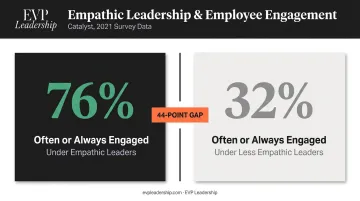
According to Catalyst's 2021 survey of 889 U.S. employees, 76% reported being often or always engaged under empathic senior leaders — compared to just 32% under less empathic leaders. That gap — 76% versus 32% — marks the difference between a team that drives results and one that simply goes through the motions.
The 5 Emotional Intelligence Skills Great Leaders Possess
Skill 1: Self-Awareness
Self-awareness is a leader's ability to recognize their own emotions, triggers, strengths, and blind spots — and understand how these directly influence their decisions and how their team experiences them.
Tasha Eurich's research draws an important distinction here: internal self-awareness means understanding your own values, reactions, and patterns. External self-awareness means understanding how others actually perceive you. Most leaders assume they have both. Few do.
Eurich's research found that 95% of people believe they are self-aware, but only 10–15% actually meet the criteria. In leadership, that gap is expensive. Leaders who lack self-awareness react defensively to feedback, make emotionally driven decisions without realizing it, and unknowingly damage team morale.
Practical ways leaders build self-awareness:
- Journaling emotional patterns after high-stakes interactions
- 360-degree feedback assessments to surface how others experience you
- Reviewing decisions after the fact to identify emotional distortion
- Slowing down before high-pressure responses to notice internal state
Self-awareness isn't about being introspective for its own sake. It's about having accurate data on yourself — so your decisions are grounded in reality, not blind spots.
Skill 2: Self-Regulation
Self-regulation is the ability to pause between an emotional trigger and a response. Leaders who have it respond with intention. Those who don't default to reaction — and their teams pay for it.
For small business owners and executives, this skill gets tested constantly. A key employee resigns. A major client pushes back. A board conversation turns contentious. In each of these moments, the leader's internal composure determines whether the team steadies or spirals.
Research by Sy, Côté, and Saavedra studying 56 intact groups found that leader mood directly influenced group mood, coordination, effort, and strategy. The leader's emotional state sets the tone — and the team follows it up or down.
What strong self-regulation looks like in practice:
- Absorbing bad news without visibly unraveling in front of the team
- Delivering difficult feedback without becoming defensive
- Navigating conflict without escalating it
- Creating psychological space for honest conversation rather than shutting it down
Empathy gets misread constantly. Leaders confuse it with sympathy, or assume it signals softness. It's neither. In leadership, empathy is the active ability to understand what someone else is experiencing — and use that understanding to lead them more effectively.
DDI's High-Resolution Leadership study — drawing on 15,000 assessments across 300+ organizations in 18 countries — identified empathy as the #1 driver of overall performance among eight core interaction skills. Yet only 40% of frontline leaders demonstrated proficiency in it. That's a significant skill gap in the most impactful competency measured.
Empathy in practice looks like:
- Listening to a team member without immediately pivoting to problem-solving
- Asking questions to understand someone's experience before offering a solution
- Using that understanding to coach more effectively — and retain more consistently
Empathy gives leaders better information about what their team is actually experiencing. That translates directly into sharper coaching, stronger retention, and decisions that account for reality — not just what leaders assume is happening on the ground.
Younger employees, in particular, expect this. Deloitte's 2025 survey of over 23,000 Gen Z and millennial respondents identified empathy as one of the most valued leadership qualities. Organizations that don't develop empathic leaders won't retain the talent they need to grow.
Skill 4: Social Awareness
Social awareness is related to empathy, but it operates at a different level. Where empathy is one-on-one — understanding one person's emotional state — social awareness is systemic. It's the ability to read the emotional climate of a room, a team, or an organization.
A socially aware leader notices when team energy drops after a reorganization. They sense unspoken resistance before it surfaces as open conflict. They adjust their communication approach based on what the organization needs emotionally — not just operationally.
This matters because what leaders miss at the group level often determines whether they can build environments where people speak honestly, take risks, and stay committed.
Google's Project Aristotle studied 180 teams and identified psychological safety as the most important factor in team effectiveness. Social awareness is how leaders build those conditions. A leader who reads the room — and responds to what they sense — creates the environment where teams perform at their actual potential rather than their cautious, self-protective minimum.

Signs of strong social awareness in action:
- Noticing energy shifts after major announcements or changes
- Picking up on unspoken resistance before it hardens into conflict
- Calibrating communication style to where the team is emotionally, not just operationally
- Recognizing when the group needs acknowledgment before they're ready for direction
Skill 5: Relationship Management
Relationship management is where all four preceding skills converge into leadership action. It's the ability to use self-awareness, self-regulation, empathy, and social awareness together — to influence others, resolve conflict constructively, coach team members toward growth, and build lasting trust.
This is the skill that determines whether a leader earns genuine buy-in or just compliance. Whether difficult conversations produce clarity or resentment. And ultimately, whether people grow under a leader's watch — or just endure it.
The stakes are measurable. According to CPP's Global Human Capital Report, U.S. employees spent 2.8 hours per week dealing with workplace conflict in 2008 — equal to approximately $359 billion in paid hours annually. Much of that conflict persists because leaders lack the skills to address it directly and constructively.
Hallmarks of strong relationship management:
- Giving honest feedback without damaging the relationship
- Addressing conflict directly rather than avoiding it until it escalates
- Knowing team members as people — not just as performers
- Coaching toward growth rather than managing toward compliance
Leaders who manage relationships well don't do so because they're naturally charismatic. They've developed the capacity through the other four EI skills — and they apply them consistently, especially under pressure.
How to Build These EI Skills Through Deliberate Conditioning
Here's what most leaders miss: reading about self-awareness doesn't make you self-aware, and understanding empathy conceptually won't help you when the pressure is real. EI knowledge and EI capacity are not the same thing.
Traditional leadership training fails on this point. Companies spent $160 billion in the U.S. and $356 billion globally on training and education in 2015, yet HBR reports that employees frequently revert to old behaviors when training ends. One-time interventions don't hold when the pressure is real.
What actually works is deliberate conditioning — repeated practice under conditions that test your emotional responses, with structured feedback that shows you where you're breaking down.
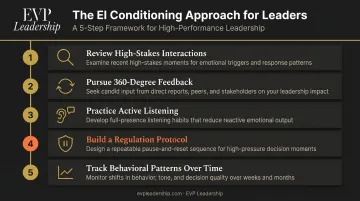
A repeatable conditioning approach for leaders:
- Review high-stakes interactions regularly to identify emotional patterns and decision distortions
- Pursue 360-degree feedback to surface blind spots that self-assessment won't catch
- Treat active listening as a discipline applied in every team interaction, not a soft-skill checkbox
- Build a personal regulation protocol so high-pressure moments don't find you improvising
- Track behavioral patterns over time — EI development is cumulative, and small consistent habits produce the most durable change
This is the philosophy behind EVP Leadership's 90-Day PressurePoint System. Rather than delivering a workshop or training curriculum, the program conditions leaders through structured, repeated practice under real leadership pressure.
The Identity Layer builds the consistency, capacity, and character that EI requires. The Diagnostic Layer trains leaders to make decisions grounded in truth rather than emotional noise. The Execution Layer gives leaders a step-by-step protocol for high-stakes moments — starting with "Pause the Noise," which creates the space self-regulation demands.
For small business owners and executives, EI conditioning isn't something to address when things slow down. Things don't slow down. The leaders who perform with emotional consistency under pressure are the ones who built that capacity before they needed it.
Conclusion
Great leadership isn't built on expertise alone. Strategy, authority, and technical knowledge get a leader in the room — but none of that determines what happens when the pressure spikes, the stakes are real, and the decision is genuinely hard.
The five EI skills covered here — self-awareness, self-regulation, empathy, social awareness, and relationship management — are what determine that. None of them are fixed traits. They're trainable — built through consistent, deliberate practice over time.
If you're a business owner or executive ready to build these skills in a structured, proven way, EVP Leadership partners with leaders to condition — not just train — the emotional intelligence that drives lasting performance. Explore the 90-Day PressurePoint System or reach out to start a conversation.
Frequently Asked Questions
What are the 4 pillars of emotional maturity?
Emotional maturity is generally associated with four pillars: self-awareness, self-regulation, empathy, and personal responsibility. These overlap significantly with core EI competencies and form the foundation of consistent, trustworthy leadership behavior.
Can emotional intelligence be learned, or is it a natural trait?
Research consistently shows EI can be developed through intentional practice, feedback, and conditioning. A meta-analysis by Mattingly and Kraiger across 58 studies confirmed that EI training in adults produces a moderate positive effect — and these skills grow stronger the more deliberately they're worked on.
What is the most important emotional intelligence skill for a leader?
Self-awareness is the foundational EI skill. Without it, a leader can't accurately assess how their emotions affect their decisions or how they're perceived by others. Every other EI skill builds from this baseline.
How does low emotional intelligence affect a team?
Leaders with low EI tend to create environments of low trust, poor communication, and elevated conflict. Team members disengage, withhold honest feedback, or leave — dynamics that directly reduce productivity and increase turnover.
What is the difference between EQ and IQ in leadership?
IQ measures cognitive ability and technical problem-solving. EQ measures the ability to understand and manage emotions in yourself and others. In leadership contexts, EQ is a stronger predictor of team performance and retention outcomes than IQ alone.
How long does it take to develop emotional intelligence as a leader?
EI development is ongoing, not a one-time event. Meaningful improvement in skills like self-regulation or empathy can appear within weeks, but deep conditioning that holds under real pressure typically takes months of intentional effort and structured feedback.