Introduction
Most small business owners can describe where they want to be in five years. Few have a structured process for getting there.
That gap is costly. According to the SBA Office of Advocacy, only 49.2% of new employer establishments survive past five years — meaning roughly half don't make it. While no single cause explains every failure, the absence of structured long-term planning consistently leaves businesses exposed when conditions shift or growth stalls.
This post walks through how to define, build, and act on long-term goals as a practical system — one small business owners can apply immediately, not just study.
One distinction matters before diving in: long-term goals don't fail because of bad strategy. They fail because the leader hasn't built the consistency to follow through when pressure builds. EVP Leadership's work with small business owners and founders is grounded in exactly that premise — conditioning the leader, not just refining the plan.
Key Takeaways:
- Long-term goals set your two-to-five-year direction; short-term goals are how you get there
- Effective goals require a framework (SMART or OKRs) to stay specific and measurable
- Quarterly and monthly milestones convert long-term strategy into daily action
- Without a review cadence and accountability structure, goals stall
- Leadership capacity — not just strategy — is what ultimately drives execution
What Are Long-Term Business Goals (and Why Small Businesses Can't Afford to Skip Them)
Harvard Business School Online defines strategic goals as measurable objectives tied to an organization's long-term vision — distinct from the day-to-day tasks or quarterly targets that keep operations running.
For small businesses, long-term goals typically span two to five years and answer a fundamental question: Where is this business ultimately headed?
Why They Matter Beyond "Having a Plan"
Long-term goals function as a decision filter. When you're clear on where the business needs to be in three years, choices about hiring, investment, pricing, and partnerships become less ambiguous. They either move you toward that goal or they don't.
Without that filter, small business owners tend to chase whatever is most urgent — which often has nothing to do with what's most important.
The research backs this up:
- A meta-analysis of 46 studies found that business planning improves performance in both new and established small firms
- Formal strategic planning showed a meaningful positive effect on sales/revenue growth and return measures in firms with fewer than 100 employees
- The SBA describes a business plan as the "foundation" that guides each stage of starting and growing a business
The best long-term goals are ambitious enough to require real growth and flexible enough to adapt as market conditions shift. What they're not is optional — clarity about where you're headed is what makes every other decision easier to execute.
Long-Term vs. Short-Term Goals: Why You Need Both
Short-term goals (weeks to 12 months) define what needs to happen now. Long-term goals (two to five years) define where the business is ultimately headed. Neither works well without the other.
The long-term goal is the destination. Short-term goals are the route that gets you there. A destination without a route keeps you stuck; a route without a destination keeps you busy — but off-course.
The Risk of Short-Term-Only Thinking
Small business owners who focus exclusively on short-term wins often make decisions that actively conflict with their long-term direction. A common pattern: a business chases a large contract outside its core market because the revenue looks good, only to find 18 months later that the detour cost them momentum in the segment they actually wanted to own.
MIT Sloan Management Review notes that annual goals are often too tactical, while long-term goals can feel too abstract — and that the gap between them is where execution breaks down. In a survey of 302 companies, only 29% of managers could identify three of their firm's top strategic priorities. That misalignment doesn't just affect large organizations.
Both timeframes are necessary. Long-term goals give direction; short-term goals create movement. The work is building the discipline to manage both simultaneously — not letting urgency permanently override strategy.
Examples of Long-Term Goals for Small Businesses
Effective long-term goals are specific enough to guide decisions, broad enough to allow strategic flexibility, and honest enough to reflect what the owner actually wants.
Here are five examples across common small business priorities:
- Revenue milestone — Reach $3M in annual revenue within four years by expanding the core service line and reducing client concentration
- Geographic expansion — Open a second location in an adjacent market within three years, with the first location operating independently
- Team development — Build a self-managing leadership team within five years so the owner can step out of day-to-day operations
- Market positioning — Become the recognized leader in a specific local or niche market, measured by referral volume and industry visibility
- Revenue diversification — Reduce dependency on the top three clients from 70% of revenue to under 40% by developing additional service offerings
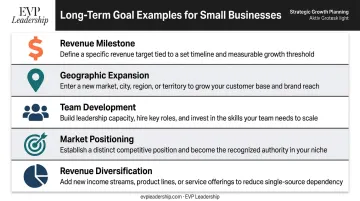
Each example above points in a clear direction and forces real trade-offs — which is exactly what makes them useful.
That specificity also needs to extend inward. Long-term goals should align with the owner's personal vision for the business, including what role they want to play five years from now. A goal to scale to $10M in revenue looks completely different depending on whether the owner intends to stay at the center of operations or step back from them entirely.
How to Create Long-Term Goals for Your Small Business
Step 1: Start with a Clear Business Vision
Before writing a single goal, articulate where you want the business to be in three to five years. Ask yourself:
- What does success actually look like for this business?
- What do I want the business to be known for?
- What role do I want to play — and what do I want to hand off?
This isn't a mission statement exercise. It's an honest conversation with yourself about the future you're actually building toward. The goal-writing comes after the clarity.
Step 2: Conduct an Honest Assessment of the Current State
Where is the business today — financially, operationally, and in terms of team capacity?
A structured evaluation should cover the areas most likely to either accelerate or cap your growth. EVP Leadership's Diagnostic Layer, for example, structures this assessment across six dimensions:
- Mission Clarity
- Force Alignment
- Problem Intelligence
- Decision Integrity
- Execution Discipline
- Momentum Control
This kind of evaluation reveals both the strengths to build on and the gaps that must be closed before the long-term vision is reachable.
Without an honest current-state assessment, goal-setting becomes wishful thinking.
Step 3: Apply a Framework to Make Goals Concrete
Two frameworks stand out:
| Framework | Best For | Structure |
|---|---|---|
| SMART | Clear, measurable goals with defined timelines | Specific, Measurable, Achievable, Relevant, Time-bound |
| OKRs | Aspirational goals with measurable milestones | Objective (the "what") + 3 Key Results (the "how") |
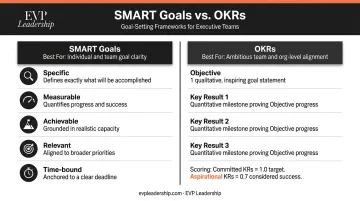
SMART goals (introduced by George Doran in 1981) prevent goals from staying vague and untestable. OKRs — used extensively at Google — work well for goals that are ambitious enough that falling short still represents meaningful progress. Google's OKR Playbook distinguishes between committed OKRs (expected to score 1.0) and aspirational ones (where 0.7 is considered a strong result).
Once you've chosen a framework, the next challenge is deciding which goals are worth pursuing in the first place.
Step 4: Prioritize Ruthlessly
Small businesses have limited bandwidth. Trying to pursue five long-term goals simultaneously is a reliable path to advancing none of them.
Limit yourself to two to three long-term goals at a time. Choose the ones with the most strategic leverage — the goals that, if achieved, would create the greatest positive impact across the business.
Step 5: Align Goals Across Key Business Pillars
Kaplan and Norton's Balanced Scorecard framework offers a useful lens for checking whether your goals are balanced. It evaluates performance from four perspectives: financial, customer, internal business process, and learning and growth.
A small business with three long-term goals — all focused on revenue — may be ignoring operational or team-development issues that will cap growth anyway. Run your goals through each lens to check for blind spots.
How to Break Long-Term Goals Into Actionable Steps
Defining a long-term goal is just the starting point. The real work is breaking it down into a cascade of progressively shorter timeframes — each level feeding the one above it.
The Cascade Model
Break each long-term goal into progressively shorter timeframes:
- Long-term goal (2–5 years) — the destination
- Mid-term strategies (6–18 months) — the major initiatives required to get there
- Short-term objectives (monthly or quarterly) — the specific actions that move each initiative forward
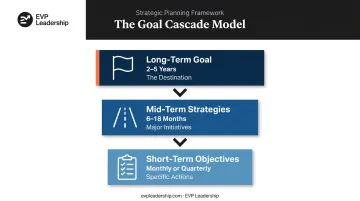
Example in practice:
- Long-term goal: Double revenue within four years
- Mid-term strategy: Build and systematize a scalable sales process
- Short-term objective: Hire a sales lead and document the current sales workflow this quarter
Each level feeds directly upward. If the short-term objective doesn't connect clearly to the long-term goal, it doesn't belong in the plan.
Building Systems, Not Just Plans
Reaching long-term goals requires routines and systems that keep the business moving forward consistently — not periodic bursts of effort between long stretches of drift.
EVP Leadership's 90-Day PressurePoint System is built on this principle. The Execution Layer gives small business leaders a repeatable protocol for translating strategic priorities into focused daily action:
- Pause the Noise
- Locate the Pressure Point
- Prioritize the Critical Move
- Execute with Discipline
- Lock in Momentum
The system is designed to condition leaders to maintain clarity and discipline consistently — not just when conditions are favorable.
Accountability and Review Cadence
Two elements that determine whether goals actually get completed:
Every goal or milestone needs a clear owner and a defined timeline. Without explicit ownership, accountability erodes — even when one person is responsible for everything, that responsibility should be named and tracked.
Review cadence:
- Monthly — check progress on short-term milestones
- Quarterly — review mid-term strategy progress and adjust tactics
- Annually — reassess long-term goals to confirm they still reflect the business's direction
Common Mistakes to Avoid When Setting Long-Term Business Goals
Setting Goals That Are Too Vague
"Become the best in the industry" is not a long-term goal. It's a wish. A vision statement and a long-term goal are different things — the vision describes a future state; the goal specifies what achieving it requires.
Locke and Latham's research on goal-setting theory found that specific, difficult goals consistently led to higher performance than vague "do your best" goals, with effect sizes ranging from 0.42 to 0.80. The mechanism is simple: vague goals have no external referent, so acceptable performance can mean almost anything.
Failing to Revisit Goals as the Business Evolves
Long-term goals written two years ago may no longer reflect current market conditions, team capabilities, or owner priorities. Treat them as living documents. An annual review isn't optional — it's the mechanism that keeps strategy connected to reality.
Neglecting the Leadership Dimension
An obstacle most owners overlook is their own capacity to lead consistently under pressure. The gaps that derail execution aren't usually strategic — they're operational and personal:
- Poor delegation that keeps the owner in the weeds
- Decision fatigue that slows momentum at critical inflection points
- Inconsistent follow-through that erodes team accountability over time

EVP Leadership's work in this area treats consistency, capacity, and character as conditioned leadership skills — not fixed traits. Capacity, specifically the ability to handle responsibility, complexity, and growth, must be built deliberately. Character determines whether that consistency gets applied in ways that actually sustain organizational health.
Goals stall when the leader hasn't been conditioned to execute through two to five years of inevitable pressure.
Frequently Asked Questions
What are some long-term goals for a business?
Common long-term goals include reaching a specific revenue milestone, opening a second location, building a self-managing leadership team, becoming the recognized leader in a local or niche market, and diversifying revenue streams to reduce dependency on one client or product line.
What is the difference between short-term and long-term business goals?
Short-term goals address immediate priorities within weeks to 12 months. Long-term goals define where the business is headed over two to five years. Both are necessary — long-term goals provide direction, and short-term goals are the stepping stones that build toward them.
How do you write a long-term business goal?
Use the SMART framework to make it specific, measurable, achievable, relevant, and time-bound. Start with your business vision, assess where you are today, and write a goal that connects the two with enough clarity to guide real decisions.
How often should you review your long-term business goals?
Review long-term goals at least annually, short-term milestone progress monthly, and mid-term strategy progress quarterly. This cadence keeps daily execution connected to your broader direction.
What happens if your long-term goals become outdated or need to change?
Revise them. Market conditions shift, team capacity changes, and owner priorities evolve — that's normal. Flexibility in execution isn't the same as abandoning ambition; what matters is staying on course, not staying loyal to an outdated plan.
How do long-term goals connect to day-to-day operations?
Long-term goals should directly inform how the owner and team prioritize daily tasks, allocate resources, and make decisions. If the day-to-day work isn't visibly connected to a long-term goal, question whether that work belongs in the plan at all.