The gap between holding the CEO title and actually functioning as one is where most small businesses stall. According to the Bureau of Labor Statistics, top executives are responsible for planning strategies and policies to ensure organizations meet their goals — yet in small businesses, the same person doing that strategic work is often also the one ordering supplies, handling a difficult client, and covering for a no-show employee.
This article covers 10 practical ways to grow into the CEO your business needs — starting with how you think, not just what you do.
Key Takeaways
- Being a CEO requires a leadership identity, not just operational involvement
- Great small business CEOs lead by example, build strong cultures, and delegate with confidence
- Financial literacy, customer focus, and industry awareness are core competencies — gaps in any one area limit growth
- Adaptability and long-term vision separate businesses that survive from those that grow
- Leadership performance under pressure is built through consistent habits, not inherited personality traits
What It Truly Means to Be a CEO of a Small Business
There's an important distinction between owning a business and functioning as its CEO. Ownership is about financial stake and legal accountability. The CEO role is about strategic direction, culture, and leading people toward a shared goal.
The BLS notes that in small organizations, an owner or manager often handles hiring, training, quality control, and day-to-day supervision simultaneously — which captures the reality most small business owners live in.
The title isn't inflated. It accurately reflects the scope of responsibility, establishes credibility with clients and partners, and signals the level of decision-making authority you carry.
The more important question isn't whether you can call yourself a CEO. It's whether you're operating like one.
From Working IN to Working ON
The foundational shift every small business CEO must make is moving from executing tasks to driving strategy. Working in the business keeps you in execution mode — handling, fixing, producing. Working on the business puts you in the role you actually need to fill: deciding, building, and leading others toward results.
That shift doesn't happen automatically. It requires building internal leadership capacity — the consistency, decision discipline, and emotional resilience to lead with intention even when competing operational demands pull you back into the weeds. When that capacity is conditioned, the ten practices that follow become executable — not aspirational.
Ways 1–3: Lead With Vision, Industry Mastery, and Adaptability
Way 1 – Lead by Example
In a small business, the CEO is visible every day. There's no executive floor to separate your behavior from the team. That visibility is an asset — but only if what people see is worth modeling.
When a CEO is punctual, transparent, and accountable, those behaviors become the cultural default. When a CEO says communication matters but goes dark for days on internal messages, the team learns that communication is optional. What you do consistently shapes what your team considers normal.
Consistency between what you say and what you do is what builds organizational trust — and trust is what makes delegation, culture, and execution actually work.
Way 2 – Know Your Industry Inside and Out
Strong CEOs don't just understand their own business. They understand the market it operates in. Blockbuster had 9,000 stores and 60,000 employees at its peak — and still filed for bankruptcy in 2010 after failing to adapt to digital distribution, despite Netflix launching six years earlier. Kodak invented the first digital camera in 1975, then protected its film business model until the company collapsed — filing for Chapter 11 in January 2012, according to reporting in the Harvard Business Review.
The pattern isn't rare. CB Insights found that 43% of failed companies cited poor product-market fit as a primary cause — meaning they lost touch with what the market actually needed.
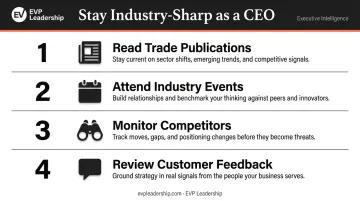
Habits that keep a CEO industry-sharp:
- Read trade publications and industry newsletters weekly
- Attend at least one or two industry events per year
- Monitor what competitors are doing — and why
- Review customer feedback regularly for signals of shifting expectations
Way 3 – Stay Adaptable Under Pressure
Adaptability in the CEO context means identifying emerging trends early, staying open to pivoting strategies, and building a business that can adjust without losing momentum. It's proactive — not reactive scrambling when things break down.
This matters most during economic uncertainty or competitive disruption, when the temptation is to either freeze or overreact. Neither serves the business.
The ability to stay clear-headed under pressure doesn't develop on its own — it's conditioned through deliberate practice. That's the core premise behind EVP Leadership's 90-Day PressurePoint System: leadership performance under pressure is trainable, not fixed.
Practices that build adaptability:
- Regularly stress-test your assumptions about market direction
- Create decision criteria in advance so pressure doesn't distort your judgment
- Debrief after difficult pivots — what worked, what didn't, what you'd do differently
Ways 4–5: Build a Culture People Want to Be Part Of
Way 4 – Create and Protect a Positive Company Culture
Company culture isn't a perk. It's a strategic asset with real financial consequences.
BambooHR's 2023 research found that 70% of new hires decide whether a job is the right fit within the first month — and 44% have second thoughts within the first week. SHRM reports that nearly one-third of all new hires quit within the first six months. For a small business with a lean team, one departure can derail an entire department.
Gallup puts the cost of replacing an employee at one-half to two times their annual salary. Which means a culture problem is also a cash flow problem.
The CEO's specific role in culture:
- How you respond to mistakes sets the psychological safety standard
- How you celebrate wins tells people what behavior gets recognized
- Whether team members feel seen and valued determines whether they stay
Culture isn't built in company-wide announcements. It's built — or eroded — in small daily moments. And in a small business, those moments almost always involve the CEO.
Way 5 – Prioritize Transparent Communication
Culture doesn't survive without honest communication to sustain it. Transparency doesn't mean oversharing — it means being intentional about keeping people informed on what affects them and the direction of the business.
Deloitte's 2024 Global Human Capital Trends report found that 86% of leaders say greater organizational transparency increases workforce trust — and 62% of workers say transparency would directly improve their trust in their organization.
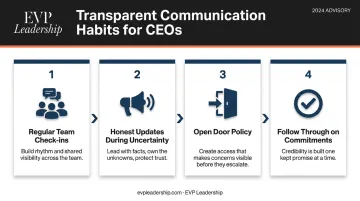
Practical communication habits for small business CEOs:
- Hold regular team check-ins, even brief ones
- Give honest updates during uncertain periods — silence breeds speculation
- Keep an open door so people feel safe raising concerns
- Follow through on what you say you'll do
Deloitte's research cautions that transparency backfires when it feels one-directional — updates flowing down with no room for dialogue. The CEOs who build real trust communicate with consistency, not just when they have good news to share.
Ways 6–7: Empower Your Team and Stay Close to Your Customers
Way 6 – Trust Your Team Through Effective Delegation
There's a difference between knowing how to do the work and insisting on doing it yourself. The first is valuable. The second becomes the ceiling.
A small business CEO who can't let go of operational tasks becomes the bottleneck. Every decision that can only move if the owner touches it is a delay. Every task that only gets done correctly if the CEO handles it personally is a liability. At that point, growth stops at the capacity of one person.
True delegation means assigning ownership — not just tasks. It means defining what gets handed off, to whom, with what authority, and against what standard of success.
Building that capacity starts internally. When CEOs develop confidence in their own leadership identity, they're more equipped to trust others. EVP Leadership's 90-Day PressurePoint System includes a dedicated Delegation, Accountability & Operating Discipline track built specifically to break the founder-bottleneck pattern and install a repeatable execution rhythm.
Way 7 – Stay Focused on Your Customer
As businesses grow, CEOs can lose direct contact with the people they serve. When that happens, decisions start drifting from what actually creates value.
Small business CEOs have a structural advantage here: their size enables closer customer relationships than most large competitors can match. Salesforce's 2024 SMB Trends Report found that over six in ten SMB leaders believe their businesses forge stronger customer relationships than larger competitors — but that advantage only holds if you protect it.
Forrester research shows that customer-obsessed companies report two times higher revenue growth, profitability, and customer retention compared to those that aren't. That's a CEO-level outcome, not a marketing one.
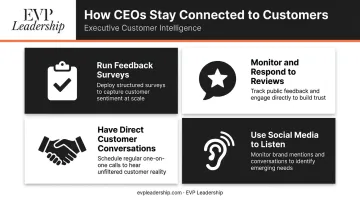
Ways to maintain customer connection:
- Run regular feedback surveys and actually act on what you hear
- Monitor reviews across platforms and respond personally
- Have direct conversations with customers — not just sales or service staff
- Use social media to listen, not just broadcast
Ways 8–10: Manage Resources Wisely, Embrace Technology, and Plan for the Future
Way 8 – Be Financially Savvy
The Federal Reserve's 2025 Report on Employer Firms found that 56% of small businesses cited paying operating expenses and 51% cited uneven cash flows as significant challenges in 2024. Cash flow issues don't just create stress. Left unmanaged, they create existential risk.
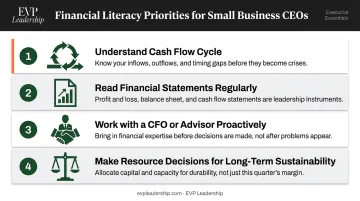
A great CEO doesn't need to be an accountant. But financial literacy is non-negotiable:
- Understand your cash flow cycle and where the gaps are
- Read your financial statements regularly — not just at tax time
- Work with a CFO or financial advisor proactively, not reactively
- Make resource decisions based on long-term sustainability, not short-term comfort
Financial awareness is what allows CEOs to make strategic decisions from a position of clarity rather than anxiety.
Way 9 – Embrace Technology and Innovation
Adopting the right tools isn't about chasing trends. It's about freeing up mental capacity for strategic work. The businesses that pull ahead aren't necessarily the ones with the biggest budgets — they're the ones using technology with intention.
Tools worth evaluating for most small businesses:
- CRM systems to manage customer relationships and pipeline visibility
- Project management platforms to keep teams aligned on priorities
- Cloud-based accounting software for real-time financial oversight
- Automation tools to eliminate repetitive manual work
Small businesses that resist these tools don't just fall behind on efficiency. They fall behind competitors who operate faster, serve customers better, and scale with less friction.
Way 10 – Plan for the Future With Clear Goals and Vision
The CEO's ultimate job is to know where the company is going and ensure everyone else knows too. That means setting strategic goals, anticipating growth challenges, planning for succession or scaling, and communicating direction clearly enough that the team can act without constant hand-holding.
A CEO without a forward vision isn't leading. They're reacting — over and over, to the same problems. Vision is a specific picture of where the business will be in three to five years, translated into the decisions made today.
Gennifer Baker, founder of EVP Leadership, has spent over 30 years helping small business owners and executive teams align day-to-day operations to long-term goals, because that gap between daily operations and long-term direction is where most businesses quietly stall. Strategic planning is how small businesses build the trajectory to become something bigger — and it starts with a CEO who owns the vision.
Frequently Asked Questions
Can you call yourself a CEO of a small business?
Yes — and many should. The CEO title reflects the scope of responsibility, establishes credibility with clients and partners, and in some business structures is used on legal and financial documents. The title earns its weight through the leadership behaviors behind it.
How much should a CEO of a small business make?
Compensation varies widely by industry, business size, and profitability. The BLS reports a median annual wage of $206,420 for chief executives broadly — though that figure covers a wide range of organization sizes and is not specific to small businesses. Many owner-CEOs prioritize reinvesting in the business during early growth stages before drawing a full market-rate salary.
What is the difference between a small business owner and a CEO?
An owner holds financial stake and legal accountability. A CEO sets strategic direction and leads toward long-term goals. In most small businesses, one person holds both roles — but the CEO mindset means thinking beyond daily operations, not just running them.
What are the most important qualities of a successful small business CEO?
Adaptability and a clear vision top the list, followed by financial literacy, strong communication, and the ability to delegate. Beyond those skills, emotional resilience matters most — not as a fixed trait, but as a capacity that's built through consistent practice under real pressure.
How do I stop working IN my business and start working ON it?
Start by building systems that run without you, delegating operational tasks to trusted team members, and protecting blocks of time for strategic thinking. The harder part is the mindset shift — moving from doer to leader happens through repeated practice, not a single decision.