Introduction
Most small business owners are exceptionally skilled at what they do. They know their product, their market, and their customers well. What they're often underprepared for is everything else: the weight of daily decisions, the pressure of scaling, and the particular isolation that comes with being the person everyone else looks to for answers.
Business coaching and strategy come up constantly in entrepreneurial circles — yet the conversation rarely connects to what actually changes inside a business. Words like "clarity" and "accountability" get thrown around without tying back to the operational realities owners face on any given Tuesday: a team that keeps escalating problems, a growth opportunity that never quite gets traction, decisions that seem to circle without resolution.
This article gets specific. It explains what business coaching and strategy genuinely provide, what measurable advantages they create across revenue, leadership, and execution, and what predictably goes wrong when they're absent.
According to the SBA's 2024 FAQ, only 49.2% of small businesses survive five years — a number that reflects, in part, the cost of running a business without the structure that coaching and strategy provide.
TL;DR
- Business coaching connects owners with advisors who build strategic clarity, leadership capacity, and accountability systems matched to their growth stage
- The core advantages: sharper decisions, consistent leadership under pressure, and accountability structures that compound over time
- Without coaching and strategy, businesses drift into reactive patterns — stalled growth, leadership bottlenecks, burnout
- Coaching's value grows with sustained engagement, not one-time interventions
- Results are measurable when tied to specific KPIs: revenue growth, goal completion rate, and execution reliability
What Is Business Coaching and Strategy?
Business coaching is a structured, collaborative process in which an experienced advisor helps an owner clarify their vision, build leadership capacity, and develop concrete plans that improve business performance. The emphasis belongs on operational outcomes — not just personal development.
The International Coaching Federation defines coaching as "partnering with clients in a thought-provoking and creative process" that helps them maximize their professional potential. In the business context, that process applies directly to how owners make decisions, structure their teams, and execute against long-term goals.
Where Business Coaching and Strategy Apply
Coaching typically delivers the most value in these situations:
- Sorting competing priorities when complexity makes it hard to identify what actually matters
- Closing gaps in systems, delegation, and leadership capacity that growth exposes
- Transitioning the owner from doing the work to leading the people who do it
- Translating revenue growth into sustainable margins
- Realigning day-to-day activity with long-term goals when execution has drifted
Coaching vs. Consulting vs. Mentoring
These three are often conflated, but they serve different purposes:
| Approach | Primary Focus | Outcome |
|---|---|---|
| Coaching | Develops owner's judgment and decision-making capacity | Durable, self-sustaining capability |
| Consulting | Delivers expert solutions to specific problems | Addresses immediate operational needs |
| Mentoring | Shares experience and guidance informally | Perspective and context, not structured outcomes |
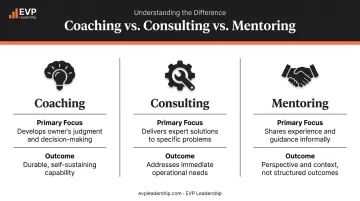
Coaching builds the capacity to solve future problems independently; consulting solves the current one. Both have a place, and neither substitutes for the other.
Key Advantages of Business Coaching and Strategy
The advantages below focus on measurable, operational impact — the kind owners can track in their revenue, team performance, and growth trajectory. Each one addresses a specific gap that emerges when coaching and strategy are absent.
Advantage 1: Strategic Clarity and Sharper Decision-Making
One of the primary advantages of business coaching is the development of a clear operating strategy — a defined vision, prioritized goals, and a consistent framework for evaluating decisions against long-term outcomes rather than short-term pressure.
Coaches introduce structured tools like goal-setting frameworks, priority mapping, and scenario planning that shift owners from reactive problem-solving to proactive strategic execution. The result is a business that operates from a playbook rather than from whoever is creating the most noise that week.
Why this matters operationally:
Without a clear strategy, every decision feels equally urgent. Decision fatigue — the well-documented phenomenon in which cognitive resources deplete over repeated choices — impairs an owner's ability to make quality trade-offs and pushes them toward default choices. Coaching instills criteria for what matters most, reducing that fatigue and improving decision quality under pressure.
Better decisions, made faster and with more confidence, reduce the cost of poor pivots and missed opportunities. That connection is direct and measurable.
KPIs most influenced:
- Revenue growth rate
- Time allocated to high-value activities vs. firefighting
- Goal achievement rate
- Cost of strategic errors and course corrections
When this advantage is most critical: Strategic clarity has the highest impact during rapid growth, market disruption, or leadership transitions — when decision volume and stakes both increase simultaneously.
EVP Leadership's 90-Day PressurePoint System addresses this directly through its Diagnostic Layer, which trains leaders across six dimensions including Mission Clarity and Decision Integrity — ensuring decisions are grounded in truth rather than distorted by pressure and noise.
Advantage 2: Leadership Conditioning for Consistent Performance Under Pressure
Business coaching doesn't just develop leadership skills. It conditions leaders to perform consistently when complexity, pressure, and high-stakes situations arrive — which, for most owners, is a near-daily occurrence.
EVP Leadership's core philosophy captures this precisely: leaders don't rise to the occasion — they fall back on their conditioning. Under stress, untrained decision-making patterns take over. Coaching builds the behavioral habits and mental discipline that make effective leadership the default response, not the exception.
Why this matters operationally:
Gallup research reports that managers account for at least 70% of variance in employee engagement across business units. For small business owners who function as both the strategic leader and primary culture-setter, the quality of their leadership under pressure directly determines team performance, retention, and execution reliability.
Leaders who perform consistently under pressure build organizations that are more stable, retain talent longer, and execute more reliably — particularly during the periods when consistency is hardest to maintain.
KPIs most influenced:
- Employee retention rates
- Team execution rates on strategic initiatives
- Leadership consistency under high-pressure periods
- Frequency of reactive vs. deliberate decision-making
When this advantage is most critical: This matters most during scaling, leadership transitions, and periods of economic disruption — when the volume of pressure-driven decisions increases and the consequences of reactive leadership are most costly.
EVP Leadership's 90-Day PressurePoint System is built specifically around this principle. Rather than one-time workshops or periodic skill-building sessions, the system conditions leaders through sustained, structured practice — developing the habits that hold when pressure rises.
Advantage 3: Accountability Systems That Drive Measurable, Sustainable Growth
Owners who engage with business coaching gain something that's difficult to replicate independently: an external accountability structure. Regular check-ins, defined milestones, and measurable goals keep strategic execution on track rather than allowing it to drift back into the daily firefighting that consumes most leadership bandwidth.
A coach reviews real progress against stated goals, challenges assumptions when the data suggests something isn't working, and adjusts strategy based on results — not intentions.
Why this matters operationally:
Self-accountability is genuinely difficult for business owners who wear many hats and lack objective external feedback. The problem isn't willpower — it's structure. Manchester's executive coaching research found an average ROI of 5.7 times the coaching investment, with participants reporting tangible improvements in productivity (53%), quality (48%), and organizational strength (48%).
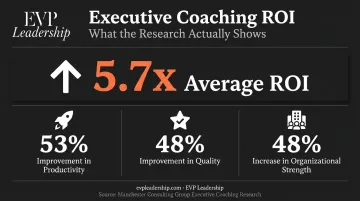
That study focused on executive coaching broadly, but the underlying mechanism — structured accountability driving consistent execution — applies directly to small business owners.
Accountability systems don't just produce short-term results. They build operational habits and leadership behaviors that compound. An owner who learns to review KPIs weekly, conduct structured team check-ins, and adjust strategy based on real data doesn't lose that capability when a coaching engagement ends.
KPIs most influenced:
- Goal completion rate
- Revenue growth trajectory
- Operational efficiency
- Leadership development milestone completion
When this advantage is most critical: Accountability structures have the highest value for owners who are strong visionaries but struggle with execution, and for businesses in growth mode where strategic drift — the slow disconnection between stated priorities and daily activity — is most costly.
What Happens When Business Coaching and Strategy Are Absent
Without structured coaching and a clear strategy, businesses don't hold steady — they drift, and the drift compounds.
The most common consequences EVP Leadership observes when owners arrive without a strategic foundation or accountability structure:
- Decision-making becomes reactive. Owners spend most of their bandwidth responding to crises rather than driving toward goals. The most urgent problem always wins, regardless of strategic priority.
- Leadership patterns plateau or deteriorate under pressure. Behaviors that worked at a smaller scale create bottlenecks as the business grows. The founder becomes the ceiling.
- Growth stalls or turns chaotic. Without accountability and a clear strategy, scaling exposes every gap in systems, delegation, and operating discipline.
- Isolation and burnout increase. Capital One's 2022 Small Business Outlook reported that 48% of small business owners experienced burnout in the prior month — a figure that reflects what happens when leaders operate without objective external perspective or recovery structure.
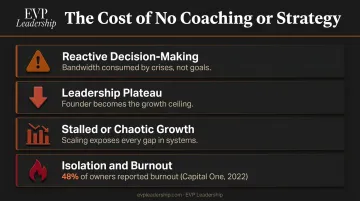
These aren't signs of personal failure. They're predictable outcomes of scaling without the structure that coaching and strategy provide — and they're entirely reversible once that structure is in place.
How to Get the Most Value from Business Coaching and Strategy
The impact of business coaching is directly tied to how it's engaged. Owners who treat it as an ongoing practice see compounding results. Those who treat it as a one-time intervention typically don't.
Conditions that maximize coaching value:
Consistency over crisis response — Coaching sessions and strategic reviews must happen on a regular cadence, not just during emergencies. The conditioning that produces durable results requires repetition.
Outcomes translated to action — Strategic insights only create value when they're converted into specific, tracked actions. A plan that doesn't connect to daily execution stays a document.
Openness to honest feedback — Owners who benefit most are willing to examine their own blind spots, leadership patterns, and assumptions — not just their operational challenges. Internal work and external work aren't separate — they compound each other.
A structured methodology — Selecting a coach with real-world executive experience and a results-driven framework ensures the engagement goes beyond motivation and into measurable operational change.
EVP Leadership's PressurePoint System is built specifically for this kind of structured, conditioning-based engagement — designed for small and mid-size business owners who need lasting operational change, not a motivational reset.
Engagement length matters here too. Meaningful conditioning compounds over time. Standard executive coaching engagements typically run six to twelve months — a timeline that reflects how long durable leadership change actually takes to set.
Conclusion
Business coaching and strategy are not abstract concepts. Their value shows up in specific, trackable places: sharper decisions made faster, stronger leadership under pressure, and accountability structures that turn growth plans into consistent execution.
The advantages compound over time. Strategic clarity, leadership conditioning, and accountability — built through sustained engagement — create organizational habits that outlast any individual coaching relationship. The goal is not reliance on an outside voice, but the development of operational systems and leadership capacity that run on their own.
Owners who invest in that practice consistently position themselves to lead with confidence under pressure, scale with intention, and build the kind of operational discipline that holds — not just in good conditions, but when it counts.
Frequently Asked Questions
What is the difference between business coaching and business consulting?
Coaching empowers owners to develop their own judgment and long-term decision-making capacity through structured, ongoing guidance. Consulting typically delivers expert-driven solutions to specific problems. Coaching builds durable leadership capability; consulting addresses immediate operational needs.
How do I know if my business is ready for a business coach?
Businesses at any stage can benefit, but coaching has the highest impact when owners are experiencing decision fatigue, stalled growth, leadership challenges, or a gap between their strategic vision and daily execution. If the business is growing faster than the owner's capacity to lead it, that's a clear indicator.
How long does it typically take to see results from business coaching?
Meaningful initial results often become visible within the first 90 days when coaching is tied to specific goals and a structured accountability system. The most significant and lasting impact compounds over six to twelve months of consistent engagement.
What should I look for when choosing a business coach?
Prioritize coaches with real-world executive experience, a structured methodology, and a track record with businesses at similar stages. The quality of the coaching relationship matters — focus on fit, not just credentials. Look for a results-driven approach, not general motivation.
Can business coaching address both strategy and leadership development simultaneously?
Yes, and the most effective coaching does exactly that. Strategy sets direction and priorities; leadership development builds the capacity to execute consistently. The two are inseparable — a clear strategy without the leadership conditioning to execute it produces little lasting change.
What makes leadership conditioning different from standard leadership training?
Training builds knowledge and skills in a controlled setting. Conditioning instills behavioral habits through repetition and structured practice, so effective leadership becomes the default response under real pressure. EVP Leadership's PressurePoint System is built on exactly this distinction.