Introduction
Running a lean small business creates a particular kind of pressure. You're expected to grow, compete, and build — often with a skeleton crew, tight margins, and a to-do list that never gets shorter. According to SCORE, 33% of small business owners work more than 50 hours per week, and 25% exceed 60 hours. When you're already at capacity, the wrong growth move doesn't just waste money — it breaks what's working.
Chasing every growth tactic at once makes this worse. Spreading effort across too many fronts drains energy without moving the needle. Sustainable growth for lean operations requires focus — the right moves, executed in sequence, with systems built to hold the load.
This article covers 7 growth strategies built for lean businesses operating with limited resources, thin margins, and real constraints on the owner's time. You'll find guidance on sequencing these strategies by stage — and a clear-eyed look at why the leader's capacity, not just the strategy itself, determines whether any of it works.
Key Takeaways
- Lean growth demands focused, high-ROI strategies — not a dozen tactics running in parallel
- Your existing customers are often the most underdeveloped revenue asset you have
- Operational systems must exist before scaling — dysfunction compounds faster than revenue without them
- The right strategy depends on your stage, cash flow, and capacity — not just market opportunity
- Leadership quality is usually the actual bottleneck — strategy is rarely the real constraint
Why Lean Operations Demand a Different Growth Playbook
"Lean operations" in a small business context means running with minimal staff, tight margins, and an owner who handles strategy, sales, operations, and customer service — often simultaneously. The playbook written for enterprises with dedicated departments and deep capital reserves simply doesn't apply here.
The risk of pursuing growth carelessly is real. The 2025 Fed Small Business Credit Survey found that 56% of employer firms struggled to pay operating expenses and 51% dealt with uneven cash flows. Growth without stable operations doesn't fix these pressures — it compounds them.
Lean growth runs on leverage — finding strategies where well-placed inputs produce results that outpace the effort behind them. The seven strategies below are selected on exactly that basis.
7 Small Business Growth Strategies for Lean Operations
Strategy 1: Maximize Revenue from Your Existing Customer Base
Before you spend a dollar acquiring new customers, look at what's already in front of you.
According to HBR's reporting on Reichheld/Bain research, acquiring a new customer can cost 5 to 25 times more than retaining an existing one. A 5% increase in retention can lift profits by 25% to 95%. Those numbers shift the math on where to invest first.
Practical tactics that require no new infrastructure:
- Upselling — offer a higher-tier version of what customers already buy
- Cross-selling — introduce complementary services or products they haven't tried yet
- Proactive check-ins — scheduled touchpoints that surface unmet needs before customers go looking elsewhere
- Loyalty incentives — simple rewards that increase purchase frequency without heavy program overhead
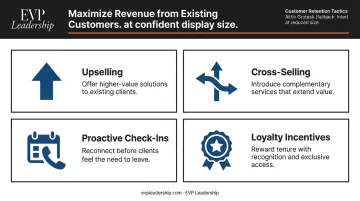
These moves work within your current team capacity, deepening what already exists rather than adding new overhead.
Strategy 2: Build a Referral and Partnership System
Word of mouth is already working in your business. The question is whether it's structured or accidental.
Nielsen research found that 92% of global consumers trust recommendations from friends and family above all other advertising forms. Peer-reviewed research from Wharton found that referred customers are at least 16% more valuable than comparable non-referred customers, with higher retention over time.
A simple referral system doesn't require software or a large budget. Three examples of how this works in practice:
- A bookkeeper offers one free consultation to any client who refers a new business that signs on — low cost, high-intent referrals
- A personal trainer partners with a nutrition coach to cross-refer clients, each expanding their reach without spending on ads
- A home services company runs a "refer a neighbor" program with a service credit — the incentive is cheap, but the conversion rate from warm referrals is high
The common thread: your satisfied customers and aligned partners become an extension of your sales function at minimal cost.
Strategy 3: Document and Systematize Operations Before Scaling
This is the growth strategy that doesn't feel like one — until the moment you try to scale without it.
If your core processes exist only in your head, growth creates chaos. Every new client, hire, or delivery demand runs through the same bottleneck: you. The Exit Planning Institute reports that only 20–30% of business transitions succeed, partly because so much operational knowledge lives with the owner rather than in documented systems.
What systematizing actually looks like:
- Written SOPs for your most repeated processes (client onboarding, fulfillment, invoicing)
- Checklists that allow team members to execute consistently without your oversight
- Workflow documentation that makes delegation possible and accountable
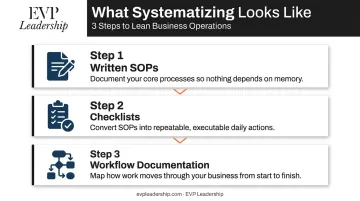
Documented systems reduce decision fatigue, free up owner bandwidth, and make real delegation possible. EVP Leadership's work with small business owners on delegation and operating discipline consistently surfaces the same root issue: growth stalls not from lack of opportunity, but because the owner is the single point of failure in too many processes.
Systematizing first isn't a detour from growth — it's what makes growth repeatable.
Strategy 6: Use Automation and Technology to Scale Output
Strategy 4: Invest in Organic Marketing and Content
Organic marketing — SEO content, email newsletters, consistent social media — is one of the most effective channels available to lean businesses because it compounds over time without requiring a continuous ad spend.
Constant Contact found that 44% of SMBs now identify email as their most effective marketing channel, up from 23% the previous year. Yet 42% of small business owners have less than one hour per day for marketing. That constraint makes channel selection critical.
The key to organic marketing for lean businesses:
- Pick one or two channels where your target audience actually spends time
- Show up consistently — frequency and relevance beat polish
- Create content that answers real questions your customers are already asking
- Build an email list you own, not a social following that can disappear overnight
Spreading across every platform kills consistency. A weekly email to 500 engaged subscribers will outperform sporadic posts on five platforms. Narrow your focus, deepen your presence, and let the compounding effect do the work over time.
Strategy 5: Expand Offerings Based on Proven Customer Demand
There's an important difference between chasing new product ideas and expanding in direct response to validated demand. The first is expensive and risky. The second is lean growth at its most practical.
A 2023 peer-reviewed review of new product development research identified insufficient customer focus as a primary cause of project failure. Before adding any new offering, confirm that demand already exists through one or more of these inputs:
- Recurring questions or requests from current customers
- Patterns in sales conversations pointing to unmet needs
- Direct feedback from your best clients about adjacent problems they face
- Market data showing growth in a segment you already serve
If you're inventing demand rather than responding to it, you're taking on unnecessary risk. The lean version of product expansion means your customers tell you what to build next — you just have to listen and act on it.
Strategy 6: Use Automation and Technology to Scale Output
A lean team can operate well above its apparent capacity if repetitive tasks are handled by systems rather than people.
Zapier found that 88% of SMBs say automation helps them compete with larger companies by moving faster, reducing errors, and freeing up staff for higher-value work. Intuit's research found that small businesses with 10 to 99 employees spend an average of 25 hours per week on manual data entry or reconciling apps — time that could go toward higher-value work.
Three automation categories worth prioritizing:
- CRM and follow-up automation — ensure no lead or client falls through the cracks without manual reminders
- Scheduling and invoicing tools — eliminate back-and-forth coordination and late payment friction
- Marketing automation — set up email sequences, onboarding workflows, and follow-up campaigns once, then let them run
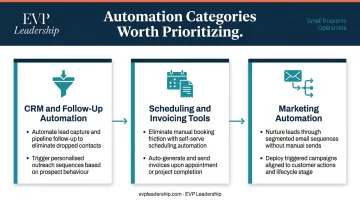
The selection principle matters: choose tools that integrate with what you already use. Adding complexity in the name of efficiency defeats the purpose. Start with the highest-friction manual process in your business and automate that first.
Strategy 7: Pursue Strategic Market Development
Market development — taking a proven product or service into a new customer segment, geography, or industry vertical — is one of the most lean-friendly growth moves available, because it uses what you've already built.
Based on Ansoff's foundational product-market framework, market development is distinct from product development or diversification. You're not building something new; you're finding new buyers for something that already works. That distinction matters for resource allocation.
Before committing to a new market, validate the fit:
- Does your existing offering solve a real problem in this segment without significant modification?
- Do you have any existing relationships, credibility, or case studies that transfer to this new audience?
- Can you run a low-cost pilot — a small geography, a test campaign, a handful of introductory clients — before scaling the effort?
Market development done without validation often means building a parallel sales and marketing effort for a segment that was never actually a fit. The lean version starts with a clear answer to whether the new segment is realistic before a dollar gets committed.
The Leadership Factor: Why Growth Strategies Fail Without It
Here's what most small business growth content skips: strategy selection is rarely the bottleneck. Execution is. And execution is a direct function of the owner's leadership capacity, decision-making quality, and ability to hold performance steady under pressure.
Common Leadership Gaps That Derail Lean Growth
EVP Leadership consistently sees the same behavioral patterns derail lean operations:
- Chasing what's loud instead of what's important — reactive decisions over strategic ones
- Holding tasks that should move down the organization, stalling real delegation
- Shifting decision quality based on stress level rather than strategic logic
- Letting daily firefighting override the growth priorities set last quarter
These patterns don't respond to one-time training. They require conditioning — building the habits, decision frameworks, and behavioral consistency that hold up when stakes are high, not just when conditions are comfortable.
What Leadership Conditioning Addresses
EVP Leadership's 90-Day PressurePoint System is built on a single premise: under pressure, leaders don't rise to expectations. They fall back on their conditioning. The system works through repeated practice across three layers:
- Identity Layer: Builds the internal consistency, capacity, and character that determine how a leader behaves when pressure hits
- Diagnostic Layer: Develops six targeted capabilities — Mission Clarity, Force Alignment, Problem Intelligence, Decision Integrity, Execution Discipline, and Momentum Control — each addressing a specific failure mode
- Execution Layer: Delivers a five-step protocol (Pause the Noise, Locate the Pressure Point, Prioritize the Critical Move, Execute with Discipline, Lock in Momentum) for the high-stakes moments most owners handle reactively
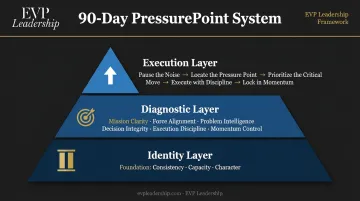
The businesses that execute lean growth strategies well aren't just better at picking the right moves. Their leaders have built the behavioral systems to follow through on them — consistently, not just when conditions are easy.
How to Choose the Right Strategy for Your Business Stage
Not all 7 strategies should run simultaneously. Lean businesses need to sequence growth initiatives based on actual capacity, cash flow, and where the business currently sits in its development.
A practical prioritization guide — not a rigid rule:
| Business Stage | Priority Strategies | Why |
|---|---|---|
| Early-stage (building customer base, inconsistent revenue) | Strategies 1–3 | Retention, referrals, and systematizing create the stable foundation everything else requires |
| Growth-stage (proven operations, stable cash flow) | Strategies 4–7 | Organic marketing, automation, product expansion, and market development compound on a functioning base |
Choosing the wrong strategy at the wrong stage doesn't just produce no results — it actively pulls resources away from what's actually working and introduces dysfunction into an already lean operation. An early-stage business that pursues market development before it has repeatable processes is expanding chaos, not revenue.
Readiness to move to the next tier depends on four concrete indicators:
- Documented processes that run without you
- A stable customer base with predictable retention
- Cash flow that can absorb a period of investment before return
- Leadership bandwidth to manage added complexity without degrading existing performance
Conclusion
Lean growth is intentional growth. These 7 strategies work because they're built around resource constraints, not in spite of them — each one amplifies what's already functioning and creates momentum that compounds over time instead of burning out.
That said, strategy alone doesn't move the needle. Having the right plan and having the leadership capacity to execute it are two different things. Most growth content only addresses the first.
If you're navigating the tension between ambition and capacity, EVP Leadership works with small business owners and executive teams to build the strategic clarity and leadership conditioning needed to execute growth with confidence.
Every engagement begins with a complimentary scoping conversation — a direct look at where your business is, what's in the way, and whether there's a fit. Reach out at info@evpleadership.com or call (833) 991-0991.
Frequently Asked Questions
What is the 1% rule in business?
The 1% rule means improving operations, habits, or performance by 1% consistently over time — a principle illustrated by British Cycling's marginal gains approach and explored in depth by James Clear. Those small gains compound significantly over months and years, making it a sustainable model for lean teams that can't afford dramatic overhauls.
What does lean operations mean for a small business?
Lean operations means running with minimal waste in time, headcount, and budget while still delivering full value to customers. For small businesses, that means tight teams, owners handling multiple roles, and thin margins — all of which require growth strategies designed for constraint rather than abundance.
How can a small business grow without hiring more staff?
Automation, documented systems, referral-driven growth, and deeper customer relationships all increase revenue without proportional headcount increases. The goal is to scale output through better systems and leverage — not by adding more people to an already-stretched operation.
What is the most effective growth strategy for a small business on a limited budget?
Customer retention and organic marketing consistently produce the highest returns relative to cost. Both build on existing assets — your current customers and your expertise — rather than requiring significant new investment. Email marketing in particular ranks as the top channel for SMBs, with 44% identifying it as their most effective tool.
How do I know when my small business is ready to scale?
Readiness to scale depends on repeatable, documented processes, a stable customer base, predictable cash flow, and a leader who can manage increased complexity without breaking existing operations. If the business falls apart when you're unavailable for a week, it isn't ready to scale.
What is the difference between growing and scaling a small business?
Growth typically means adding revenue in proportion to added costs — more clients, more staff, more overhead. Scaling means increasing revenue faster than costs by leveraging systems, automation, and efficiencies already in place. Scaling requires infrastructure that growth alone doesn't automatically create.