Introduction
Picture this: your leadership team leaves the quarterly strategy meeting in apparent agreement. Two weeks later, each department is running in a different direction. Sales is chasing volume, operations is protecting margin, and product is building features nobody requested. The strategy is fine. The problem is what happens after the meeting ends.
This pattern is common in growing organizations, and it's expensive. McKinsey's 2025 research on top executive teams — drawing on 354 top-team members across 28 major global companies — found that companies whose top executive team is aligned and working effectively together are almost twice as likely to achieve above-median financial performance.
That performance gap isn't a strategy problem. Most leadership teams treat alignment as something that happens naturally — through shared values and good intentions. It doesn't. Not at scale.
This guide is for founders, CEOs, and executive team leaders running growing organizations where informal alignment has stopped working. It walks through eight steps — from defining who's actually on your leadership team to sustaining alignment as a conditioning practice.
Key Takeaways
- Alignment means synchronized decisions and consistent behavior — not unanimous agreement
- Misalignment shows up quietly: mixed signals, competing priorities, fragmented culture
- The 8-step process moves from clarity through accountability to ongoing recalibration
- Organizational growth is the most common alignment disruptor, as informal channels break down when teams scale
- Sustaining alignment requires repeated practice, not a single off-site or strategy session
What Is Leadership Team Alignment?
Leadership team alignment is the collective agreement among senior leaders around shared purpose, strategy, values, and behavioral expectations — and the consistent way those agreements show up in how leaders manage, decide, and communicate.
In practice, alignment produces three things:
- A consistent culture experience for employees, regardless of which leader they report to
- Faster, cleaner execution because priorities don't compete across departments
- Reduced confusion during periods of growth, change, or transition
That last point is where most leadership teams run into trouble — and it starts with a misconception about what alignment actually means.
Alignment Is Not Agreement
This distinction matters. Aligned leaders don't think identically or avoid conflict. They debate. They disagree on approach. What they share is a commitment to move in the same direction and hold to the same standards — even when they don't see eye to eye on how to get there.
When leaders conflate the two, they either suppress healthy debate to maintain false harmony — or mistake unresolved conflict for a sign the team can't align at all. Both assumptions stall execution.
Why Leadership Team Alignment Matters for Growing Organizations
The Compounding Cost of Misalignment
When leaders prioritize their functional interests over organizational ones, teams absorb the contradiction. Conflicting instructions, inconsistent standards, and fragmented culture don't stay at the leadership level — they cascade.
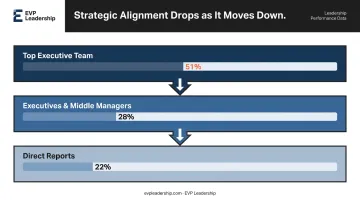
MIT Sloan Management Review research across 4,012 respondents from 124 organizations found that only 28% of executives and middle managers responsible for execution could list three of their company's strategic priorities. Strategic alignment sat at 51% among the top team — and dropped to 22% among their direct reports. The misalignment multiplies as it moves down.
The Scale Problem
In small organizations, alignment often happens through proximity — leaders share space, overhear conversations, and calibrate informally. That works when the team is five people. When organizations grow by adding remote roles, new departments, or leaders from different companies, those informal channels disappear. Without deliberate alignment infrastructure to replace them, the gap becomes structural.
Why This Is a Leadership Failure, Not a Strategy Failure
Most growing organizations have a workable strategy. The breakdown happens in execution. HBR's research on strategy execution identifies weak cross-functional coordination as a primary failure point — not the quality of the strategy itself. Leaders interpret and implement the same strategy differently, and the organization fractures along those interpretive fault lines.
The 8-Step Guide to Building Leadership Team Alignment
Step 1: Recognize That Alignment Must Be Created Intentionally
The first shift is a mindset one. Alignment will not emerge from good intentions, shared values statements, or periodic strategy meetings. Especially as organizations grow.
The leadership team must decide — as a group — to pursue alignment deliberately and treat it as an ongoing operational priority. Not a one-time initiative, not a box to check — a practice that requires sustained attention.
Step 2: Define Who Is on the Leadership Team
You cannot align a team whose membership is unclear.
Wageman, Nunes, Burruss, and Hackman's foundational work on senior leadership teams identifies bounded membership — clarity about who is and who is not on the team — as a prerequisite for effectiveness. Yet in many organizations, that clarity doesn't exist. Leaders assume they're on the team. Others assume they're not. The resulting ambiguity creates accountability gaps before alignment work even begins.
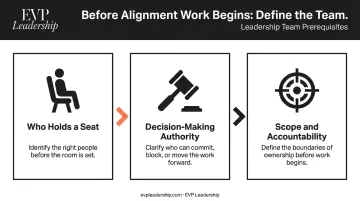
Before any alignment effort, explicitly define:
- Who holds a seat on the leadership team
- What decision-making authority that membership carries
- What scope and accountability each role owns
Most leadership teams skip this step — and pay for it throughout every subsequent stage of alignment work.
Step 3: Clarify Shared Purpose and Strategic Priorities
Once the team is defined, the work begins with the "why" and the "what matters most."
Aligned teams don't just nominally agree on purpose — they agree operationally. When leaders carry different mental models of the organization's top one or two priorities, every downstream decision pulls in a different direction.
Finance optimizes for margin. Marketing optimizes for growth. Operations optimizes for efficiency. None of them are wrong — but without explicit agreement on precedence, they're pulling against each other.
This step requires actual conversation and documentation:
- Why does this organization exist, and for whom?
- Which strategic priorities take precedence when they compete?
- What does "success" look like in 12 months — and do we all mean the same thing?
Write the answers down. Shared mental models require shared language.
Step 4: Establish Shared Values and Behavioral Expectations
Values alignment is not a wall plaque exercise. It's a behavioral agreement.
Leaders must explicitly discuss and commit to:
- How they will manage their teams
- What performance standards are non-negotiable
- How flexibility and accountability are applied consistently across departments
- Communication norms — especially when leaders disagree
Inconsistency here is corrosive. When one leader runs tight performance conversations and another avoids them entirely, employees don't experience that as different management styles. They experience it as unfairness — and it erodes trust in the leadership layer as a whole.
Research on organizational justice at the collective level confirms this: perceived consistency of standards across the organization directly affects employee attitudes and performance.
Step 5: Create a Dedicated Space for Alignment Conversations
Alignment conversations can't happen as the last agenda item in a management meeting. They require intentional time, intentional setting, and an environment where candid input is genuinely welcome.
In practice, this looks like a structured half-day, full-day, or multi-day session — an off-site or facilitated workshop specifically designed for this purpose.
At EVP Leadership, Teri Evans facilitates these engagements across executive teams, healthcare leadership groups, education organizations, and nonprofit boards, with a focus on building psychological safety and trust as a foundation for honest exchange.
The research on psychological safety at the leadership team level is specific: McKinsey's top-team data found psychological safety correlated with high top-team performance at r=0.63 across 28 teams — and at r=0.77 for teams led by more tenured CEOs. Google's Project Aristotle study of 180 teams identified it as the single most important dynamic in effective teams.
Leaders who feel unsafe to disagree or raise concerns will perform alignment rather than practice it. That's worse than no alignment work at all — because it creates the appearance of cohesion without the substance.
Step 6: Surface Themes, Agree on Common Ground, and Document It
During a facilitated session, record responses and themes visibly — on a whiteboard, a shared screen, a working document. The goal isn't to achieve agreement on every perspective. It's to identify the core leadership behaviors, priorities, and commitments the team will actually hold each other to.
From that session, distill a short, concrete list:
- Shared behavioral commitments (how we lead, how we manage, how we communicate)
- Decision-making principles (what we prioritize when things compete)
- Non-negotiables (where there is no flexibility on standards)
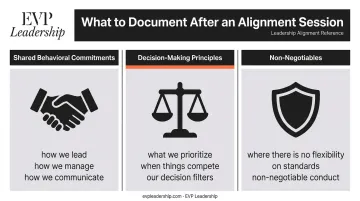
Document these and keep them accessible. The act of writing it down turns a conversation into a commitment — and gives the team something concrete to return to when behavior drifts.
Step 7: Build Individual and Collective Accountability Structures
Alignment without accountability is just a good conversation.
Structural accountability means each leader carries both:
- Individual functional objectives tied to their specific role
- Shared cross-functional goals that require the leadership team to succeed together
EVP Leadership's approach to accountability integrates an operating rhythm — check-ins, performance conversations, scorecards — that holds both individual leaders and the group accountable for alignment behaviors. Frameworks like the Balanced Scorecard, as Kaplan noted, only work when executive leadership is genuinely committed to them; failure consistently traces back to lack of leadership commitment, not poor design.
Without built-in accountability structures, alignment commitments fade fast under operational pressure. Good intentions don't survive a difficult quarter.
Step 8: Schedule Regular Review, Reflection, and Recalibration
Leadership team alignment is not a destination — it degrades over time without deliberate maintenance.
New leaders arrive with different assumptions. Markets shift. Restructures change ownership. Without deliberate recalibration, alignment that felt solid six months ago quietly fragments.
Set a regular cadence — quarterly is a reasonable starting point — for the leadership team to:
- Assess how well they're living out their alignment commitments
- Name the places where drift has occurred
- Recalibrate without blame
This is where the conditioning model matters most. EVP Leadership's 90-Day PressurePoint System is built on the premise that leadership performance under pressure is conditioned over time, not established in a single session. The same applies at the team level. Sustainable alignment is built through consistent, repeated practice — not a one-time off-site, however well-facilitated.
Key Factors That Affect Leadership Team Alignment
Three variables consistently determine how difficult alignment is to build and sustain:
Organizational growth. Adding new leaders, entering new markets, or restructuring teams introduces new mental models and competing priorities. Without proactive alignment work, growth erodes cohesion that took years to build. Each new phase of scale introduces pressure the previous team structure wasn't designed to absorb.
Cultural dynamics. The degree of psychological safety on the leadership team directly shapes the quality of alignment conversations. Where leaders feel unsafe to raise concerns or disagree openly, alignment becomes performative. The team appears aligned on the surface while real disagreements stay buried.
Role clarity and decision rights. When it's unclear who owns which decisions, leaders default to functional interests. The competing-priorities dynamic that fragments strategy execution typically traces back to ambiguous ownership. Alignment is easier to build when roles, decision rights, and escalation paths are explicit.
Common Mistakes Teams Make When Pursuing Alignment
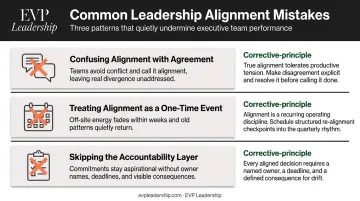
Confusing Alignment with Agreement
Many leadership teams mistake consensus for alignment. This leads to conflict avoidance, not healthy debate. True alignment creates space for diverse views within a shared framework — it doesn't require everyone to agree before moving forward.
Treating Alignment as an Event
Organizations hold an off-site, leave energized, and return to business as usual. Within weeks, old patterns reassert. Alignment requires a follow-up structure and regular reinforcement to become durable. The energy from a single session doesn't carry the work forward.
Skipping the Accountability Layer
Most alignment efforts invest heavily in vision and values but fail to build measurable accountability. Without explicit individual and collective goals tied to alignment behaviors, the work stays aspirational. It changes the conversation without changing the day-to-day decisions — and decisions are where alignment is either proven or abandoned.
Frequently Asked Questions
What is the difference between leadership alignment and team agreement?
Alignment means leaders move in a shared direction and uphold common standards — not that they agree on every decision. Healthy alignment actually creates space for constructive debate while maintaining behavioral and strategic consistency across the organization.
What are the signs that a leadership team is misaligned?
Common indicators include leaders sending different messages to their teams, competing priorities across departments, inconsistent management practices, low trust at the leadership level, and strategy execution that consistently falls short. These signals typically precede a visible crisis by months — without anyone realizing it until the damage shows up in execution.
How long does it take to build leadership team alignment?
Initial alignment conversations can happen in a single session, but durable alignment develops over months through consistent practice, structured follow-up, and regular recalibration. It's a conditioning process, which is why sustained development over time produces results that a single event rarely can.
Why does leadership alignment break down when organizations grow?
Growth adds new leaders, roles, and complexity, which dilutes the informal communication that kept small teams aligned. Without intentional structure, new leaders import their own assumptions and the team fragments, sometimes without anyone realizing it until execution starts breaking down.
How do you hold a leadership team accountable for alignment?
Accountability requires explicit goals tied to alignment behaviors, a regular review cadence, and ownership at the top. CEOs must model the expectations they set. Pairing accountability with recognition — when leaders hold to commitments under pressure — reinforces the behavior rather than just tracking it.
Can a leadership team be aligned without being in the same location?
Remote or distributed teams can achieve strong alignment, but they must be more deliberate about it. When informal overlap disappears, structured touchpoints and documented commitments stop being nice-to-haves. They become the foundation. The absence of proximity raises the standard for intentional alignment work, not the other way around.