Most leaders manage this tension the same way: they rely on instinct, pattern recognition, and whatever worked last time. That works until the situation changes, the pressure spikes, or the cost of being wrong is too high to absorb.
A leadership decision-making framework doesn't slow you down. It gives you a repeatable system so that good decisions become second nature — especially when things get complicated.
This guide covers the types of decisions leaders face, five proven frameworks, a step-by-step application process, common traps to avoid, and how to condition decision-making as a leadership habit rather than a situational skill.
Key Takeaways
- Not all decisions deserve the same approach — diagnosing the decision type comes first
- Five frameworks (Cynefin, RAPID, Eisenhower, OODA, 5R) serve different situations
- Bain research shows a 95% correlation between decision excellence and top-tier financial results
- Structured practice and honest post-decision reviews sharpen decision-making over time
- Internalized frameworks outperform referenced ones — consistent practice converts knowledge into instinct
What Is a Leadership Decision-Making Framework (and Why It Matters)
A leadership decision-making framework is a structured, repeatable approach that guides leaders through evaluating options and selecting a course of action. It replaces ad hoc judgment with a consistent, bias-reducing methodology — one that holds even when pressure is high and information is incomplete.
Without that structure, decisions get made on familiarity, social pressure, or urgency rather than strategic fit. The result: inconsistent outcomes that quietly compound over time.
McKinsey research found that executives spend roughly 37% of their time making decisions — and much of that time is used ineffectively. At an average Fortune 500 company, that ineffectiveness translates to more than 530,000 lost manager days and roughly $250 million in wasted labor costs annually.
Framework vs. Process — They're Not the Same
- A framework is the thinking structure — how to categorize the situation, evaluate options, and weigh tradeoffs
- A process is the step-by-step execution — what to do and in what order
Strong leaders use both together. The framework tells you what kind of decision you're facing. The process is how you actually move through it.
The 4 Types of Decisions Every Leader Faces
Not all decisions deserve the same approach. One of the most common leadership errors is misreading which type of decision you're facing — and applying the wrong tool to it.
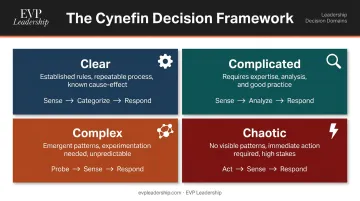
The Cynefin Framework, developed by Dave Snowden and detailed in a 2007 Harvard Business Review article by Snowden and Boone, identifies four decision environments:
| Domain | Situation | Leader Response |
|---|---|---|
| Clear | Cause and effect are obvious; best practice applies | Sense → Categorize → Respond |
| Complicated | Requires expertise and analysis; right answer exists but isn't obvious | Sense → Analyze → Respond |
| Complex | Unpredictable; multiple factors interact; experimentation needed | Probe → Sense → Respond |
| Chaotic | No clear cause-effect; immediate stabilizing action required | Act → Sense → Respond |
What This Looks Like in Practice
- Clear: A small business owner reorders inventory using a standard formula. The process is established; execution is the only variable.
- Complicated: A COO evaluates whether to restructure operations — say, consolidating two divisions. The data exists, but interpreting it correctly requires expertise.
- Complex: A founder navigates entering a new market with no direct precedent. Small experiments, not big bets, are the right move.
- Chaotic: A CEO manages a sudden key-employee departure mid-engagement with a critical client. Stabilize first, analyze later.
Misreading the domain is where most leadership decisions go wrong. Treating a Complex situation like a Clear one — reaching for a playbook when the situation actually calls for experimentation — is how leaders stall progress and burn trust.
5 Proven Decision-Making Frameworks for Leaders
The right framework depends on your decision type, the stakeholders involved, and the time you have. No single tool fits every situation — strong leaders keep a small, intentional repertoire and know when to reach for each one.
Cynefin Framework
Cynefin, developed by Dave Snowden, is the diagnostic starting point. Before choosing how to decide, leaders use Cynefin to determine what kind of situation they're in.
Its value isn't in producing the answer — it's in preventing the wrong process from being applied to the wrong problem. Leaders operating in fast-moving or ambiguous environments use it to match their response mode to their actual context, not to the context they wish they were in.
RAPID Model
Developed by Bain & Company and detailed in a 2006 HBR article by Paul Rogers and Marcia Blenko, RAPID assigns five distinct roles in any major decision:
- Recommend — proposes the decision
- Agree — must sign off before the decision is made
- Perform — executes the decision
- Input — provides relevant information or perspective
- Decide — makes the final call
RAPID solves the "everyone agrees but no one owns it" problem that stalls growing organizations. When it's unclear who holds the final call versus who provides input, decisions stall or get made twice. Clarifying those roles eliminates the bottleneck.
Eisenhower Decision Matrix
Popularized by Stephen Covey in The 7 Habits of Highly Effective People, inspired by an Eisenhower urgency-importance framework, the matrix organizes decisions into four quadrants:
- Urgent + Important: Do it now
- Important, Not Urgent: Schedule it (this is where strategic work lives)
- Urgent, Not Important: Delegate it
- Neither: Eliminate it
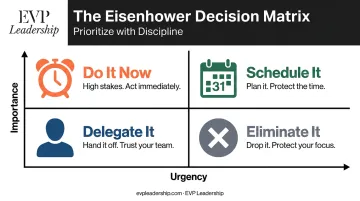
Leaders who stay trapped in reactive mode typically neglect Quadrant 2 — the important, non-urgent work that actually drives long-term results. The matrix protects that space.
OODA Loop
Developed by Colonel John Boyd and applied to business contexts by Chet Richards in Certain to Win (2004), the OODA Loop — Observe, Orient, Decide, Act — is built for speed and adaptability.
It's most valuable when analysis time is short — specifically in situations like:
- Competitive threats requiring fast counter-moves
- Sudden disruptions with incomplete information
- Crisis scenarios evolving faster than deliberation allows
Where OODA drives real-time response, the final framework shifts focus to what happens after the decision is made.
5R Framework
The 5R Framework — Reporting, Responding, Relating, Reasoning, Reconstructing — is a reflective tool, not a real-time decision engine. Documented through the University of Edinburgh's reflection toolkit, it's designed for post-decision analysis.
Use it after significant decisions to examine what happened, why it happened, and what to adjust. It's best suited for strategic pivots, major resource decisions, or any high-stakes call worth analyzing in hindsight.
How to Apply a Decision-Making Framework Step by Step
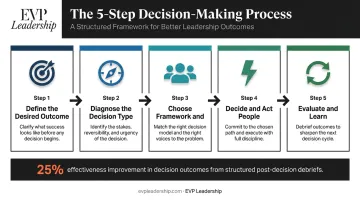
Step 1: Define the Desired Outcome
Before choosing a framework, clarify what success looks like — what outcome, for whom, by when. This anchors every downstream choice to purpose rather than momentum. Vague goals produce vague decisions.
Step 2: Diagnose the Decision Type
Use Cynefin's four domains to identify your actual situation. Is the path forward obvious, or does it require expertise? Is it genuinely unpredictable, or does it just feel that way? Skipping this step is one of the most expensive mistakes leaders make — it sends well-intentioned analysis in the wrong direction.
Step 3: Choose the Right Framework and Involve the Right People
Match the framework to the decision type, then determine who needs to be at the table:
- Who has relevant expertise?
- Who will be directly affected?
- Who is responsible for execution?
Diverse input strengthens outcomes. But input is not the same as the final call — clarifying that distinction upfront (the RAPID framework assigns explicit roles for this) keeps decisions from stalling.
Step 4: Decide and Act with Context-Appropriate Confidence
Action style should match the environment:
- Clear situations: Bold and direct
- Complex situations: Incremental and adaptive
- Chaotic situations: Fast and stabilizing
The tendency to over-analyze in complex situations and under-act in chaotic ones typically reflects discomfort with uncertainty — not a genuine read of the context. Recognizing that pattern is what allows leaders to act from context rather than from anxiety.
Step 5: Evaluate and Learn
A decision-making framework is a cycle, not a checklist. After acting, review:
- Did you achieve the intended outcome?
- What happened that you didn't anticipate?
- What would you do differently?
This matters more than most leaders realize. A 2013 meta-analysis by Tannenbaum and Cerasoli, drawing on 46 samples and 2,136 participants, found that structured debriefs improve effectiveness by 25% compared to control groups.
At EVP Leadership, the reflective review isn't an afterthought — it's built into the conditioning process through the 90-Day PressurePoint System. The system is designed to build the kind of decision-making consistency that doesn't erode when conditions get hard.
Common Decision-Making Mistakes to Avoid
Three traps account for most avoidable leadership failures:
1. Oversimplifying complex situations. Leaders reach for a familiar solution and apply it to an unfamiliar problem. The problem looks similar on the surface; the solution misses entirely. This is Cynefin's core warning — treating a complex situation as if it were clear.
2. Analysis paralysis. Gathering more data indefinitely rather than committing to a direction. McKinsey found that only 48% of respondents agreed their organizations make decisions quickly, and only 37% said decisions are both high quality and high velocity. Slow decisions aren't automatically better — they're often just late.
3. One-size-fits-all thinking. Applying the same framework regardless of context. Using a crisis response model for a strategic planning decision, or a deliberative analysis process for a situation demanding immediate action, both produce poor results.
Why These Mistakes Persist
Under pressure, leaders default to what's familiar — not what's appropriate. McKinsey's behavioral strategy research confirms that unchecked cognitive biases consistently undermine strategic decision-making, and that those biases are most active precisely when stakes are highest and time is shortest.
Recognizing these traps matters. Overriding them under pressure requires something different — conditioned responses built through deliberate, repeated practice until the right instinct replaces the familiar one.
Building Decision-Making Into a Leadership Habit
Frameworks are only valuable when they become automatic. The research supports this: the prefrontal cortex (responsible for focus, planning, and decision-making) performs worse under overload. Habitual processes reduce cognitive load and free up capacity for the decisions that actually require higher-order thinking.
The goal isn't to consult a framework when a decision arrives. It's to have internalized one.
What Conditioning Actually Looks Like
- Running significant decisions through the same structured steps, consistently
- Debriefing outcomes honestly — what worked, what didn't, what you'd change
- Building an environment that makes structured thinking the default: accountability systems, trusted advisors, clear criteria
This is the distinction EVP Leadership is built around. Their tagline — "leaders don't rise to expectations, they fall back on their conditioning" — isn't rhetorical. It reflects what happens in high-pressure situations when a leader's preparation meets reality.
The 90-Day PressurePoint System is specifically structured to build this kind of decision-making capacity. The Diagnostic Layer includes a Decision Integrity diagnostic that examines whether decisions are grounded in truth or distorted by noise and emotion — developing the self-awareness to catch biases in real time.
The Execution Layer then provides a five-step protocol for critical moments:
- Pause the Noise
- Locate the Pressure Point
- Prioritize the Critical Move
- Execute with Discipline
- Lock in Momentum
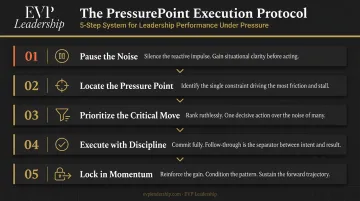
The outcome is a leader who makes consistently strong calls under the conditions that typically derail people.
Your Practical Starting Point
Identify one recurring decision category in your business — hiring, resource allocation, strategic direction. Commit to running every instance of that decision through the same framework for the next 30 days. Track what changes. That's how the habit starts.
Frequently Asked Questions
What are the 4 frameworks of leadership?
Four widely referenced frameworks are the Cynefin Framework (decision context), the RAPID Model (decision roles and accountability), the Situational Leadership Model (matching leadership style to team readiness), and the Transformational Leadership Framework (inspiring lasting change). Each serves a different purpose — most effective leaders draw on more than one.
What are the 5 P's of leadership?
The 5 P's — Purpose, Passion, People, Practices, and Presence — are a practitioner mnemonic for aligning personal values and daily behaviors with organizational goals and team development. Widely used in leadership circles, though not a formally validated academic model.
What is the difference between a decision-making framework and a decision-making process?
A framework is the thinking structure — how to categorize and evaluate a decision. A process is the step-by-step execution — what to do and in what order. Effective leaders use both: the framework identifies what kind of decision they're facing; the process moves them through it.
How do I choose the right decision-making framework for my situation?
Start by identifying the decision type (clear, complicated, complex, or chaotic). Then match the framework to the environment: OODA Loop for crisis or fast-moving situations, RAPID for multi-stakeholder decisions where role clarity is the bottleneck, and the Eisenhower Matrix for prioritization and time management.
Can decision-making ability actually be improved?
Yes — decision-making is a conditioned skill, not a fixed trait. Consistent practice using structured frameworks, combined with honest post-decision review, builds stronger judgment over time. Research in organizational psychology consistently shows that structured debriefing alone can improve decision performance by roughly 25%.