Introduction
You're in the middle of a vendor negotiation when your operations manager walks in: a key supplier just failed, and you need a replacement by end of week. Your phone shows three missed calls from a major client. Your CFO is waiting on a cash flow decision you've been deferring for two days.
This is not a hypothetical. For most founders and executives, some version of this scenario is a regular occurrence.
Here's what the research shows: acute stress measurably degrades cognitive flexibility and working memory — the exact mental resources you need most when the stakes are highest. The brain doesn't rise to the occasion under pressure. It falls back on whatever it's been conditioned to do.
That's the core belief at EVP Leadership: decision-making under pressure is not a personality trait you either have or don't. It's a conditioned skill, built through deliberate practice, structured frameworks, and repeated rehearsal before the pressure hits.
This guide covers why pressure degrades decision quality, the most common mistakes leaders make, proven frameworks for acting confidently with incomplete information, and how to build the conditioning that holds up when it matters most.
Key Takeaways:
- Pressure triggers reactive System 1 thinking — and recognizing that pattern is what lets you override it
- Common high-stakes mistakes: deciding in isolation, confusing urgency with importance, defaulting to familiar but suboptimal options
- The 40/70 Rule and the 3 C's provide a structured process for acting on incomplete information
- Deliberate practice, scenario rehearsal, and post-decision review build automatic responses that hold under real pressure
- A personal decision protocol — built before the pressure hits — is one of the highest-leverage tools a leader can develop
Why Decision-Making Under Pressure Is So Difficult
The Physiology of Pressure
When stress hits, your body activates the SAM and HPA systems, releasing cortisol and adrenaline that alter how the prefrontal cortex functions. The prefrontal cortex governs working memory, attention, response inhibition, and cognitive flexibility — the executive functions you rely on most when decisions are hard.
A meta-analysis of 165 studies found acute stress impaired cognitive flexibility (Hedges g = 0.39) and working memory (g = 0.31). These aren't trivial effects. They mean pressure actively narrows the cognitive bandwidth available for careful analysis.
System 1 vs. System 2 Under Pressure
Psychologist Daniel Kahneman's framework distinguishes two modes of thinking:
- System 1 — fast, automatic, intuitive, and pattern-driven
- System 2 — slow, deliberate, analytical, and effortful
Under pressure, the brain shifts from deliberative processing toward intuitive processing, favoring habitual responses and reducing adjustment of initial judgments. In practical terms: a leader facing a supply chain disruption defaults to the vendor they've always used — not because it's the best option, but because it's the one System 1 can retrieve fastest.
That instinct can feel like clear-headed confidence. Most of the time, it's pattern retrieval dressed up as judgment.
Why This Hits Small Business Leaders Harder
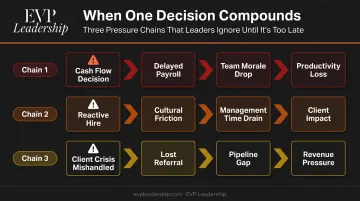
For founders and executives running small to mid-size businesses, pressure decisions rarely arrive in isolation. One rushed call on cash flow affects payroll. A reactive staffing decision sends a culture signal. A mishandled client crisis compounds into a referral problem.
That compounding effect is what makes cognitive degradation under pressure so costly at this level. Each reactive decision creates a correction that demands another decision — often under the same pressure that caused the first one.
Common compounding chains include:
- Cash flow decision → delayed payroll → team morale drop → productivity loss
- Reactive hire → cultural friction → management time drain → client impact
- Client crisis mishandled → lost referral → pipeline gap → revenue pressure
Common Mistakes Leaders Make When Deciding Under Pressure
Defaulting to the Familiar
Status quo bias — the documented tendency to favor options that maintain the current state — intensifies under stress. Research by Samuelson and Zeckhauser established that decision makers show a strong pull toward alternatives that perpetuate the status quo, even when better options exist.
Under pressure, this bias closes off alternatives before they're even evaluated. The result isn't a conscious choice — it's a reflex that feels like one.
Deciding in Isolation
Time pressure causes leaders to skip consultation, which eliminates the diverse perspectives that catch blind spots. HBR research on management teams found that teams challenging each other's thinking develop more complete understanding and richer options than those that default to consensus.
Deciding alone feels efficient. It regularly produces outcomes that require correction — and correction costs more time than the consultation would have.
Confusing Urgency with Importance
Not every pressure moment requires an immediate, irreversible decision. Leaders who treat every urgent situation as a "one-way door" — a call with no path back — exhaust their teams, increase error rates, and burn decision-making capacity on situations that deserved far less deliberation.
Treating every urgent situation as consequential is how leaders deplete the capacity they need for the decisions that actually matter.
Emotional Contagion
Leaders absorb team anxiety. When a room is panicked, the leader's emotional state sets the tone for the entire group. In smaller organizations, where the founder or CEO is directly visible to most of the team, this dynamic is amplified — panic at the top becomes panic throughout.
The facts don't change when anxiety runs the room. The interpretation of those facts does.
Analysis Paralysis
The flip side of impulsive decisions is indefinite delay. McKinsey reports that executives spend nearly 40% of their time making decisions and believe most of that time is poorly used. Waiting for certainty that never arrives is itself a decision. And unlike the choices leaders agonize over, this one accrues costs quietly — in lost momentum, missed windows, and team confidence that erodes while leadership stalls.
Proven Frameworks for Making Decisions Under Pressure
The 40/70 Rule
Colin Powell's 40/70 Rule offers a practical threshold: don't act with less than 40% of the information you need, but don't wait for more than 70%.
Acting below 40% is recklessness. Waiting past 70% wastes time that rarely changes the outcome. The rule forces leaders to identify their actual information threshold — and commit when they've crossed it.
The 3 C's of Decision-Making
A simple structure that prevents reactive, emotion-led decisions:
- Clarity — Define the actual problem, not the symptom. "We're losing a client" is a symptom. "Our onboarding process creates misaligned expectations" is the problem.
- Criteria — Establish in advance what a good outcome looks like. Without criteria, every option looks equally valid under pressure.
- Choice — Filter available options against those criteria. This step becomes mechanical once the first two are done.
Reversible vs. Irreversible Decisions
Jeff Bezos's 2016 Amazon shareholder letter introduced the one-way door vs. two-way door distinction:
| Decision Type | Characteristics | Appropriate Response |
|---|---|---|
| Two-way door (reversible) | Can be undone or adjusted | Act quickly with light process |
| One-way door (irreversible) | Difficult or impossible to reverse | Slow down; apply disproportionate scrutiny |
Most decisions leaders agonize over are two-way doors. Recognizing this frees up deliberation capacity for the decisions that actually warrant it.
The Pause-Assess-Act Protocol
Even a 60–90 second structured pause changes decision quality. EVP Leadership's Execution Layer operationalizes this through five steps:
- Pause the Noise — Control the moment before it controls you
- Locate the Pressure Point — Identify where the situation is actually breaking down
- Prioritize the Critical Move — Focus on what matters most right now
- Execute with Discipline — Clean action, no excess complexity
- Lock in Momentum — Turn action into sustained progress
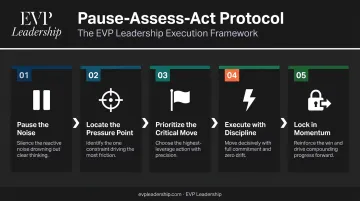
The pause matters neurologically. It creates enough distance from the stress response to allow System 2 back into the process before a commitment is made.
The same logic applies when a team is in the room. The "disagree and commit" principle — team members surface disagreements quickly before a decision is finalized, then fully commit once it's made — reduces blind spots without creating endless consensus cycles. The Amazon 2016 letter cites this as a direct counter to prolonged deliberation that slows high-velocity decisions.
How to Condition Yourself to Decide Better Under Pressure
Training gives leaders frameworks. Conditioning builds automatic responses through repeated practice under simulated pressure. The distinction matters because under real pressure, knowledge doesn't activate reliably — but conditioned habits do.
This is the core thesis behind EVP Leadership's 90-Day PressurePoint System: leaders haven't been conditioned to think clearly in complexity. They've been trained. Those aren't the same thing.
Deliberate Practice Through Scenario Rehearsal
Run "what if" simulations on realistic pressure scenarios before they occur. Walk through a cash flow crisis, a key employee resignation, or a sudden client loss — not to predict the future but to condition the mental process so it activates automatically when stakes are real.
Deliberate practice explains 29% to 61% of performance variance depending on the domain, when properly structured with specific goals, immediate feedback, and repeated opportunities to practice. The same principle applies to leadership decisions.
Physical Anchoring Before High-Stakes Moments
Controlled breathing reduces the cortisol spike that narrows cognitive bandwidth. A randomized controlled study found that diaphragmatic breathing training improved sustained attention and reduced salivary cortisol in healthy adults. Pre-decision routines — controlled breathing, a short centering phrase, a physical reset — don't need to be elaborate. They need to be practiced consistently enough to activate automatically when pressure arrives.
Post-Decision Debriefs as a Conditioning Tool
Reviewing significant pressure decisions — what was known, what was assumed, what was decided, and what resulted — builds the pattern recognition that makes future decisions faster and better.
A meta-analysis of 46 samples found that properly conducted debriefs improve performance by approximately 20% to 25%. Applied consistently after high-stakes decisions, that gain compounds — leaders who debrief regularly develop sharper pattern recognition and shorter decision cycles over time.
The PressurePoint System
Each of the three techniques above — scenario rehearsal, physical anchoring, and structured debriefs — works because it conditions a specific response. EVP Leadership's 90-Day PressurePoint System integrates all three into a single structured engagement. It operates across three layers:
- Identity Layer — establishes the consistency, emotional capacity, and character that hold under pressure when frameworks alone won't
- Diagnostic Layer — develops six leadership dimensions, including Decision Integrity: the ability to cut through noise and emotion to reach clear, grounded decisions
- Execution Layer — installs a five-step protocol (Pause the Noise → Lock in Momentum) as a repeatable sequence leaders can execute in real time, not just recall in hindsight
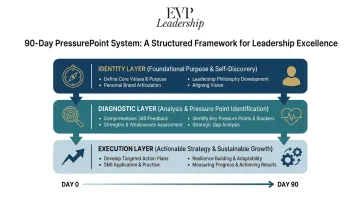
Throughout the 90 days, leaders are tested against real scenarios — so by the time pressure arrives, the response is already there.
Building Your Personal Decision Protocol
A personal decision protocol is a repeatable, pre-committed sequence of mental steps a leader runs through before acting on any pressure decision. Under stress, the brain cannot reliably construct a good process in the moment — but it can execute one it already knows.
The Core Elements
Build your protocol around four questions:
- What is the actual decision I need to make? (Not the symptom — the real call)
- Is this a one-way or two-way door? (Reversibility filter)
- Who else needs to weigh in before I commit? (Stakeholder check)
- What is the real deadline — not the perceived one? (Time constraint audit)
These questions take under two minutes to run through. They prevent the most common failure modes: reactive framing, disproportionate deliberation on reversible decisions, decisions made without input from the people who hold critical context, and false urgency.
How to Make It Automatic
A protocol only performs under pressure if it's been practiced before pressure arrives. Use it deliberately on low-stakes decisions — vendor choices, meeting priorities, resource allocation — so the sequence becomes reflexive.
By the time a genuine crisis lands on your desk, the protocol runs without conscious effort. That's not training. That's conditioning — and conditioning is what holds under pressure when training often doesn't.
Frequently Asked Questions
What is decision-making under pressure?
Decision-making under pressure is the process of reaching sound, timely decisions in high-stakes situations with limited time, incomplete information, or significant emotional stress. It is a conditioned skill — built through deliberate practice and structured rehearsal — rather than an innate leadership trait.
What are the 3 C's of decision-making?
The 3 C's are Clarity (define the actual problem, not the symptom), Criteria (establish in advance what a good outcome looks like), and Choice (filter options against those criteria). This structure prevents reactive, emotion-driven decisions by creating a logical sequence before committing.
What is the 40/70 rule in decision-making?
The 40/70 Rule advises leaders to act when they have between 40% and 70% of the information they ideally want. Acting with less invites recklessness; waiting for more wastes critical time and rarely changes the outcome.
How do you deal with extreme indecisiveness?
Indecisiveness is a conditioned response to fear of being wrong. Counter it by setting a deliberate time constraint, running the reversibility filter (is this decision reversible?), and recognizing that delayed decisions carry the same compounding costs as bad ones.
Can decision-making under pressure be learned and improved?
Yes. It's a trainable skill built through deliberate practice, scenario rehearsal, post-decision review, and physical stress regulation — not a fixed personality trait.
What are the most common cognitive biases that affect decisions under pressure?
The three most common are confirmation bias (seeking information that confirms existing assumptions), status quo bias (defaulting to familiar options regardless of fit), and overconfidence bias (overestimating the accuracy of your own judgment).