Introduction
There's a cruel irony at the center of high-stakes leadership: the pressure that demands your clearest thinking is often what destroys it. When the consequences are real and the clock is running, the brain doesn't upgrade its processing power — it downgrades it.
Most leadership development misses this entirely. It focuses on skills, frameworks, and strategies — all useful when conditions are calm.
But small business owners, founders, and executives don't make their most consequential decisions in calm conditions. They make them when cash is tight, a key person just quit, or a major client relationship is on the line. That's when the quality of thinking matters most, and that's exactly when it's most compromised.
This article breaks down the psychology behind that failure: what makes a decision genuinely high-stakes, how stress hijacks rational thinking, which cognitive traps are most likely to surface under pressure, and what leaders can actually do to build decision-making capacity that holds up when it counts.
Key Takeaways
- High-stakes decisions are defined by large potential loss combined with high reversal costs — not by company size or dollar amount
- Stress actively impairs evaluation of alternatives, long-term thinking, and other functions critical to sound decisions
- Confirmation bias, sunk cost fallacy, and "Go Fever" are predictable patterns — not personal failures — and each can be countered
- Group decisions under pressure carry distinct risks, particularly groupthink and suppression of dissenting voices
- The difference between consistent decision-makers and inconsistent ones is conditioning, not talent
What Makes a Decision "High-Stakes"?
Not every difficult decision is a high-stakes one. The distinction matters: treat every choice as high-stakes and you get paralysis; underestimate a genuinely consequential one and you get disaster.
Two factors define a high-stakes decision:
- Significant potential loss — financial, reputational, or human
- High reversal costs — once the decision is made, unwinding it is expensive, slow, or impossible
The combination is what separates high-stakes choices from ordinary ones. A bad decision you can reverse cheaply in a week is a low-stakes decision, regardless of how uncomfortable it feels. A decision that commits significant capital, restructures a team, or pivots the business model carries real stakes because the cost of being wrong is compounded by the cost of undoing it.
This applies across business sizes. For a small business owner, the decision to bring on a major new client, restructure the team, or deploy cash reserves into growth carries the same psychological weight as a corporate merger. The numbers are different; the cognitive dynamics are identical.
That cognitive weight shows up in the data. Gallup found that 45% of U.S. entrepreneurs reported experiencing stress "a lot of the day" — and that was before the sustained uncertainty of recent years.
The NFIB's May 2026 Uncertainty Index hit 91, well above its historical average of 68. Small business leaders aren't making decisions in comfort — they're making them under chronic pressure, often without the structured support systems that larger organizations rely on.
Why Pressure Derails Rational Thinking
The Neurological Reality
When a leader perceives a high-stakes situation, the brain activates its threat-response system. This triggers the release of cortisol and adrenaline, which shift resources away from the prefrontal cortex — the brain region responsible for evaluating trade-offs and thinking across time horizons. Activity in the amygdala increases, orienting attention toward immediate threats.
This is not a character flaw. Peer-reviewed research confirms that high stress hormones actively disrupt prefrontal cortex function while enhancing emotional reactivity. The result is a leader who feels decisive but is actually operating with degraded analytical capacity.
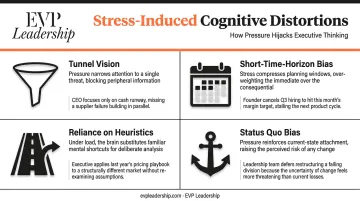
Four Ways Stress Distorts Thinking
Tunnel vision. Under pressure, the brain narrows focus to the most immediate, visible threat — at the expense of broader context. A sudden cash flow problem triggers reactive cost-cutting; the longer-term effect on team capacity or client relationships doesn't register with the same urgency.
Short-time-horizon bias. Stress amplifies the natural tendency to prioritize immediate consequences over long-term outcomes. Research on intertemporal decision-making shows that time pressure increases discounting of future rewards. Leaders under pressure consistently underweight what happens next quarter in favor of what happens tomorrow.
Reliance on heuristics. Under pressure, the brain defaults to mental shortcuts that work well in routine situations. The problem: high-stakes decisions are rarely routine. Experienced leaders are not immune — heuristics built from past success can be dangerously misapplied in unfamiliar situations.
Status quo bias. When facing difficult trade-offs with no obvious right answer, the instinct is to delay or preserve the current state. In fast-moving environments, that delay is still a decision, and it carries its own opportunity costs. Samuelson and Zeckhauser's foundational research on status quo bias confirmed this pattern across real-world decisions, and it shows up constantly in business leadership.
The Cognitive Traps That Sabotage High-Stakes Decisions
These aren't random failures. They're predictable patterns that show up most reliably when the stakes are highest.
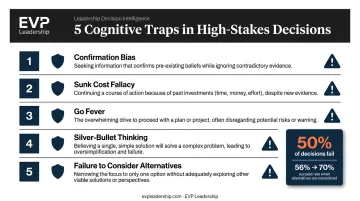
Confirmation Bias
Under stress, decision-makers actively seek information confirming the path they're already leaning toward — and unconsciously discount contradictory evidence. Kodak is the well-documented case: the company invented the first digital camera in 1975 and had access to market data for decades, yet consistently interpreted signals through a lens that favored its existing film business. By 2011, it was in Chapter 11.
The confirmation loop is especially dangerous before major moves — new market entries, significant hires, strategic pivots — because optimism is highest and skepticism is lowest exactly when scrutiny is most needed.
Sunk Cost Fallacy
Founders are particularly vulnerable here. When you've invested years, personal capital, and significant identity into a venture, the psychological cost of cutting losses feels unbearable. The result is continued investment in a failing course of action because of what's already been spent, not because of what future outcomes justify.
The reframe that breaks this trap: "Given where we are today, is this the best use of our resources going forward?" That question removes the backward-looking weight of sunk costs and forces a forward-looking evaluation. Most leaders know the question intellectually. Few can ask it honestly when their identity is wrapped up in the answer.
"Go Fever"
This is the state in which urgency to move forward — driven by competitive pressure, deadline stress, or group momentum — overrides careful risk evaluation. Warning signs get rationalized. Dissenting voices get quieted. The team collectively accelerates toward an outcome that cooler reflection would have flagged as problematic.
The Space Shuttle Challenger disaster remains the defining organizational case. NASA's drive toward 24 flights per year created schedule pressure that consistently suppressed technical concerns, including documented warnings about O-ring performance at low temperatures. The House investigation found that communication failures and urgency bias contributed directly to the launch decision.
It's an aerospace example — but the organizational dynamics map directly onto business contexts where competitive pressure or investor timelines create artificial urgency.
Silver-Bullet Thinking
Under pressure, executives often search for one bold action that will solve a complex problem — a reorganization, a single new hire, a market pivot. Bain's research on 57 major corporate reorganizations found that fewer than one-third produced meaningful performance improvement — yet 88% of leaders enter reorganizations confident they will succeed. Complex problems get attributed to structural causes, and structural solutions get applied to what are often leadership, culture, or execution problems.
Failure to Consider Alternatives
Paul Nutt's study of 356 organizational decisions found that 50% failed, and managers generated multiple options in fewer than 20% of cases. When they did generate alternatives, decision success improved from 56% to 70%. The single-option trap isn't laziness — it's the product of how most organizations frame decisions. A recommendation gets tabled; the group evaluates it. No one is explicitly tasked with generating competing options or justifying why alternatives were rejected.
How Group Dynamics Amplify Decision Failures
Individual cognitive traps are difficult enough. Group dynamics make them worse — reliably and predictably.
Groupthink Suppresses the Honest Input You Need
Groupthink is the social pressure to conform that suppresses dissenting perspectives, creates false consensus, and produces decisions that feel decisive but have never been genuinely stress-tested. Harvard Business Review identifies consensus-based problem-solving groups as highly prone to groupthink and status quo solutions — and the effect intensifies under time pressure and in hierarchical teams where challenging the leader feels risky.
Group Size Works Against Decision Quality
Bain's "Rule of 7" holds that for every person added to a decision-making group beyond seven, decision effectiveness declines by approximately 10%. More voices don't produce more clarity — they produce more social coordination requirements and slower, more diluted deliberation. For high-stakes decisions, smaller and more deliberately composed teams consistently outperform larger ones.
Psychological Safety Determines What Gets Said
Amy Edmondson's widely cited study of 51 work teams established that psychological safety — the shared belief that the team is safe for interpersonal risk-taking — is directly linked to learning behaviors: speaking up, seeking feedback, and discussing errors openly.
Teams where people fear being wrong or challenging authority produce worse outcomes under pressure. Not because they lack good ideas — but because the good ideas don't surface.
For leaders, this means the work of building an environment where honest input is rewarded happens before the crisis. You cannot install psychological safety in the middle of a high-stakes decision.
Decision-Making Frameworks That Perform Under Pressure
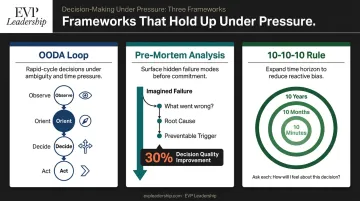
The OODA Loop
Developed by U.S. Air Force strategist John Boyd, the OODA Loop (Observe, Orient, Decide, Act) is a framework for rapid but deliberate decision-making under uncertainty. The four stages are sequential, but the "Orient" step is the most critical and most often skipped under pressure.
Orienting means analyzing new information in context (filtering it through existing knowledge, patterns, and situational understanding) rather than reacting to it directly. Leaders who skip this step mistake fast for decisive.
Pre-Mortem Analysis
Gary Klein's pre-mortem method asks a team to imagine that a decision has already failed, then work backward to identify what went wrong. It's more effective than conventional risk assessment because it bypasses optimism bias and makes it socially safe to raise concerns. Research cited in Klein's original HBR article found that prospective hindsight increased the ability to identify reasons for future outcomes by 30%.
The technique also surfaces concerns that team members may be reluctant to raise in real time. When failure is hypothetical, the social stakes of saying "this could go wrong" are much lower.
The 10-10-10 Rule
Developed by author Suzy Welch, this framework asks three questions: How will I feel about this decision in 10 minutes? In 10 months? In 10 years? It's a simple tool for reintroducing long-term perspective when short-term pressure is dominating thinking — particularly useful when the immediate emotional weight is distorting evaluation of longer-term impact.
Setting Information Thresholds
Waiting for complete certainty before deciding is itself a decision, one with significant opportunity costs. Herbert Simon's concept of bounded rationality established that decision-makers operate under real cognitive and information constraints, and that satisficing (finding a good-enough solution given those constraints) is often more effective than pursuing optimal information.
The practical application is straightforward:
- Define in advance what level of information is sufficient to act, based on the stakes involved
- Treat indefinite delay as an active choice with consequences, not a neutral default
- Recognize that premature action and analysis paralysis are equally costly process failures
Building the Capacity to Decide Well, Consistently
Training vs. Conditioning
This distinction matters more than most leaders realize.
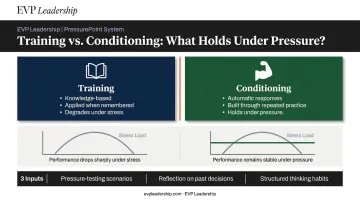
Training provides knowledge and frameworks that a leader can apply — when they remember to apply them, when conditions are favorable, and when stress hasn't degraded deliberate thinking. Conditioning builds automatic, reliable responses that hold up when stress, fatigue, and time pressure degrade the deliberate layer entirely.
EVP Leadership's core thesis is direct on this point: "Under pressure, leaders don't rise to expectations — they fall back on their conditioning. And most leaders haven't been conditioned to think clearly, stay focused in complexity, or execute with discipline when it matters most. They've been trained, but not prepared for real pressure."
The difference isn't semantic. Under real high-stakes conditions, most leaders fall back on whatever is most ingrained — not whatever they most recently learned at a training event.
Building Decision Capacity Through Deliberate Practice
Three inputs build leaders who default to sound process under pressure — not just in calm conditions:
- Consistent exposure to pressure-testing scenarios
- Regular reflection on past decisions, especially failures
- Systematic habit-building around structured thinking tools
Emotional Capacity: The Layer Most Leaders Skip
Every cognitive trap described in this article is amplified when a leader lacks the self-awareness to recognize that distorted thinking is happening at all. Conditioning frameworks build the technical layer — emotional capacity is what keeps a leader able to access them. Emotional capacity — the ability to stay clear-headed under pressure, manage the physiological stress response, and maintain perspective — is as important as any analytical framework.
Leaders experiencing decision fatigue, burnout, or chronic overload aren't just tired. Their decision-making quality is compromised at the neurological level. Restoring it requires the same deliberate conditioning approach — and it's precisely why EVP Leadership builds emotional resilience into the Identity Layer rather than treating it as a separate concern.
Frequently Asked Questions
What is high-stakes decision-making?
High-stakes decision-making involves choices where two conditions are present: the possibility of a significant loss — financial, reputational, or human — and high costs to reverse the decision once made. These decisions occur across all organization types and sizes, not just large corporations.
What is the 10-10-10 rule?
Developed by Suzy Welch, the 10-10-10 rule asks a decision-maker to consider how they will feel about a choice in 10 minutes, 10 months, and 10 years. It's specifically designed to counteract the short-term thinking bias that intensifies when immediate pressure dominates decision-making.
What are the most common cognitive biases that affect high-stakes decisions?
The most frequently documented biases are confirmation bias (favoring information that fits existing beliefs), the sunk cost fallacy (continuing to invest based on what's already been spent), and status quo bias (choosing inaction to avoid difficult trade-offs). Recognizing these patterns in the moment — not just in theory — is what allows leaders to override them.
How does stress affect a leader's decision-making ability?
Stress activates the brain's threat-response system, reducing prefrontal cortex activity and shifting leaders toward emotional, pattern-based processing. The result is degraded decisions — not from lack of skill or knowledge, but from a neurological state that knowledge-based training alone cannot address.
What is the difference between training and conditioning for high-pressure leadership?
Training builds knowledge and frameworks. Conditioning builds automatic responses through repeated, deliberate practice. Under real pressure, leaders default to what is most conditioned — not what they most recently learned — which is why sustained conditioning produces consistently different outcomes than one-time training events.