Introduction
Picture this: your top performer just resigned, a key client is threatening to walk, and your operations manager is waiting for a call back—all before 9 a.m. You have incomplete information, real consequences, and no time to think.
Some leaders freeze. Others react impulsively. A smaller group moves through moments like this with a steady, repeatable process—not because they're smarter, but because they've conditioned themselves to have one before the pressure hits.
Good decision-making isn't a talent. Research from McKinsey found that only 20% of organizations say they excel at decision-making, and managers reported spending 37% of their time making decisions—with 61% saying that time was used ineffectively. Most leaders aren't underskilled — they're unsystematic.
What follows addresses that gap directly: how to read the type of decision in front of you, a step-by-step framework for making better calls, and how to build the decision-making capacity that holds up under real pressure.
Key Takeaways
- Decision-making failures typically come from applying the wrong approach to the wrong situation, not from a lack of information.
- Diagnosing the type of situation before choosing how to respond is the most overlooked step.
- Better pressure decisions come from conditioning, not just knowledge of frameworks.
- Post-decision reflection is what turns each call into stronger judgment over time.
- Leaders who've defined their values decide faster and second-guess themselves less.
Why Decision-Making Breaks Down Under Pressure
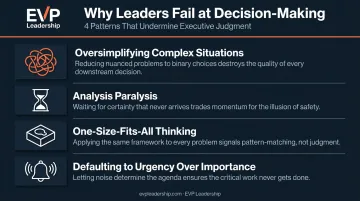
Most leaders don't fail at decision-making because they're uninformed. They fail because of four specific patterns:
- Oversimplifying complex situations — forcing a clear answer onto a problem that doesn't have one yet
- Analysis paralysis — gathering more information than the decision actually requires
- One-size-fits-all thinking — applying the same approach to every problem regardless of context
- Defaulting to urgency over importance — reacting to what's loudest rather than what matters most
The Emotional Dimension Most Frameworks Miss
There's a layer beneath these patterns that rarely gets addressed directly: the emotional toll of carrying significant decision load without sufficient support systems.
Stress degrades the executive functions leaders depend on most. A 2016 meta-analysis found that acute stress impairs working memory and cognitive flexibility — precisely the mental resources required for complex decisions. When those functions are taxed, judgment deteriorates quietly, often before a leader notices.
This hits small business owners and entrepreneurs with particular force. Unlike enterprise executives, they carry a concentrated decision load with fewer formal structures, smaller teams, and less access to expert support. Research on small-firm owner-managers consistently shows they face cognitive and informational constraints — often lacking time, financial resources, or formal planning frameworks. They're navigating high-stakes calls with the least infrastructure to support them.
That gap between decision demand and decision support is exactly where leadership conditioning becomes the differentiator.
The Core Insight
EVP Leadership's core principle is direct: leaders don't rise to the occasion—they fall back on their conditioning.
Effective decision-making means building the mental habits, emotional resilience, and practiced frameworks that make clarity available when stakes are highest. Leaders who decide well under pressure have done that conditioning work before the pressure arrives.
Not All Decisions Are the Same: How to Read the Situation First
One of the costliest leadership mistakes is misreading the type of situation you're in. Applying data-driven analysis to a crisis, or reacting urgently to something that needed patience, produces worse outcomes than not deciding at all.
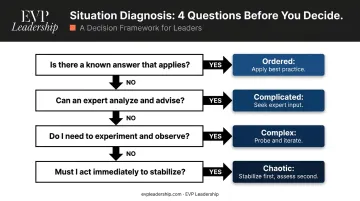
Snowden and Boone's foundational HBR framework describes three distinct environments that determine how a leader should respond:
Ordered Situations: When Best Practices Apply
Some situations have clear cause and effect. The right answer either exists already (simple/clear) or becomes visible once experts analyze it (complicated).
In these contexts, the failure mode isn't applying the wrong method—it's overthinking. Leaders who demand certainty before executing in ordered situations create unnecessary delay and signal indecisiveness to their teams.
When the path is clear, act. When it requires expert input, get it quickly and move.
Complex Situations: When You Need to Experiment
Most significant business decisions—team restructuring, product direction, market positioning—fall here. In complex environments, cause and effect are only clear in retrospect. There is no "right answer" to find through analysis because the answer doesn't exist until you create it through action.
The appropriate response is to probe, run small experiments, watch for emerging patterns, and build direction incrementally. Forcing a tidy solution onto a genuinely messy problem is how leaders stall progress. Patience here is the correct strategy.
Chaotic Situations: When Speed is the Priority
Crisis is different. When a situation is chaotic, there's no time to analyze before acting. The priority is to stabilize first, then assess. The biggest mistake leaders make in chaotic situations is treating them like complex ones—gathering input, running experiments, waiting for clarity—while the situation deteriorates.
Act decisively enough to stabilize the situation, then shift into assessment mode once the immediate threat is contained.
A Quick Situation-Diagnosis Tool
Before choosing how to proceed, ask yourself:
- Is there a known answer that applies here?
- Can an expert analyze this and tell me what to do?
- Do I need to run a small experiment and watch what happens?
- Do I need to act immediately to stabilize before I can think clearly?
Your answers point you toward the right environment—and the right approach. Getting that diagnosis wrong is where most leadership decisions go sideways before they even begin.
A Leader's Decision-Making Framework: Step by Step
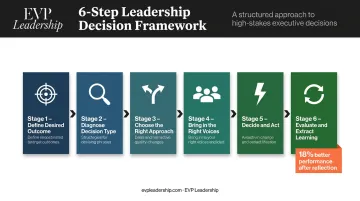
Once you've diagnosed your situation, apply this six-step sequence. The steps are consistent; what changes is how you execute each one based on context.
Step 1 — Define the Desired Outcome
Clarity about what success looks like is the most overlooked step in high-pressure decision-making. Leaders who skip this often make the right decision for the wrong problem.
Define success in two dimensions:
- Short-term: What does resolution look like in the next 48-72 hours?
- Long-term: Does this decision align with where the organization is heading?
Step 2 — Diagnose the Type of Decision
This step was covered in depth in the previous section — but it earns its place in the sequence because misdiagnosis derails everything that follows. Before choosing an approach, run a quick check: Is the situation stable with clear cause-and-effect (ordered)? Unstable with emerging patterns (complex)? Or in active breakdown with no reliable patterns (chaotic)? The answer determines your entire approach.
Step 3 — Choose the Right Approach
- Ordered situation: Set clear goals, gather relevant facts, execute with confidence.
- Complex situation: Take incremental action, build in feedback loops, adjust as patterns emerge.
- Chaotic situation: Act decisively enough to stabilize, then shift to analysis once the crisis is contained.
For a small business owner, this might mean the difference between calling an all-hands meeting to address team tension (ordered) versus quietly piloting a new sales approach for 30 days before committing (complex).
Step 4 — Bring in the Right Voices
Identify who to involve using three filters:
- Who has relevant expertise?
- Who will be affected by this decision?
- Who will be responsible for implementing it?
Two failure modes to avoid: deciding in complete isolation (missing critical input), and over-consulting to the point of creating delay and diluting accountability. The goal is informed speed, not consensus.
Step 5 — Decide and Act
Decision avoidance—waiting for more certainty than is ever available—is one of the most expensive leadership habits. McKinsey research found that organizations that make decisions quickly are twice as likely to produce high-quality outcomes as slower peers.
Calibrate action to context:
- Bold execution in ordered situations
- Incremental steps in complex ones
- Rapid stabilization in chaotic ones, then regroup
Step 6 — Evaluate and Extract the Learning
The decision cycle closes with reflection. Ask:
- What was the intended outcome?
- What actually happened?
- What would you do differently?
Most leaders skip this step under pressure — which is exactly when it matters most. Research from Harvard Business School found that participants who reflected on their work performed 18% better in subsequent tasks than those who didn't. Done consistently, reflection converts experience into sharper judgment — so the next high-stakes call is easier than the last.
The Hidden Factor: Decision-Making as a Conditioned Reflex
Here's the gap no framework alone can close: most leaders can reason clearly about decisions when they're calm. The breakdown happens when stakes are high, time is short, and emotions are running.
Knowing the steps isn't the same as being able to execute them under real pressure.
What Conditioning Actually Looks Like
EVP Leadership draws a sharp line between training and conditioning. Training gives you information — conditioning builds the internal capacity to act on it when pressure is highest.
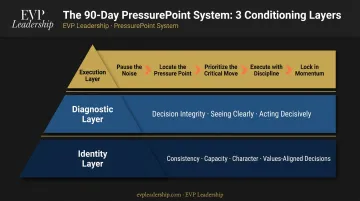
The 90-Day PressurePoint System is built around this distinction. Rather than teaching leaders a framework to reach for when things go wrong, it conditions them to operate from that framework automatically — through three structured layers:
- Identity Layer: Where consistency, capacity, and character are built — so values-aligned decisions become the default, not a deliberate choice under pressure.
- Diagnostic Layer: Develops the ability to see clearly and act decisively, including Decision Integrity — asking whether a decision is grounded in truth or distorted by noise and emotion.
- Execution Layer: A five-step protocol for critical moments: Pause the Noise → Locate the Pressure Point → Prioritize the Critical Move → Execute with Discipline → Lock in Momentum.
The Role of Values Clarity
Leaders who have done the work of defining their core principles make decisions faster and with less second-guessing — because they have an internal filter that's already running. When a choice conflicts with their values, it gets filtered out before deliberation begins.
That's precisely what the Identity Layer develops. Consistency, as EVP Leadership defines it, means acting in alignment with values and expectations over time — so when pressure hits, leaders aren't rebuilding their compass. They're already oriented.
What that produces is judgment leaders can count on — not in ideal conditions, but in the moments that actually define their leadership.
After the Decision: Execution and Learning
A great decision executed poorly produces mediocre results. The handoff from deciding to doing is where most leaders lose momentum.
Translating a Decision into Action
After a significant decision, establish three things before moving:
- Who owns what — one clear person accountable for each action, not a group
- By when — specific deadlines, not "soon" or "as soon as possible"
- How progress is measured — a defined indicator that tells you whether it's working
Without these three elements, decisions dissolve into good intentions.
Triage as a Leadership Discipline
The list of actions after a decision is almost always longer than available bandwidth. Apply a simple urgent/important lens to sequence what happens first: focus energy on actions that move the outcome, not just the ones that feel most pressing. The PressurePoint System calls this "Prioritize the Critical Move"—what matters most right now, not everything at once.
The Post-Decision Review
Brief reflection after significant decisions builds compounding judgment. Keep it simple:
- What was the intended outcome, and what actually happened?
- What drove the gap, if there was one?
- What does the next decision in this area look like as a result?
Leaders who do this consistently accumulate sharper instincts over time. Those who skip it tend to face the same pressure points again — just wearing a different name.
Frequently Asked Questions
What is a decision-making framework for leaders?
It's a structured, repeatable process leaders use to evaluate situations, choose the right approach, and act with clarity. Without it, high-stakes calls get made inconsistently—driven by whoever is loudest, what's most urgent, or whatever worked last time.
How do I make better decisions under pressure?
Better pressure decisions come from practicing your framework on smaller decisions consistently, not just reaching for it in a crisis. Know your emotional triggers and have pre-defined values in place—those two things simplify choices when conditions get difficult.
What are the most common decision-making mistakes leaders make?
The top four:
- Oversimplifying complex situations
- Applying one approach to all problems
- Waiting too long when speed is critical
- Skipping the step of defining what success looks like before choosing a path
How do I know which decision-making approach to use?
Start with situation diagnosis. Ask whether cause and effect are clear, whether you need expert analysis, whether experimentation is required, or whether immediate stabilization is the priority. Match the approach to that answer, not to your default preference.
What's the difference between reactive and strategic decision-making?
Reactive decisions are triggered by urgency and emotion. Strategic ones are anchored in desired outcomes, organizational values, and an honest read of the situation type. The goal is building habits that make strategic thinking the default—not something you have to fight your way back to.
Can a small business owner build better decision-making habits without a large team or formal processes?
Yes. The framework scales to individual leaders. Practice on everyday decisions, get clear on your values, and build a brief reflection habit after significant choices. That combination compounds into sharper judgment over time—no large team or formal structure required.