
The math is unforgiving. At the executive level, decision quality determines organizational outcomes far more than effort volume. Yet most executives operate on a combination of experience, instinct, and informal judgment — approaches that work well in familiar terrain but erode fast when decisions multiply in complexity and scale.
Structured decision making is discussed often in leadership circles, usually in the abstract. This article makes the case for it in operational terms: what it is, the specific advantages it delivers, what accumulates when it's missing, and how to build it as a practiced discipline rather than a concept consulted occasionally.
Key Takeaways
- Structured decision making is a repeatable process for evaluating options against defined criteria — not a bureaucratic ritual
- It reduces cognitive bias, cuts decision fatigue, and produces faster, higher-quality decisions consistently
- At the executive level, it creates shared decision logic that aligns how the entire organization thinks and acts
- Without it, executives default to reactive behavior — and scaling or delegating becomes structurally harder
- The compounding value only appears when it's practiced as a conditioned habit — not pulled out for high-stakes moments alone
What Is Structured Decision Making
Structured decision making is a deliberate, step-by-step approach to evaluating problems, weighing options against defined criteria, and committing to a clear decision. The process is repeatable by design — not improvised anew each time a hard call lands on your desk.
This stands apart from intuitive or informal decision making. Intuition has real value — but without a consistent process behind it, judgment varies by mood, pressure, and who's in the room. Structured decision making doesn't replace experience. It gives experience a reliable channel to run through.
What It Looks Like in Practice
Familiar tools fall within this category — SWOT analysis, cost-benefit frameworks, the OODA Loop — but the framework matters less than the logic it creates. A structured approach consistently answers four questions before a decision is made:
- What information is required before we commit?
- Who needs to provide input, and who has final authority?
- What criteria govern the tradeoffs?
- How will the decision be communicated and tracked?
At the senior executive level, structured decision making applies most critically to resource allocation, organizational changes, competitive responses, and crisis management. In each of these areas, speed pressure and high stakes arrive together — which is precisely when an undisciplined process produces its worst outcomes.
Key Advantages of Structured Decision Making for Senior Executives
Each advantage below connects directly to operational outcomes. The gaps are measurable — and they show up consistently between organizations that apply structured decision making and those that don't.
Advantage 1: Reduced Cognitive Bias and More Objective Choices
Structured decision making creates friction between an executive's initial instinct and the final decision. That friction is intentional. By requiring documented assumptions, explicit consideration of alternatives, and stress-testing against objective criteria, the process surfaces blind spots that unstructured thinking consistently misses.
Research from McKinsey on behavioral strategy found that decision-making process quality was six times more important than the quantity of analysis in explaining decision outcomes — studied across 1,048 major decisions. Moving from bottom-quartile to top-quartile process quality correlated with a 6.9 percentage point increase in ROI.
The same research showed that in multibusiness corporations, a unit's share of capital expenditure tracked almost perfectly with its prior-year share over a 15-year period — regardless of changing growth opportunities. That's stability bias operating unchecked at the highest levels of resource allocation.
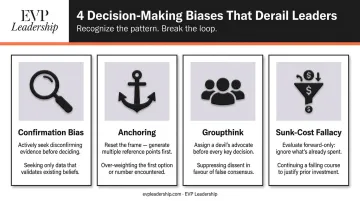
Common biases that structured process directly counters:
- Confirmation bias — seeking data that validates existing beliefs
- Anchoring — over-weighting the first number or option encountered
- Groupthink — suppressing dissent in favor of consensus
- Sunk-cost fallacy — continuing a failing course to justify prior investment
KPIs impacted: Decision reversal rates, strategic initiative success rates, error frequency in high-stakes choices
When it matters most: High-complexity decisions where the executive already holds a strong opinion, cross-functional decisions requiring fair weighting of multiple perspectives, and crisis situations where incomplete information amplifies the pull toward instinct.
Advantage 2: Faster Decisions Without Sacrificing Quality
Speed and structure appear to conflict. They don't. The time wasted in unstructured decision making isn't spent thinking harder — it's spent redefining problems that should already be defined, re-gathering information that should already be at hand, and stalling while waiting for certainty that never arrives.
Structure eliminates that lag. Pre-defined criteria for what information is required, clear roles for who provides input and who decides, and agreed timeframes for when a decision must be made all reduce the distance between identifying a problem and committing to action.
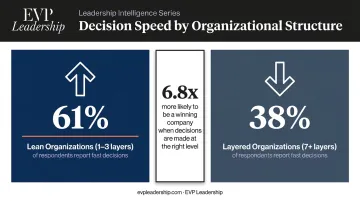
McKinsey's research quantifies this directly: organizations with one to three reporting layers had 61% of respondents agreeing that their companies make decisions quickly, versus 38% at organizations with seven or more layers. Organizations that make decisions at the right level are 6.8 times more likely to be winning companies.
The competitive cost of delayed decisions compounds. Organizations that wait for complete certainty routinely find the decision window has closed before action is taken.
KPIs impacted: Time-to-decision, strategy execution speed, competitive response time, resource deployment efficiency
When it matters most: time-sensitive crises, competitive pivots, and scaling decisions where delays create organizational bottlenecks that cascade downward.
Advantage 3: Organizational Alignment Through Consistent Decision Logic
Structured decision making at the executive level doesn't stay at the executive level. When senior leaders apply a consistent framework, teams below them can predict how decisions will be made, what data matters, and how to bring recommendations that will gain traction. That predictability creates alignment — without requiring constant executive oversight to sustain it.
McKinsey found that only 41% of respondents reported that their organizations align decisions with corporate strategy — yet companies that do are 2.9 times more likely to be winning organizations. The gap between knowing what the strategy is and actually making decisions aligned to it is where most execution failures originate.
When executives define what winning looks like, what data is required before a decision, and what criteria govern tradeoffs, those standards filter down. Three things follow:
- Employees make better decisions at their own level because they understand the organization's decision logic
- Recommendations that reach the executive are better framed and more actionable
- Escalation frequency drops as teams gain confidence in applying consistent criteria
This is also what makes real delegation possible. Without a shared decision model, every significant call routes back to the executive — not because teams lack ability, but because they lack the framework to act with confidence.
EVP Leadership's PressurePoint System builds this capacity through its Force Alignment component — conditioning executives to get the right people aligned and accountable — and through facilitated executive team development work that embeds consistent decision logic across leadership teams, not just at the top.
KPIs impacted: Team decision quality, escalation frequency, strategy-to-execution gap
When it matters most: Organizations scaling rapidly, distributed or multi-location teams, and leadership transitions where consistency of judgment must survive beyond any individual executive.
What Happens When Structured Decision Making Is Missing
The consequences of operating without decision structure rarely announce themselves clearly. They accumulate in patterns that look like talent problems, market challenges, or execution failures — and get misdiagnosed accordingly.
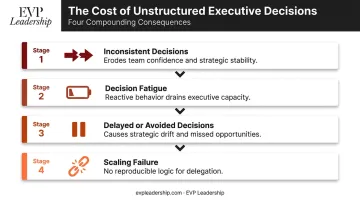
At the executive level, the specific consequences are:
- Inconsistent decisions on similar issues erode team confidence and make strategic priorities appear unstable
- Decision fatigue drives reactive behavior — executives exhaust cognitive capacity on low-value choices and have less available for the decisions that actually determine performance
- Difficult decisions get delayed or avoided, creating strategic drift and missed opportunities
- Scaling becomes harder because there is no reproducible decision logic that others can learn and apply — every significant call requires the executive personally
McKinsey research found that inefficient decision making costs a typical Fortune 500 company more than 530,000 days of manager time annually — and roughly $250 million in annual wages. At the senior level, where each decision carries the widest organizational impact, that cost compounds further.
The decision quality problem runs just as deep. 72% of senior executives said bad strategic decisions were either as frequent as good ones, or were the prevailing standard in their organizations. Only 28% of executives in a separate McKinsey survey rated their companies' strategic decision quality as generally good.
That's not a sample of struggling companies. It's a representative picture of what executive decision making looks like when there's no system behind it.
How Senior Executives Can Build Structured Decision Making as a Practice
Knowing a decision-making framework and being able to apply it reliably under pressure are not the same thing. The distinction is the entire problem.
EVP Leadership's core thesis puts it directly: under pressure, leaders don't rise to expectations — they fall back on their conditioning. Most executives have been trained in frameworks but haven't conditioned them. When stakes are highest and time is shortest, training evaporates. Conditioning holds.
The Three Conditions That Make It Work
Structured decision making delivers its full value only when three conditions are in place:
- It's applied consistently across all high-stakes decisions, not selectively. Inconsistent application teaches teams the structure is optional — and dissolves the alignment benefits.
- Decision quality is reviewed regularly — not just whether the outcome worked, but whether the process was followed and where it broke down.
- The structure is conditioned through repeated practice, not just understood intellectually. This is the condition most often skipped and the one that determines whether it holds under pressure.
What This Looks Like in the PressurePoint System
EVP Leadership's 90-Day PressurePoint System is built around exactly this conditioning approach. Three layers work together to make structured decision making an automatic response rather than a recalled procedure.
The Diagnostic Layer trains leaders to see clearly and act decisively. Two components are central to decision quality: Decision Integrity, which conditions executives to ground choices in truth rather than noise and emotion, and Problem Intelligence, which builds the reflex to identify the real problem quickly rather than reacting to symptoms.
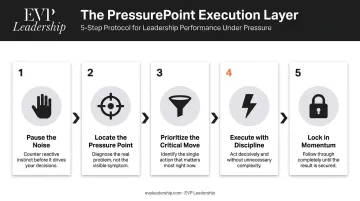
The Execution Layer gives leaders a five-step protocol for high-pressure moments:
- Pause the Noise — counter the reactive instinct before it governs the decision
- Locate the Pressure Point — diagnose the real problem, not the presenting symptom
- Prioritize the Critical Move — cut through competing priorities to identify what matters most
- Execute with Discipline — eliminate unnecessary complexity and act decisively
- Lock in Momentum — follow through rather than letting the decision dissolve into isolated action
Executives don't need one rigid framework for every decision. They do need a consistent logic — one that defines what information is required, who is involved, what criteria govern the choice, and how the decision gets communicated and tracked. That logic only becomes reliable when it's conditioned, not just understood. That's the work the 90-Day PressurePoint System is designed to do.
Conclusion
Structured decision making doesn't make executives smarter. It makes their intelligence more reliable, consistent, and scalable across the decisions that most determine organizational outcomes.
Bias reduction, faster decisions, and organizational alignment don't appear fully formed the first time a framework is used. They build as structured decision making becomes a conditioned practice — embedded in how a leader and their organization operates, not just how they plan to operate when conditions are ideal.
For executives, the real question isn't whether structured decision making is useful. It's whether they're practicing it consistently enough that it holds under pressure. Frameworks conditioned in low-stakes environments are the ones that perform when the stakes are high.
Frequently Asked Questions
What is the structured decision-making process?
Structured decision making follows a repeatable sequence: identify the problem, gather required information, evaluate options against defined criteria, commit to a decision, communicate it clearly, and review the outcome. The value isn't in any single step — it's in applying the same logic consistently across high-stakes situations rather than improvising each time.
How can organizations improve decision making for senior executives?
The highest-leverage changes are: defining clear criteria for what information is required before major decisions, establishing decision authority so the right people are making the right calls, reviewing decisions for process quality (not just outcomes), and conditioning structured decision habits through practice rather than one-time training.
What decision support systems (DSS) help senior-level executives?
Decision support systems range from data analytics platforms to structured review processes — all designed to convert raw information into actionable intelligence. The most effective setups combine the right tools with a disciplined decision process. Tools without process still produce inconsistent outcomes; the discipline is the differentiator.
What are the most common decision-making mistakes senior executives make?
The most frequent: relying on gut instinct without data validation, delaying decisions while waiting for certainty that never arrives, involving too many or too few people in the process, and failing to distinguish high-stakes irreversible decisions from lower-stakes reversible ones.
How does decision fatigue affect executive performance?
Decision fatigue depletes cognitive resources across the day, degrading judgment quality on the high-stakes choices that often occur later in a decision-heavy schedule. Structure counters this by reserving executive attention for decisions that warrant it and delegating or systematizing lower-value choices — keeping cognitive load in check before it compounds.
How does structured decision making differ from intuitive decision making?
Intuitive decision making draws on pattern recognition and experience — valuable, but inconsistent under pressure or in unfamiliar situations. Structured decision making doesn't replace intuition — it gives it a framework, so experience informs the decision rather than bypassing objective analysis.