According to McKinsey, executives spend roughly 37% of their time making decisions, and more than half of that time is viewed as ineffective. Only 37% of organizations report making decisions that are both high quality and fast. That gap is where businesses quietly lose ground.
Top-performing leaders close that gap with structure. They use proven decision-making frameworks that cut through noise, reduce cognitive load, and create clarity — especially when pressure is highest. This article covers six of the most effective ones, when to use each, and what it actually takes to apply them when it counts.
Key Takeaways
- A CEO decision-making framework is a repeatable process for moving from reactive problem-solving to intentional, strategic action.
- The most effective frameworks include the OODA Loop, Eisenhower Matrix, Second-Order Thinking, 80/20 Rule, One-Way vs. Two-Way Door, and First Principles Thinking.
- Framework selection should be driven by stakes, time available, and problem complexity — not by default habit.
- Knowing a framework is not the same as being conditioned to execute it when the pressure is real.
- Small business owners and entrepreneurs often benefit from these frameworks more than large-company executives do — because the margin for error is smaller.
What Is a CEO Decision-Making Framework?
A CEO decision-making framework is a structured, repeatable approach to evaluating choices. Rather than reacting to each new situation from scratch, frameworks give leaders a consistent process: gather relevant information, weigh options against clear criteria, and commit with confidence.
That structure creates advantages that compound over time:
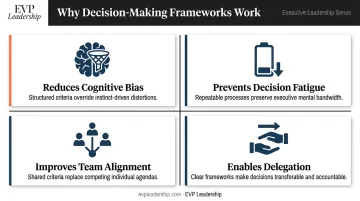
- Reduces cognitive bias by introducing structure before emotion takes over
- Prevents decision fatigue by conserving mental energy for high-stakes choices
- Improves team alignment because reasoning becomes transparent and explainable
- Enables delegation by giving teams a shared language for how decisions get made
This matters especially for small business owners and entrepreneurs, who often carry the full weight of organizational decisions without the staff, systems, or buffers that large enterprises provide. When pressure spikes, there's no committee to defer to — which is exactly why a reliable framework isn't optional.
No single framework handles every situation. The most effective leaders build a personal toolkit of three to five frameworks they've internalized through repeated use, not just read about once. That internalization is what holds under pressure — when there's no time to consult a model and every call is made in real time.
Top CEO Decision-Making Frameworks
McKinsey research shows that "winning" organizations — roughly the top 20% — are twice as likely as others to report financial returns of 20% or more from recent decisions. What separates them isn't access to better information. It's more disciplined decision processes.
The six frameworks below are consistently used by high-performing leaders across industries.
The OODA Loop (Observe, Orient, Decide, Act)
Developed by U.S. Air Force Colonel John Boyd, the OODA Loop breaks decision-making into four steps: observe the current situation, orient by interpreting what you're seeing through experience and context, decide on a course of action, and act.
The most valuable step for business leaders is "orient." It's a deliberate pause between receiving information and responding to it — interrupting the impulse to react immediately. MIT Sloan describes the OODA Loop as a four-step process for recovering from business disruption and deciding where to invest time and resources to develop faster responses.
Best used when: the environment is changing fast, competitive pressure is intense, or a crisis requires both speed and composure.
The Eisenhower Matrix (Urgent vs. Important)
Inspired by a distinction attributed to Eisenhower — that urgent problems are seldom important, and important problems are seldom urgent — and later popularized by Stephen Covey, this matrix classifies every task into four quadrants:
| Urgent | Not Urgent | |
|---|---|---|
| Important | Do now | Schedule |
| Not Important | Delegate | Eliminate |
CEOs and business owners routinely get pulled into Quadrant 3 — urgent but unimportant decisions that consume focus without generating strategic value. The matrix restores discipline by making the distinction explicit.
Best used when: your calendar is running you, or you need to reclaim time for high-leverage strategic work.
Second-Order Thinking
First-order thinking asks: "What happens if I do this?" Second-order thinking asks: "And then what?" It traces the downstream consequences of a decision before committing — ripple effects, trade-offs, and long-term implications that aren't visible in the immediate result.
Oaktree Capital's Howard Marks describes second-level thinking as "deep, complex and convoluted" — requiring consideration of the full range of outcomes, probabilities, and how your expectations differ from conventional wisdom.
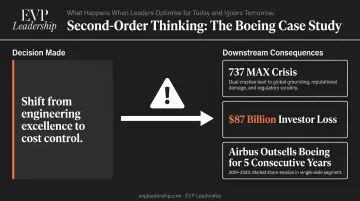
HBS research on Boeing's 737 MAX crisis traces the failures to leadership decisions made more than 25 years earlier, including a cultural shift from engineering excellence toward cost control.
Decisions aimed at short-term shareholder value ultimately cost investors an estimated $87 billion and allowed Airbus to outsell Boeing in new aircraft orders for five consecutive years.
Best used when: making decisions with long time horizons, organizational consequences, or irreversible structural changes.
The 80/20 Rule (Pareto Principle)
Vilfredo Pareto observed in 1895 that roughly 20% of inputs produce 80% of outcomes. Joseph Juran formalized this as the Pareto Principle in quality management, distinguishing the "vital few" from the "useful many."
In practice, this means:
- A small fraction of your customers likely generate the majority of revenue
- A small number of decisions each week actually move the business forward
- Most of your team's effort — and your own — falls into lower-leverage activity
Identify which decisions actually drive revenue, culture, and strategic progress, and protect your cognitive energy for those. Don't spread attention evenly across everything.
Best used when: you're overextended, unclear on priorities, or trying to identify the highest-leverage actions in a complex situation.
The One-Way vs. Two-Way Door (Reversibility Framework)
Jeff Bezos introduced this framework in Amazon's 2015 shareholder letter. It categorizes decisions by how reversible they are:
- One-way doors (Type 1): Consequential and hard to reverse. These require deliberate analysis, broad consultation, and slower movement.
- Two-way doors (Type 2): Reversible and lower-stakes. Make them quickly, at the right level, without heavy process.
Bezos's language is precise: most decisions are two-way doors, and treating them like one-way doors is what makes organizations slow. The trap for most leaders runs the other direction — they under-analyze the genuinely irreversible choices (a major hire, a market exit, a capital commitment) because the urgency of the moment feels like a reason to move fast.
Best used when: you need to calibrate how much time and rigor a decision actually deserves before investing in the analysis.
First Principles Thinking
First principles thinking means stripping a problem down to its foundational truths and reasoning upward from there, rather than relying on convention, analogy, or "how things have always been done."
Elon Musk applied this directly to SpaceX. Rather than accepting market prices for rockets, he asked what a rocket is actually made of, compared raw material costs to market prices, and found the gap large enough to build the manufacturing himself. That gap was enormous. The result broke a cost structure that aerospace had accepted as fixed for decades.
For small business owners and entrepreneurs — who often face challenges without a clear playbook — first principles thinking is a way to cut through inherited assumptions and find solutions that are more creative and frequently more economical.
Best used when: facing a novel problem, an entrenched industry assumption you want to challenge, or a situation where conventional approaches keep producing the same inadequate results.
How to Choose the Right Framework for Your Decision
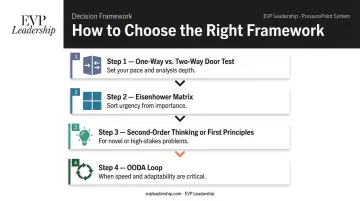
Framework selection depends on three factors: stakes (how reversible and consequential is this?), time available (is speed critical or is this deliberate?), and complexity (is the problem well-defined or deeply ambiguous?).
A practical starting guide:
- Run the One-Way vs. Two-Way Door test first — it sets your pace and calibrates how much analysis is warranted
- Apply the Eisenhower Matrix to sort urgency from importance before committing focus
- Use Second-Order Thinking or First Principles when the problem is novel, high-stakes, or poorly understood
- Use the OODA Loop when speed and adaptability are the primary demands
Colin Powell's 40-70 Rule adds another useful lens here: act once you have roughly 40–70% of the information you'd ideally want. Act below 40% and you're reckless. Wait past 70% and you're usually too late. Delayed decisions carry compounding operational and competitive costs that most leaders underestimate.
The most common mistake is applying the same framework to every decision out of habit. Effective leaders develop the judgment to match the tool to the situation. That judgment comes from practice and deliberate reflection, not just familiarity with the concepts.
From Knowledge to Conditioning: Making Frameworks Stick Under Pressure
Here's the problem most leaders don't talk about: they can describe these frameworks clearly. In a calm moment, they know exactly which one applies. Under real pressure, when the situation is time-compressed and emotionally charged, they default to reactive instinct anyway.
Knowing a framework and being conditioned to reach for it under pressure are two different capabilities — and the second one takes deliberate work to build.
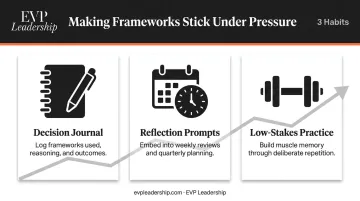
Three habits help close that gap:
- Keep a brief decision journal. After meaningful decisions, log which framework you used (or should have used), your reasoning, and the outcome. Pattern recognition develops over time.
- Build reflection prompts into recurring routines. Weekly reviews, quarterly planning sessions, and leadership check-ins are natural moments to ask: how are we making decisions, and is the process holding up?
- Practice in lower-stakes situations deliberately. Frameworks become instinctual through repetition. Applying them to smaller decisions builds the muscle memory that shows up when pressure is real.
This is the principle at the core of EVP Leadership's 90-Day PressurePoint System. The program is built on a straightforward premise: leaders don't rise to expectations under pressure; they fall back on their conditioning.
The system's Diagnostic Layer includes a component called Decision Integrity, focused specifically on whether decisions are grounded in truth or distorted by noise and emotion. The Execution Layer provides a five-step protocol (Pause the Noise, Locate the Pressure Point, Prioritize the Critical Move, Execute with Discipline, Lock in Momentum) designed to be accessed automatically in critical moments.
The goal is to condition leaders to reach for the right tool when it counts most — not just know it exists.
Conclusion
The shift from reactive decision-making to framework-driven leadership isn't a one-time event. It's a capability built through consistent practice, honest self-assessment, and the willingness to treat decision-making as a skill — one that can be developed and refined like any other.
The frameworks covered here give you the starting point. The harder work is embedding them into how you actually operate when stakes are high and time is short.
If you're ready to move beyond learning these tools to actually conditioning yourself to use them under pressure, that's where Gennifer Baker and the team at EVP Leadership focus their work. Their 90-day PressurePoint System pairs decision-making frameworks with structured scenario conditioning — so that when a high-stakes moment arrives, your response is trained, not improvised.
Frequently Asked Questions
How do top CEOs make decisions?
Top CEOs combine structured frameworks with accumulated experience. They use tools like the OODA Loop, Eisenhower Matrix, and Second-Order Thinking to process information quickly, reduce bias, and act with conviction — even when information is incomplete. The difference is that they've conditioned themselves to reach for these tools under pressure, not just in calm reflection.
What is the 40-70 rule in decision-making?
The 40-70 Rule, attributed to Colin Powell, advises leaders to act once they have between 40% and 70% of the information they'd ideally want. Acting below 40% is reckless; waiting beyond 70% costs critical time and competitive opportunity.
What are the five temptations of a CEO?
Patrick Lencioni's The Five Temptations of a CEO identifies five behavioral traps: choosing status over results, popularity over accountability, certainty over clarity, harmony over productive conflict, and invulnerability over trust. Left unchecked, each one erodes the decision quality and team performance a leader is capable of.
What is the difference between a one-way door and a two-way door decision?
A two-way door decision is reversible — it should be made quickly without excessive analysis. A one-way door decision is difficult or costly to reverse and warrants deliberate, slower consideration with broader input. Most decisions are two-way doors; the mistake is treating them like one-way doors and creating unnecessary slowness.
Can small business owners benefit from CEO decision-making frameworks?
These frameworks are especially valuable for small business owners and entrepreneurs, who typically make high-stakes decisions with fewer resources and less organizational support than their large-company counterparts. Structured approaches give them the same strategic discipline as enterprise executives, regardless of company size.