Introduction
What does a single poor leadership decision actually cost a small business? A botched negotiation, a disengaged manager who drives out three high performers, a strategy that consumes six months of effort and produces no traction — each of these can cost tens of thousands of dollars. Yet most small and mid-size businesses treat leadership development as optional.
Executive coaching is a risk-management and growth investment — one that pays measurable returns. In 2026, with replacement costs rising and leadership cycles compressing, the cost of underinvesting in leadership has never been more concrete.
This article covers what the research actually shows about coaching ROI, the hidden costs of skipping it, the four drivers that determine whether coaching pays off, and a practical measurement framework — built specifically for small and mid-size leadership teams.
Key Takeaways:
- Studies show executive coaching returns a median 7x the initial investment, with some analyses exceeding 700%
- Training alone improves productivity by ~22% — adding coaching pushes that figure to 88%
- Replacing one employee costs 50–200% of annual salary; stronger leadership directly reduces this exposure
- Coaching ROI compounds across four drivers: goal alignment, behavioral conditioning, team cascade, and accountability
- Measuring results requires both hard KPIs and qualitative indicators — tracked before, during, and after the engagement
Why Executive Coaching ROI Matters More in 2026
The Pressure Has Changed
Leadership in 2026 operates under compounding stress that didn't exist five years ago. McKinsey's 2025 AI workplace report found that 92% of companies plan to increase AI investment, yet only 1% of leaders consider their organizations mature in AI deployment. Meanwhile, the U.S. Chamber reports that 58% of small businesses used generative AI in 2025, up from 40% the year before.
That's only part of the picture. Leaders are also navigating:
- Multi-generational workforces with diverging expectations — Deloitte's 2024 survey found 86% of Gen Zs and 89% of millennials say purpose is important to job satisfaction
- Hybrid work as a permanent operating norm, not a temporary accommodation
- Economic conditions that demand faster, higher-quality decisions with less margin for error
Why SMB Leadership Quality Is the Deciding Variable
Large enterprises absorb weak leadership through deep bench strength and redundant teams. Small and mid-size businesses don't have that buffer. A single executive's blind spot — an inability to delegate, chronic avoidance of hard conversations, reactive decision-making under pressure — can bottleneck the entire organization.
Gartner's 2024 survey found leader and manager development was HR leaders' top priority for the third consecutive year — with 75% saying managers are overwhelmed by increased responsibilities and 69% saying leaders aren't equipped to lead change. The global coaching market reached $5.34 billion in 2025 — a 17% increase since 2023. Investment follows urgency.
The Business Case: What the Data Shows
The Headline Numbers
Two figures anchor the executive coaching ROI conversation:
- 7x median return: The ICF/PwC Global Coaching Client Study (conducted with PwC and the Association Resource Centre) found that companies reporting financial data saw a 700% median ROI — meaning a typical company returned seven times what coaching cost.
- 788% ROI: A MetrixGlobal case study, cited by American University, found 788% ROI from an executive coaching program, driven by productivity and retention gains. (The most directly traceable figure is 529% when retention effects are excluded.)
For a small business leader, these numbers aren't abstractions. A $15,000 coaching engagement generating even a 5x return produces $75,000 in measurable business value — through better decisions, reduced turnover, and improved team output.
What the ICF Performance Benchmarks Mean in Practice
The ICF/PwC study also found that coaching clients reported positive impacts across three levels:
| Level | % Reporting Positive Impact | What It Means |
|---|---|---|
| Work performance | 70% | Individual productivity, goal attainment, decision quality |
| Team effectiveness | 51% | Collaboration, communication, accountability |
| Organizational performance | 48% | Revenue, retention, execution capacity |
These are self-reported, not lab-controlled — but the pattern holds across individual, team, and organizational levels.
The Retention Math
Those performance gains don't stay abstract for long — they show up directly in retention. Leadership quality is the primary driver of voluntary turnover. SHRM's 2025 research puts employee replacement cost at 50% to 200% of annual salary depending on role level.
A concrete example: if a 10-person leadership team with an average salary of $120,000 avoids even one voluntary exit per year through stronger leadership, that's $60,000 to $240,000 in replacement cost avoided — before accounting for lost productivity during the vacancy and ramp-up period.
Framed that way, the investment question shifts. Underdeveloped leadership doesn't just slow growth — it generates a turnover bill that dwarfs the cost of the coaching that could have prevented it.
The Training-Only Gap
Gerald Olivero, K. Denise Bane, and Richard Kopelman published a landmark study in Public Personnel Management (1997) examining 31 managers across two conditions:
- Training alone: 22.4% productivity improvement
- Training + 8 weeks of executive coaching: 88.0% productivity improvement
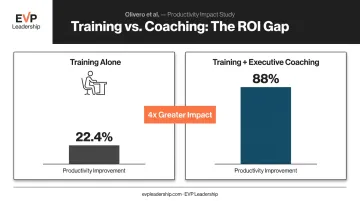
Coaching doesn't replace training. It multiplies it. Organizations that invest in workshops, offsites, or courses and stop there are leaving the majority of that investment on the table.
The Hidden Cost of Not Coaching Your Leadership Team
Reframe the question: instead of asking "can we afford coaching?", ask "what are we already paying for underdeveloped leadership?"
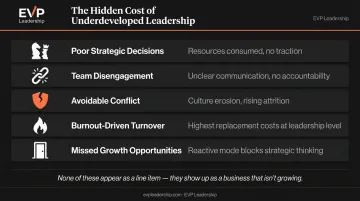
These costs rarely appear on a P&L — but they compound quietly:
- Poor strategic decisions that consume resources and produce no traction
- Team disengagement driven by managers who can't communicate clearly or hold accountability
- Avoidable conflict that erodes culture and increases attrition
- Burnout-driven turnover at the leadership level, where replacement costs are highest
- Missed growth opportunities that never make it onto a strategy document because the leader is operating in reactive mode
Gallup estimates that disengaged employees cost the global economy $8.8 trillion in lost productivity — and manager behavior is one of the primary drivers of engagement or its absence.
That dynamic plays out at every company size — including yours. For small business owners and founders, the cost is often invisible because it's embedded in stalled growth.
The bottleneck that never gets solved. The key hire who leaves after 18 months. The strategy meeting that produces activity without alignment. None of these show up as a "leadership cost" line item — they show up as a business that isn't growing as fast as it should.
The 4 Key Drivers of Executive Coaching ROI
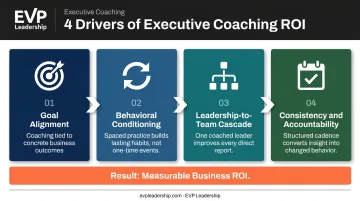
Not all coaching produces equal returns. Four factors determine whether an engagement delivers measurable results or simply produces good conversations.
Driver 1: Goal Alignment
Coaching only produces measurable ROI when it connects explicitly to organizational goals. Sessions mapped to personal reflection without business anchors are development activities — not business investments.
From the start, coaching objectives should tie to concrete outcomes:
- Revenue growth targets
- Team capacity milestones
- Retention rate improvement
- Decision-making speed and quality under pressure
These targets need to be revisited throughout the engagement, not set once and forgotten.
Driver 2: Behavioral Conditioning vs. One-Time Training
Behavioral change is the hardest part. Research into the COM-B model from behavioral science identifies that lasting change requires capability, opportunity, and motivation — all three, simultaneously. A single training event can deliver capability. It rarely delivers the repeated practice required to make new behaviors automatic when the pressure is on.
EVP Leadership's 90-Day PressurePoint System is built on this principle: structured, spaced conditioning that builds leadership performance over time — not a one-day event that gets filed away and forgotten. Repeated practice embeds new neural pathways. Single-event instruction produces knowledge. Conditioning produces behavior.
Driver 3: Leadership-to-Team Cascade
A coached executive doesn't just improve individually. They influence every person they lead.
Clearer communication makes accountability easier to hold. Better decisions move teams out of ambiguity and into execution. When delegation works, people grow. Each of these effects multiplies across the team — the ROI of one coaching engagement extends well beyond the individual.
ICF/PwC data shows 51% of coaching clients reported positive impact on team effectiveness — not because coaching directly targeted the team, but because the leader changed.
Driver 4: Consistency and Accountability
Awareness without accountability doesn't change behavior — the cadence and structure of an engagement matter as much as its content.
Regular sessions, documented progress against defined goals, and accountability checkpoints are what convert insight into changed behavior into business results. This is why 90-day structured engagements with built-in progress reviews outperform ad-hoc coaching relationships — the accountability structure carries more of the load than most people expect.
How to Measure Executive Coaching ROI: A Practical Framework
Step 1: Define Success Before Coaching Begins
Establish both quantitative and qualitative targets at the outset.
Quantitative KPIs to track:
- Productivity output (project delivery rates, output per leader/team)
- Employee retention (voluntary turnover rate 6–12 months before vs. after)
- Revenue or margin growth tied to leadership-driven initiatives
- Employee engagement survey scores
Qualitative metrics to track:
- 360-degree feedback assessments (pre and post engagement)
- Self-reported leadership confidence
- Decision-making quality under pressure
- Peer and direct-report observations
- Culture sentiment surveys
These aren't "soft" metrics — they're leading indicators. Confidence in decision-making precedes better decisions, and better decisions precede better results. Track the leading indicators now to forecast the lagging ones later.
Step 2: Establish a Measurement Cadence
| Timing | Action |
|---|---|
| Before coaching begins | Collect all baseline data: turnover rate, engagement scores, 360 feedback |
| Engagement midpoint | Progress check against defined goals; adjust if needed |
| Engagement completion | Formal post-engagement assessment across all KPIs |
| 6 months post-engagement | Follow-up review to capture delayed ROI effects |
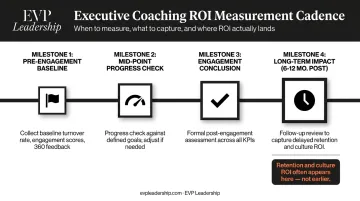
The six-month follow-up matters. Some ROI — particularly retention and culture-level impact — doesn't appear immediately. Building the follow-up review into the plan from the start ensures you capture the full return.
With your baseline data collected and a cadence in place, you have what you need to run the actual numbers.
Step 3: Calculate Your Return
Use this formula:
(Value of measurable gains − cost of coaching) ÷ cost of coaching × 100 = ROI %
To assign dollar values:
- Hard outcomes: Use actual retention savings (replacement cost × number of exits avoided), productivity gains (output improvement × team size × average salary), and revenue tied to leadership-driven initiatives
- Soft outcomes: Apply conservative estimates — for example, a 10% productivity improvement across a 5-person team earning $80,000 average salary equals $40,000 in annualized value
The formula will likely undercount the full return. Averted bad decisions, retained talent, and initiatives that held their momentum don't show up as line items — but they're real. Treat the number you calculate as a defensible minimum, not the whole story.
Choosing the Right Executive Coaching Program for Your Team
What to Look For
Non-negotiables when evaluating a coaching program:
- Verified track record with organizations of similar size and complexity — not just Fortune 500 case studies
- Structured methodology that ties sessions to business outcomes, not just personal reflection
- Validated tools like 360-degree assessments and defined goal-setting frameworks
- Transparent intake process that establishes objectives before billing begins
The distinction that matters most is whether the program builds repeatable habits and decision-making frameworks that outlast the engagement itself — or simply delivers insights that fade once the sessions end.
For small business leaders and executive teams specifically, look for a program designed to develop performance under sustained pressure — not just skills demonstrated in ideal conditions. EVP Leadership's PressurePoint System is built around this premise: conditioning founders, owner-operators, and executive teams through structured frameworks for decision-making, execution discipline, and momentum — so the development holds when pressure is real.
Common Mistakes to Avoid
- Selecting based on personality fit alone — without examining methodology, you're hiring a conversation partner, not a performance system
- Treating coaching as remediation for a single problem rather than a strategic investment in leadership capacity
- Starting without leadership buy-in — if the leader being coached doesn't see the value, accountability collapses and ROI never materializes
Frequently Asked Questions
What is the average ROI of executive coaching?
The ICF/PwC Global Coaching Client Study found a median 700% ROI (7x the investment) among companies that provided financial data. A MetrixGlobal case study cited by American University found 788% ROI from productivity and retention gains.
How long does it take to see ROI from executive coaching?
Some behavioral and team performance improvements appear within the first 90 days. Olivero et al. found measurable productivity gains after just eight weeks of coaching. Retention and culture-level ROI typically becomes measurable over 6–12 months post-engagement.
Can small businesses afford executive coaching?
For SMBs, the ROI on a coached executive is proportionally high because leadership bottlenecks have outsized organizational impact. Programs structured for small and mid-size teams, like EVP Leadership's 90-Day PressurePoint System, offer more targeted engagements than enterprise-scale initiatives at a fraction of the cost.
What is the difference between executive coaching and leadership training?
Training delivers knowledge in a single event. Coaching builds behavioral change through repeated practice, accountability, and goal-aligned feedback over time. The Olivero et al. research found training alone improved productivity by 22% ; training combined with coaching produced 88% improvement. Coaching doesn't replace training; it converts training into lasting behavior change.
How do you measure ROI when coaching benefits are intangible?
Intangible benefits such as confidence, communication quality, and decision-making under pressure can be tracked through 360-degree feedback assessments and engagement surveys administered before and after coaching. These are leading indicators of quantifiable outcomes: stronger decisions drive retention, clearer communication improves team output, and confident leadership presence supports revenue growth.
How many coaching sessions does a leadership team need to see results?
Structured engagements typically run 90 days to 12 months with regular sessions. Session volume matters less than consistency and accountability between sessions. That cadence is what converts awareness into lasting behavioral change and measurable business results.